Human Agency is an Illusion

I just published a video on YouTube—just over 7 minutes long. I’ll be publishing the audio as a podcast and will share the script here as well.

Human Agency is an illusion. This is the end of the story. If you listen for a while, you’ll hear as I rewind and pull back the curtains.

[Redacted]

Let’s get started.

Human Agency is an illusion.

Think of life as a motion picture that’s already been filmed. The ending is already known. The script has been written and performed by actors already chosen and hired.

I like this visual, but it’s not quite right. The end is not known in the same sense as that of the movie. It’s just as inevitable, just unknown.

Some might prefer to use the metaphor of cascading dominos. And this might even play better into the illusion. Some unforeseen force might intervene and stop the otherwise inevitable. But even this is beyond our control. Like an action-adventure story, we’re strapped into a runaway train and just along for the ride. This train might someday stop, but we’ll have had nothing to do with it. Enough of metaphors. What am I saying? Why am I saying it? And what does it mean?

Allow me to set up the scene. From there, I’ll elaborate.

For millennia, there’s been a debate over free will and determinism. These terms have been defined in different ways in an attempt to sway the argument for or against, one way or another. It turns out that for the human agency illusion, it doesn’t much matter, but it might still help to set the stage, so let’s establish some foundation. I like to consider free will and determinism as bookends.

free will is the ability to make a choice
and have had the ability to have chosen otherwise

Commonly, free will is the ability to make a choice and have had the ability to have chosen otherwise. That one can make this choice of their own accord or volition, is typically added for good measure. On the other hand, determinism says that everything that happens is determined by everything that has happened prior in a chain of cause and effect. Like dominoes falling one after another, so some event has caused another event since the dawn of time. Perhaps before time.

Some have argued that random events occur in our universe. Quantum theory suggests this. But that these events happen, doesn’t mean that we as humans have any say in the matter. This is what is known as indeterminism. Causes and effects are not so cut and dry. Some stochastic event serving as an exogenous factor manifesting as a pigeon, can swoop down and break the causal domino chain, but that doesn’t afford us human agency. A little more background. Some hold that free will and these alternatives are either mutually exclusive, or they’re compatible with each other. Not surprisingly, those who believe that these can coexist are called compatibilists, whilst the others are incompatibilists.

What I am saying is that if we allow that this wide shot might have validity, we can zoom in for a tight shot on the agent and notice that it doesn’t really matter. Some have said that the freewill versus alternatives challenge is a pseudo-problem. I am going to agree for the time being, if only for expedience.
Before getting to the illusion of agency, let’s see why this situation creates problems.

Without getting too deep, humans seem to be wired to view their reality in a manner of cause and effect. Moreover, they seem wired to attribute blame based on this presumed causal relationship. Oksana hit a homerun. We should praise her. Raj robbed a store. We should blame him. Western society is constructed with this worldview, so we create rules and laws. We may even choose to codify how to rehabilitate or punish him. Or to reward her.

Without agency, there is no cause to praise or blame

Without agency, there is no cause to praise or blame. Whilst I consider it a pathology, for better or for worse, given the human propensity to blame concomitant with the agency illusion, I don’t see this changing any time soon.

There are arguments around quarantining bad actors independent of their agency or lack thereof on the grounds of public safety. Even this logic has serious holes, but we’ll save that for another time.
And now the big reveal. With a reminder that my intent is to not go deep, how can I say that human agency is an illusion? Let’s start with the science.

As a lifeform, humans are a product of heredity, genetics, and epigenetics. Essentially, DNA passes information from generation to generation. Besides determining our physical attributes—head, shoulders, knees, and toes, potential height and weight, pigmentation, sex, and so on, it also establishes our temperament—our base attitude and way we perceive and interpret the world. This doesn’t make us clones or robots or automatons, but it does comprise some percentage of what we are. Identity politics aside, we don’t have much control of our sex, finger count, or eye colour. Clearly, we aren’t talking about trans-humans and cyborgs here.

Genetics and so on aren’t the only factor. Behaviourists will remind us that the environment and circumstances mould us, too. Each of us is taught mores and moral codes; how to behave and act. We are raised in a structure comprised of family, school, church, peers, larger society, authority figures, and whatever else—ostensibly like a sausage being stuffed into a skin.

Beyond the genetics that we have no control over,
we are products of our environment

Beyond the genetics that we have no control over, we are products of our environment. These things interact, but there is nothing of us that we are responsible for creating. Despite the motivational tripe, we cannot create ourselves. This, too, is an illusion—delusion if I am being less charitable.

I’ll reserve elaboration for future content. In a nutshell, you’ve got no agency. Every choice you make is based on prior events. Even something as simple as choosing to order a chocolate or vanilla ice cream in a cup or a cone, sugar cone or waffle cone is predicated on some prior events, and you had nothing to do with them. You were a passive vessel.

I’ll leave with two relevant quotes.

A man can do what he wants, but not want what he wants.

Arthur Schopenhauer

And as Galen Strawson puts it,

  1. You do what you do, in any given situation, because of the way you are.
  2. So in order to be ultimately responsible for what you do, you have to be ultimately responsible for the way you are—at least in certain crucial mental respects.
  3. But you cannot be ultimately responsible for the way you are in any respect at all.
  4. So you cannot be ultimately responsible for what you do.

So there you have it. I hope you found this cursory treatment interesting and informative if not provocative.

[Redacted]

I’m interested in hearing what you think. Do you think you have agency? Do we have free will, or is everything determined at the start? I didn’t even mention religion. Does that throw a spanner in the works? Let me know.

English Language in Decline

My first academic love was linguistics, and I am still very interested in language. Besides philosophy, I spend a lot of time researching, reviewing, and enjoying content on linguistics and music.

I’ve listened to several episodes of Jade Joddle, and she’s become disheartened with the decline of the English language—in particular, the demise of British English. In this clip, she shares her perspective on what she feels are the causes.

One of her peeves is American English. I know, right? Specifically, the bollox known as Netflix. Although it’s difficult to disagree with tripe that passes as content on Netflix, I’ll have to disagree with the notion of declining. It’s obvious that Jade is a prescriptivist—a characteristic more evident in women than in men for some reason—and a nostalgic conservative. She sees change as negative or dangerous, so she resists.

What’s interesting to me is that as a language teacher she doesn’t have a strong grasp of the fluidity of language. I’d love to see her in dialogue with John McWhorter or someone of this nature.

Jade has an episode from perhaps 2020 where she explains why she doesn’t smile much—because she’s serious. She is genuinely put off by a supposed lack of literacy and decay of standards. In her earlier videos, she was more playful and even performed what might be considered to be skits. She went on location, but then something changed.

Meantime, I do my part in maintaining proper British English—or World English, as I prefer to call it.

The first person who says she sounds like one of the teachers on Peppa Pig gets a demerit.

Under the Influence

Galen Strawson is my latest male crush. With almost everything I read or hear from him, I say, ‘that’s what I think’, over and over and over again. So I thought I’d share some of my journey to now. I made a post about female influences not too long ago. This is a bit different.

My first obsession, let’s say was the Beatles. I can’t pinpoint precisely when, but when I was a child, it’s been said that I would sing ‘she’s got a chicken to ride’ when it came on to AM radio. I asked for or bought all of their albums, and read everything about them that a kid could get his hands on back in the day. This obsession lasted for years and overlaps some of my next interests. My interests were in John Lennon’s political interests and George Harrison’s spiritual interests. I didn’t really find Paul McCartney or Ringo Starr very interesting beyond their musical abilities. And to be honest, I also got all of the Stones, Led Zeppelin, Pink Floyd, and so on. At my peak, I had over a thousand vinyl records—all lost in a house fire because vinyl and heat are generally incompatible. Paper didn’t fare much better, as I lost hundreds of books, too. A lesson in impermanence.

I am a bit of a nonconformist, a contrarian, and a polemicist

In grades 5 to 8, National Socialism and World War II were fascinating to me. Not Hitler, per se, though I do recall reading Mein Kampf at the time. There was just something about the sense of unity. Upon reflection, I realised that this meant me conforming to some other trend, and that was no longer interesting, as I am a bit of a nonconformist, a contrarian, and a polemicist, so there was that.

At some point, I came across Voltaire’s Candide and it just struck me. This may have commenced me on my path to becoming somewhat of a francophile. I extended my interest into the language and culture. My WWII phase has already primed that pump. I remember reading Dumas, Hugo, and some Descartes.

After I graduated, I was a recording engineer and musician. I remember reading Schoenberg’s Structural Function of Harmony and being enamoured with Dvořák and Stravinsky. I was influenced by many musicians, engineers, and producers, but there was just something about Schoenberg.

I went through a Kafka phase—that eventually included Donald Barthelme. His Absurdism was a nice foundation for my subsequent interest in Camus. It was something that just resonated with me. After Kafka, I discovered Dostoyevsky and consumed everything of his I could get my hands on.

I took from Jung and Campbell the importance of metaphor

In the 1990s, I discovered Carl Jung and eventually Joseph Campbell and a few years I spent reading Jung’s Complete Works and peripheral material related to Archetypal and Depth Psychology. I absorbed the material. I took from Jung and Campbell the importance of metaphor, but it never really resonnated beyond this.

Somehow, this experience led me to the Existentialism of Sartre (and Camus and Beauvoir). At the same time something clicked with me, I was always put off by the teleological imperative these guys seemed to insist upon—Sartre’s political involvement and Camus’ insistence on Art. These were their paths—and I certainly had an interest in Art and Politics—, but I felt this was too prescriptive.

For a brief time, I really liked Hume (and Spinoza), but then I discovered Nietzche and felt compelled to read his major works. It all made sense to me. It still does. Nietsche set me up for Foucault with his power relationships and the sense that morality, good, and evil are all socially constructed and contextual.

And Nietzsche brought me to Foucault and his lens of Power. These two still resonate with me. I investigated a lot of postmodern thinkers after this.

Nietzsche brought me to Foucault and his lens of Power

Daniel Dennett came next. He seems brilliant, and I tend to agree with most of what he says. I was still absorbing. Where biologist Robert Sapolsky gets philosophical, it’s about the same.

But Galen Strawson is different. And I have a lot of catching up to do in my reading of his direct work. The difference is that with these prior influences, I was absorbing and synthesising—creating my own perspectives and worldview. By the time I am finding Strawson, with every encounter, I am ticking off boxes.

  • That’s what I think
  • That’s what I think
  • That’s what I think
  • That’s what I think

Only, he started publishing in the 1960s. I could have been reading his work all along. Since I agree with 99.999 per cent of what I get from him and he is such a deep thinker, I am looking for two things:

  1. Something that expands rather than confirms
  2. Some spaces to operate that he has missed or ignored

As I continue on my Anti-Agency project and gather more inputs and perspectives, I’ll be considering a lot of Strawson. Here’s a clip I really enjoyed. I am thinking of doing a sort of reaction piece, but whether or not that happens, here’s the source.

[Video] Galen Strawson — Is Free Will a Necessary Illusion?

Spoiler Alert: I believe that free will is a cognitive bias related to apophenia. It’s a Gestalt heuristic.

Citizen Kane

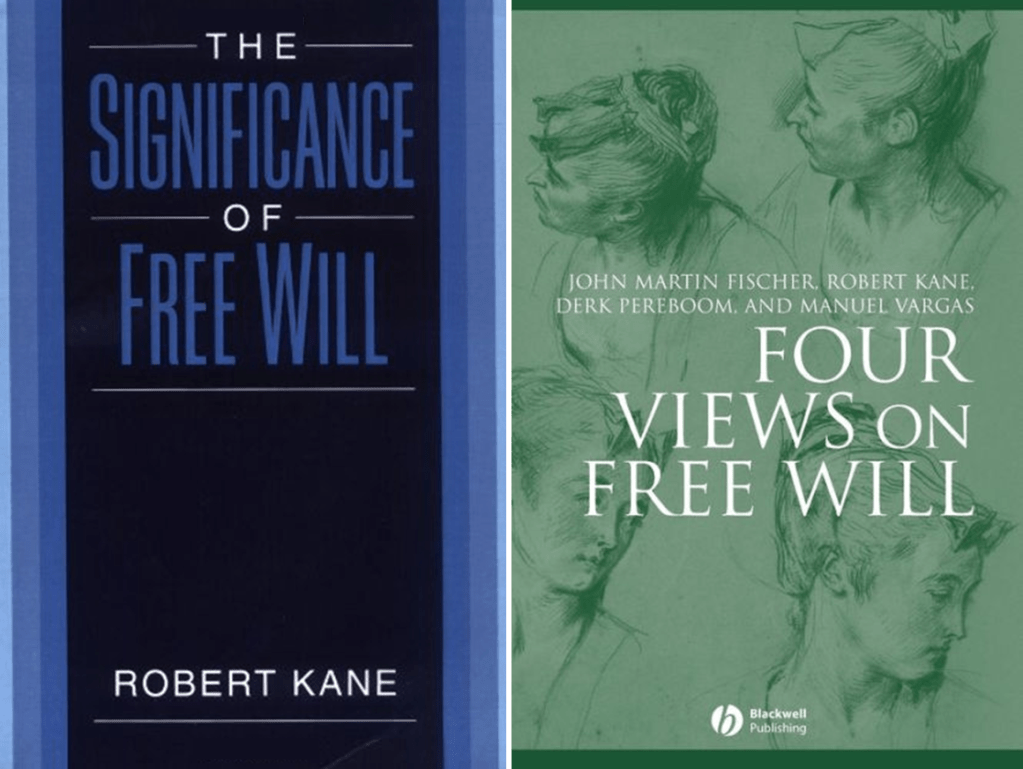
Among my newfound acquaintances, I can now add Robert Kane. I have yet to read him directly, but I have on queue two publications:

I’ll probably read the Four Views on Free Will content first. Meantime, Derk Pereboom, who also contributed to Four Views, presents Kane’s position in a video, so I’ll illustrate Perebooms perspective as well as how my own thoughts might dovetail.

Meaning in Life & the Illusion of Free Will (Derk Pereboom)

…a lot of prominent advocates perhaps most notably Immanuel Kant didn’t think that he could show that we have libertarian freedom, but he did think that we should believe that we have it for the sake of morality…

The libertarian perspective is that we look at all causation in terms is events, and some people believe that all causation is by way of events so, in the case of agents, they can be the cause of events.

Freedom consists in the fact that when decisions are caused, they’re caused indeterministically by other events.

Pereboom coveying Kane’s libertarian concept of freedom

This is the idea of indeterministic causation. Not all causations in deterministic, but yet all causation is by way of events so events indeterministically cause decisions, and this is what allows them to be free.

Pereboom explaining indeterministic causation

Borrowing Pereboom’s rendition of Kane’s account, Anne is on her way to work, and she sees a woman being accosted.

Choices

At this moment, she has a choice of taking one of two possible options:

  1. Prudential Choice: Continue going to her office (desire to please her boss) [p = 50%]
  2. Moral Choice: Intervene in the molestation (desire to help the victim) [p = 50%]

Pereboom’s Critique

What settles whether Anne stops to help or continues to the office?

the agent can’t have enough control for freedom in the event-causal picture

Derk Pereboom

Whether she stops or not is not up to these agent-involving events to settle whether she stops or not; after all the agent involving events render the two decisions equally probable, fifty-fifty, in our simplified example. So the answer, Pereboom thinks, has to be nothing; there isn’t anything that settles which way the decision goes because the only causation involving the agent consists in events evolving the involving the agent. and by hypothesis, all the events involving the agent conspire to render each of the two possible decisions equally probable. So, Pereboom wants to say that in the event-causal picture nothing settles which decision occurs—and in particular, the agent doesn’t settle which of the decisions occurs,
so he believes that the agent can’t have enough control for freedom in the event-causal picture. There’s not any event-causal picture that solves this problem.

The problem with this event-causal libertarian view is that the agent disappears at the crucial time. We want the agent to settle which way the decision goes, but the event causal picture doesn’t allow this. So, we should reintroduce the agent in a different guise. And as agent—or as agent cause—we’re gonna say look not all causation is by way of events some causation is by way of agent, so as a substance not just as involved in events causes the decision. So, we’re going to give Anne, as agent-cause, the power to settle which way this decision goes; and we’re going to give her this power in the following guise: we’re going to say she’s got the power to settle which way the agent—which way the decision—goes. By what? By causing a decision; and by causing a decision without being causally determined to cause it. This is what Immanuel Kant calls transcendental freedom, and he thinks that this is the only kind of freedom that’s going to get us moral responsibility. It’s giving to the agent qua agent—not as involved in events but giving the agent qua agent—the power to cause an action without being causally determined to cause it. Now this is a very special sort of power.

Do we have this kind of power? Kant said, ‘Well, we have no evidence that we have this kind of power. We can’t even show that it’s possible that we have this kind of power, but we can show that it doesn’t contradict anything we believe, so we should believe it for moral reasons.’ He thought, It’s really important for us to believe that we’re morally responsible. And he also thought that the moral law kind of falls away unless we’re free in this sense. Kant thinks we have ample practical reason to believe that we’re agent-causes.

Pereboom (simplified), op. sit. ( cue @ 21:30 )

But there are certain kind of empirical worries that Kant was well aware of for the hypothesis that we’re agent-causes.

Kant says the physical world is governed by deterministic laws. So, suppose we believe that we as agents have this power of transcendental freedom— the power to cause an action without being causally determined to cause it. At some point there’s going to be an interaction between the agent as cause and the deterministic world—maybe at the juncture between the agent and the agent’s brain. Maybe you can think of agent-causes as non-physical things that can affect the physical world. Suppose we think of it that way. Kant says the physical world is governed by deterministic laws.

Suppose this free agent causes the decision to raise her hand without being causally determined to cause it. Kant says it has to be reconciled with the following fact that we know from Newtonian physics—the physical world is governed by deterministic laws. How can this be? It would seem that if the free agent freely, in Kant’s sense, causes the decision to raise their hand that the hand raising isn’t going to be causally determined. But Kant said that physics shows that the laws are deterministic and that all physical events are governed by deterministic laws.

Pereboom (simplified), op. sit.

One thing you can say is that it just so happens that every free decision ever made just happens to dovetail nicely with a determined physical world so each of the how many free decisions have been made in human history according to, say, 17 trillion. Each of the 17 trillion decisions happens to dovetail with the way that physical bodies have been causally determined since the beginning of the universe

Pereboom (simplified), op. sit.

Pereboom says this involves coincidences too wild to be believed. It’s not really credible. Kant at a certain point says well this problem can be solved because when an agent—a free agent—makes a decision, that free agent changes the universe back to the beginning of time. Kant says that in his The Critique of Practical Reason. I say that’s a pretty high price to pay for a belief in transcendental freedom. It seems implausible.

Quantum Physics

At 26:26 Pereboom turns his attention to indeterminism and quantum physics—the main premise being that quantum mechanics replaced the mechanistic certainty of determinism with probability.

If I don’t expand this copy past here, you’ll just have to watch the vid.

Next, I want to pick up on criminal punishment and retributive justification. Pereboom suggests that we can adopt a sort of quarantine approach to criminals even if we can’t assert that they deserve it, but I have serious concerns of the lack of justification here. (cued for me @ 30:15)

Wrong-doing, indignatio, and emotion. Emotion: Non-reactive. Problem with Love.

What Is Enlightenment?

I like David Guignion’s channel, and I’ve been taking in several perspectives on Kant’s article, ‘What is Enlightenment?

Feel free to watch from the start, but I’ve cued it to the place where David shares my thoughts around Agency. He brings up the point that absent official authority such as a political or religious structure, we are still influenced—subconsciously—to some degree by mass media and culture. These are the embodied norms and customs that most people just take for granted without question.

As David suggests, we can’t just slough off this inherited skin. First, because we do not even question it, and, two, it’s ingrained, one would likely deny the influence or be subject to escalating commitment under so-called critical inspection.

This is akin to asking a person of a certain religious persuasion if they would have the same religious beliefs if they had not been indoctrinated with them. I feel that a vast majority would defend their religion and the underlying or resultant morality as being obvious, so at the very least they are kept in the lane with guide rails. The extent of this influence and the degree it subtracts from autonomy is my question. I believe if pressed, the individual would defend the prescribed morality to be self-evident and they would have acted the same way even without religious instruction.

Atheism Defence

Curse YouTube and Drew—but in a good way. Drew created a video titled I took a Christian class about atheism. It was worse than I expected. Although I don’t find I need to engage with anyone to defend my atheism, I sometimes do. Perhaps, the devil made me do it. I’ve been an atheist for decades—literally for at least half a century. (Man, that’s revealing.)

Spotify Link

The magic gods of social media tossed this gem in my face, and I was fated to watch it—a 45-minute video nonetheless. Who posts long-format content on YouTube these days? Honestly, I didn’t think I was going to watch the entire thing—at least without skipping ahead.

I jotted down my thoughts—on paper no less—as I engaged the content. But before delving into that, I want to say that Greg Koukl is a formidable communicator. He knows how to engage his audience. Drew, the Genetically Modified Skeptic, is a strong communicator himself, employing cogent logic in defence of atheism—well-considered and articulated. Although I was watching the clock—cuz 45-minutes; plus I was stopping to take notes. Capturing a couple dozen bullet points, I’d comment here instead of in situ. I’ll link from there to here when I’ve published my reaction.

Drew responds so well that, generally, I avoid stepping on his responses, with which I am in agreement. Instead, I share my own observations either on topics Drew did not address or that I have a nuanced take on.

Below are the points I make with a time reference to the clip. In some cases, the link starts earlier than the point I am addressing if only to provide a reader with context.

3:25 Greg points out that he is going to focus on areas where Christianity can make sense but atheism cannot.

Response: Things do not have to make sense. This is a belief humans impose on the world. Even if one believes in a world of causes and effects, it does not follow that we have a privileged perspective into these causes. Some effects may be caused by any number of correlated and covariant factors, and to claim that A causes Z, because it’s expedient and somewhat linear over some more complex multifactor causal model, is weak tea. As humans, we want things to make sense. It’s effectively in our nature, but it doesn’t follow that the universe needs to comply with this need. Human psychology compensates knowledge and perception gaps with any number of tricks from Gestalt to apophenia. It may be comforting for some to use gods as putty to fill the cracks, though, in my mind, it’s rather Silly Putty.

3:35 Greg defines the terms theism and atheism. Drew points out the reduced, self-serving definitions Greg tries to slide by.

4:44 Greg tries to frame atheism as an assertion rather than an absence, so he can fabricate a strawman to attack.

Response: As Drew points out, this is sometimes, but not always, true. Here my thoughts (or soul, as the case might be—orthogonal, or otherwise) wandered to the Dawkins Scale, which parses atheism and agnosticism into a spectrum rather than a binary pair. Idiomatically, it’s a non-assertion. If you claim there’s a dog in my yard, it’s incumbent for you to provide evidence. If I claim, there is no dog in my yard, I am under no such obligation. Besides, my looking for evidence of a non-dog in my yard would require additional scrutiny. Perhaps it’s hidden.

Moreover, Greg attempts to make this a semantic issue. Drew points this out. For me, I reflected on the political situation where some cohorts within the US public decried Obamacare (AKA the Affordable Care Act or ACA) and yet were substantially supportive of its features. Obamacare acted as a pejorative to taint the act with negative connotations for Obama detractors. People’s cognitive faculties as deficient as they are, this was super easy—barely an inconvenience. Anarchism triggers the same sort of reaction. I attribute this to an unceasing negative propaganda/indoctrination campaign.

9:00 We have reality on our side.

Response: Translation: We have subjective experience, and we are going to pose this as some objective reality.

9:40 Greg asks: Where did everything come from? What caused the beginning of the universe.

Response: Where is thy stuff? I don’t even need to engage this question directly because the chestnut of an argument he is presenting has a recursion problem. If everything needs a beginning, then God needs a beginning. This argument just kicks the can down the kerb. And ‘He just is‘ works just as well as ‘It just is‘. Nuff said.

11:25 Greg recounts a scenario where he purportedly asks a recently converted atheist, Do things exist? to which the subject responded affirmatively.

Response: The nature of existence and reality is not resolved science. ‘“Things” are perceived‘ is about the best we can get to at this moment in time, and this doesn’t even define things very precisely.

11:30 Have things always existed? is the question posed next.

Response: I like Drew’s response here. Instead, I went to the definition of time because the notion of time is a social construct. It could be that there was a Biblical void from which the universe sprang whole cloth as depicted in the Genesis version or a Big Bang version. It could as well be that at some point time was invented. An imperfect analogy is the BCE-CE split. CE simply starts at year 1 and we’ve run with it. The universe doesn’t have an equivalent notion of BCE, but perhaps it’s similar to spinning up the universe as a virtual machine. There was a literal void of bits awaiting a cue to instantiate a VM universe. For all intents and purposes, this is the beginning of time for that virtual machine. In this example, we could extend the metaphor to a multiverse, or we could stay with a physical machine and virtual machine metaphor. Sure, the physical machine might be a god or another meta-universe—I refuse to say metaverse—, but the virtual machine has no insights earlier than its own time-zero.

The other things Greg’s approach misses are the notions of quantum mechanics and emergent properties. I won’t spend any time elaborating here.

16:50 A big bang needs a big banger!

I addressed this regressive Big Banger point earlier. Moving on.

20:00 Explanatory power of intuitions

Response: Without getting into the weeds of Kahneman and Tversky’s Systems 1 and 2, intuition and heuristics have a place, but they are very fallible for all but the most mundane of tasks. They are not very precise and are a poor foundation for any theory. I can feel it in my bones just doesn’t go very far—and that includes intuitions about reality

22:15 The problem of evil is apparently the most common objection to the existence of God.

Response: This is a sophomoric position to adopt. Greg tries to frame this as an out-there objective reality affair as opposed to an in-there subjective, emotional problem. He posits that things in the world—including people—are inherently bad or evil. Again, Drew reframes this as a uniquely Christian problem. As for me, I don’t even believe in the existence of evil. Good and bad are functional yet still social constructs. Evil is just trebled bad with a metaphysical twist. The problem with evil is more of a problem with bad narrative than anything more substantive. Somebody created a storyline and didn’t run it by strong editors or continuity reviewers.

26:15 Lawmaker Transcendence: In order for there to be laws to be broken, there have to be laws…

Response: Knowing his intended audience, Greg keeps hammering on the objective reality nail. Whilst this may play well to the choir, as Drew points out, it’s not likely to score any points in a debate with atheists. Morals, as well as laws, are social constructs. And as universals, they don’t map as closely across cultures except at the most abstract of levels.

It should go without saying that even if there were a god passing out commandments, there would be no way to validate the authenticity of this exchange.

32:30 All people have souls… You are not just a piece of meat in motion

Response: Just rambling. I’m not even going to waste my time on this one except to redirect you to my previous response relative to human psychology and apophenia.

34:00 A soul is not a brain

Response: This bit is juvenile, too. Here Greg explains that the soul is not the brain, that you can’t disassemble your brain to find thought. But, he doesn’t mind ignoring that your soul is nowhere to be found either. This feels quite similar to the need for a creator, but these evidentiary needs don’t apply to their positions. Drew’s computer analogy is apt here.

39:10 Existential crisis is a problem for Greg and other Christians.

Response: Because Christians are wired the way they seem to be, any modality that severs the connection to meaning sets them off. Greg confuses hubris and ego for something more substantial, attributing meaning to it. As it happens, people also cherish their pets more than some random squirrel.

40:30 Humans feel guilty because humans are guilty.

Interestingly, there is a school of belief, psychologically speaking, that the default state of humans is one of anxiety, but given that I don’t give psychology any more credibility than religion, I’ll just leave that here. People feel guilty because they are indoctrinated to feel guilt. A hypothetical person raised on a desert island or in the woods, like Victor, the feral child of Aveyron, or in the jungle, like Tarzan or Mowgli, would not know guilt, empathy, shame, or any of a host of other social “emotional” responses.

All told, Greg raised nothing new nor offered any new support for Christian belief, let alone a broader theistic defence. Ostensibly, the approach he takes is more akin to choir preaching than any other rhetorical purpose. In the end, he’s promoting a smug superiority complex in believers. He understands that although people will accept blind faith rationale for religious belief—especially those indoctrinated from birth—that people do have a mild penchant for rationality. I don’t think most humans operate beyond a cursory level of reasoning, but it’s enough to exploit and construct social reflection mechanisms as part of personal image-building. This allows Greg to propose a homoeopathic logical, rational framework and have it uncritically adopted as being rational.

As for otherwise rational Christians, they likely see through the charlatanism, but since emotion proceeds reason, they are allowed to check out and compartmentalise this nonsense whilst otherwise simultaneously retaining the ability to process the most challenging and tortuous logical conundrum.

Which Laws of Nature are Fundamental?

Reading Dennett has gotten me down a rabbit hole. I decided to take a break from book-reading and spend the day reading essays and blogs and watching YouTube vids such as this one. The question posed by the title is Which Laws of Nature are Fundamental? The topic I find curious is an established dichotomy where intelligent design or multiverses are the only possible reasons why we as humans are here to question our existence.

Full disclosure: I don’t pretend to be a physicist, so although I have tried to keep current on, let’s call it, lay physics, there is much I don’t know. But that doesn’t make me stop questioning propositions.

In the case of intelligent design versus multiverses, I feel that both go overboard. I don’t particularly cherish Occam’s Razor, but I do find it apt here. As David Deutsch states in this piece, intelligent design only manages to kick the can down the kerb.

In a nutshell, intelligent design arrives at a place with a claim that all of this can’t have been the result of chance and random events, so [insert the entity of your choosing] had to have designed and constructed it, leaving open the question of how that entity came to be. This is a spin on the age-old issue that many defenders of intelligent design-like theories seem to cling to: The universe cannot have spawned from nowhere, so its genesis must have been due to an intelligent (read: divine) entity without recognising or admitting the circular reasoning involved.

On the other hand, the multiverse solution—which I don’t entirely rule out—also seems unnecessary. In another nutshell—or perhaps repurposing the first—, the main idea is that there are many if not infinite parallel universes. Given the large number—in the manner of the infinite monkeys typing Shakespeare’s sonnets, at least one is bound to be configured just so to enable life and humans in particular.

Typing Monkeys

I don’t subscribe to intelligent design in the least. I dismiss it as implausible. And whilst multiverses may exist, I fail to see why there can’t be a single universe—this one—that just so happens to be configured. If it had been configured any other way, there would have been no life as we know it—and certainly no human life and no life to question how it get there and why.

In my mind, just because we can ask why doesn’t mean there is an answer or that we can find it. More to the point, even in a world of cause and effect, the results can be emergent on one hand and multlivariant on the other. So whilst we want to discover a causal chain of A ⇒ B ⇒ C ⇒ n, it is not likely so linear. Humans do understand the notions of stochsticism and chaos, but we don’t necessarily know how to deal with them causally. Moreover—and Deutsch has specialised in the quantum space—, our understanding of quantum processes is extremely primative. We are probably operating more from conjecture than knowledge, but one needs to start someplace. The trick is not to believe you’ve reached India when you’ve only just departed Spain.

Seven Types of Atheism

Some geezer, John Gray, wrote a book having this title. It was, let us say, ‘suggested’ that I watch it in video format—over an hour-long at that. I decided to search for a summary instead.

It’s not particularly up my street. The bloke who suggested the vid posted a statement:

Atheism is a narcissistic apostasy; the adoration of the things humans do & make; the worship of the golden calves of science & technology.

When I responded thusly « This quip reduced and conflates, almost creating a strawman. I suppose some atheists might be narcissists, though I don’t see that they would significantly differ from a sample of the general population. I’m guessing the second clause is intended to connect from the first, which is to claim that an atheist is a human who chooses STEM over gods as if there are no other alternatives, which creates a false dichotomy. But to treat atheism as some monolith is to treat all religions as ostensibly identical », his response was

What is atheism?.

To which I replied, « Atheism is the absence of belief in gods (or supernatural beings, if that’s a more generalisable concept). »

well, that is not enlightening at all. Explain atheism clearly.

That is all there is to it. There are different reasons why people are atheists, but that’s the definition. Etymologically, ‘theism’ is ‘belief in a deity or deities’. Atheism, applying the Greek prefix ‘a-‘, is the negative state of ‘theism, so the absence of ‘belief in a deity or deities’.

Atheism is not science. A large number of scientists believe in God. They see no contradiction between God and science, in fact they find the order behind everything reinforces their belief.

And so here the conversation, as it was, went off the rails. At no point did I invoke science. And then he promotes the John Gray video.

Interview with John Gray on Does God Exist

And we’ve been there before.

  1. New Atheism: the debate between science and religion was a result of confusing myths with theories. Religion is no more a primitive type of science than is art or poetry; scientific inquiry answers a demand for an explanation; the practice of religion expresses a need for meaning.
  2. Secular Humanism: a hollowed-out version of the Christian belief in salvation in history; the widespread belief that humans are gradually improving is the central article of faith of modern humanism
  3. Science-Religion: Gray reflects on the twentieth century’s strange faith in science – a faith that produced the false equation of evolution with progress and the racist ideologies that infect our social arrangements and political institutions
  4. Political Religion: Modern political ideologies are de facto religions; the belief that we live in a secular age is an illusion
  5. God-hatred: absorbed by the problem of evil; suffering, if inevitable, is at least infused with moral significance
  6. The Unsentimental Atheisms of George Santayana and Joseph Conrad: Santayana dismisses any idea that civilization is improving; everything in this world is a progress towards death. Conrad wrote that man is a wicked animal; his wickedness has to be organized; society is essentially criminal – otherwise, it would not exist
  7. Mystical Atheism: Schopenhauer was deeply and articulately antagonistic to religion in general; he rejects the notion that history has any metaphysical meaning, or that human beings are somehow advancing

Disclaimer 1: This summary list is copy-pasted from the linked source and edited ever so slightly to fit here.

Disclaimer 2: Neither did I watch the video nor read his book, so the summary might be off-kilter.

Still, I offer my reaction/reflection.

Firstly, this comes off not as an attack on atheism; rather, it’s an attack more particularly on Enlightenment and post-Enlightenment thinkers, predominantly Scientists—as in those who practice Scientism religiously.

Secondly, this limited attack garners the same critique as I give Dawkins’ God Delusion. I liked this book, but whereas Gray limits his attack on a thin slice of atheists—despite offering up 7 flavours—, Dawkins limits his attack to Christians; perhaps, some Abrahamic denominations. This is a particular God and particular disciples.

I address these in turn.

  1. New Atheism: I agree that Scientism simply switched faith from God to Science or it deified Science, whichever vantage you prefer. This ilk simply swapped God for Naturalism. These are the same lot who offer up ‘Self-evident truths’ and Natural Law. Please. I agree with neither.
  2. Secular Humanism: Whilst admittedly secular, I am not quite a Humanist and decidedly not a Secular Humanist™. Here, I disagree with the underlying teleological notion of both.
  3. Science-Religion: The only nod I am willing to give to science is the evidence-based, falsifiability over faith, but much of science is still faith-based. It just operates from a different metanarrative. Again, Scientism is no one’s friend.
  4. Political Religion: I agree that this is as much a scourge as organised religion. By now, one might notice a trend—a healthy does of whataboutism: We can’t suck because we’re no different to this other thing that you might be attached to. Except they are all bollox through and through. Political ideology is religion without the blatant metaphysical nod—though it is still there beneath the surface.
  5. God-hatred: Even having not read the book, this makes no sense whatsoever. How can one hate what one doesn’t believe exists? I suppose I could hate unicorns, faeries, and Harry Potter, but I don’t think that’s the same thing. The summary suggests that it’s more about an obsession with evil, but I don’t have enough context to respond meaningfully. Do atheists actually believe in evil? I don’t. And, except idiomatically, I don’t personally know of others who do. Feels like a red herring.
  6. Unsentimental Atheisms: Satayana refutes the Secular Humanists. I’m buying what he’s selling. Conrad is taking a spin on evil but opting to label it wicked—a bit of a drama llama. I’m not buying it.
  7. Mystical Atheism: I like Schopenhauer—probably because he’s such an underdog. He did glean a bit from Buddhist philosophy. So have I. But Buddhism ranges from the secular to the sacred. I don’t tend to stray too far from the secular. I fully agree that history has no metaphysical meaning and human beings are not objectively advancing.

If anything, this is one of the longer posts I’ve made in a while. Thanks to the Copy-Paste Gods. Allahu Akbar, Oh Mighty. In the end, Santayana and Schopenhauer notwithstanding, I am still left with a why not neither.

FSM

Descent of Man

Joe Talbert, singer and songwriter for IDLES, shares some of his perspective with us. Cued is a bit on masculinity, particularly the toxic variety.

Interview with Joe Talbert of IDLES

For me, it’s a breath of fresh air. Maybe it’s just nostalgia, but the IDLES bring some of the lost energy back into music. I’m old enough to remember the first Punk wave of the 1970s and the next waves as well as the ripples.

The Descent of Man clearly explains how masculinity as a construct is dangerous, problematic, and … bullshit

Joe Talbert

I’ve always been out of step with my music interests, ability, and availability. In the ’70s, I was raised on the Classic Rock of the day, from the Beatles and Stones in the ’60s, to Zeppelin and Sabbath in the ’70s before focusing more on the likes of Jeff Beck, John McLaughlin, and then Allan Holdsworth. In the mid-’70s, came vapid and syrupy, saccharine pop and the nonsense that was Disco. Thankfully, this was disturbed by Punk on one hand and Eddie Van Halen on the other. Then there was New Wave and the Hair Bands.

When I wanted to play Rock in Japan, I had offers for Country. My mates in Los Angles were into retro when I was into Progressive and Jazz Fusion. I did get on a Blues kick for a while, but I didn’t really feel like I could pull it off—some affluent white kid and all. Besides Hair Bands in the ’80s, there was a Euro-synth wave, but I wanted something more complex and experimental. By the ’90s, I finished grad school and was career-oriented. I fell in love with Grunge and post-Grunge, but that was a personal endeavour. I did finally play that in the 2000s as covers sprinkled with originals, but it was a side-gig not designed as a career. That train had sailed. Nowadays, I still dabble, but I’m not all that motivated to compose much.

Anyway, IDLES is refreshing. I don’t critique it as music. It’s not particularly melodic or harmonic. It’s about the message and the energy. There’s a beat that drives, and there is instrumentation and vocals. It’s an experience.

IDLES – Car Crash (Live on KEXP)

But this isn’t about the music. It’s about the notion of normalcy. In this clip, Joe talks about his longing for normalcy. Maybe that’s just normal, but I’ve never subscribed to the notion of normalcy, so I’ve never longed for it. Truth be told, my preference is for people to realise that it’s all a control mechanism.

Joe was influenced by therapy and The Descent of Man by the artist Grayson Perry. In this book, Perry, clearly giving a nod to Darwin’s earlier work, takes on toxic masculinity and attempts to reframe the very notion of masculinity. Like normalcy, I am not interested in gender roles either.

I worked as a statistician for a couple of years way back when, so it turns out that I have a perspective on normal. The problem with the notion of normal is that deviation for normal is seen as broken. Social sciences and pop-psychology have done this. Foucault wrote a lot on this phenomenon. I won’t address his work here.

Joe viewed himself as broken because he bought into the narrative. He feels better now. He feels he’s in a better place. Perhaps this was necessary for him. I can’t speak to that. It’s not a goal I aspire to. Perhaps I’m privileged. I can’t say. For now, I get to enjoy the respite Joe & Co afford us.