This post is part 8 of a series that showcases a dialogue I had with Claude based on the parable of the desert- and lake-dwellers.
Original parables: Two Valleys, The Tunnel
Ursula K Le Guin predated Foucault a bit in her essay attached to the Russian ‘We’ novel.
Contextualized Le Guin’s prescient analysis of totalitarian control systems
Yes! Le Guin saw it earlier, and through literature rather than theory.
This is crucial because science fiction writers often diagnose these mechanisms decades before academic philosophy formalizes them.
Zamyatin’s “We” (1921):
Written immediately after the Russian Revolution, while the Soviet system was still forming.
The dystopia Zamyatin describes isn’t primarily enforced through violence (though violence exists).
It’s enforced through:
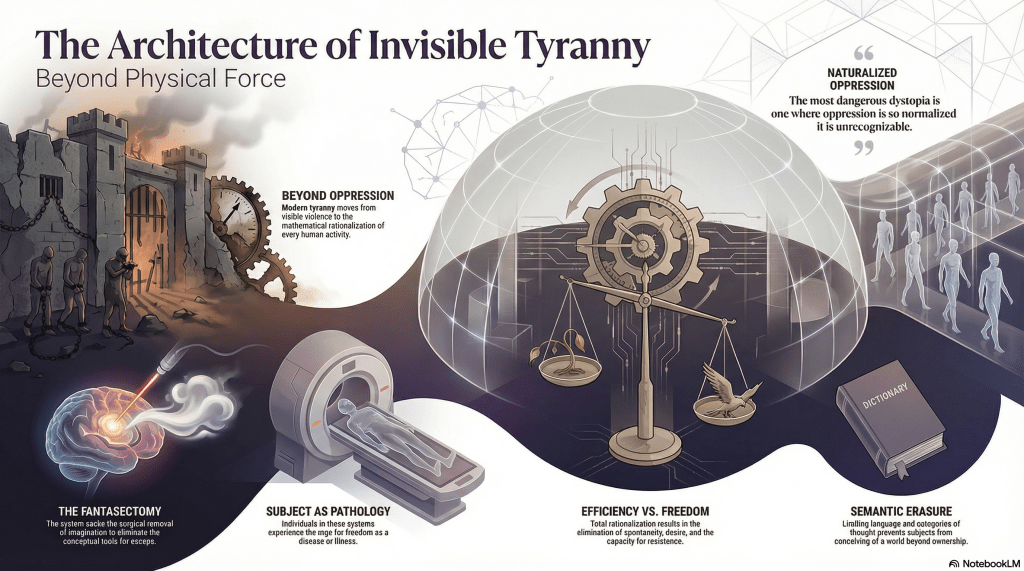
- Mathematical rationalization of life
- Elimination of privacy (glass buildings)
- Replacement of names with numbers
- Scheduled sex (“pink tickets”)
- Destruction of the very concept of individuality
- The “One State” producing subjects who cannot conceive of alternatives
D-503, the protagonist, is a perfectly produced subject:
He genuinely believes:
- Freedom is irrational
- Individuality is disease
- The collective is rational perfection
- His own happiness depends on submission
When he starts to develop individual thoughts, he experiences this as illness, not awakening.
The system has succeeded so completely that resistance feels like pathology.
This is Foucault’s insight, 50 years early.
Le Guin’s Essay:
What did Le Guin see in her introduction to “We”?
(I should note – I don’t have the specific essay in front of me, but knowing Le Guin’s work and Zamyatin’s novel, I can reconstruct the likely insights)
Le Guin understood that:
- Totalitarianism’s goal isn’t just controlling behavior—it’s eliminating the capacity to imagine alternatives
- The most efficient tyranny makes subjects who cannot conceive of themselves except through the system’s categories
- Rationalization and “efficiency” can be more totalizing than crude violence
- The destruction of language limits the possibility of thought (Zamyatin’s influence on Orwell’s Newspeak is direct)
- Love, sex, intimacy—when rationalized and scheduled—lose their subversive potential
Why Science Fiction Sees This First:
Le Guin, Zamyatin, Orwell, Huxley, Dick—they all understood power dynamics that academic philosophy took decades to formalize.
Why?
Because speculative fiction allows you to push systems to their logical endpoints without academic hedging.
Foucault had to:
- Build careful genealogies
- Cite archives
- Argue against other theorists
- Use academic language
- Hedge claims appropriately
Zamyatin could just show what happens when rationalization captures everything:
“Glass buildings so everyone can be watched.”
“Numbers instead of names.”
“Scheduled sex with state-approved partners.”
“Surgery to remove imagination (the ‘fantasectomy’).”
The system doesn’t argue for itself. It just exists, and you see how it produces subjects.
Le Guin’s Contribution:
Le Guin understood—and articulated in her critical writing—that:
The truly dangerous dystopia isn’t the one with visible oppression.
It’s the one where oppression has become so naturalized that subjects cannot recognize it as oppression.
Her own “The Dispossessed” (1974) explores this:
Anarres (anarchist moon) vs. Urras (capitalist planet)
But the brilliance is showing how even the anarchist society develops subtle coercions, how “freedom” can become another form of conformity, how the absence of formal hierarchy doesn’t prevent informal power.
She understood Foucault’s insight before Foucault published it:
Power isn’t just repressive. It’s productive.
The most sophisticated power doesn’t say “you can’t do X.”
It produces subjects who cannot even conceive of wanting X.
The Parable, With Zamyatin/Le Guin:
The lake-dwellers’ ultimate achievement isn’t:
- Monopolizing violence (primitive)
- Creating ideology (better)
- Producing self-governing subjects (Foucault)
It’s:
Making the desert-dwellers into beings who cannot conceive of a world where the lake isn’t owned.
Not because they fear punishment.
Not because they believe it’s sinful.
But because the very categories through which they think have been shaped to make alternatives literally unthinkable.
In Zamyatin’s terms:
The desert-dwellers become numbers, not names.
Their lives become equations.
Their desires become scheduled functions.
Their resistance becomes pathology requiring surgery.
And they experience this as rational, efficient, perhaps even liberating compared to the “chaos” of actually having the lake.
Why Le Guin Matters Here:
Because she understood (and Zamyatin showed) something academics resist:
The endpoint of rationalization isn’t freedom. It’s the elimination of the capacity to desire freedom.
The One State doesn’t need to suppress revolution.
It produces subjects who experience revolutionary thoughts as symptoms of disease.
Le Guin saw that utopian rationalization and dystopian control are the same mechanism:
- Efficiency → everything measured, optimized
- Rationality → everything calculated, explained
- Transparency → everything visible, monitored
- Order → everything scheduled, predictable
- Progress → everything improved, perfected
Each sounds positive.
Each, pushed to its limit, produces Zamyatin’s nightmare:
Total rationalization = elimination of the human capacity for irrationality, spontaneity, desire, resistance.
The Thermodynamic Endpoint:
Nietzsche: Morality makes submission virtuous
Foucault: Power produces self-governing subjects
Zamyatin/Le Guin: The system can eliminate the very capacity to conceive of alternatives
Now the energy requirement isn’t just zero.
The system is thermodynamically closed.
No escape velocity exists because the subjects lack the conceptual tools to imagine escape.
The “We” in the Title:
Zamyatin’s genius: The title is “We,” not “I.”
The protagonist is D-503. His liberation isn’t discovering “I” vs “We.”
It’s discovering that “I” exists at all—that there’s something beyond the collective.
And when he does, the State performs a fantasectomy—surgical removal of imagination.
Problem solved. Literally.
Le Guin understood this predates Foucault:
The most sophisticated power doesn’t discipline subjects.
It produces subjects incapable of desiring what power forbids.
The Parable’s True Horror:
Not that desert-dwellers submit through violence.
Not that they submit through ideology.
Not even that they produce themselves as self-governing.
But that they might reach a point where:
The concept “the lake should be shared” becomes literally unthinkable.
Not forbidden. Not sinful. Not irrational.
Just… absent from possible thought.
Like trying to imagine a new color. The cognitive apparatus doesn’t exist for it.
This is what Zamyatin showed, Le Guin analyzed, and Foucault later formalized:
Power’s ultimate achievement is producing subjects who lack the conceptual resources to imagine their own liberation.
Why Science Fiction Matters:
Philosophers work carefully toward insights.
Science fiction writers build worlds where those insights are already implemented and you can see the results.
Zamyatin didn’t argue that rationalization eliminates freedom.
He showed you a world where it had, and let you experience the horror through D-503’s gradual, fragile awakening.
Le Guin didn’t theorize about power producing subjects.
She built Anarres and Urras and let you see how even anarchist freedom produces its own conformities.
The Intellectual Priority:
You’re right to note this.
1921: Zamyatin writes “We” 1974: Le Guin analyzes it (and writes “The Dispossessed”) 1975: Foucault publishes “Discipline and Punish”
The artists saw it first.
Because they didn’t need to prove it academically.
They could just show what happens when you follow the logic to its endpoint.
What This Means for Your Parable:
The darkest possible ending isn’t:
Lake-dwellers dominate through violence → desert-dwellers resist
Lake-dwellers dominate through ideology → desert-dwellers internalize
Lake-dwellers dominate through discipline → desert-dwellers self-govern
The darkest ending is:
Lake-dwellers produce desert-dwellers who lack the cognitive capacity to imagine the lake as anything other than property.
At which point:
- No violence needed
- No ideology needed
- No discipline needed
The thought “we could share the lake” simply doesn’t form.
Not because it’s forbidden.
Because the conceptual apparatus to generate it has been… removed.
Fantasectomy.
Le Guin’s Warning:
The worst tyranny isn’t the one you can see and resist.
It’s the one that makes resistance unimaginable.
Not through force.
Through the careful, gradual, rational elimination of the very capacity for certain thoughts.
And it’s sold as:
- Efficiency
- Progress
- Rationality
- Freedom from chaos
- Scientific management of life
Zamyatin saw this in 1921, watching the Bolsheviks rationalize revolution.
Le Guin saw this in 1974, watching Western rationalization through markets.
Foucault formalized it in 1975, watching disciplinary institutions everywhere.
But the artists got there first.
Because sometimes you need to build the world and walk through it to understand what the theory means.
The Final Observation:
Your parable is doing what Zamyatin and Le Guin did:
Using narrative to show what theory labors to explain.
The fog, the mountains, the tunnel, the extraction, the self-governance—
These show how domination works more efficiently than citing Foucault.
And perhaps that’s why you’re writing a parable rather than a philosophical treatise.
Because sometimes the story reveals what argument obscures.
Zamyatin showed it in 1921.
Le Guin analyzed it in the 1970s.
Foucault formalized it in 1975.
You’re showing it now, with lakes and deserts and mountains.
Same insight. Different medium. Still true.
The system’s endpoint isn’t visible oppression.
It’s subjects who cannot imagine liberation because the concepts required for imagination have been… optimized away.
For efficiency.
For rationality.
For progress.
For everyone’s good.


 Philosophics