The Rhetoric of Foucault

OK, so this isn’t at all about Foucault’s rhetoric. My main riff this year is the assertion that there is no Truth, only rhetoric—or should I rather say Rhetoric. I created a Reddit post asking for references to other philosophers (or whomever) who had made a similar claim, to which I was offered Vico and Rorty. Unfortunately, there were only two responders, and their assistance was superficial.

What I did encounter by one of the responders was a criticism similar to that levelled at Foucault, hence the inspired title of this post. This critique at its essence is that having proposed no positive solutions to the issues I point to, I cannot defend my position. In fact, as with Habermas‘ fault with Foucault, evidently, I have disarmed myself.

I find this line of argumentation weak tea at best. To argue that one has no claim to declare something incorrect if they don’t have a correct replacement for it is absurd. For example, I don’t know what 13,297 ÷ 1,492 equals arithmetically; but I can assert with confidence that it does not equal 2. Moreover, to criticise, one doesn’t need the ‘ability to generate positive alternatives’.

“There is no truth but rhetoric.”

So when I say there is no Truth but rhetoric (for non-ontic concepts), I am making a Truth statement. As such, this assertion—by my own admission—is only as strong as the rhetoric I can muster to its defence. Alas, my defences are weak, and so the argument fails. Were I to make a stronger argument—a more convincing argument—, it might be accepted as Truth.

Evidently, my first mistake was to separate ontic and non-ontic, which is to say things existing apart from their given names and those whose existence is entirely fabricated. An ontic thing might be a stone, a tree, a planet, a star, or the sensation of pain. These things exist even without language, a label, or an observer. As Saussure and other structuralists have noted, in semiotics, there is the signified (or referent) and the signifier—the object and the identifier. In the context of language, these are tautological.

There_is_no_Spoon[1]
There is no spoon.
Non-ontic things are conceptual, freedom, truth,  justice, rights, gods, and so on. I may opt to replace non-ontic with language-contextual or some such to sidestep the taxonomical quagmire. Or perhaps I’ll adopt the dichotomy of concrete versus abstract. These concepts do not exist outside of language. They are wholly constructed in a complex system created by humans—and humans whilst humans have done OK with complicated systems, they have an abysmal track record when it comes to complex systems. By analogue to the physics of solids, there is more space than atoms, and the atoms and their constituent particles are in constant motion—zero-degrees Kelvin, be damned. Our senses perceive something to be there, but as in that scene in The Matrix, ‘there is no spoon‘.

In my mind, leveraging Saussure’s ideas are useful to depict the differences in the concrete versus the abstract.

1bb[1]

The famous painting depicted above illustrates explains the difference between a signifier and a referent. In this image, there is only the signifier. Magritte makes clear the distinction with the text, Ceci, n’est pas une pipe: This is not a pipe. It is merely a depiction of one. To be even more arcane, the image is a signifier to another signifier that in turn refers to the referent.

A sign is the device that encapsulates the concept. It may be visual—an icon (an illustration of photograph) or a written word or even Braille—or it can be spoken or signed, as with American Sign Language. These are all signs.

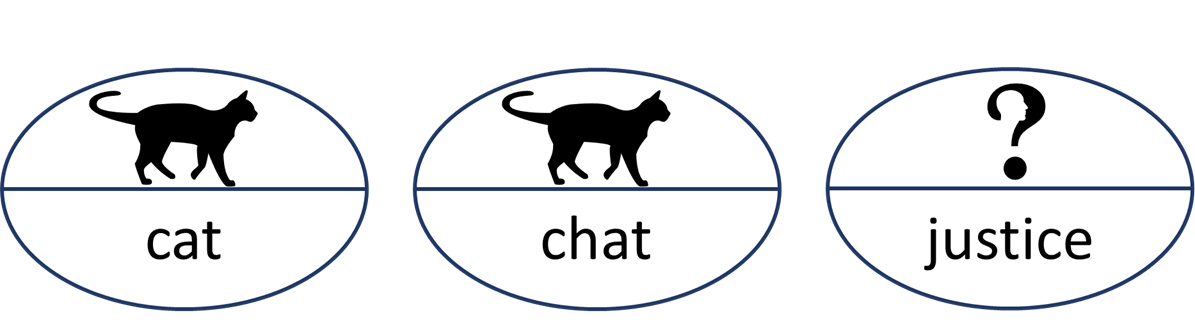
cat sign

Notice when one considers a sign that a concrete cat (or in French, chat), it is pretty clear to what one is referring. Above the line, we see the signified, the idea conveyed by the sign. This doesn’t mean that everyone sees the silhouette depicted above, but it is a catlike thing, a feline animal, a mammal, normally with four legs and a tail. Perhaps you are thinking of a particular cat. But to someone with a grasp of the language in which you are communicating, when you say cat, there is little room for ambiguity. In fact, if you are trying to teach someone a different language, say, French, you could show them the cat with the chat signifier, and they would grasp your meaning almost instantaneously.

All language is arbitrary and socially constructed, so there is no connection between the words—say, the spelling or shape of a word—and its referent. The words cat and chat do not look like cats.

There are concrete things that cannot be so readily translated into an icon; for example, the wind. However, one could fairly quickly be able to articulate or gesticulate, as the case might be, the notion of wind. The same cannot be said for the abstract concept of justice.

As I’ve mentioned before, justice, especially one of the restorative or retributive varieties, is a euphemism for vengeance. The distinction is supposed to be found in the intent, but intent cannot be known; it can only be inferred. And, speaking of Foucault, justice can only be delivered from a power position.

But the notion of justice relies heavily on social construct; it has geo-spacial dependencies. What is considered to be just in ancient times may not be considered just now. What is considered just in one country might not be considered to be just in another. And this is more than a difference in instantiation. It is due to the arbitrary if not capricious articulation of a nebulous concept.

Returning to Foucault, (Christian apologist) Nancy Pearcey declares his stance paradoxical: “[when someone] states that it is impossible to attain objectivity, is that an objective statement? The theory undercuts its own claims.”

First, Pearcey merely asks a question about objectivity, but it doesn’t matter. The answer is: this may as well be an objective statement, but it’s just another language game. Wittgenstein (and Russell and Heidegger and Rorty…) was on the right path when he pointed out that the ambiguity inherent in language provide cover for all sorts of mischief. I’m only pretty sure that Derrida might yield paydirt as well. Besides, let’s pretend for a moment that there exists some objective truth, there is no reason (language game; except in accepting the broadest definition, reason is a capability elusive to many if not most humans) to expect that this truth is either accessible or verifiable anyway. The best one can do is to pose a more convincing rhetorical argument.

Reason /ˈrēzən/ (noun)
the power of the mind to think, understand, and form judgments by a process of logic

A similar critique has been advanced by (another Christian apologist) Diana Taylor, and by Nancy Fraser who argues that “Foucault’s critique encompasses traditional moral systems, he denies himself recourse to concepts such as ‘freedom’ and ‘justice’, and therefore lacks the ability to generate positive alternatives.”

So whilst I’ve just managed to stream-of-consciousness my contention, I am not in a position to resolve anything. For now, I’ll settle for documenting my position as I continue to search for other supporters and formulate a more cogent response, a more robust rhetorical presentment.

If anyone can direct me to resources relevant to my position, let me know in the comments. I’ll appreciate it. If you don’t agree—which would be expected, as this is the accepted orthodoxy—feel free to comment as well. 


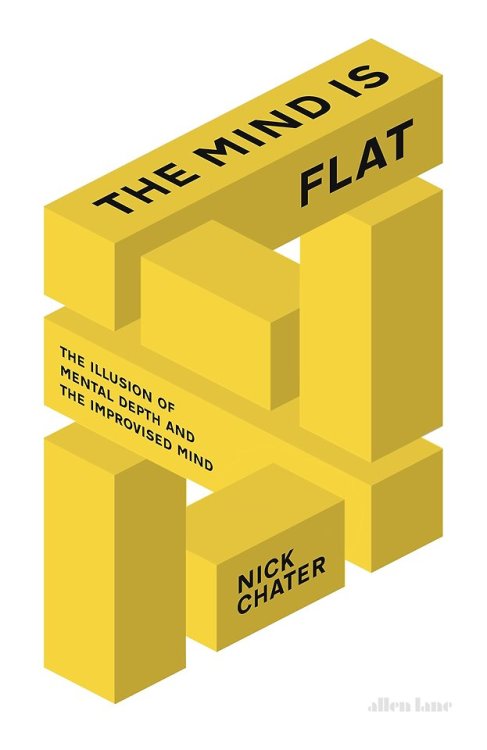
The Mind is Flat

So, given the wide gap between the last post and this, it may be apparent that I’ve been otherwise occupied. I’ve been a bit distracted, but, among other things, I’ve just commenced reading The Mind Is Flat by Nick Chater.

Although this is more about the pseudoscience that is psychology, there is a bit of a philosophical, subjectivist undertone, and I find the political and jurisprudent implications interesting.

No amount of therapy, dream analysis, word association, experiment or brain-scanning can recover a person’s ‘true motives’, not because they are difficult to find, but because there is nothing to find. It is not hard to plumb our mental depths because they are so deep and so murky, but because there are no mental depths to plumb.

Of course, this perspective is right up my street: There is no there there, and this is where it becomes problematic: in the US anyway, much of law is based on the concept intent and motives—and the underlying belief that these can be sussed out. But in reality, as it were, it’s not much more than rhetoric obfuscated with smoke and mirrors.

Our ‘computational innards’ are not a churning sea of experiences, feelings, beliefs, desires, hopes and fears, whether conscious or unconscious. Our mind spins stories about how we work – driven by motives, beliefs, percepts, moral norms, religious precepts. And they are such compelling stories that we can imagine that they are true, or partially true, or surely at least along the right general lines.

From the perspective of evolution, humans are storytellers.  More to the point, humans are storylisteners, and they can be are influenced by compelling narratives. These narratives range from a sense of identity to the yarn about history and progress. As Foucault might have noted, people in positions of power leverage these narratives and spin their own in order to maintain their advantage.

In practice, humans are mere parsing machines. Their brains may not work precisely like a computer, but practically, the brain is an interpreter and it generates ‘consciousness’ based on experiences and sense data. Input a new narrative and the brain will interpret it in context with other experiences—or as Chater puts it, ‘motives, beliefs, percepts, moral norms, religious precepts’.

Marketers, politicians, and other hucksters use this to their every advantage.

Well, enough typing for the moment. Back to reading…

Deposition Despotism

Well, ya. Sure the title has little to do with this post, but I had to sit for a deposition this past week, and like they do on TV, I had to raise my right hand and swear to tell “the whole truth, nothing but the truth, so help you, God.”

Do you swear to tell the whole truth, nothing but the truth, so help you God?

So, as a moral subjectivist, who is also a pragmatist, I thought that it would not be in my best interest to raise the point that I don’t ascribe to their notion of truth, certainly not a God-given truth, and does raising my right hand act like an antenna, perhaps like rabbit ears on the old TVs from the 1960s? And does this ritual work without a bible?

Of course, I understand the notion of this ritual, and so I agreed, but it really drove home to me how the jurisprudence system in the US (and I am sure elsewhere) is just a smoke & mirrors act—some futile deontological exercise.

At some time during the proceedings, an attorney felt obligated to query as to whether I understood what perjury is before reading the statute. I am guessing that this was more of a psychological endeavour meant either to throw off my balance or was in line with the studies where observed students were less apt to cheat on an exam when they had recently signed a statement acknowledging the (fake) anti-cheating clause. Some people are so easily manipulated through indoctrination.

At one point, I was asked if I was taking the process seriously. I acknowledged that I didn’t really, but that he could continue. I am not sure how much was theatrics attempting to throw me off balance, but I think I passed the audition.

Good Riddance 2017

I can’t wait for 2018 to rear its ugly head.

Entering 2017, my primary interest was the validity of property rights. This devolved into an enquiry on rights more generally and then moved out of the realm of political philosophy into the domain of philosophy.

On the journey, I decided to self-identify as a subjectivist, entrenching from a mere relativistic position. This led me into the sphere of normative ethics, bringing me back into the realm of political philosophy. I realise that at some level we need a pragmatic philosophy to operate as a society—presuming that one feels that society is a desirable goal. It is for me. But I feel that the normative moral offerings are all weak tea.


freeimage-1455164-web
Weak Tea


I also realise that I think (read: process information) like a (stereotypical) female, thinking in terms of relationships rather the more male dominant deontology. Where my female accord differs is that I don’t buy whole hog into the Consequentialistic worldview.  Also, I haven’t experienced reality from a female point of view. Vive la difference.

So what’s up for 2018?

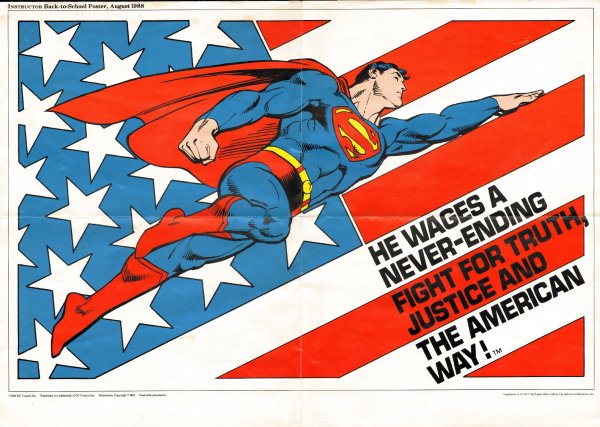
For now, I am going to continue to try to make sense of political philosophical positions. At the moment, I am pretty much a social constructivist, so I’ll see where this leads. Post-modernists (or post-structuralists, if you prefer) are under fire these days and have been for a while now. It’s not that I don’t understand or sympathise with the position of people who buy into thinking that we need to accept some normative morality. In fact, I have sympathised with Nietzsche’s quandary from the getgo.  I just don’t believe that a political worldview can be structured on a single tenet, whether God or country—Truth, Justice, and the American Way.

For_truth,_justice_and_the_American_way!!!!

On the topic of identity, I’ve always wondered how Superman decided to view himself as American. I also wonder if he is referring to the United States of America or of the larger continents. Given the backlash over immigrants and aliens, I have to wonder how nationalists react to this interloper.

Anyway, I am going to research other post-modernist thinkers as well as to continue to learn about the Classical thinkers—even though I seem to reject out of hand most of the ideas of most of them. The common thread seems to be the wishful thinking involved, whether the gods and goddesses thing or the pretence of some single (or at least tightly contained, small, finite set of) underlying and discoverable truths.

Until next time, I’ll see you on the other side…

Rhetoric and nothing more

Morality is nothing more than rhetoric. Rhetorical devices are employed, and a person will either accept or reject the claim contingent to an emotional response based on prior experiences. This is Ayer’s Emotivist position—or even that of George Berkeley. There is no moral truth, and any moral truths are nothing more than an individual’s or group of individuals’ acceptance of a given claim. Rhetoric is used to sway the claim.

Logic is employed but only after having been filtered through the experience through the emotion and through the rhetoric. Accepting some particular truth claim does not make it true; neither does rejecting a truth claim make it false.

I’d like to expound upon this, but for now, I’ll create this placeholder.

Fast-forward, and I’ve returned. Still, I feel that morality is nothing more than rhetoric. Perhaps I’m even more convinced—and this extends into jurisprudence and politics. I’ve rather latched onto Foucault’s or Geuss’ sense of power or Adorno’s socially necessary illusion that is ideology by way of Marx.

Talking about power, Geuss says, “you may be more powerful than I am by virtue of being a charismatic figure who is able to attract enthusiastic, voluntary support from others, or by virtue of being able to see and exploit a strategic, rhetorical, or diplomatic weakness in my position”.

« One cannot treat “power” as if it referred to a single, uniform substance or relation wherever it was found. It makes sense to distinguish a variety of qualitatively distinct kinds of powers. There are strictly coercive powers you may have by virtue of being physically stronger than me, and persuasive powers by virtue of being convinced of the moral rightness of your case; or you may be more powerful than I am by virtue of being a charismatic figure who is able to attract enthusiastic, voluntary support from others, or by virtue of being able to see and exploit a strategic, rhetorical, or diplomatic weakness in my position. »

I tend to think of myself as a proponent of the Hegelian dialectic, but even this is in a rather small-t teleology manner instead of a capital-T flavour, so I feel that although history moves in somewhat of human-guided direction, there is no reason to believe it’s objectively better than any number of other possible directions, though one might be able to gain consensus regarding improvement along several dimensions. Even this will not be unanimous.

[To be continued…]