I posted a video on YouTube that I shared here. They’ve added some AI to the studio channel interface.
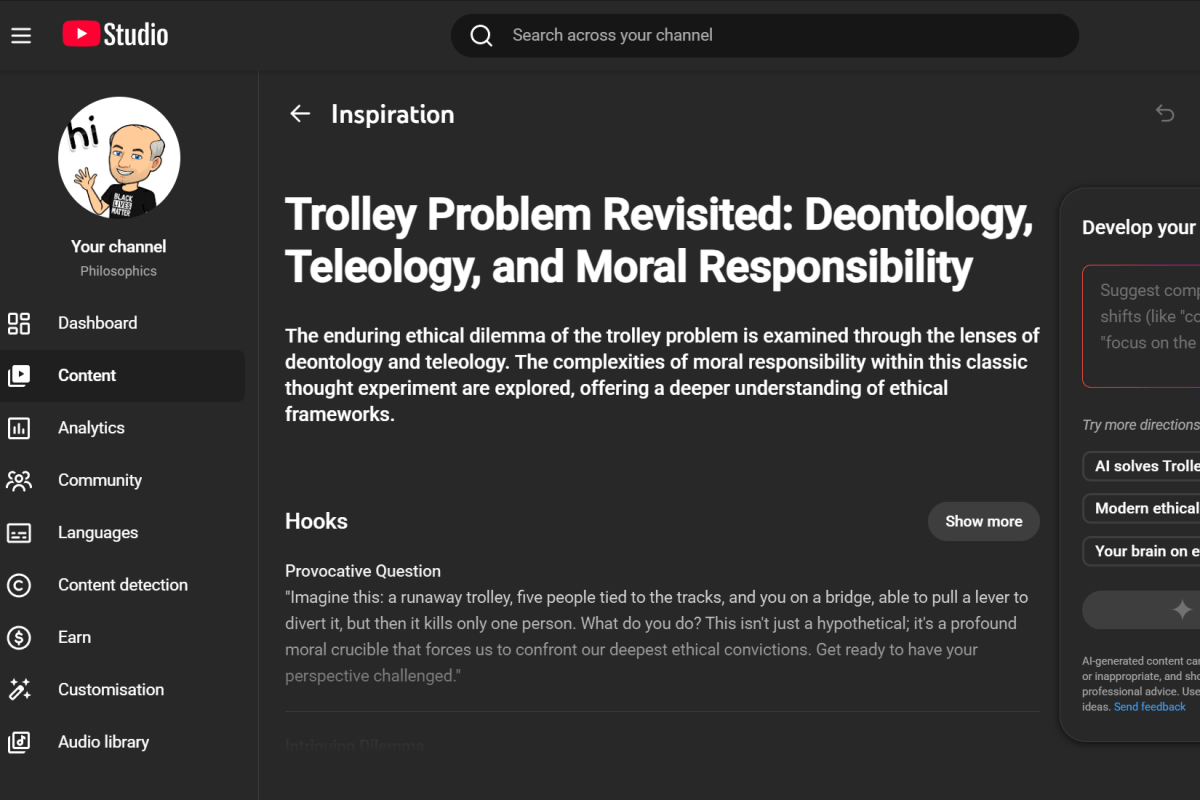
Image: YouTube Studio’s Inspiration Page. Thanks, but no thanks.
On the previous page, the prompt window (top right) asked if I wanted to know how my video was performing versus the baseline. I affirmed, and it spit out results. Brilliant.
I noticed a handful of ‘inspiration items’. None looked particularly interesting, but I have a nostalgia for Trolley Problems™. A few years ago, I would have jumped on the idea. Nowadays, I’ve seen hundreds of variations, and I’ve lost interest. However, being on familiar ground, I clicked on it to see what would happen. The result is the screenshot above.
Not only is the response templated with thumbnails, but AI is also ready to write the script. At this rate, why doesn’t YouTube just create ideas and generate them itself – like Spotify or Suno? It may just be a matter of time.
I am a heavy user of AI, but I lead the conversation. I am an author, and a reason I don’t join writers groups – I’ve attended some – is that I don’t need help with topics. I don’t get writer’s block. I just need the time and focus to get it out. I suppose that one day the creative well could run dry, but I don’t do this for commercial gain. Sure, that happens, but it’s not my goal. My goal is to write to share and exchange ideas.
I have many colleagues who are commercial writers and artists. I don’t know how they can do it. I understand that people have different interests and temperaments, but this is not one of mine. It would literally take all of the joy out of it. Not all people are artists™. Some people are more acquisitive than I am; I’m not judging, but it’s not me.
When I look at YouTube’s shiny AI muse and think, thanks, but no; I’d rather derail the trolley myself.
The trolley problem is a philosophical thought experiment that pits action against inaction. In the original version, a person faces a choice: a trolley hurtles down a track toward five people tied to the rails, but a lever allows the trolley to be diverted onto another track, where one person is tied. The dilemma is simple in its grotesque arithmetic: let five die or actively kill one to save them. A perennial favourite of ethics classes, the trolley problem is most often used to explore Consequentialism, particularly Utilitarianism, and its cool calculus of harm minimisation. Over the years, countless variations have been conjured, but few approach the nightmarish reality of its real-world application: the for-profit healthcare system in the United States.
With the recent death of UnitedHealthcare CEO Brian Thompson, the trolley dilemma takes on a new and morbid relevance. Let’s reframe the challenge.
The Healthcare Trolley Loop
Picture the trolley again on a bifurcated track. The lever remains, as does the moral agent poised to decide its fate. This time, the agent is Brian Thompson. The setup is simple: one track leads to the deaths of five people, and the other is empty. But here’s the twist: the trolley doesn’t just pass once in this version—it’s on a loop. At every interval, Thompson must decide whether to pull the lever and send the trolley to the empty track or allow it to continue its deadly course, killing five people each time.
But Thompson isn’t just deciding in a vacuum. The track with five people comes with a financial incentive: each life lost means higher profits, better quarterly earnings, and soaring shareholder returns. Diverting the trolley to the empty track, meanwhile, offers no payout. It’s not a single moral quandary; it’s a recurring decision, a relentless calculus of death versus dollars.
This isn’t just a metaphor; it’s a business model. For-profit healthcare doesn’t merely tolerate death—it commodifies it. The system incentivises harm through denial of care, inflated costs, and structural inefficiencies that ensure maximum profit at the expense of human lives.
Enter the Shooter
Now, introduce the wildcard: the shooter. Someone whose loved one may have been one of the countless victims tied to the track. They see Thompson at the lever, his decisions ensuring the endless loop of suffering and death. Perhaps they believe that removing Thompson can break the cycle—that a new lever-puller might divert the trolley to the empty track.
Thompson is killed, but does it change anything? The system remains. Another CEO steps into Thompson’s place, hand on the lever, ready to make the same decision. Why? Because the tracks, the trolley, and the profit motive remain untouched. The system ensures that each decision-maker faces the same incentives, pressures, and chilling rationale: lives are expendable; profits are not.
The Problem of Plausible Deniability
The shooter’s actions are vilified because they are active, visible, and immediate. A single violent act is morally shocking, and rightly so. But what of the quiet violence perpetuated by the healthcare system? The denial of coverage, the refusal of life-saving treatments, the bankruptcy-inducing bills—all are forms of systemic violence, their harm diffused and cloaked in the language of economic necessity.
The for-profit model thrives on this plausible deniability. Its architects and operators can claim they’re simply “following the market,” that their hands are tied by the invisible forces of capitalism. Yet the deaths it causes are no less real, no less preventable. The difference lies in perception: the shooter’s act is direct and visceral, while the system’s violence is passive and bureaucratic, rendered almost invisible by its banality.
A System Built on Death
Let’s not mince words: the current healthcare system is a death loop. It’s not an accident; it’s a feature. Profit-seeking in healthcare means there is always a financial incentive to let people die. During the Affordable Care Act (ACA) debates, opponents of universal healthcare decried the spectre of “death panels,” bureaucrats deciding who lives and who dies. Yet this is precisely what for-profit insurance companies do—only their decisions are driven not by medical necessity or moral considerations, but by spreadsheets and stock prices.
This is the logic of capitalism writ large: maximise profit, externalise harm, and frame systemic failures as unavoidable. Healthcare is merely one example. Across industries, the same dynamic plays out, whether in environmental destruction, labour exploitation, or financial crises. The trolley always runs on tracks built for profit, and the bodies left in its wake are just collateral damage.
How to Break the Loop
The death of Brian Thompson changes nothing. The system will simply produce another Thompson, another lever-puller incentivised to make the same deadly decisions. Breaking the loop requires dismantling the tracks themselves.
Remove the Profit Motive: Healthcare should not be a marketplace but a public good. Universal single-payer systems, as seen in many other developed nations, prioritise care over profit, removing the incentive to let people die for financial gain.
Recognise Passive Harm as Active: We must stop excusing systemic violence as “inevitable.” Denying care, pricing treatments out of reach, and allowing medical bankruptcy are acts of violence, no less deliberate than pulling a trigger.
Hold the System Accountable: It’s not just the CEOs at fault; the lawmakers, lobbyists, and corporations sustain this deadly status quo. The blood is on their hands, too.
Conclusion: The Real Villain
The shooter is not the solution, but neither is their act the real crime. The healthcare system—and by extension, capitalism itself—is the true villain of this story. It constructs the tracks, builds the trolley, and installs lever-pullers like Brian Thompson to ensure the loop continues.
When will it end? When we stop debating which track to divert the trolley toward and start dismantling the system that made the trolley inevitable in the first place. Until then, we are all complicit, passengers on a ride that profits from our suffering and death. The question isn’t who’s at the lever; it’s why the trolley is running at all.
The assassination of Brian Thompson, CEO of UnitedHealth, has electrified public discourse. In the court of public opinion—and particularly on social media—the assailant has been lionised, hailed as a hero who slayed a corporate leviathan. Yet the metaphorical beast is no simple predator; it’s a hydra. Slice off one head, and two grow back.
Still, this act has stirred the waters. It forces us to reckon with a clash of titans: the corporate machine versus the rogue idealist. Both are acting rationally, but neither is acting morally—at least not in the conventional sense. The question, then, is whether the assassin’s actions might occupy the higher moral ground, particularly through the lens of Consequentialist ethics.
The Hydra: UnitedHealth and the Systemic Beast
To understand the morality of the act, we must first confront the monster. UnitedHealth didn’t invent the healthcare system; it merely exploited its flaws with cold, clinical efficiency. Thompson’s leadership was emblematic of an industry that sees human lives as variables in a profit-maximising equation. Claims denial, inflated premiums, and labyrinthine bureaucracy are not bugs—they’re features. And for every life saved by healthcare, countless others are destroyed by its financial and emotional toll.
Rational? Certainly. Morally defensible? Hardly. Yet from the corporation’s perspective, these actions are the logical byproducts of a system designed to prioritise shareholder value above all else. Blame the player, yes—but blame the game more.
The Assassin: Vigilante Justice or Trolley Ethics?
Now consider the assassin, who embodies a grimly utilitarian logic: sacrifice one life to spare the misery of thousands. It’s a brutal, visceral iteration of the trolley problem—or perhaps the “baby Hitler problem,” only carried out decades too late. This wasn’t mindless violence; it was a calculated act of symbolic retribution.
From a Consequentialist perspective, the act raises uncomfortable questions. If Thompson’s death leads to systemic reform—if it forces even one profit-hungry executive to hesitate before denying care—does the assassin’s action gain moral weight? In utilitarian terms, the calculus seems clear: one life traded for a net reduction in suffering.
But that’s a dangerous game. Symbolism doesn’t always translate to change, and the hydra analogy looms large. The industry won’t topple because one CEO fell. The machinery grinds on, indifferent to the blood spilled in Manhattan. Worse, the system might grow even more resilient, using Thompson’s death as justification for tighter security, greater secrecy, and more aggressive self-preservation.
Rationality vs. Morality
What makes this clash so compelling is the cold rationality on both sides. UnitedHealth’s actions, reprehensible as they are, make sense within a capitalist framework. The assassin’s actions, though violent and morally fraught, also make sense if viewed as a desperate attempt to restore balance to a world that prioritises profit over human life.
The difference lies in their moral standing. The corporation’s rationality is underpinned by greed; its actions perpetuate suffering. The assassin’s rationality, however misguided, is rooted in outrage at injustice. If morality is determined by intent and consequence, the assassin might indeed occupy higher moral ground—not because killing is inherently justifiable, but because the system left no other path for redress.
The Symbolism and the Hydra
The tragedy is that this act of violence, however symbolic, won’t solve the problem. The hydra will grow another head, as corporations close ranks and reform remains elusive. Yet the act remains a potent reminder of the power of individual resistance. Perhaps it will force a moment of reflection, a hesitation before the next denial stamp hits the desk. Or perhaps it will simply serve as another chapter in the grim saga of a system that turns suffering into profit.
The Final Question
In this clash of titans, one side wields institutional power and systemic exploitation; the other wields desperation and bullets. Both are rational. Neither is fully moral. But perhaps the assassin’s act—brutal, symbolic, and imperfect—offers a glimpse of what happens when systemic injustice pushes people past the breaking point.
The real question is whether this singular act of defiance will lead to change—or whether the hydra will simply grow stronger, hungrier, and more entrenched.


 Philosophics