“In order to gain and to hold the esteem of men, it is not sufficient merely to possess wealth or power. The wealth or power must be put in evidence, for esteem is awarded only on evidence.”
Thorstein Veblin, The Theory of the Leisure Class, 1899
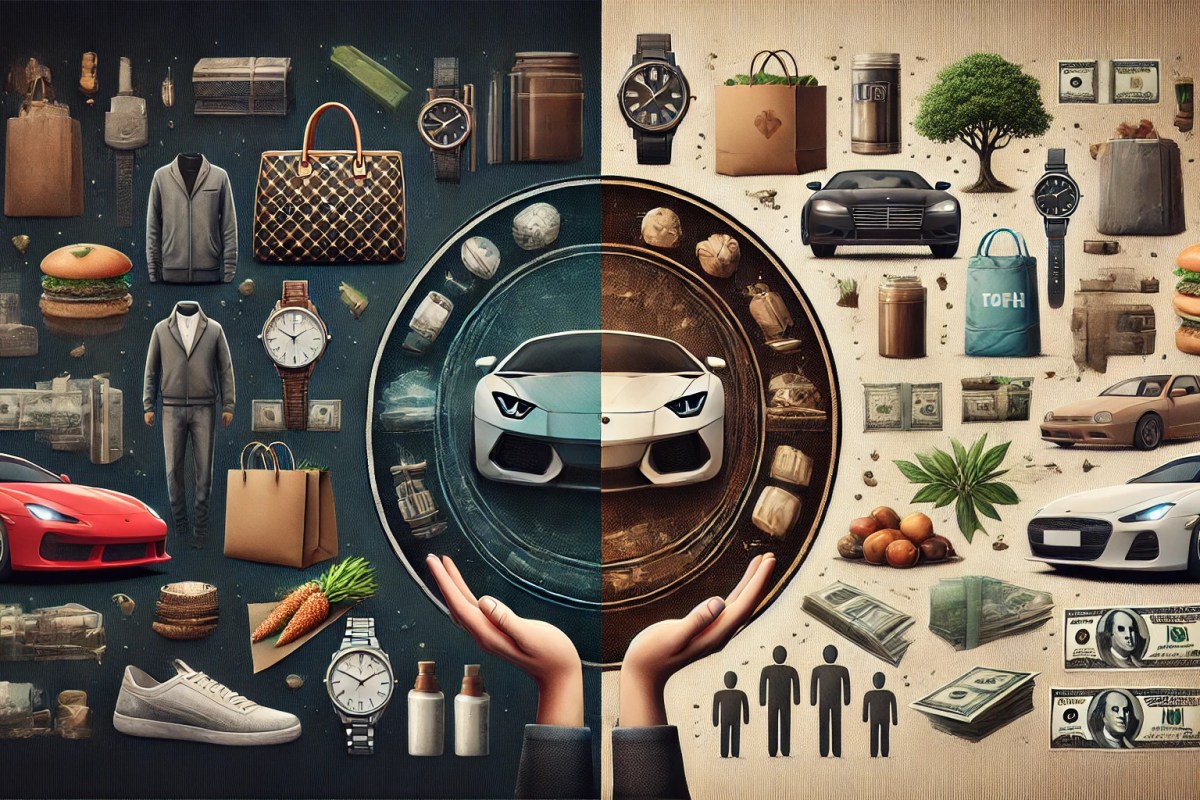
In a world where our worth is increasingly measured by what we own rather than who we are, it’s time to question the hollow pursuit of conspicuous consumption. Thorstein Veblen, over a century ago, saw through the shiny façade of status-driven consumerism. He coined the term conspicuous consumption to describe a phenomenon that has only grown more insidious in our time: the wasteful, performative display of wealth and luxury to signal social standing.
“The world has enough for everyone’s needs, but not enough for everyone’s greed.”
Mahatma Gandhi
From luxury cars to designer handbags, we live in a society that encourages us to broadcast our economic worth at every turn. But what does this ostentatious display really achieve? Veblen would argue that it’s not about personal fulfilment or the intrinsic value of what we buy, but about outshining others—a relentless race with no finish line. We’re not buying goods; we’re buying validation, trying to purchase a place in an imagined hierarchy that is as fragile as the latest trend.
Peter Singer, the moral philosopher known for his advocacy of effective altruism, would take this critique even further. For Singer, conspicuous consumption is not just wasteful; it’s morally indefensible. His ethical stance, grounded in utilitarianism, compels us to consider the opportunity cost of our spending. Every pound spent on a designer item is a pound that could have been used to alleviate suffering—whether through combating extreme poverty, funding life-saving medical treatments, or addressing global environmental crises. In a world where preventable suffering and death are rampant, lavish spending on status symbols is not just misguided; it’s a moral failure.
“The money we spend on luxuries could be donated to help people in need and thereby reduce avoidable suffering.”
Peter Singer, The Life You Can Save, 2009
Singer’s principle of equal consideration of interests demands that we weigh the impact of our actions on others as seriously as we consider their impact on ourselves. When we choose to engage in conspicuous consumption, we’re prioritising superficial self-expression over the tangible needs of those who are suffering. It’s a glaring contradiction to claim we value human life while squandering resources on goods that serve no purpose beyond ostentation.
The issue with conspicuous consumption isn’t just its superficiality—it’s the economic and social rot it perpetuates. It sustains a cycle of pecuniary emulation, where those lower on the socio-economic ladder are pressured to mimic the consumption patterns of those above them. The result? A society locked in an absurd competition, where individuals drown in debt just to keep up appearances, and resources are squandered on goods that serve no practical purpose other than to flaunt.
But why should we care? Isn’t spending on luxury just a harmless personal choice? Not quite. Every pound spent on a status symbol is a pound diverted from something meaningful—education, healthcare, the environment. When the affluent engage in extravagant spending, they set a toxic standard, promoting the idea that personal worth is tied to material excess. It’s not just bad taste; it’s bad ethics, bad economics, and bad for the planet.
More disturbingly, this drive to display wealth erodes the social fabric. It deepens divisions, creating resentment and alienation. The ultra-wealthy, insulated in their gilded cages, become oblivious to the realities faced by the rest of society. Meanwhile, those struggling to maintain the illusion of prosperity are left with the fallout—financial instability, stress, and a gnawing sense of inadequacy.
Veblen saw this trap for what it was: a hollow spectacle. Singer’s ethics give us a way out. He challenges us to shift our focus from self-indulgence to selflessness, from conspicuous consumption to conscious contribution. Instead of spending exorbitantly to bolster our social standing, why not use that wealth to create real, measurable change in the world?
We don’t need another luxury brand or another status symbol. We need a society that values substance over style, sustainability over excess, and human dignity over the incessant demand to buy more to be more. Singer’s challenge is simple: consider the true cost of your choices—not just for yourself, but for the world around you.
Conspicuous consumption is a dead end. It’s time to take a different road—one that leads not to a display case, but to a more equitable, thoughtful, and genuinely prosperous society.
“The mass of men lead lives of quiet desperation. What is called resignation is confirmed desperation.”
Henry David Thoreau, Walden, 1854

 Philosophics