Schrödinger’s Weasel

The cat is out. And it has been replaced by a weasel. Yes, dear reader, you’ve entered the strange, paradoxical world of Schrödinger’s Weasel, a universe where words drift in a haze of semantic uncertainty, their meanings ambushed and reshaped by whoever gets there first.

Now, you may be asking yourself, “Haven’t we been here before?” Both yes and no. While the phenomenon of weasel words—terms that suck out all substance from a statement, leaving behind a polite but vacuous husk—has been dissected and discussed at length, there’s a new creature on the scene. Inspired by Essentially Contested Concepts, W.B. Gallie’s landmark essay from 1956, and John Kekes’ counterpoint in A Reconsideration, I find myself stepping further into the semantic thicket. I’ve long held a grudge against weasel words, but Schrödinger words are their sinister cousins, capable of quantum linguistic acrobatics.

To understand Schrödinger words, we need to get cosy with a little quantum mechanics. Think of a Schrödinger word as a linguistic particle in a state of superposition. This isn’t the lazy drift of semantic shift—words that gently evolve over centuries, shaped by the ebb and flow of time and culture. No, these Schrödinger words behave more like quantum particles: observed from one angle, they mean one thing; from another, something completely different. They represent a political twilight zone, meanings oscillating between utopia and dystopia, refracted through the eye of the ideological beholder.

Take socialism, that darling of the Left and bugbear of the Right. To someone on the American political left, socialism conjures visions of Scandinavia’s welfare state, a society that looks after its people, where healthcare and education are universal rights. But say socialism to someone on the right, and you might find yourself facing the ghost of Stalin’s Soviet Union – gulags, oppression, the Cold War spectre of forced equality. The same word, but two worlds apart. This isn’t simply a “difference of opinion.” This is linguistic quantum mechanics at work, where meaning is determined by the observer’s political perspective. In fact, in the case of Schrödinger words, the observer’s interpretation not only reveals meaning but can be weaponised to change it, on the fly, at a whim.

What, then, is a Schrödinger word? Unlike the classic weasel words, which diffuse responsibility (“some say”), Schrödinger words don’t just obscure meaning; they provoke it and elicit strong, polarised responses by oscillating between two definitions. They are meaning-shifters, intentionally wielded to provoke division and rally allegiances. They serve as shibboleths and dog whistles, coded signals that change as they cross ideological boundaries. They are the linguistic weasels, alive and dead in the political discourse, simultaneously uniting and dividing depending on the audience. These words are spoken with the ease of conventional language, yet they pack a quantum punch, morphing as they interact with the listener’s biases.

Consider woke, a term once employed as a rallying cry for awareness and social justice. Today, its mere utterance can either sanctify or vilify. The ideological Left may still use it with pride – a banner for the politically conscious. But to the Right, woke has become a pejorative, shorthand for zealous moralism and unwelcome change. In the blink of an eye, woke transforms from a badge of honour into an accusation, from an earnest call to action into a threat. Its meaning is suspended in ambiguity, but that ambiguity is precisely what makes it effective. No one can agree on what woke “really means” anymore, and that’s the point. It’s not merely contested; it’s an arena, a battlefield.

What of fascism, another Schrödinger word, swirling in a storm of contradictory meanings? For some, it’s the historical spectre of jackboots, propaganda, and the violence of Hitler and Mussolini. For others, it’s a term of derision for any political stance perceived as overly authoritarian. It can mean militarism and far-right nationalism, or it can simply signify any overreach of government control, depending on who’s shouting. The Left may wield it to paint images of encroaching authoritarianism; the Right might invoke it to point fingers at the “thought police” of progressive culture. Fascism, once specific and terrifying, has been pulled and stretched into meaninglessness, weaponised to instil fear in diametrically opposed directions.

Schrödinger’s Weasel, then, is more than a linguistic curiosity. It’s a testament to the insidious power of language in shaping – and distorting – reality. By existing in a state of perpetual ambiguity, Schrödinger words serve as instruments of division. They are linguistic magic tricks, elusive yet profoundly effective, capturing not just the breadth of ideological differences but the emotional intensity they provoke. They are not innocent or neutral; they are ideological tools, words stripped of stable meaning and retooled for a moment’s political convenience.

Gallie’s notion of essentially contested concepts allows us to see how words like justice, democracy, and freedom have long been arenas of ideological struggle, their definitions tugged by factions seeking to claim the moral high ground. But Schrödinger words go further – they’re not just arenas but shifting shadows, their meanings purposefully hazy, with no intention of arriving at a universally accepted definition. They are not debated in the spirit of mutual understanding but deployed to deepen the rift between competing sides. Kekes’ critique in A Reconsideration touches on this, suggesting that the contestation of terms like freedom and democracy still strives for some level of shared understanding. Schrödinger words, by contrast, live in the gap, forever contested, forever unresolved, their ambiguity cherished rather than lamented.

Ultimately, in the realm of Schrödinger’s Weasel, language becomes a battlefield where words are held hostage to polarising meanings. Their superposition is deliberate, their ambiguity cultivated. In this brave new lexicon, we see language not as a bridge of understanding but as a weapon of mass disinformation – a trick with all the precision of quantum mechanics but none of the accountability. Whether this ambiguity will one day collapse into meaning, as particles do when measured, remains uncertain. Until then, Schrödinger’s Weasel prowls, its meaning indeterminate, serving whichever agenda is quickest to claim it.

Equality. Equity. Egality.

I can’t count how many times I’ve seen takes on this equality versus equity meme. One appeared on by LinkedIn feed this morning and I wanted to comment. I thought I’d have posted on this before and wanted to link to it. If I did, I couldn’t find it, so here’s a fresh accounting. I searched Google for the original image and cobbled together my own versions, if only for visual continuity.

 L’homme est né libre, et partout il est dans les fers.

Jean-Jacques Rousseau
Social Equality vs. Equity Meme

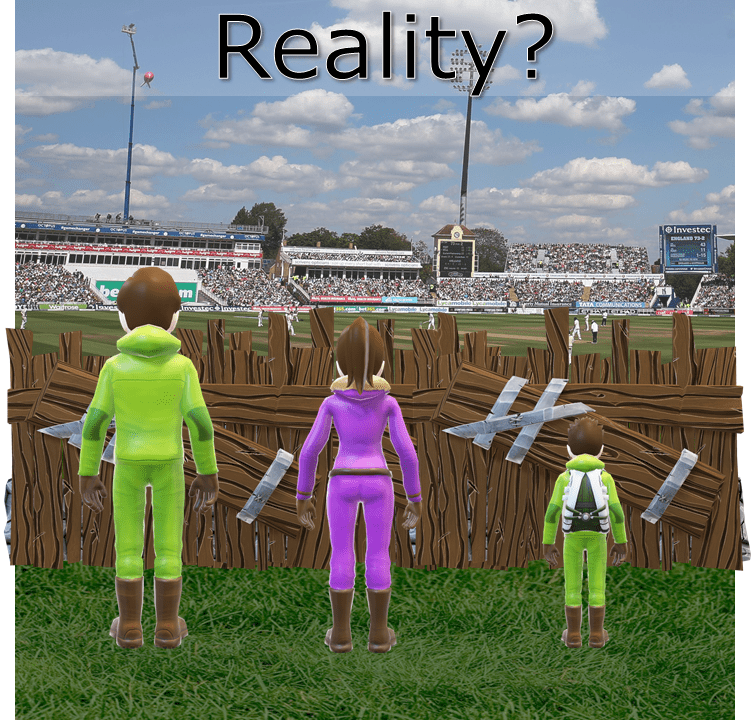
The meme renders something like this:

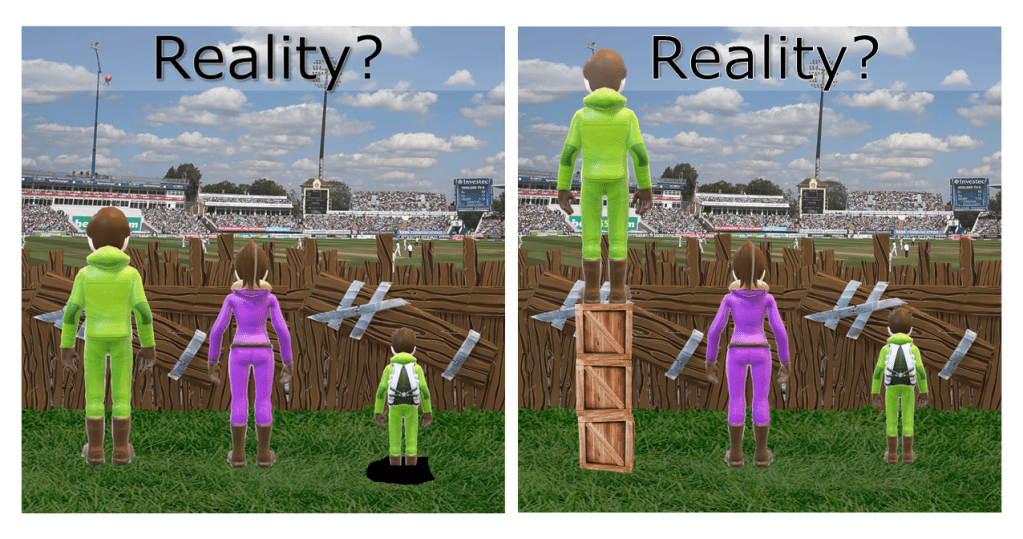
There are two frames being compared—equality and equity. In both, we see three people trying to view an event, but a barrier obstructs their view. The people are of different heights—tall, medium, and short—, metaphorically representing some intitial social status.

In one we see a representation of equality. In the spirit of equality, each person has one crate upon which to stand. This represents equality of condition. Each person is ensured to start the game on equal social footing. At a glance, it’s easy to discern that this intervention allows two of the people to see the event but leaves one of the three at a disadvantage and unable to view.

In the other, we see a representation of equity. In this frame, we see the same three people and a redistribution of the three crates. Equity is more in tune with equality of opportunity if not of outcomes. The taller person who had been standing on a crate had no need for it as he was tall enough to see over the barrier without it. The mid-size person, who could see the event with the crate but not without it, retained the crate. The shortest person was given the crate from the tallest person, now standing on a stack of two. The result is that each of the three people can now view the event unimpeded.

This comparison is such a nice conversation starter. It’s a hot button topic for some—and I’ll get to that presently. For me, it illustrates the concept of framing. There are several things left out of frame—at least one literally. In this meme, we are given a binary frame, but we can pull the shot back and there’s a third option: egality. This term has fallen out of favour in English, but the French retain it—égalité. In this frame, there is no need for crates, and the plank barrier is replaced by a chain-link fence.

Social Equality

Yet there’s the matter of metanarrative device. Why should there be any barrier? Why focus on these three in the foreground? Do the seated people represent the haves and those standing represent the have-nots? Might we interpret this as bourgeois versus proletariat with the focus on the struggle between the prols distracting from the broader issue? —being further distracted by the circus event? Have we lost the forest for the trees?

As it happens, people along the way have inserted their own social commentary through like-memes. I’ve similarly reconstructed these.

Societal Common Ground

In the beginning there are no crates. They are simply a device. At the start, only the tallest person can see over the barrier. At some point three crates appear ex nihilo and each person obtains one as depicted in the equality of condition frame, which leaves one of our participants better off and the other in no different of a social status, though a bit off the ground in the event of flash flooding. Small wins.

Past Burdens and Generational Wealth Transfer

Some shared the opinion that at least we all start on common ground, and yet others—likely Left- or Liberal-leaning—propose that some people start in a hole. Others might have noted that whilst some start out in a hole others start out with inherited boxes—or houses or networks—showcasing the transfer of generational wealth . Another might be able to view if there was a crate available. Given the negative starting place, the third would likely require three boxes to be on par to view, so even a redistribution of the three boxes would be insufficient.

For my first diversion, I’d like to spend a few moments defending a common response for the Right and Libertarians. Firstly, no one who supports this level-setting is suggesting that the advantaged be put into a hole like the disadvantaged. Nor is anyone asking for The Prince and the Pauper treatment where they trade places. This is a silly attempt at a strawman attack. Secondly, in a similar vein, no one is asking for the best off to relinquish everything and now be unable to see whilst the meek inherit the earth. As if that could ever happen.

Some people were overly optimistic—presumably representing the ‘if some is good, more must be better’ contingent. Why don’t we give everyone two boxes? Aside from the fact that only three are necessary for everyone to view the event, there was no mention where the original three crates came from let alone these additional three. I suppose they might have fashioned them from the fence. Who knows? But this leads us into contributions from the advocates of Capitalism.

Capitalism: Libertarian Vantage

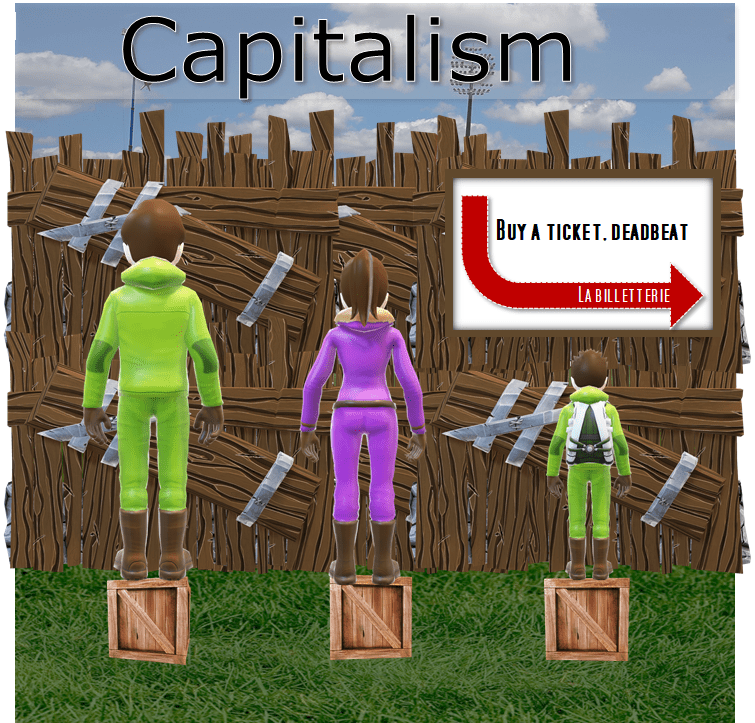
Let’s chalk this up to the Right can’t meme syndrome. To this cohort, Capitalism is the solution. In fact, there will be more crates than one could possibly use. A rising tide rises all boats—and crates. None are left behind. In fact, this is what Capitalism is known for. Of course, this suffers from several cognitive biases: survivorship, selection and availability. But who’s really counting?

For this less fond of Capitalism, this illustrates excess and waste. We needed three crates, yet we produce over thirty. Moreover, these less-fond likely also notice a capital distribution challenge with Capitalism.

Capitalism: Democratic Vantage

The prevailing view by one cohort is that some of the excess crates ‘owned’ by the tallest person should be redistributed whilst the polar perspective holds that this person ‘earned’ those crates and is entitles to keep them. And why can’t that woman just hold her child so he can see? Don’t get me started.

Capitalism for Sale

You really do have to love Capitalists. The solution is always ‘you just have to pay for it. Duh’. Without going too far off track, many of these people—likely vastly most of them—can’t afford what they want, yet they stand by this mechanism.

Socialism Kills

Some people who despise Socialism have a rather macabre perspective on how socialism operates. To them, equality can only be acheived via some Harrison Bergeron mechanism—primarily because they choose not to distinguish between social and physical equality. And maybe they are simply sadistic and enjoy watching people suffer.

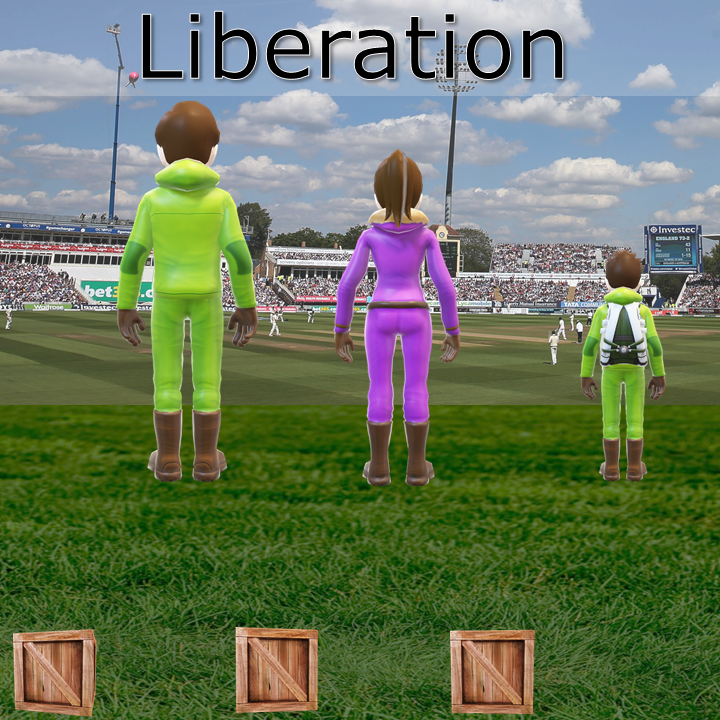
My personal favourite is the one for liberation.

Liberation is Liberating

We don’t need no fences. No barriers. No boundaries. Sit on the boxes. Fill them with food for the hungry.

But in the end, if all you are fighting for is free access to cricket matches and other circus events, you aren’t really liberated anyway. You are the slave that Rousseau wrote about, ‘Man is born free but everywhere is in chains’.


Disclaimer: For the record, I have been using the term, Capitalism idiomatically equivalent to a market economy because Americans just don’t want to separate them. I think they feel that if they can pretend they are the same, that criticising Capitalism would be tantamount to criticising market economics. This is wrong on so many levels, but, at least in North America, the terms are inextricable. The fact that Capitalism is a means of production, and the other is a distribution mechanism, people—from syndicalists and worker coöperatives to Mercantilists, tradesmen, and craft-workers—could choose to distribute goods and services through a market system without consequence. It’s not even worth expending a breath. Even English dictionaries have given up and conflated the concepts. Economic textbooks are the last bastion of academic sanity.

The Problem with Sex Work is Work

I just happened across this article from almost a year ago. It fits into my worldview that the fundamental issue with prostitution and other forms of so-called ‘sex work’ is the concept of work itself. As humans in a Capitalist (or even Socialist) system, we are conscripted into employment.

Rousseau or Locke may have called this a social contract, but I never signed it, and still I am forced to accept the terms and conditions.

I’ve been quite busy working to survive, so I don’t have time to comment, save to say that I agree with the major concepts, as I have written previously here, here, here, and here.