This is a continued reflection of the ramifications of yesterday’s post.
There is a growing tendency to describe certain moral conflicts as educational failures: If only people were shown the right perspective. If only they listened. If only they learned to see differently.
This language is most visible in discussions of objectification. Some men are told that what they perceive, feel, or notice is something that can be unlearned through dialogue. That with sufficient moral instruction, a perceptual orientation can be rewired into a different one. The problem is not that this ambition is moral. The problem is that it is architecturally incoherent.
The category mistake at the centre
Objectification is routinely treated as if it were a belief. A proposition. A theory about women that can be corrected with better arguments.
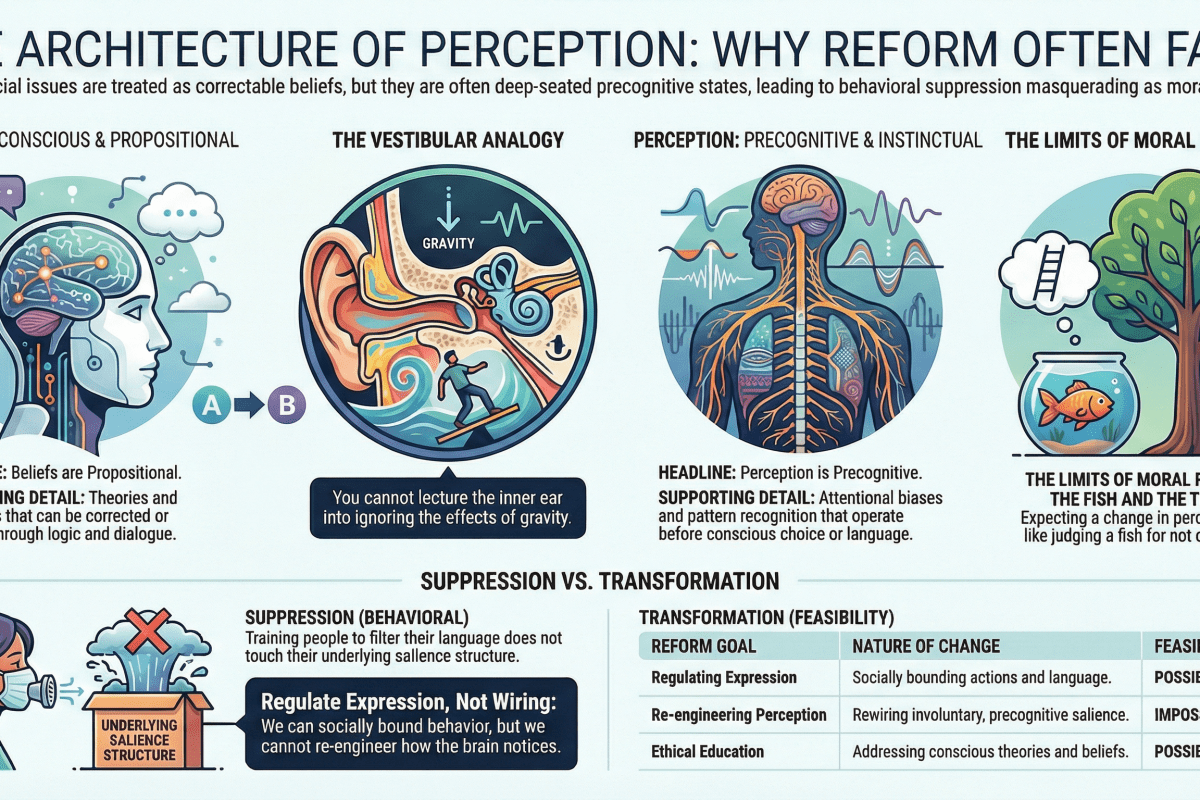
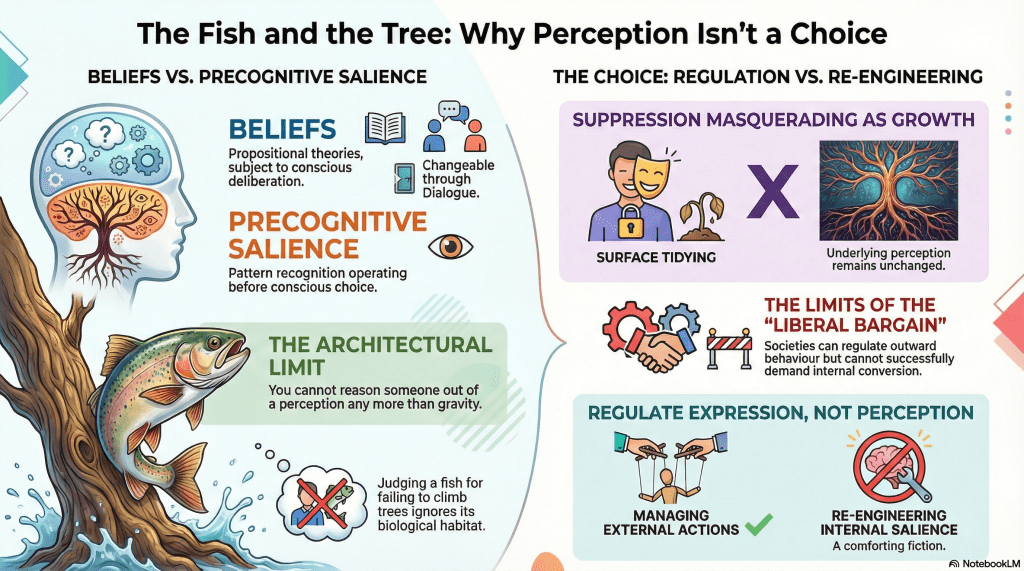
But much of what is being targeted is not propositional at all. It is precognitive salience. Attentional bias. Pattern recognition that operates before language, before justification, before conscious choice. You cannot reason someone out of a perception any more than you can lecture the vestibular system into ignoring gravity.
This is not a defence of behaviour. It is a refusal to confuse perception with endorsement. When we mistake a precognitive state for a belief, we end up conducting moral seminars aimed at the wrong organ.
Image: NotebookLM infographic
What education quietly becomes
Once this mistake is made, the rest follows with grim reliability.
If the orientation persists after instruction, it is no longer treated as structural. It is treated as obstinacy. The individual is said not merely to have a problematic perception but to be refusing growth.
At this point, moral education slides into something else entirely. Compliance is redescribed as transformation. Suppression is redescribed as insight. Silence is redescribed as progress.
The person learns to inhibit expression, to monitor language, to filter behaviour. None of this touches the underlying salience structure. But the culture congratulates itself anyway, because the surface has been tidied. This is how behavioural containment comes to masquerade as moral reform.
The fish and the trees
The fish analogy is not flippant. It is diagnostic. Telling a fish it must climb trees is not an invitation to growth. It is a refusal to acknowledge habitat. When the fish fails, the failure is moralised.
‘You could do this if you tried.’
‘Others have managed.’
‘Your resistance is the problem.’
The water is never named. Only the inadequacy of the swimmer.
Likewise, telling someone that a precognitive orientation can be dialogically dismantled assumes a plasticity that does not exist. When it fails, the failure is framed as an ethical defect rather than an architectural limit.
A topical case study
Rather than think in abstractions, let’s use a culturally-relevant example – at least through a relatively recent US frame – objectifying women. This has been a topic since at least the 1970s, and it remains in the cultural consciousness.
Some men have been accused of objectifying women. They are told this is wrong and asked to change their perspectives. But what’s really happening here?
These people are being asked to suppress the expression of a precognitive state. In Haidt’s parlance, they are being chastised for not controlling their elephant.
No amount of dialogue will rewire this faculty. This is akin to judging the fish for not climbing a tree and adopting an arboreal lifestyle.
I am not saying that all men are wired like this, nor am I saying that some men cannot control their baser impulses, but I am saying that asking a person not to express something does not thwart the impulse. In fact, it may make them also feel guilty for this instinct.
Why this becomes culturally unstable
A culture can regulate behaviour without demanding internal conversion. That is the old liberal bargain. You may think what you think; you will act within bounds.
What it cannot do indefinitely is promise inner transformation it cannot deliver, while punishing those who fail to achieve it. That produces exhaustion. It produces resentment. It produces a constant background hum of self-surveillance.
Worse, it moralises involuntary cognition. Not what you do, but what you notice. Not action, but salience. Not harm, but perception. Once that line is crossed, the scope of moral suspicion expands without limit.
The choice we avoid naming
The dilemma is not whether objectifying behaviour should be constrained. It should.
The dilemma is whether we will admit the difference between:
regulating expression, and
re-engineering perception
One is possible. The other is a comforting fiction. Pretending otherwise allows us to speak the language of enlightenment while practising the mechanics of discipline. It lets us call suppression ‘growth’ and exhaustion ‘progress’. The honest position is less flattering.
Some orientations cannot be taught away. They can be managed, constrained, and socially bounded. Demanding more than that is not moral ambition. It is ontological impatience.
You can’t teach a fish to stop being wet. You can decide which waters it is allowed to swim in.
In the end, the point is that it isn’t a matter of knowing; it’s a matter of feeling – something much deeper.
I’ve just published Objectivity Is Illusion: An Operating Model of Social and Moral Reasoning, an essay that began as this blog post. I’m sharing the ‘official’ link and this first draft. As the essay matured, I added additional support, but I focused primarily on refuting the anticipated opposing arguments. Rather than regurgitate the final version here, I felt showing the genesis would be more instructive. Of course, the essay didn’t spring fully formed; I’ve pruned and expanded from earlier notes still sitting on my hard drive.
Every so often, I’m told I’m too slippery with words, that I treat truth as if it were just another game of persuasion, that I reduce morality to chalk lines on a playing field. The objection usually comes with force: ‘But surely you believe some things are objectively true?‘
I don’t. Or more precisely, I don’t see how ‘objectivity’ in the metaphysical sense can be defended without lapsing into stagecraft. Granite foundations have always turned out to be scaffolding with the paint touched up. Priests once told us their gods guaranteed truth; scientists later promised the lab would serve as granite; politicians assure us democracy is the stone pillar. But in each case the creaks remain.
Audio: NotebookLM podcast on this topic.
This essay is written with an academic readership in mind. It assumes familiarity with figures like Nietzsche, Foucault, Rorty, and Ayer, and with the long quarrel over subjectivity, relativity, and objectivity. My aim is not to retell those arguments from the ground up, but to position my own framework within that ongoing dispute.
Scope
Before proceeding, some guardrails. When I say ‘objectivity is illusion,’ I mean in the social and moral domain. I’m not denying quarks or mathematics. My claim is narrower: in human discourse, no truth escapes subjectivity or contingency.
This dovetails with my broader Language Insufficiency Hypothesis: that even our words are leaky vessels, prone to misfire and misunderstanding. If language itself is unstable ground, then objectivity built upon it can hardly be granite. My claim here is not that nothing exists outside us, but that in the social world we inhabit together, every ‘truth’ rests on creaking boards.
One more note: just because social administration requires appeals to objectivity doesn’t mean objectivity exists. Courts, laboratories, and parliaments invoke it to secure trust, and it works well enough as theater. But necessity is not proof. And it is not my responsibility to conjure a granite replacement. What follows is an operating model, not a new altar.
Thesis
Objectivity is an illusion. Truth is rhetorical. Morality is prescriptive, not propositional. Our ethic is not granite but care: tending the planks we walk on, knowing they creak.
Operating Model: Five Premises
This framework is not a foundation. It is an operating model – contingent, provisional, subject to revision as circumstances change. Like any model, it can (and should) be updated to fit the culture and times.
Premise 1: Subjectivity is the baseline. Every claim originates in a perspective. No statement is free of the lens through which it is made. Even to deny subjectivity is to speak from a subject.
Premise 2: Relativity is emergent. What we call ‘relative truth’ is not a separate category but the convergence of individual subjectivities into provisional consensus. Consensus is never neutral: it is formed rhetorically – through persuasion, cultural resonance, and power [1]. MacIntyre made a similar point in After Virtue. The moral consensus of the Ancients was not grounded in objectivity but in a shared tradition – a thick account of human flourishing that gave coherence to their claims. When that scaffolding collapsed, consensus fractured, leaving modern moral discourse in fragments. Critics accused MacIntyre of relativism, since different traditions yield different ‘truths’, but his point reinforces mine: what looks like objectivity is in fact the temporary overlap of subjectivities sustained by tradition [2].
Premise 3: Objectivity is illusion. Claims presented as objective are relative norms hardened by repetition and forgotten as contingent scaffolding. ‘Objectivity’ is consensus disguised as granite. Its invocation in courts or parliaments may be useful, but usefulness is not existence. The burden of proof belongs to anyone insisting on an independent, metaphysical anchor for moral or social truths (Nietzsche’s ‘mobile army of metaphors’ [3], Kuhn’s paradigms [4], Latour’s laboratories [5]).
Even if one concedes, with Weber (as MacIntyre reminds us), that objective moral truths might exist in principle, they remain inaccessible in practice. What cannot be accessed cannot guide us; reconciliation of values and virtues must therefore take place within traditions and rhetoric, not in appeal to unreachable granite [13].
Premise 4: Rhetoric establishes truth. What counts as ‘true’ in the social and moral domain is established rhetorically – through coherence, resonance, utility, or force. This does not mean truth is ‘mere spin’. It means truth is never metaphysical; it is enacted and enforced through persuasion. If a metaphysical claim convinces, it does so rhetorically. If a scientific claim holds, it does so because it persuades peers, fits the evidence, and survives testing. In short: rhetoric is the medium through which truths endure [6].
Premise 5: Non-Cognitivism, Stated Plainly. I take moral utterances to be prescriptions, not propositions. When someone says ‘X is wrong’, they are not reporting an objective fact but prescribing a stance, a rule, a line in chalk. This is my operating position: non-cognitivism (Ayer [7], Stevenson [8]).
That said, I know the term feels alien. Many prefer the dialect of subjectivism – ‘X is true-for-me but not-for-you’ – or the quasi-realist stance that moral language behaves like truth-talk without cosmic backing (Blackburn [9]). I have no quarrel with these translations. They name the same scaffolding in different accents. I am not defending any school as such; I am simply stating my plank: morality prescribes rather than describes.
Ethic: Care. Since scaffolding is all we have, the obligation is not to pretend it is stone but to keep it usable. By ‘care’, I do not mean politeness or quietism. I mean maintenance – deliberation, repair, mutual aid, even revolt – so long as they acknowledge the scaffolding we share. Care is not optional: stomp hard enough and the floor collapses beneath us all.
Examples clarify: peer review in science is care in action, patching leaky vessels rather than proving granite. Civil rights movements practiced care by repairing rotten planks of law, sometimes with revolt. Communities rebuilding after disaster embody care by reconstructing scaffolding, not pretending it was indestructible. Care is maintenance, reciprocity, and survival.
Bridge: These five premises do not add up to a system or a foundation. They form an operating model: subjectivity as baseline, relativity as emergent, objectivity as illusion, rhetoric as truth, morality as prescription. Together they outline a practice: walk the planks with care, admit the creaks, patch where needed, and stop pretending we live in marble halls.
Rationale
Why prefer scaffolding to granite? Because granite has always been a mirage. The history of philosophy and politics is a history of crumbling temples and collapsing empires. The promises of permanence never survive the weather.
Think of Nietzsche, who called truths ‘a mobile army of metaphors’ [3]. Think of Foucault, who showed that what counts as ‘truth’ is always bound up with power [1]. Think of Rorty, who reduced truth to what our peers let us get away with saying [6]. These are not nihilists but diagnosticians: they exposed the creaks in the floorboards and the wizard behind the curtain.
Metaphors drive the point home:
Scaffolding and granite: What holds is temporary, not eternal. Granite is an illusion painted on timber.
Chalk lines: Rules of play – binding, real, but contingent. They can be redrawn.
Shoreline houses: Rome, the USSR, the British Empire – each built like beachfront villas with a fine view and bad footing. Storms came, sand eroded, and down they went.
Bias as framing: Kahneman himself admitted ‘bias’ is not a thing in the world [10], only a deviation from a chosen model. Gigerenzer [11] and Jared Peterson [12] remind us heuristics are adaptive. To call them ‘biases’ is not neutral – it’s allegiance to a standard of rationality.
The point is simple: what holds today is scaffolding, and pretending otherwise is self-deception.
Counterarguments and Refutations
Objection: Moral Paralysis. Without objective morality, why abolish slavery or defend rights?
Refutation: Chalk lines still bind. Speed limits aren’t cosmic, but they regulate conduct. Abolition endured not because it tapped a cosmic truth but because it persuaded, resonated, and took root. Slavery was once ‘in bounds’. Now it is ‘offsides’. That shift was rhetorical, emotional, political – but no less binding.
Objection: Problem of Dissent. If all is subjective, the lone dissenter is ‘just another voice’.
Refutation: Dissent gains traction through coherence, predictive success, or resonance. Galileo, abolitionists, suffragists – none relied on metaphysical granite. They persuaded, they resonated, they moved chalk lines. Truth was made through rhetoric, not uncovered in stone.
Objection: Performative Dependency. Even to say ‘subjective’ assumes the subject/object split. Aren’t you still inside the house?
Refutation: Of course. But I’m the one pointing at the slippery boards: ‘Mind the dust’. Yes, I’m in the house. But I refuse to pretend it’s marble. And even the category ‘subject’ is not eternal – it’s porous, dynamic, and leaky, just like language itself.
Objection: Infinite Regress. Why stop at subjectivity? Why not de-integrate further?
Refutation: Subjectivity is not granite, but it is the last plank before void. Peel it back and you erase the possibility of claims altogether. If tomorrow we discover that the ‘subject’ is a swarm of quarks or circuits, fine – but the claim still emerges from some locus. Regression refines; it doesn’t disprove.
Conclusion: The Ethic of Care
This is not reintegration. It is dis-integration: naming the creaks, stripping polyvinyl from rotten boards, refusing granite illusions.
If you wish to build here, build. But know the ground shifts, the storms come, the shoreline erodes. The ethic is not certainty but care: to tend the scaffolding we share, to patch without pretending it is stone, and to let dissent itself become part of the maintenance.



 Philosophics