If philosophy were a game, Wittgenstein rewrote the rulebook. Then he tore it up halfway through and told us the game was the thing itself.
“Don’t ask for the meaning; ask for the use.”
— Ludwig Wittgenstein
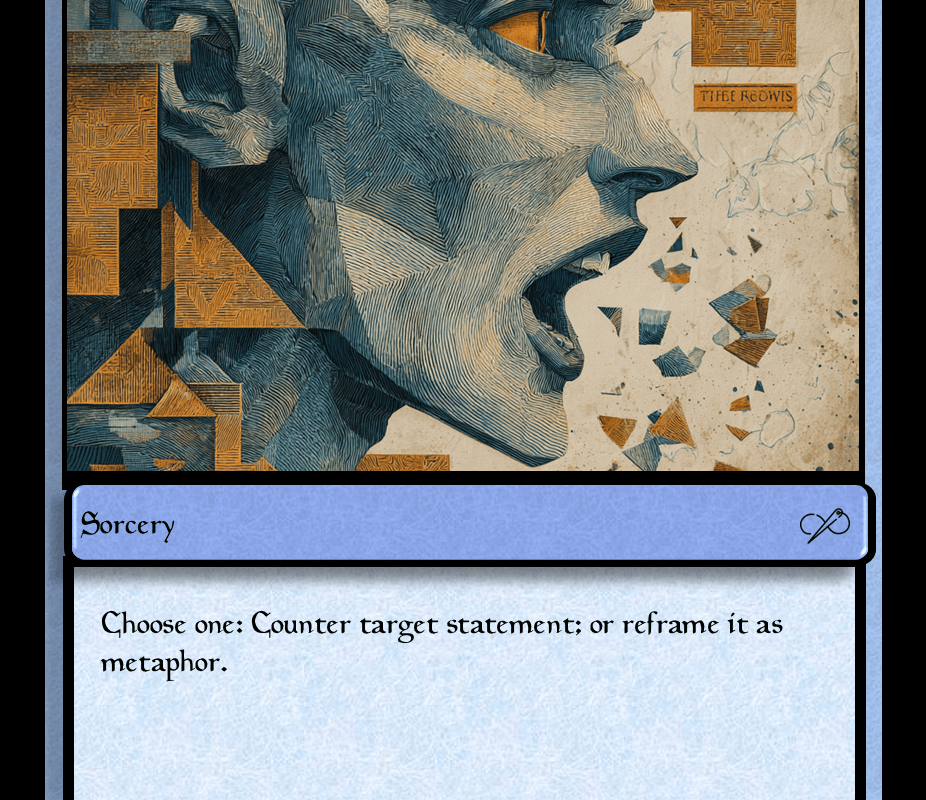
Language Game, the third card in my Critical Theory parody set, isn’t just homage; it’s confession. Wittgenstein is among my top five philosophers, and this card embodies why. His idea that ‘meaning is use’ unhooked language from metaphysics and tethered it to life – to the messy, unpredictable business of how humans actually speak.
The card’s text reads: Choose one: Counter target statement; or reframe it as metaphor.
At first glance, it sounds like a standard spell from Magic: The Gathering – a blue card, naturally, since blue is the colour of intellect, deceit, and control. But beneath the parody is an epistemic mirror.
To “counter” a statement is to engage in the analytic impulse – to negate, clarify, define. To “reframe it as metaphor” is the continental alternative – reinterpret, play, deconstruct. These are not two distinct acts of philosophy but the alternating heartbeat of all discourse. Every argument, every essay, every tweet oscillates between contradiction and reframing.
The sorcery lies in recognising that both are linguistic manoeuvres within the same game. Meaning is not fixed in the words themselves but in how they’re used – by whom, in what context, and to what end. Wittgenstein’s point was brutally simple: there’s no hidden substance behind language, only a living practice of moves and counter-moves.
The Shattered Face
The artwork visualises this idea: speech breaking into shards, thought fragmenting as it leaves the mouth. Meaning disintegrates even as it’s formed. Every utterance is an act of creation and destruction, coherence and collapse.
I wanted the card to look like a concept tearing itself apart whilst trying to communicate, a perfect visual for the paradox of language. The cubist angles hint at structure, but the open mouth betrays chaos. It’s communication as combustion.
Wittgenstein’s Echo
Wittgenstein once wrote, ‘Philosophy leaves everything as it is’. It sounds passive, almost nihilistic, until one realises what he meant: philosophy doesn’t change the world by building new systems; it changes how we see what’s already there.
He was the great anti-system builder, a man suspicious of his own intellect, who saw in language both the limits of thought and the infinite playground of meaning. He dismantled metaphysics not through scepticism but through observation: watch how words behave, and they’ll tell you what they mean.
In that spirit, Language Game is less an argument than an invitation – to watch the mechanics of speech, to see how our statements perform rather than merely represent.
Personal Reflection
Wittgenstein earns a place in my top five because he dissolves the boundaries that most philosophers erect. He offers no comforting totalities, no grand narratives, no moral architectures. Just language, and us inside it, flailing beautifully.
His work aligns with my larger project on the insufficiency of language – its inability to capture the real, yet its irresistible compulsion to try. Wittgenstein knew that words are our most sophisticated form of failure, and he loved them anyway.
To play Language Game is to remember that communication isn’t about arriving at truth but about keeping meaning in motion. Every conversation is a temporary alliance against silence.
The card’s instruction remains both playful and tragic: Counter target statement; or reframe it as metaphor.
Whichever you choose, you’re still playing.
 Philosophics