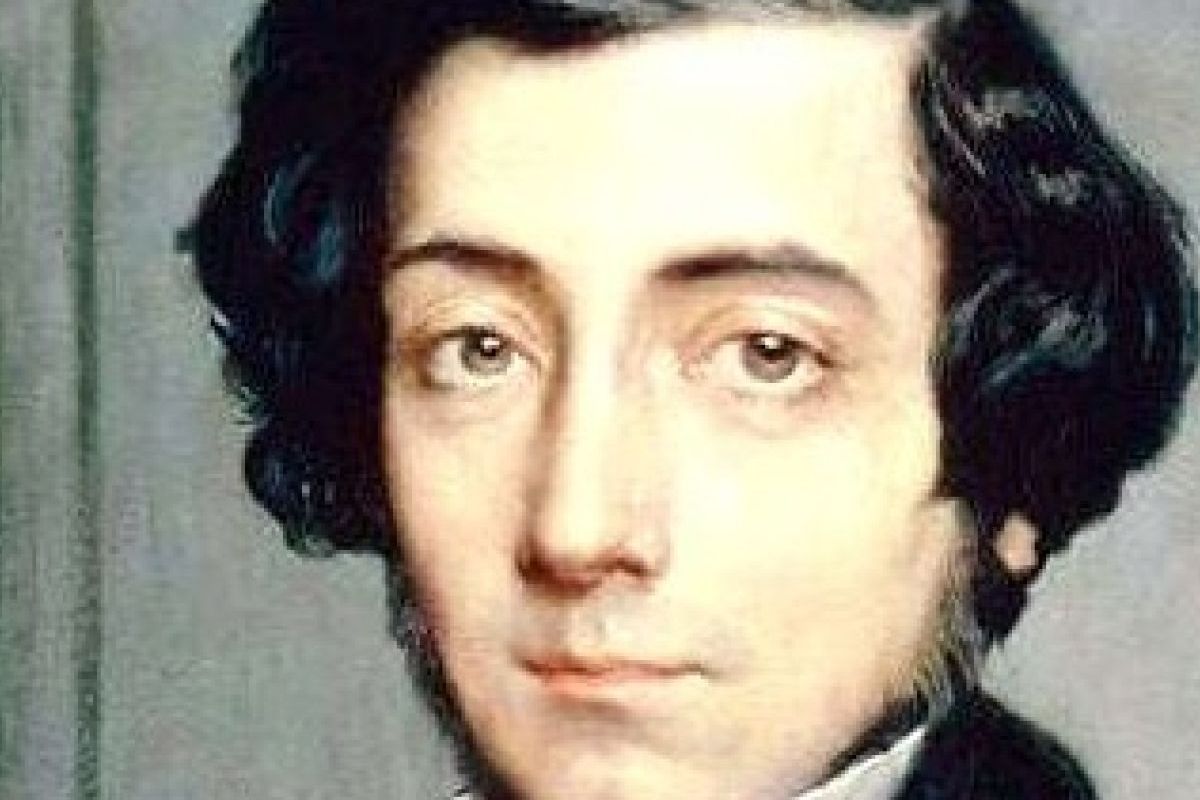
Democracy in America

In the furtherance of my critique of Democracy, I’ve gone back to re-read de Tocqueville’s Democracy in America, an original critique, though with much promise at the time.

In the introductory chapter, de Tocqueville notes the tradeoffs democracy makes. Essentially, he recognises the mediocrity, but he senses it’s somehow worth it. I break up his paragraphs and italicise for emphasis.

I admit that, in a democratic State thus constituted, society will not be stationary; but the impulses of the social body may be regulated and directed forwards;

Here de Tocqueville presumes the metanarrative of progress and all it entails.

if there be less splendor than in the halls of an aristocracy, the contrast of misery will be less frequent also;

The middle class served this purpose, but this benefit is being eroded as the acquisitive classes have learnt how to game the system and pillage the public coffers.

the pleasures of enjoyment may be less excessive, but those of comfort will be more general;

Here he considers the masses, but he fails to distinguish them from the aristocracy, now manifest as the 1%.

the sciences may be less perfectly cultivated, but ignorance will be less common;

Literacy may be elevated under this system, perhaps owing as much to the needs of Capitalism than of Democracy. In the US, the pair are inextricable.

Here, de Tocqueville is spot on. I won’t defend science or progress, but if this is a goal, the post-truth era is testament to the need for cultivation. Science is like investing: there is a compounding effect. Failing to progress effects downstream advancements, not linearly, but geometrically.

the impetuosity of the feelings will be repressed, and the habits of the nation softened;

there will be more vices and fewer crimes.

Interesting point, but I won’t linger; vices are morality plays, and crimes are tautological—though I suppose he is hinting that the demos will consider fewer situations to qualify as crimes, and so they’ll be relinquished to the realm of vices.

In the absence of enthusiasm and of an ardent faith, great sacrifices may be obtained from the members of a commonwealth by an appeal to their understandings and their experience;

each individual will feel the same necessity for uniting with his fellow-citizens to protect his own weakness; and as he knows that if they are to assist he must coöperate, he will readily perceive that his personal interest is identified with the interest of the community.

The nation, taken as a whole, will be less brilliant, less glorious, and perhaps less strong

Alexis de Tocqueville

The nation, taken as a whole, will be less brilliant, less glorious, and perhaps less strong;

Indeed.

but the majority of the citizens will enjoy a greater degree of prosperity, and the people will remain quiet, not because it despairs of amelioration, but because it is conscious of the advantages of its condition.

Tocqueville gets partial credit for this insight.

If all the consequences of this state of things were not good or useful, society would at least have appropriated all such as were useful and good;

Tocqueville misses the mark a bit here, tripping himself up on a somewhat Utilitarian—if not Pollyanna—worldview.

and having once and for ever renounced the social advantages of aristocracy, mankind would enter into possession of all the benefits which democracy can afford.

But here it may be asked what we have adopted in the place of those institutions, those ideas, and those customs of our forefathers which we have abandoned.

The spell of royalty is broken, but it has not been succeeded by the majesty of the laws;

the people has learned to despise all authority, but fear now extorts a larger tribute of obedience than that which was formerly paid by reverence and by love.

Here de Tocqueville appears to suggest a citizenry that fears rather than reveres its government in classic Machiavellian splendour.

I perceive that we have destroyed those independent beings which were able to cope with tyranny single-handed;

the weakness of the whole community has therefore succeeded that influence of a small body of citizens, which, if it was sometimes oppressive, was often conservative.

the Government that has inherited the privileges of which families, corporations, and individuals have been deprived

Alexis de Tocqueville

but it is the Government that has inherited the privileges of which families, corporations, and individuals have been deprived;

Ever the Madisonian, de Tocqueville shows concern of the consolidation of power.

the weakness of the whole community has therefore succeeded that influence of a small body of citizens, which, if it was sometimes oppressive, was often conservative.

The division of property has lessened the distance which separated the rich from the poor;

Although there was more egality…

but it would seem that the nearer they draw to each other, the greater is their mutual hatred, and the more vehement the envy and the dread with which they resist each other’s claims to power;

…and Tocqueville was prescient here—, the enmity of the haves of the moneyed classes crashes full-force into the have nots as the fabric of separation becomes more and more threadbare, as with Samhain this weekend.

the notion of Right is alike insensible to both classes, and Force affords to both the only argument for the present, and the only guarantee for the future.

The poor man retains the prejudices of his forefathers without their faith, and their ignorance without their virtues;

he has adopted the doctrine of self-interest as the rule of his actions, without understanding the science which controls it, and his egotism is no less blind than his devotedness was formerly.

If society is tranquil, it is not because it relies upon its strength and its well-being, but because it knows its weakness and its infirmities;

a single effort may cost it its life;

everybody feels the evil, but no one has courage or energy enough to seek the cure;

Alexis de Tocqueville

everybody feels the evil, but no one has courage or energy enough to seek the cure;

the desires, the regret, the sorrows, and the joys of the time produce nothing that is visible or permanent, like the passions of old men which terminate in impotence.

More Illusion

I’ve been thinking a lot lately about Democracy and thinking that the emperor is wearing no clothes, but in dialogue, I am having difficulty getting people to understand that I am talking about democracy as a concept—the very essence of democracy—, not how some place or another has implemented it. My point is that democracy is a silly system built on false hope, smoke, and mirrors.

Some get it, and they fall back to the Churchill quote:

‘Many forms of Government have been tried, and will be tried in this world of sin and woe. No one pretends that democracy is perfect or all-wise. Indeed it has been said that democracy is the worst form of Government except for all those other forms that have been tried from time to time…’

—Winston S Churchill, 11 November 1947

But this misses the point.

First, Churchill’s logic is limited to ‘forms that have been tried‘, a minuscule set to be sure.

Next, perhaps he is talking a position of not letting perfection be the enemy of the good. Except there is no one seeking perfection. The question is: what is good enough? Is Democracy in and of itself good enough? And it doesn’t end there, are there systems—even theoretically—better than democracy? And then, how might these systems fair when humans populate the model?

The problem is a systems thinking optimisation problem—and then there’s the question of what democracy is attempting to optimise. Clearly, this is a multifactor model, so what outputs are being optimised? It’s not likely that this would be a steady state model, and much of this relies on an unstable preference theory, so what is optimal today might no longer be optimal tomorrow—or in ten minutes.

how does one optimise a heterogeneous model?

As anyone who follows me know, I have a problem with the notion of progress as well, so participants can vote on various definitions of progress and various initiates toward that end, and, of course, other participants would prefer the comfort zone of the nostalgic and familiar instead. So, how does one optimise a heterogeneous model?

In the business world or entertainment, we are all familiar with the concept of death by committee, the slow deliberative process that mostly yields diluted results—results that might make the participants feel that they had a voice (perhaps), but—that would be ineffectual.

I am not eschewing coöperation.

I am not eschewing coöperation. I’m of the age where the Beatles were a big influence on me—and the Rolling Stones—, so I cherish the partnerships of Lennon-McCartney and Jagger-Richards. Their solo material paled miserably. The collaboration was synergetic. But there is a reason Ringo and Charlie were not asked to participate in the song-writing process. Their inputs would not have improved the output. Even imagine listening to an album of Ringo tunes: Act Naturally, Yellow Submarine, Octopuses Garden, What Goes On, Don’t Pass Me By, and Boys? Really? Right? And he only contributed to two of these anyway, save for lending his vocal instrument.

consider the concept of diminishing marginal returns

As I continue down this stream of consciousness, I consider the concept of diminishing marginal returns. So, even if there were a democratic system that could theoretically be optimised, it would have to face the human factor—and that would be subject to the diminishing marginal return of knowledge and information—, as we’d go down the participation pool from highly knowledgeable to low-information voters. And this doesn’t even address vested interests and conflicts of interest. It doesn’t even touch on the point that people are predictably irrational.

Plato’s Republic, in all of its elitist glory, offered a solution for this—aside from the philosopher-leader: a republic of the meritorious and virtuous (as if these were meaningful or measurable concepts). At least we wouldn’t be scraping the bottom of the barrel—or would we be?

merit being honed is how to gain and exert power and political competency

The problem with Plato’s meritocratic approach is that the merit being honed is how to gain and exert power and political competency—how to play the game of politics. And notion of virtue was nothing more than a façade, so rhetoric and the decorum of appearance is all that matters in this model.

Clearly, this stream is coming to an end, so I’ll disembark here and reembark later.

Democracy and Demarchy

As I research notions of democracy during this election cycle, I found several flavours of order by people, a core tenet of democracy.

As it happens, most people assume ‘order by people’ to mean order by the masses or the public-at-large, but there is not such magnitude provision for democracy. Ostensibly, it’s just people ruling people.

Historically, it is used to differentiate between anarchy, monarchy, oligarchy, and so on—though to be fair, save for anarchy, all of these involve people ruling people. And even anarchy is people exercising individual sovereignty.

Democracy’s Athenian origins had citizen-people ruling in a direct democracy. The catch, is that the definition of citizen excluded the majority of people—women, slaves, persons younger than 20, and so on—, so clearly it was not intended to be all-inclusive.

Another people-oriented order is demarchy—rule by the randomly selected. No modern country has ever adopted this form of government, but it should be noted that randomness has been used as part of selecting leaders in the past. Sortition, another term for random selection, was used for a hundred years in ancient Athens to choose members of the legislative council.

To be honest, given the political climate—at least in the United States —, random selection feels like a better alternative to the current system of meritocracy [sic].

Democracy Now

Let’s face it and be honest: Democracy is not a great system of governance. In fact, it’s as mediocre as the outcomes it generates.

Plato hated it. He preferred a Republic, but all that does is kick the can down the proverbial kerb. A mob of demos voting for self-interested politicos with the gift of gab and self-promotion.

Alexis de Tocqueville noted that Democracy requires an education populace, but that’s the least of its shortcomings, and, man, was he spot on.

Democracy is the worst form of government, except for all the others.

— Winston Churchill

Winston Churchill is to have said, “Democracy is the worst form of government, except for all the others.” Except he didn’t get out much and probably hadn’t survey all the others he demeaned. I don’t reckon he was very imaginative at the start.

Kenneth Arrow demonstrated with his Impossibility Theorem that no voting system would work even if the concept was otherwise solid, so that’s just adding insult to injury.

to what extent is democracy simply playing on the cognitive illusion of control?

Democracy sounds good on paper, but to what extent is democracy simply playing on the cognitive illusion of control? I’d imagine that the more one feels able to control outcomes (or happen to be in sync with the decided outcomes), the more favourable one feels towards it. But as much one might assume the disenfranchised to be disillusioned by it—and against all logic—, many still defend it.

The problem, is course, is people, so what are the alternatives? Besides Democracy, some people are easily enamoured by the Beneficent Dictator, but the shortcomings of that have been debated for centuries. For the most part, monarchies have run their historical course—at least as far as to demonstrate that they are not a solution either.

Some have raised Artificial Intelligence as a solution, but unless AI can unlearn the human elements, it’s not much of an improvement. It’s just faster and more efficient within a sub-optimal system. And humans are fearful of how another superior entity might treat them—especially given how poorly humans treat encountered ‘inferior’ entities.

To be fair, I don’t have an answer, but any system that outputs Vladimir Putin, Boris Johnson, or Donald Trump is in serious need of an overhaul—especially simultaneously.

* I included the Democracy Now!’s logo in this post. Democracy Now! is neither affiliated with this blog or this post. Still, I suggest you check it out.

Critique of ‘Some Problems with the Intellectual Left’

This post is a commentary on this post, which I happened upon through this other post on via this blog that I follow but that I haven’t yet read because I was distracted by the source. As the title suggests, the source post is about the author’s perspective on ‘some problems with the intellectual left‘. I am not sure who he includes in this group, so I am not defending anyone in particular.

I’ll disclose at the start that although I am sympathetic to the author, I feel he has a worldview I don’t share. He is obviously very frustrated and does not feel his voice is heard. It’s evident that he wants to persuade, yet he hasn’t mastered the art of rhetoric. Not having read his other posts and the concept of political Left and Right being somewhat nebulous, I’ll presume him to identify with the Right rather than the Centre. He seeks and finds solidarity among his brethren on the Right, people it seems who share his perspective, and yet feel alienated from the Left and from society as they envisage it.

I can’t speak for the rest of the world, but in the United States, there is very little conservatism or liberalism in politics. These have been coöpted by the brand politics of Republicans and Democrats. My Conservative and Liberal colleagues are all pretty much fed up with the lack of an ideological anchor in the US. Each claim that neither of the dominant political parties represent them or their ideologies. That might be a topic for another day. What this means is that I will be commenting by referencing the political party brand names, which in the UK translate to Tories and Labour parties.

What I can critique is this polemic. I am neither Conservative or Liberal, though a Conservative may deem me to be a Progressive.

First, it’s nice to see you begin with an admission that you are reacting from a place of emotion. I’ll try to comment on each paragraph in sequence and as necessary.

« A general issue that tends to recur is the arrogance of assumed or presumed access to truth and reality. »

This is an interesting claim. Two things:

(1) Most rational people presume whatever opinion they hold to be true at the time they express it. This is a known cognitive phenonenon for all humans. I am not sure how this is only attributable to Left intellectuals.

(2) Let’s estabish some working definitions. When I read ‘Right’, I presume Conservatism, a fundamental element of which is about traditionalism. ‘Left’, I presume to equate either to Liberalism (non-Classical, so from a US-biased perspective) or Progressivism, which views much of the past as flawed and wishes to remdeiate it.

If we accept as a simple attribute of Conservatism that there is a desire to take what has seemed to work in the past and continue to rely on it now and going forward, then it would seem to me this past would be the single truth upon which to operate. For the Progressive, there are many possible solutions, though, admitedly, a person might choose one as being more apt to be the best past forward, which I sup0pose could be characterised as the truth.

I disagree that the person on the Left would assume this to be the only path forward, so the claim of truth intransigence seems a bit overblown.

« They will take a complicated issue with many ambiguities to it, and present dogmatically one party line as fact. »

I have not experienced this. In practise, I see that the Right is able to signal simplistic slogans and sound bites, where the Left is required to be mired in nuance to explain, thereby losing the attention span of its constituents. Again, I am speaking from the perspective of the US. It may be different elsewhere.

« Not only this, they will try to ridicule and humiliate anyone who disagrees with them. This kind of shaming approach so common on the left to force a sham public consensus, extends as a tactic also and especially to intellectuals on the left. »

As there is no discernable Left or Right in American politics, there is only us and them relative to the two dominant competing brands, each clumps of mud and spercial interests, but neither with a recognisable underlying poltical ideology.

I am going to fast-forward because the tendency to single out one party when both parties are equally guilty continues.

« For all that they may try to condescendingly diagnose people who oppose them as suffering from one from of irreality or another… »

This is not limited to one side or another.

« At no point is there respect for some reality they could be missing »

Neither is this limited to one side or another.

« This is a ludicrous state of affairs. Can you imagine anyone on the right, or just independently minded, being willing or even able to engage in a reasonable dialogue with a group of people who have such strong attachment to their values… »

Notice how we distinguish Left from Right, but we also attempt to associate Right with ‘independantly minded’. I can imagine a so-called indepenant to be able to engage in ‘reasonable dialogue’. I can’t as much image the same for a person on the Right.

« And don’t think this is not the case, because it clearly is a fact… »

This is ironic given the previous claim that the Left is steadfast in owning the truth, yet the claim here is the writer owns the truth. Anything counter to his beliefs is opinion.

« The problem I think is that there is this general tendency among more intelligent people … have been insulated from reality more… »

I’m guess I need to get clarity on how intelligent people are shielded from reality. Is the claim that these people somehow live apart from reality? Apparently intelligent people are some monolithic group.

« …they prefer to hide in theoretical realms and not face the judgement of the practical world. »

What is this hiding mechanism? Does this hiding allow one to avoid reality as we know it? Is the practical world different to the real world?

« As a result, they try to hide their assertions behind claims of neutral fact, camouflaging opinionated things in this way, and by sneaky tactics of exploiting the human desire to fit in, in order to shame people into line with these opinions. »

I am not sure I am able to parse this sentence, but somehow there are sureptitious claims that shame people into compliance. I was under the impression that people of the Left were the free sex hippies of bygone days and Conservatives were ostensibly The Man. Moving on…

« They are not sure enough of themselves and their values… »

I thought the Left were the ones with ‘presumed access to truth and reality’. How would you be unsure if this were the case?

« so they must resort to all this underhand stuff, and once it spreads worldwide we get the kind of climate we are now in today. A climate where a tautological assertion such as climate change, becomes a calling card for worldwide shame and conformity. »

If I am interpreting this correctly, the Left is bludgeoning the general populace into conformity with shame. Again, the Left is not not monolithic entity, so I am not sure what conformity is being forged.

Also, there is a claim that ‘climate change’ is a tautological assertion, yet this missing the point that the assertion is an ‘anthropogenic climate change’ rather than a generalised claim that the climate is changing, an important distinction and not nuance.

« Another issue I have with intellectuals on the left is their disingenuous cherry picking of reality. »

Some examples would be nice.

« They think by obsessing on one “truth” in a much larger debate… »

Again, I believe that the concept of a single truth is one adopted by Conservatives, and I feel this is why more Conservatives believe in the notion of a monotheistic existence because it allows them to believe in a single source of Truth.

« …somehow saves them from criticism and gives them free reign to criticise and ridicule anyone else who questions that “truth”. »

Ditto

« Of course a person questioning it may only be making a point of nuance to distinguish an aspect of truth to it, and an aspect that is not true. »

There are a few possibilities here:

(1) That a thing can be simultaneously true and untrue, such as in a quantum place as exemplified by Schrodengers cat.

(2) That the definition of the thing being discussed is not common, so we are talking about a different reference.

(3) The definition is ambiguous, as captured by the old Groucho Marx joke, ‘I once shot an elephant in my pyjamas; how he got in my pyjamas, I’ll never know.’

(4) The topic being discussed can be further broken down or clarified, as portrayed by the African story of the man walking down the street wearing a hat coloured red on one side and blue on the other. Asked to recount, the people on one side declared his hat to be red, and the other that it was blue. In fact, they only had access to a partial truth based upon their own limited vantage.

(5) Neither side has access to the truth, as exemplified by the stoey of the blind men and the elephant, one who envisions the tail as a rope and another who envisions the ears as a carpet.

« But once you try to go into that debate, they have achieved their aim which was solely to get you on the defensive… »

Pretty sure this is a fundamental Debating 101 tactic we learn in high school

« …so now they can just belabour their same dumb point over and over and look like they know what they are talking about. »

Perception is reality, as the adage goes.

« All these kinds of underhand tactics… »

This author sounds bitter and has a difficult time communicating his position or gaining traction on his ideas. A person coming from this position will likely be defensive and put others on the defensive from the start. I’ll presume that these ideas are ones associated to the Right. I haven’t read any of his other writings, so I don’t have a broader or deeper perspective.

« Individuals must rebel against this encroaching totalitarianism… »

Again, the author is tilting windmills or strawmen as the case might be. I’m not sure I can parse this final paragraph, so I’ll just end here.

Character Arc

The US government are a crime syndicate, a veritable mafioso family. The current Don, quite literally, Donald Trump, The Don, is a conman at all levels. Some forget that conman is short for confidence man. About a quarter of the eligible voters had confidence in him–or at the least had more confidence in him than in his rival.

The US don’t have a vote of no confidence, but the impeachment process may serve as a worst case proxy. Watching the news, much f the political theatre and grandstanding revolves around the issue of character. It all sounds so tidy. A particular legal defence tactic is to impugn character. He’s got character; she doesn’t. One can’t trust that bloke even though he’s in a position presumably predicated on this character thing.

Character is a quaint notion, remnant of specious Virtue Ethics. The warring families–let’s call them Republicans and Democrats–attempt to secure the moral high ground by making a claim on the impeccability of their character pedigree. But what is character?

Character is another weasel word mired in cultural relativism. Essentially, it’s an asymptotic function wherein a person approaches some archetypal ‘good life’, as in eudaimonia. In the end, it suffers the fate of a no true Scotsman logical fallacy.

Political Path

People can change.

Although I have changed my opinion and perspective over the years, I feel that most people settle into their ways, fixing their positions with an unhealthy dose of confirmation bias. I’d like to think that I could change my position materially from where I am now given the introduction of new evidence, but I don’t think it’s likely. First off: because I am coming from a vantage where I feel I am ‘right’.

Don’t believe everything you think.

— Various

Of course, there is no absolute right, but from the perspective of the times and place and some triangulation, I’ll say ‘relatively right’.

Rewinding…

When I left high school in 1979, I considered myself to be generally Conservative — at least as I understood the word to mean and without dimension or nuance. I’m not sure I had a great grasp of the definition.

Upon graduation, I entered the military. I remember in conversation with a mate that I was a Conservative. He laughed, and said I was the least Conservative person he’d ever come across. I was perplexed, but I had to reorient my self-perspective.

New Definition

I decided that I was a Conservative — a Fiscal Conservative —, but I was a Social Liberal. I’d pretty much been a Social Justice Warrior (SJW), concerned with the underdogs, but it wouldn’t be on my dime — or the prospect I had for future nickels and dimes.

I held this position for years — until I realised that the two positions were untenable. You can’t simultaneously offer full social equality for free, and these were rights we were discussing. Fundamental rights. If money was the friction between a right and its realisation, then it needed to be spent. Fiscal Conservatism be damned!

Politicus Interruptus

Somewhere in the fray, I had dabbled with Libertarianism. Again, I dismissed this as an untenable fantasy. There had never been even close to an instance of this working, and it goes against the grain of all social concepts. It’s built on a dream — somehow anarchy without the anarchy, so anarchy + magic.

Progress

At some point, I didn’t like the PR of the Liberal tag, so I opted for Progressive. In the real world, I tend to side pragmatically with Progressives — the Bernie Sanders crowd in the US — , though I understand the illusion of progress and of politics in general.

Searching further to find a political identity, I settle on anarcho-syndicalism, the system I most identify with today, though there are only slightly more examples of this as there are Libertarian instances, a problem being that when some people see a leaderless group, they see it as a vacuum, and history repeats itself, so I’m not sure how sustainable this system could be.

This is now…

I am under no delusion that there is a right way for society to exist. I do believe there are plenty of wrong ways, but there are too many dimensions and complexities to have a single way. After all, how are you optimising the system? Trade-offs exist, and making a choice to maximise X might (and does) mean that Y is no longer maximised. Do you make X = 10 and Y = 8, or do you settle for X = 9 and Y = 9? And there are decidedly more than just X and Y.

There is no real reason to believe that society or even humans should exists, but given consciousness and self-preservation urges, I’ll take that as a given. That’s an inviolable metanarrative element.

Criminal Conservatism

A few years ago, I shared with a colleague that I had noticed that my high school classmates who seemed to be the most non-conformist (or perhaps the most anti-authoritarian), the ones most likely to have abused drugs and alcohol and most likely to criticise the Man, have by and large become extremely conservative on the political spectrum. Most are card-carrying Republicans, and dreaded low-information voters, continuing the trend of low-information acquisition and processing. He said that he had noticed a similar trend.

I still keep in contact with some some old mates who are Conservative Republicans, but who were high-information consumers then and still, so I am not saying that all Conservatives are low-information people.

A man who is not a Liberal at sixteen has no heart; a man who is not a Conservative at sixty has no head.

—Benjamin Disraeli (Misattributed)

The past couple of years, in a sort of nod to Bukowski, I’ve been researching or circulating among the underbelly of the United States, the veritable dalit-class comprised of drug dealers and users, pimps, prostitutes, and thieves. And I’ve noticed the same trend. These people might fear or hate the police and the system, and they may not vote or even be high-information seekers, but they seem to have a marked propensity to Conservatism. I admit that this is anecdotal and rife with confirmation bias, but this is my observation.

To broad brush any group into some monolith is always a fools errand and missing dimensional nuance, but the general direction holds. In my observation, these people are very black & white, and they want to see law & order (as much as they want to avoid its glance). They are interested in fairness, and call out being beat, as in being shorted in a drug deal or overpay at the grocery store–the same grocery store from which they just shoplifted.

When they see a news story, ‘That bank robber deserved to get caught’ would not be an unexpected response. Even if they got caught, they might voice that they deserved it. The received sentence might be a different story.

I am not sure why this shift from anti-establishment to hyper establishment happens. I’ve also noticed that even if they dislike the particular people serving government roles, they still feel that the abstract concepts of government, democracy, capitalism, and market systems make sense, if only the particular instance is not great.

One reaction I had is that some of these people feel that the transgressions of their youth might have been avoided only if there were more discipline, and so they support this construct for the benefit of future generations, who, as embodied in Millennials, are soft and lack respect for authority.

I’d recently re-discovered a Bill Moyers interview with moral psychologist Jonathan Haidt, and there is some relationship. And whilst I could critique some of Haidt’s accepted metanarrative relative to society, his points are valid within the constraints of this narrative.

The video is almost an hour long and was produced in 2012, it is a worthwhile endeavour to watch.

I am wondering if anyone else has seen this trend or who has experienced a contrary trend. Extra points for an explanation or supporting research.

Cover image: Sean Penn, excerpt from Fast Times at Ridgemont High, and Brett Cavanaugh, SCOTUS and posterboy Conservative hack

Emotion Trumps Reason

“Reason is, and ought only to be, the slave of the passions, and can never pretend to any other office than to serve and obey them,” said David Hume said in his Treatise of Human Nature.

Reason is, and ought only to be, the slave of the passions, and can never pretend to any other office than to serve and obey them.

David Hume, A Treatise of Human Nature

Hume claims that “reason alone can never be a motive to any action of the will,” and that reason alone “can never oppose passion in the direction of the will.”

In the United States, forces on the Left have still not learnt this lesson. They are still trying to fight emotion and irrationality with reason. It’s like trying to coöpt the insane with rationality. It’s not going to happen.

And despite protestations, even the most supposedly logical of us are still motivated by some emotion or passion, as much as we can try to deny it. One can claim to have become an accountant or an engineer or a physicist because it was a calculated, logical thing to do, but in the end, even the brightest of these are driven by passion, by emotion.

As long as we are fighting emotion with reason, the battle is already over before it starts. We need to fight emotion with empathy. This is where the story of the oak and the willow comes in handy. Reason is the oak. Reason is the hare, but emotion is the supple willow of the tenacious tortoise.

Wage this fight and escalating commitment will prevail, as the emotional response will trigger a sort of fight or flight, but your opponent’s reason will form a hard shell to fend off any attacks.

But don’t feel too smug. It’s only your emotions that give you the passion to fight the good fight. Reason has convinced you that this is the logical route.

American Exceptionalism

It’s sometimes difficult living in such a narcissistic place. I’ve lived in and out of the US, but I seemed to have settled here for now. I’ve lived on each coast, the Southwest, and the Midwest. I’ve visited all but four states—notably, Wyoming, Montana, and North & South Dakota, so you might recognise the trend.

Currently, I reside in Delaware, but my office is in Manhatten. As a consultant, I am most often wherever my client is. Combined, I’ve lived in LA for well over a decade, my earliest youth was spent in and around Boston. In my 20s in the 1980s, I spent my formative years in Los Angeles, the centre of the music industry at the time, where I was a recording engineer and musician. I had left my roots in Boston with various pitstops along the way to settle in LA, but I returned to Boston in the late ’80s to attend university and grad school. In Boston, I was married and then divorced, an event that gave me leave to return to Los Angeles, where I got married again and relocated to Chicago, where I spent over a decade as well. Divorced again, I relocated near Philadelphia for work and settled into rural northern, Delaware.

To the uninitiated, the US have two cosmopolitan cities, NYC and LA. By population, the third largest city, Chicago, is an oversized farm town. It qualifies as a city on the basis of population, and it’s not a bad place to be, but it lacks the cultural diversity and buzz of a NY or LA. There is none of that in Philadelphia and even less in Delaware.

Donut

The United States are like Australia. It’s ostensibly like a doughnut—empty in the middle, except to say the top and bottom don’t offer much either. So this is not to say that there aren’t valuable things, lessons, and people in these other areas, but by and large, even with the Internet and social media, they are still a decade and more behind.

When I lived in Japan—and I realise that I am coming off as some sort of culture snob—, I was taken aback at how far they seemed behind my frame of reference, having come from an affluent, white, East Coast, family. On one hand, their technology was off the charts and, owing to the exchange rate, it was cheap. Besides the exchange rate, the mark-up was enormous. Americans have no sense of value, and so as much as they exploit other countries, the last laugh is on them.

Americans are not some monolithic entity. There are many dimensions and divisions. To say Americans [fill in the blank] would be disingenuous. To listen to the politicians—especially the ones on the Right, and not just the fringe—you might be left thinking that American are all narcissistic assholes. In fact, this is the same cohort that leaves you feeling that the US have never left the Dark Ages with their religious superstitions.

Much of the country is actually in the 21st Century, but when you try to assess some average sentiment, this vocal minority makes it seem we live in perhaps the fifteenth century.

Roman General Lucius (John Cusack) — Dragon Blade Film

Even behind these anachronisms, there is still a sense of American exceptionalism—or perhaps there was a time that they were exceptional in some bout of nostalgia. You can cherry-pick some dimensions and claim to rank high on the scale but any exceptionalism only happens by adopting a frame. Many who come to the conclusion that the US are or were exceptional tend to fetishise Ancient Greece and Rome as well. In my opinion, it’s indoctrination, but there has to be more than this. There needs to be a certain gullibility gene that creates the propensity to believe these narratives. Without going off the rails, it might be fair to say that this genetic predisposition might have been the reason humans have evolved this far. I’d like to think it’s merely vestigial, but I’ll presume that this is only wishful thinking.

Americans, like most people, have a sense of identity, whether personal or to groups. And like the personae we project as individuals, we have myriad group personae as well. Perhaps there is already a term for this. If not, I’m not going to coin a term now.

Like individual identity, people defend their notion of group identity, and they tend to over-estimate. More than half of people consider themselves to be average or better than average in looks or intelligence and so on. Clearly, this defies statistics, but it is not merely an attempt to assuage some cognitive dissonance; you can come to a defensible position by picking some attributes that might excel (on some subjective aesthetic scale) and then overvaluing these attributes relative to the entire domain. Perhaps a person is taller than average and has been told s/he has beautiful eyes. It would be easy to discount other factors and place oneself in a higher rank due to these two factors. It works like this for national identity.

In the US, they will focus on some economic indicator, argue that it is important and captures broader coverage than it does, and then reference it as proof of exceptionalism. Meantime, the population is being indoctrinated into accepting this narrative, and much effort is spent trying to convince the larger world that this attribute is important.

In this MAGA Age of Make America Great Again, it’s helpful to remember that it never was and never will be great. And that’s OK. It’s also helpful to remember that the ‘good ole days’ are rarely as we remember them in the rearview mirror.