I stumbled upon Professor Jordan Peterson and his defenders of virtue morality, like Dr Stephen Hicks, and I decided to watch some vids.
Full Disclaimer: Not a fan
I ended up on his lecture about Carl Jung.
I’d been interested in archetypal and depth psychology for ages, and I’ve read most of Jung’s work. I still own all of the volumes of his complete works. The difference between me and Professor Peterson is that I take it as metaphor and, by his words, I presume that he doesn’t.
The video clip is cued to the location where Jordan says, speaking of Nietzsche,
“…‘God is dead, and we have killed him’ led Nietzsche to pose another question, which was: What are we going to do to replace him? Because Nietzsche believed—and I think he was absolutely right about this. I can’t see how it could be otherwise—, he believed that the morality that had structured Western society was predicated on the fundamental axiom of divinity, and so, as far as Nietzsche was concerned, the whole purpose of morality was dependent on that axiom being true—or at least being accepted as true. And when that axiom was knocked out by, say, the conflict between science and religion—because in some sense that’s what did it—, then the whole system no longer had anything to stand on and could become entirely questionable…”
“The whole purpose of morality was dependent on [the existence of divinity] being true.”
As I’ve said time and again, this is the primary reason people—especially those defending or seeking some sense of status quo, conservative vanguards, and morality warriors—insist on the existence of a real, objective moral centre or a good-enough version of it—one that coincidentally conforms to their worldview.
I’m afraid that I am going to need to hear something well more convincing than that because I’m not buying what these guys are selling.
As I read his Utilitarianism, I want to like John Stuart Mill. He seems like such a clever man, but he is a victim of his Enlightenment Age. Attempting to fabricate order created by science’s encroachment on the absolutes of religion and the shifting sentiments toward monarchies, Mill tries to replace this moral compass with Jeremy Bentham‘s utility.
£1 ≠ £1
The problem is that despite (sort of) dispensing of religious doctrine, Mill was still fettered by the dogma of virtue ethics of dignity and duty. To this, he adds happiness. Not to go full-on Foucault, but these are concepts leveraged, like religion, to maintain power—take an elevated system in a constructed society, and the duty becomes a burden to the bottom, save for pretence of duty and dignity at the top.
I’ve had an issue with the concept of virtue and all of its offspring: duty, justice, and so on. I’ll likely write about this later. I expect that I’ll be reading Mill’s On Liberty next, so stay tuned.
Ignoring my contention that Utilitarianism is baseless, I have two other issues, using economic examples, each related to prospect theory (pdf):
Regressivity: A person with less money values an incremental dollar more than a person with more money.
Loss to gain asymmetry due to risk aversion: A person values losing a dollar more than earning a dollar, ceteris paribus.
Pareto efficiency, a cornerstone of Classical economics, does not take this into account. For this theory, all dollars are created (or perceived to be) equal, so it doesn’t matter whether person A, who earns £10,000 p.a., or person B, who earns £100.000 p.a., gets £100, but in the real world, person A would give it a higher value, so a transfer from A to B would be an inferior transaction to a B to A transaction.
This said, person B values the £100 more than having gained the amount, but it is not clear how to reconcile (in order to reach perceived parity) what the fair equilibrium would be, allowing that equality of outcome might not be the desired outcome.
Of those who do not require meaning, I don’t have much to say, and anything I do have to say about this will be obvious in reflection to the people who do.
Some people—perhaps even the majority or super-majority of them—require meaning. Of these, some accept the doctrines offered by religion or society whilst others will construct meaning. Even those who don’t patently need meaning may still construct one anyway, whether employment, family, country, or duty.
People who require meaning feel that the world will devolve into chaos if no meaning were inherent, that people would become selfish anarchists, hooligans, and ne’er-do-wells. Most of these people (convincingly) convince themselves that there is some source of objective morality and that that reality is known. Insomuch as, in this case, perception is reality, it doesn’t matter whether it is or isn’t.
Pinker’s possible objections in The Blank Slate notwithstanding—there may be some genetic component driving this delusion—, this reality is a social construct.
I guess the point is that some people are incapable of accepting a world with no meaning. Unfortunately, politicians, and Randian Objectivists (perhaps a large overlap in some circles) can prey on these gullible masses, and they can vilify others who are not so lucky in masking their motives.
I’ve just finished reading Steven Pinker‘s The Blank Slate. Originally published in 2002 (and re-published with an afterword in 2016), it still feels fresh. Pinker offers compelling rationale for accepting that humans are not blank slates entering the world.
Though I am somewhat of a social justice warrior in principle, I am still a moral subjectivist, a post-modern thinker. Pinker shares his strong feelings against subjectivism, but he provides no evidence of the moral objectivism he advances, relying instead on an emotional appeal; in fact, he employs the same defensive tactic his detractors employ, which is to try to make an empathic connection to the reader.
All he does is to claim that there is an objective morality because everybody feels and knows that X is better than Y, taking a strawman approach. It’s not that I disagree with his Xs and Ys; it’s just that they are subjective not objective measures. He tries to slip in an appeal to popularity by claiming that everybody would (or should) feel this way when push comes to shove.
Nietzsche, I think, had it right in Beyond Good and Evil when he pointed out the dual moral systems of masters and slaves. Although a moral (just) system might be best constructed from scratch in the manner of Rawls‘ veil of ignorance, we are not starting from a blank slate. The power structures are already in place. There is a possibility for upward and downward mobility, but large jumps are not likely except in the manner of a lottery. Other than this, it’s unlikely that one will move from one quintile to another and even less likely to skip a quintile, especially on the upward trend.
In any case, the issue is not whether some might feel subjectively better; it’s whether—across all possible dimensions—a relative, stable equilibrium can be found. Even here, this is not objective, even if it’s not otherwise arbitrary or capricious. The larger problem is one of epistemological empiricism—apart from the ontological question—, whether we can know that we’ve found the objective truth or if we’ve just settled on something that works for our current station.
As much as I really do like Steven Pinker, and I await his next book, Enlightenment Now, I do so only to read how he couches his argument in support of Enlightenment and Humanism, two concepts I feel are tainted by hubris
In the video, Lewis knocks down a weak strawman argument about subjectivism. He starts with a backstory about biological evolution. In his setup, he conflates empirical tautological truth with moral truth and paints them as equivalent.
Lewis introduces right and wrong and good and evil in order to provoke an emotional to realists and cognitivists, and attempts to underscore it with an appeal to tradition wrapped in an appeal to authority and positive ad hominem that ‘until modern times, no thinker of the first rank ever doubted that our judgments of value were rational judgments‘ [in situ].
Lewis notes that if one believes that morals are socially conditioned, then we could as soon have been conditioned differently, but he’s just trying to set up his next strawman, which is to say that some subjectivist, say, an educator or reformer, may ask us to improve our morality, and leads into his punchline, that subjectivism will surely ‘be the disease that will certainly end our species‘ [in situ]. I’ll ignore his eternal damnation quip as quaint.
He points out that some indignation toward the Third Reich (Godwin’s Law) is groundless, but what he continues to ignore is that this claim cannot be made on moral grounds. In fact, from the vantage of a Nazi at the time, they were doing the moral thing. Furthermore, had the Nazis won the war, this would be the prevailing morality.
Here Lewis tries to conjure an is from an ought by claiming that without ‘objective standards of good‘, then any ideology is as good as the next, and so he is simply tilting at windmills and arguing with this gossamer strawman. From this condition, he complains that one cannot measure better without an objective measure, so, therefore, there needs to be an objective measure. This, of course, is wishful thinking, like my complaining that I cannot win the lottery without winning the lottery, therefore, I must have won the lottery. (I accept payment by cash, cheque, or Bitcoin.)
In essence, the argument attempts to make a claim that a subjectivist wanting to make a moral claim of ‘better’ or ‘progress’ cannot because there is no ‘better’ or ‘progress’, these terms being subjective. The strawman here is that a subjectivist would make this claim on the basis of moral argumentation. As even Lewis notes, subjectivists claim value judgments as sentiments or complexes, so preferences. This is true; so the claim would be based on a preference rather than on a moral one.
He proclaims that the question ‘why should we preserve the [human] species?’ is somehow profound. It’s a valid question, but, again, it can be answered outside of the realm of morality—constructed or otherwise. Then he goes down some instincts rabbit hole based on this faulty premise but tries to circle back to his standby old universal moral law.
From the rabbit hole down a slippery slope down a rat hole, he rambles anecdotally. Tailing the vid with some supposed objective prescriptions, it mercifully ends.
Philip Goff presents a strong argument published on Aeon as to why taxation is not theft, primarily because it is based on false assumptions about the morality of property ownership.
I have written a lot of short pieces addressing this question (the answer is always no). But this piece for Aeon magazine is the most extensive thing I’ve written so far, and goes into much more detail about the nature of ownership. I’m always amazed at how much this stuff angers people. I’ve been enjoying […]
Listening to the Robert Wright’s audiobook, Moral Animal, it’s become even more apparent that ethics and morality are the results of a later stage of an evolutionary strategy. Not that he’s saying that.
After cognitive abilities came language and then, presumably, ethics then moral proto-structures. Subsequently, gods and God came into fashion.
That morality is the result of evolutionary progression is not particularly controversial, but sociobiologists seem to view the evolutionary development of morals as a parallel to Chomsky’s theory of innate language and universal grammar. My modification is that morality (as distinct from mores, customs, and such) necessarily requires language and cannot exist independent of language.
Given the evolutionary perspective, it is obvious that this concept will not be popular for those who do not support this base position, but it should not much of a stretch for those who do.
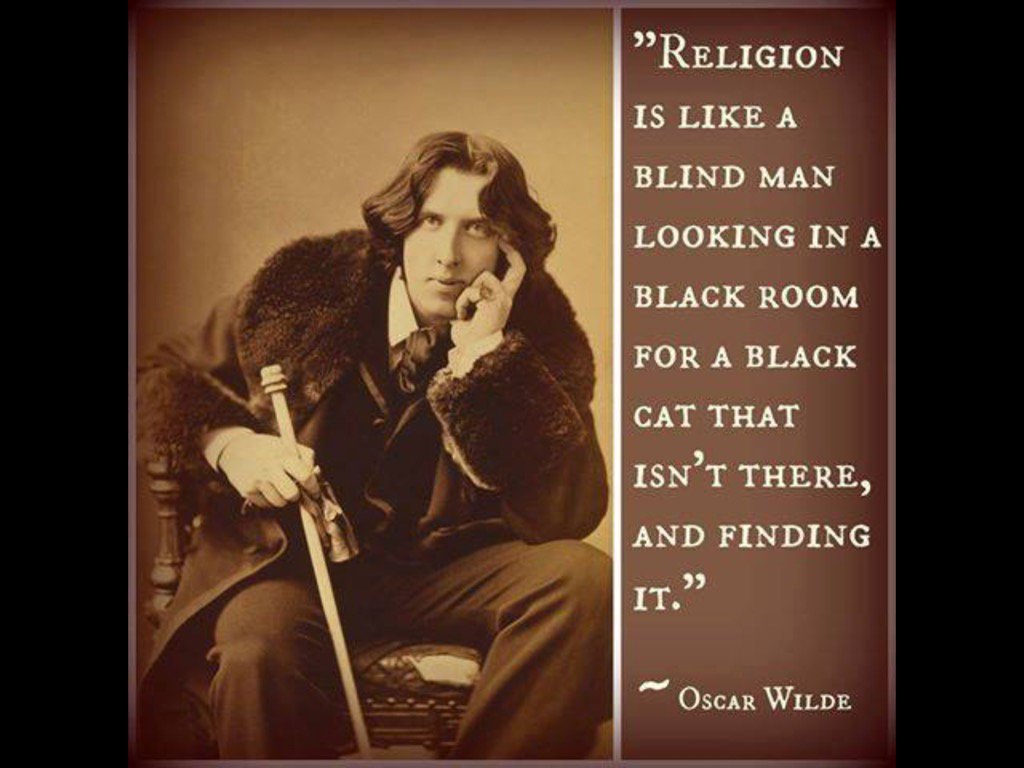
If life has no inherent meaning, why are humans so attached to finding meaning?
A common cognitive phenomenon humans exhibit is apophenia. From Jesus in toast to constellations in stars to dragons in clouds and faces on Mars, we see imagine we see things that aren’t there. We perceive signal where there is only noise. We create gods where they don’t exist.
On one hand, this may be some vestigial artefact that was necessary—or at least evident—for survival along our evolutionary journey. On the other hand, it may just have been inculcated through social indoctrination, and so is just a social construct, a byproduct of language and the ability to reason.
« I don’ t know whether this world has a meaning that transcends it. But I know that I do not know that meaning and that it is impossible for me just now to know it. »
Camus claimed that life has no meaning and is in fact Absurd. He proposed that you had three courses of action.
Physical suicide
Psychological suicide
Acceptance — embracing the Absurd
Regarding physical suicide, I believe that Camus was being melodramatic. This essay was a product of its day, and in 1942 people were even more steeped in the need for meaning.
Societies exist due to the perception of meaning, so they are obligated to enforce this belief. Societies need to promulgate order, and so much effort is expended to battle concepts that counter this. They envisage anarchists, not only as antithetical to order but as active chaos, black-masked, jack-booted hooligans, smashing windows and looting shops. So, too, do they vilify nihilists and atheists of whatever stripe.
Societies are organisms, and they require meaning to justify their own existence. Nihilism is a cancer, a virus, destroying the very core of their being.




 Philosophics