I want to write about this Quanta Magazine article: What Is Life? Its Vast Diversity Defies Easy Definition. but I’ve not got enough spare time. Too many irons in the fire or plates spinning or which ever metaphor you favour.
My interest in the insufficiency of language is what attracted me to the article, and is probably how it ended up in my feed. To highlight some aspects, in 2011, Russian geneticist Edward Trifonov reviewed 123 definitions of life and found as many definitions as authors. Although he discovered some core shared features. His version distilled to self‐reproduction with variations.
The article mentions Wittgenstein’s language games—and rightfully so. But it underscores the point that language is an approximation of reality. My working position was that naming objects is simple—in fact trivial—, but naming abstract concepts presents challenges. Now, I find that the challenge sets in earlier than even I expected. Language is truly insufficient.
The first step to recovery is to admit there’s a problem.
Audio: Philosopher Bry Willis discusses this topic.
Postmodernism was summarised by Lyotard as having an incredulity toward metanarratives.
What does this mean? What are metanarratives, and why harbour incredulity toward them?
Audio: NotebookLM podcast on this topic.
Metanarratives are narratives. Stories presented through a lens with a certain perspective. These stories provide a historical account of how a culture arrived to where it has. They can be viewed as origin stories. Metanarratives are also teleological, as they provide the foundation to progress, to advance the culture to a better future. Embedded in these metanarratives are the rules and conditions necessary to navigate, both from the past and into the future.
We’ve got stories. In his book Sapiens: A Brief History of Humankind, historian, Yuval Noah Harari tells us how important stories are for having made human progress. Hooray for us!
This sounds good so far. Right? We’ve got Caesar, Cornwall, and Kahn. We’ve got triumph of us over others. Good prevailing over evil. Right over wrong. So why the incredulity?
Let’s keep in mind that Lyotard is suggesting incredulity and not rejection. The narrative could be fine and accurate enough. One might argue that the benefit of the narrative for the purpose of cohesion outweighs the detriments posed.
There are several notable problems with metanarratives.
Firstly, the past suffers from a cherry-picked survivorship bias. The story threads that don’t support the narrative are abandoned, and some threads are marginalised. So, there’s a dimensional problem. As with any historical account, one needs to adopt a perspective and create a story. Let’s not forget that the word history comes from the word story. In fact, French only has one term: l’histoire. History is story.
Secondly—and this is somewhat related to the survivorship bias problem—, is that we privilege the perspective we take to view this history. In his book, We Have Never Been Modern, Latour uses this line of argumentation to arrive at the conclusion that we have never been modern. It is only because we are here now and surveying history through a rearview mirror that we can even look into the past. And we feel that we have somehow overcome this past. The past was primitive, but we are modern. Some time in the future we’ll deservedly be viewed in the same light because that’s how progress works. But there is no reason to accept this privileged assignment. It’s a function of ego—and to be even more direct: hubris.
Lastly, there’s the issue of teleology. Through this privileged vantage, we orient toward some alleged destination. Like fate, it’s just there for the taking. The only barriers are time, not keeping your eyes on the prize, and not following the rules to get there. There’s an embedded deontology. Those other societies don’t understand what it takes. You need to follow this path, this religion, this sports team. Because this is the best there is.
But there are no crystal balls. We cannot divinate the future. There is no particular reason to believe that our imagined path is the best path. If you don’t believe this, just ask the culture next door.
I’d like to think that somehow Progressives would be more aware of this tendency—and perhaps in some sense they are, but it’s not very apparent pragmatically. I don’t want to get distracted by the notion of institutionalism, but that is evidence of taking a privileged position regarding the status quo—even if your vision of the future would take a different path than your more conservative brethren and sistren.
In closing, this has been a summary of the problem postmoderns have with metanarratives. It could be that the metanarrative you believe to be valid is valid. It could be that your religion is the true religion. It could be that your sports team is the best sports team. That your system of government is the best of all other alternatives. It’s more likely that you’ve convinced yourself that these things are true than them being true.
We can either adopt the perspective of Voltaire’s Dr Pangloss and consider our world to be the best of all possible worlds, or we can step back and consider that we haven’t exhausted all of the possibilities.
Riffing on my recent post, I wanted to provide a tab more perspective on my claim that postmodernism serves a purely disintegrative function. Anyone can disintegrate a narrative into constituent parts, but postmodernism provides no grounds for privileged reintegration, as this too can be disintegrated. So, whilst one is free to disintegrate and even to reassemble the parts, one is never in a position to claim that this is how it should be put together because this privileges the subject and another subject can always come along and privilege another perspective. Also, there is no PoMo toolkit available to reassemble the parts that I am aware of.
When I was a child, a neighbour owned and operating a demolition company. He disintegrated buildings. He kept some of the materials and sold some other for scrap. Whilst these materials could be repurposed and used in the construction of another building—or a picnic table—, this was not the function of the demolition company. It’s safe to say that no one was ringing him up under the premise that he had tools, so why won’t he build them a house. He knows houses, right?
This is the same problem we face when deconstructing a narrative with postmodern tools. If we want to construct something, we can, but we should expect that no matter what we do, the next wave can readily knock it down. And though we can rebuild more castles made of sand, they are all subject to the same forces.
* I admit that this title was lent from The Cure’s Fascination Street, which does happen to be on their album Disintegration.
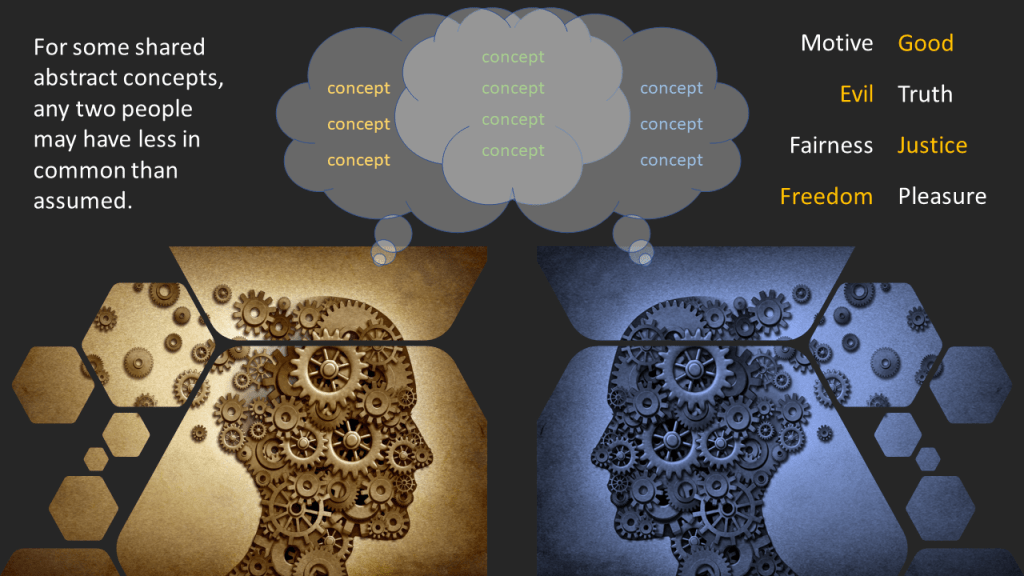
I tend to go on about weasel words and the insufficiency of language, but I tend to get a lot of resistance by people who insist the chasm isn’t as expansive as I make it out to be. This makes me wonder how one might create a test to determine how much is similar and how much doesn’t.
To summarise my position, abstract concepts of this type are specious archetypes that cannot exist in the real world: truth, justice, freedom, fairness, and so on. The common thread here is almost always that they exist in the realm of morality, another false concept.
It seems to me that one could construct a sort of word cloud intersecting with a Venn diagramme. I’d assume that more articulate people would have more descriptors, thereby creating landscape with more details and nuance for any given concept.
Additionally, I could see a third dimension which would capture diametric meanings. There is also the issue of diverse contexts, e.g. in the case of justice, we have distributive, retributive, restorative, and procedural flavours, so one would need to be taken into account.
In everyday existence, I notice that these terms are good enough and have enough substance to trick people into believing not only that it’s real but that the are operating with a shared concept. My point is that it’s more apples and oranges. We could employ dimensions that make these appear to be similar.
Approximate spheroids
Fruits
Contain fruits
Have skin
Additional scrutiny would illustrate the differences.
Colour
Taste
Consistency
This difference between this concrete case is that we can observe the objects to compare and contrast, but with abstractions, we have a sort of survivorship bias in play. We remember what we agree on and forget or diminish the parts we don’t agree on. And we don’t necessarily even know the complete inventory of descriptors of our counterparts.
The image at the top of the page is not to scale. I don’t know what the percent breakdowns are, but I wouldn’t be surprised if in a situation where there were 10 possible descriptors, that only 4 would be commonly shared—so 40 per cent—, leaving 6 not in common—60 per cent.
In any case, I wonder if anyone has attempted this sort of inventory comparison. I haven’t even looked, do there could be tome upon tome published, but I don’t suppose so.
One if the biggest foci of postmodern philosophy is the metanarrative. Employment diversity is a place that the metanarratives go unquestioned by most. The most predominant aspect is the frame. Don’t accept it.
Inside this frame, some uncritically adopted narratives are as follows:
Work is good
Work builds character (proportionately to the effort exerted)
Work defines your value or worth as a human
Work signifies your place in society
Work is its own reward (except for monetary payment and recognition)
Value is defined by monetary achievement
Worth is defined by your place in an enterprise
And so on…
In this HBR article*, the frame has been established as a corporation and the diversity within this context. What this say by omission is that money and power is the measure of a meaningful existence. If only women were afforded a seat at this table—proportional to their population in society—, things will be even.
Women should start their own successful companies. Women should rise to the top of existing companies. Especially if they buy into the aforementioned narratives. Many women and men buy into this story lock, stock, and barrel (whatever that means), but only is you accept this as a frame is this relevant.
It’s easy to imagine a world where money is unnecessary, where labouring is unnecessary.
It’s easy to imagine a world where money is unnecessary, where labouring is unnecessary. Some have imagined a world without work, where people could instead pursue artistic endeavours, but this is just adopting a different set of narratives—like the person who exchanges drugs or alcohol for Jesus or some such. Out of the frying pan into the fire. This is the lie.
Interestingly, the HBR article makes these points:
Quantify gender equity in terms of economic gains for the company.
Hold leaders accountable for change by tying DEI metrics to performance reviews.
Offer development opportunities to increase gender intelligence, empathy, and self-efficacy.
Pull back the curtain on misperceived social norms.
Establish cross-gender professional relationships.
Frame, focus, and integrate interventions into core business outcomes and mission.
Notice that each of these operates from the perspective of the company. Granted, this is HBR, where the B is for Business, but still. Here’s the low down.
Gender equity will at some point increase your bottom line.
Create diversity metrics (and incentives) and tie them to performance review—presumably tied to the economic performance expected in bullet 1.
Educate your executives and staff to the misconceptions—so long as you don’t question the deeper metanarratives.
Essentially, the ask here is to establish male-female protégé-mentor relationships. Of course, this could be expanded to break binary gender stereotypes, too.
Back to business, frame the frame. But to tell the truth, I don’t even know how to interpret and summarise the provided example. It seems this is an admixture of points 1 and 2, given metrics should ladder up to stated objectives and outcomes.
asking for this equity in diversity is a short-term fix
In any case, asking for this equity in diversity is a short-term fix, but it’s unimaginative and buys into the worldview of the patriarchy. There is no reason to accept this prima facie. As with the notion of Democracy, I’d be willing to argue that the system itself is the problem and that any tinkering within the system is limited by the system itself.
* Apologies in advance if HBR has a paywall. Typically, the first 3 articles are free, but if you are like me that exhausts on day one.
How does one justify reason without reason? Isn’t this just circular reasoning— circular logic? Can one justify reason without employing reason? Can there be logic without reason?
The Age of Enlightenment is simultaneously the Age of Reason. Reason is the best path forward, and yet one can’t even board the train without a predisposition toward reason at the start.
This reminds me of the troubles the logical positivists encountered by claiming that everything need to be falsifiable, and yet this claim could not be falsified. It’s Hume’s ought problem.
One could employ empiricism, but can one arrive there alogically?
Is there a term for ‘not logical’ without the same baggage as illogical?
Alogical
Antilogical
Contralogical
Counterlogical
Delogical
Dislogical
Inlogical
Mislogical
Nonlogical
Oblogical
Unlogical
For example, a work of art is not (necessarily) logical, but neither is it illogical; this feels like improper usage. So, what prefix modifier would one employ to communicate ‘not within the sphere of logic’ in shorthand? Or is it just ‘not logical‘. That doesn’t seem quite right either.
I’m not a gamer. OK, so I have been known to play some games, but I’m not very good at them and don’t justify committing any significant time improving my playing skills. Besides, I’m fairly occupied outside of the gaming experience. Part of it, I think, is that games I don’t identify with the experience gaming offers. Driving games? No. Flying games? Nope. Shooting games? Nah. Puzzle games. For a few moments, then naw. Building games? Farming games? Role play games? Not so much. That said, many friends and associates play games, so I remain somewhat aware and occasionally participate badly. My son plays certain games, so I am aware enough to allow for a communication thread in the same way I am somewhat conscious of sports because my brother steeps himself in sports. But in practise, I couldn’t tell you the difference between Marcus Rashford and Alex Verdugo.
All of this said, I come upon a piece from a few months ago. Ultimately, it reads like a philosophy on gaming. In the piece, the author, Austin Walker reviews Watch Dogs: Legion and explains why it doesn’t live up to its meta potential. I haven’t played any of the Watch Dog games and might not ever, but his point seems to be that they had the best talent and could have been edgy, but they didn’t. He offers some possible solutions on the edge, but he leaves a fuller solution to the game makers.
For those unfamiliar with the context of Watch Dogs: Legion (as I was), it’s a collaborative anti-establishment game. It promises to rail against the oppressive, ultraconservative, fascist powers through collective action, but as Walker writes, this activity is performative. In the end, nothing changes beyond some superficiality.
Perhaps, this, itself, is the commentary: Nothing changes except at the margins, but I don’t think this was the intent. Instead, it’s about a place to redirect one’s anger and frustration, except there is no resolution. Perhaps it’s supposed to be more about the journey than the destination, but I’m not buying that either.
In any case, rather than summarise Walker’s work, I link to it to speak for itself. And despite its deficits, it still feels it reserves a space not yet occupied by other properties yet, so a little more imagination could inch it into just the right place.
For the record, the last game I enjoyed playing with friends was 7 Days to Die, which I’ve played on and off since 2013 or so. It’s come a long way since it was first released. Interestingly, it’s still in Alpha—some 8 years later, so I’m not sure what that even means anymore.
So, I’ve gone down a rabbit hole. Again. This time, it’s Žižek. Again. I’ve still not read any of Žižek’s own work, but people mention him often and he is a shameless self-promoter. In this video clip, he responds to whether gender is a social construct. Unfortunately, he conflates gender with sex, and his examples cite transsexuals not transgenders.
sex is about biological sex assignment
To set the stage, sex is about biological sex assignment—the sex category you are assigned into at birth: male, female, or other for some 1.8%. This is a simplistic categorisation: penis = male; vagina = female; both or neither: rounding error. In some cases, a decision is made to surgically conform the child to either male or female and ensure through prophylactic treatment that this isn’t undone hormonally in adolescence.
gender is about identity
Gender is about identity. As such, it is entirely a social construct. All identity of this nature is a function of language and society. In this world—in the West—, females wear dresses (if they are to be worn at all) and males don’t—kilts notwithstanding. In this world, sex and gender have little room for divergence. so the male who identifies as this gender (not this sex) is ostracised.
The example I usually consider first is the comedian Eddie Izzard—a cross-dresser. He’s probably a bad example because he does identify as a male. He just doesn’t wish to be constrained by male role restrictions and wants to wear the makeup that’s been reserved for women in the West at this time.
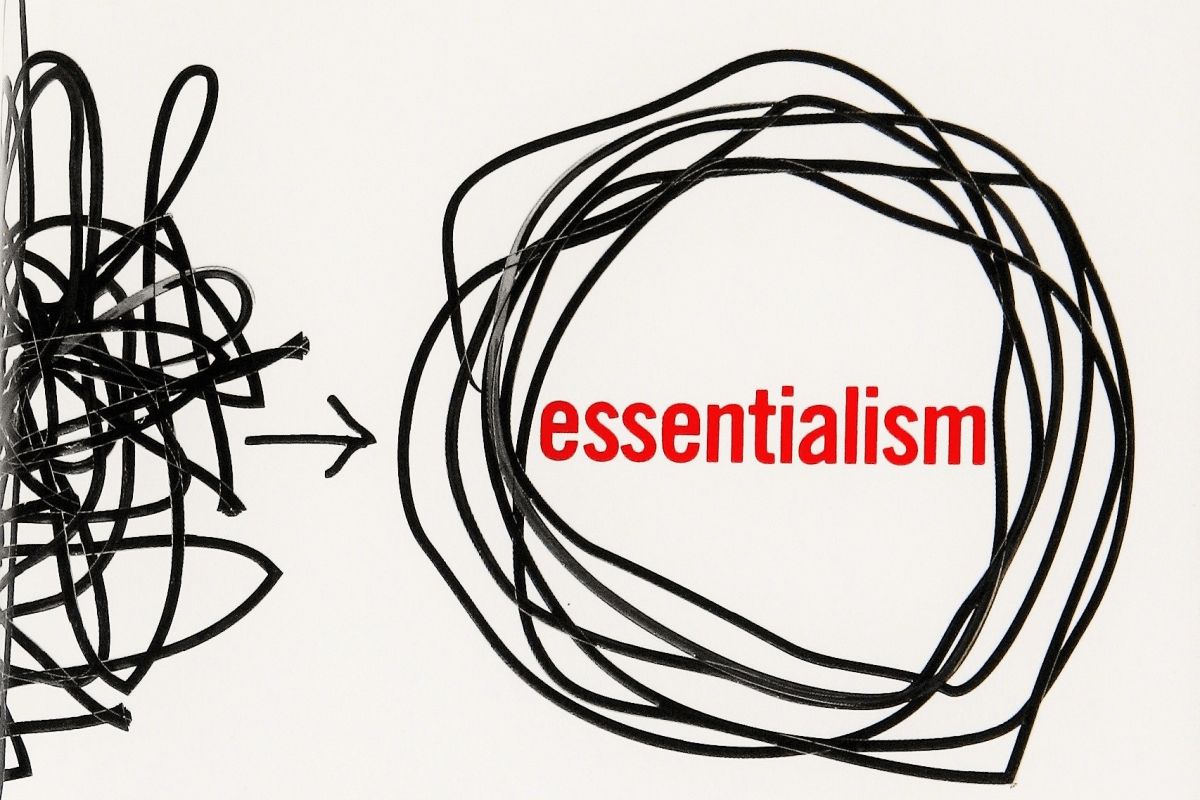
Žižek eventually gets to an argument about essentialism—so we’re back at Sorites paradoxes and Theseus again. At the start, I could argue that the sexual distinction has few meaningful contexts. For me, unless I am trying to have sex and/or procreate, the distinction is virtually meaningless. For others, only procreation remains contextually relevant. In this technological world, as Beauvoir noted in the late 1940s, strength differentials are not so relevant. End where they are, sex is not the deciding factor—it’s strength.
Žižek’s contention seems to be that the postmoderns (or whomever) disclaim essentialism in favour of constructivism but then resolve at essentialism as a defence because ‘now I am in the body originally intended’. I’ll argue that this is the logic employed by the person, but this person is not defending some academic philosophical position. They are merely engaging in idiomatic vernacular.
I am not deeply familiar with this space, and if the same person who is making a claim against essentialism is defending their actions with essentialism, then he’s got a leg to stand on. As for me, the notions of essentialism and constructivism are both constructed.
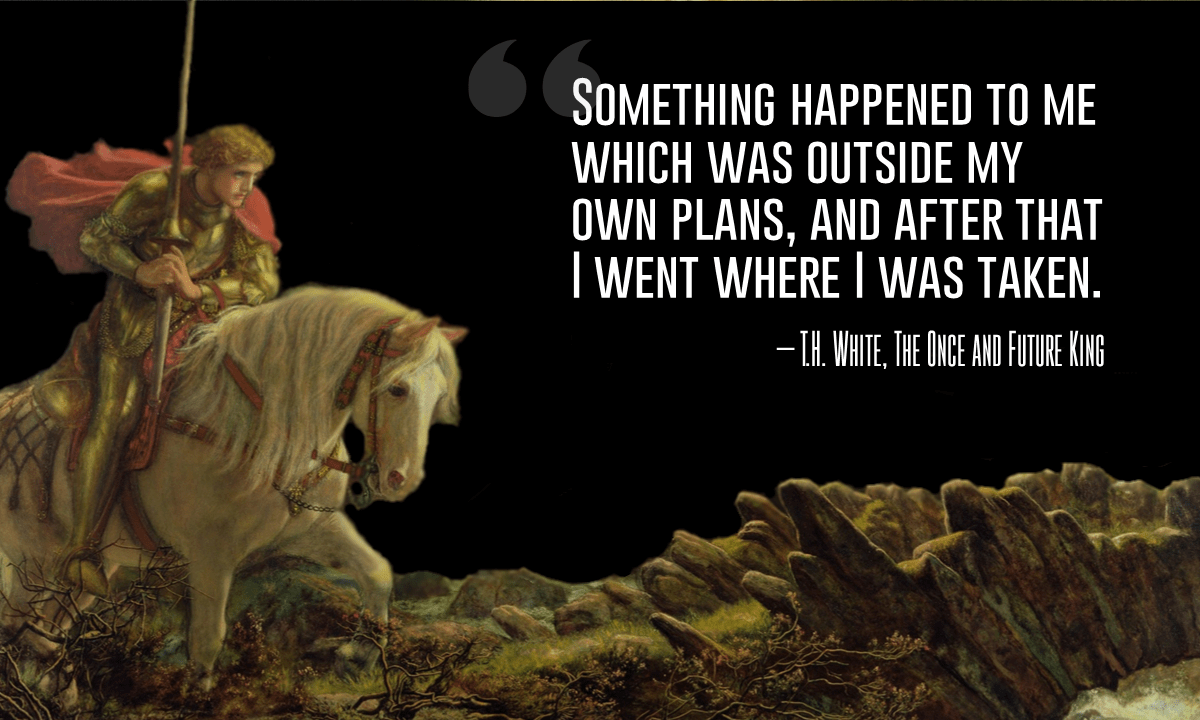
An Internet friend led me to this quote. I felt it was appropriate to share in reflection of 2020, not only for me but many people who were forced to go with the flow.
The quote reminded me of the mid-1990s, a time when I was steeped in the archetypal and depth psychology of Jung and Hillman. I also read a lot of works pertaining to the Holy Grail. I decided to composite the quote onto the cover image. I’m not asking for a holy grail. Let’s just hope 2021 fares better than 2020 by most accounts.
Chump in Chief* wrote a piece on dementia using analogue of the ship of Theseus. As a topic, Hobbes’** Theseus thought experiment has been well-covered, but that’s never stopped me before.
This is all about identity. Essentially, there are two perspectives. To an observer not on the ship or aware of the transformation, they would be none the wiser. For all intents and purposes, if they had ever seen the ship before, it’s the same. But what about those on the ship?
For nearly all of these observers, it’s almost unquestionably still the same ship. In a manner paralleling a person’s cells being sloughed off every 7 years, the cells in place at the start aren’t there after 7 years. Most will not doubt that you are the same person.
the average human cell is about 7 to 10 years old
As cells are continually dying and replacing themselves, for an adult the average human cell is about 7 to 10 years old, which might be interpreted as saying in the fashion of Theses’ ship that a person is anew each 7 to 10 years. Let’s ignore that this is an average, and many cells have a lifespan of only a few days whilst others—cerebral cells in particular—are here from the start and so are as old as the person.
Another perspective is to consider the replacement parts: would it matter if the colour of the parts changed in the process? What about the materials? What about the underlying architecture? What if the departing sloop arrived a schooner? Weight? What then?
My favourite extension of this thought experiment is to ask the question two-fold: Not only do we ask if this ship built with new materials is still Theseus’ ship—which to be fair is more a question of ownership than of identity—, but what if I reconstruct the original ship with the original materials. Are these both Theseus’ ships? Can we continue this exercise with new material ad infinitum?
As far as I know, we can’t repurpose cells in this fashion, but what if we could? There are many such Star Trek transporter mishap thought experiments, or the Duplicates Paradox.
In these experiments, a transporting device disintegrates the subject, and replicates the subject at a distance—but this replication presumably uses different atoms and cells, and so what if a duplicate copy is made rather than the replacement copy? Who’s identity prevails? Is it murder to eliminate one of the duplicates? Similar questions have played out in the science fiction / fantasy space.
Locke and others suggest that for people, memory and the continuity of thought are key, but your thoughts of me are not the same as my thoughts of me. This is why an amnesiac may no longer maintain some original identity, and yet to the familiar outside observer, this shell of a person remains intact. This is pretty much how it plays out with zombies and dementia patients. This sense of identity is projected upon the person rather than exuded from them.
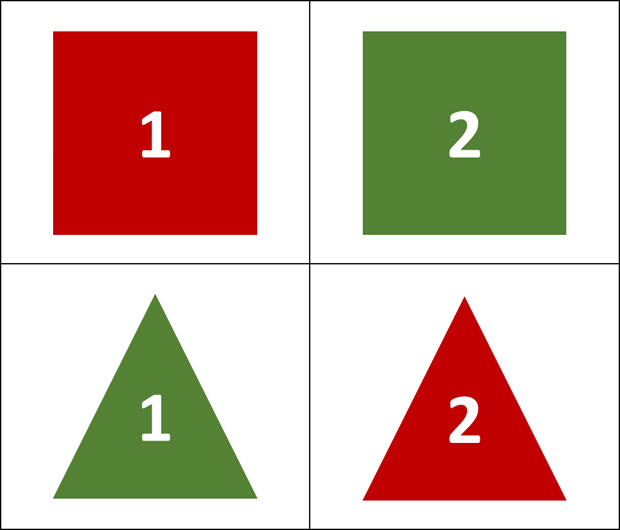
So what is my perspective? Rather than a paradox, it is more a problem of vaguity or ambiguity and how we’re defining sameness. There are many dimensions to similarity. I can present you a red square, a green square, a blue triangle, and a green triangle and play the Sesame Street ‘one of these things is not like the other game.
Is the sameness the colour, the shape, or the number? Could one be comparing area or perimeter?
So, I’ve gone off the reservation. I don’t put a lot of weight in notion of identity. It has evolutionary merit and is an effect of humans’ nature (as it were) to categorise and taxonomise.
* This Chief Chump charge may be unwarranted or even understated, as I don’t know this bloke. ** This is the same Hobbes with the ‘solitary, poor, nasty, brutish, and short’ claim to fame.






 Philosophics