
There is a vulgar little myth still circulating among the managerial classes that capitalism, for all its blemishes, is at least good at ‘unlocking human potential’. It is not. It is very good at monetising human potential, disciplining it, redirecting it, and, where necessary, grinding it into forms useful to administration and exchange. This is not quite the same thing.
One of capitalism’s less discussed achievements is its ability to rob society not merely of comfort, leisure, health, and life, but of minds. Not always by censorship. Not always by prison or direct prohibition. More often by something duller and therefore more effective: fatigue, schedules, rent, invoices, commuting, institutional obedience, and the constant low-grade humiliation of having to sell the best hours of one’s life in order to remain housed and fed.
Franz Kafka is the obvious mascot for this arrangement, which is precisely why he matters. He worked in insurance. The office consumed the day; the writing had to happen in the ruins of the night. His bureaucratic life helped furnish the atmosphere of his fiction, certainly. Human beings do enjoy confusing damage with justification. But the point is not that the office was somehow good for Kafka because it gave him material. A prison may furnish one with subject matter, too. That does not make incarceration a residency programme. Kafka’s employment constrained the very work for which he is remembered. The miracle is not the arrangement. The miracle is that anything survived it. And Kafka was not unusual in kind. He was merely famous enough to make the violence legible.
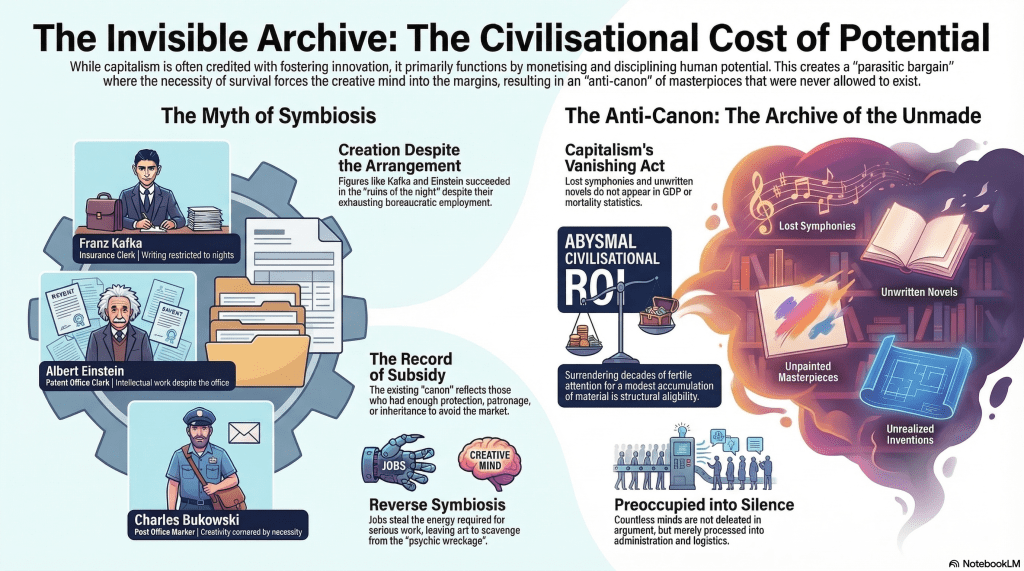
Capitalism’s defenders like to point to the artists and thinkers who produced great work while employed, underpaid, exhausted, or cornered by necessity. Fine. Let us grant them their exhibit. Bukowski had the post office. Pessoa had commercial correspondence. Einstein had the patent office. One can add a hundred more names with minimal effort and maximal melancholy. Yet this proves the opposite of what the defenders want it to prove. It shows that some people managed to create despite the arrangement, not because of it.
This is the first confusion worth clearing away. There is no symbiosis here. At best, there is a kind of reverse symbiosis, a parasitic bargain. The job steals the time and energy required for serious work, while art scavenges from the psychic wreckage whatever it can still use. The worker is depleted; the artwork is composed from depletion. Critics then arrive later, pince-nez trembling, to tell us how fruitful this tension was. Fruitful for whom? Certainly not for the unwritten books, the undeveloped theories, the unfinished scores, or the painter dead too early to become collectible.
That, in fact, is the real question. Not which celebrated figures managed to drag a masterpiece out of economic adversity, but which works never appeared at all.
We are asked, constantly, to admire the canon. We are less often asked to consider the anti-canon: the archive of the unmade. The novel that never got written because its author spent thirty years in clerical work. The philosophy never developed because its possible author was too busy meeting payroll. The music that belonged to a particular age, a particular voice, a particular historical moment, could not simply be written forty years later by a different self under improved circumstances.
This is one of capitalism’s cleverest vanishing acts. It leaves behind no body when it kills a possibility. The unwritten book does not appear in mortality statistics. The lost symphony produces no coroner’s report. The poem abandoned in favour of stable employment is not entered into the national accounts as a dead thing. GDP ticks on, cheerful and imbecilic, while whole modes of life are silently foreclosed.
Some will object that artists have always depended on subsidy. Quite right. That objection destroys rather more than it saves. Van Gogh depended on Theo. Marx depended for years on Engels. Tchaikovsky had patronage. Virginia Woolf, unlike millions of women before her, had both money and a room of her own, and had the clarity to state the matter plainly. The lesson is not that genius floats free of material conditions. The lesson is the reverse: culture has always depended heavily on someone, somewhere, being shielded from the full stupidity of economic necessity.
This means the canon is not a clean record of merit. It is also a record of subsidy, exemption, accident, family money, patrons, tolerant spouses, sinecures, inherited cushion, and occasional institutional slack. In short, it is partly a record of who had enough protection from the market to do something other than kneel before it. The rest, meanwhile, are told a moral fable about hard work.
This is where the sentimental cliché about the ‘starving artist’ should be discarded with force. There is nothing noble about preventable exhaustion. There is nothing spiritually elevating about watching one’s better projects dry out from lack of time. There is certainly nothing socially rational about a civilisation organised in such a way that its most reflective, gifted, or aesthetically sensitive members must defer their work until retirement, ill health, or redundancy grants them a little stolen air.
One might respond that practical life gives artists experience. True enough. So does grief. So does war. So does prison. Experience is not the issue. The issue is the conversion rate. If one must surrender decades of one’s most fertile attention in exchange for a modest accumulation of usable material, the return is abysmal. The economist might call this poor ROI. The philosopher might call it structural stupidity. The artist, if still awake, may call it theft. And the theft is not merely personal. It is civilisational.
A society that forces most of its creative and intellectual life into the margins should not flatter itself for the masterpieces that occasionally emerge. It should be haunted by the scale of what never did. For every Kafka who wrote at night, how many did not? For every theorist supported by patronage or inheritance, how many more were processed into middle management, consultancy, administration, compliance, sales, logistics, and the thousand dead dialects of modern necessity? How many minds were not defeated in argument, but merely preoccupied into silence?
The answer, of course, is unknowable. Which is convenient for the system because what cannot be counted can be dismissed, and what can be dismissed can be repeated indefinitely.
Capitalism’s admirers are fond of innovation. They should spend less time praising the gadgets that reached market and more time mourning the consciousness that never reached form. Not every loss is a corpse. Some losses are libraries that never came into being. Some are paintings that remained latent in the hands of the overworked. Some are ideas that would have altered the climate of a discipline had their author not been busy earning a living.
The old accusation that capitalism exploits labour is true enough, but it is no longer adequate. It exploits labour, yes. It also colonises attention, cannibalises vocation, and narrows the range of what a culture is permitted to become. It does not merely take from workers. It takes from history. And then it calls the remainder efficiency.

 Philosophics