Announcement: Legibility GPT

2–3 minutes

I’ve just published a new GPT in support of my new ontology, grammar, and legibility project, Legibility GPT.

As with Languange Insufficiency GPT and MEOW GPT, it is meant to assist in the exploration of the concepts for which they were built and named. For an interesting time, analyse a concept through all three.

Simply put, Legibility GPT assesses conceptual thickness, based on the work of Bernard Williams in Ethics and the Limits of Philosophy. Thin concepts, whether containing moral content or description, carry commensurable information, so disagreement remediation may be attained. For thick moral concepts, this becomes increasingly unlikely because the moral content becomes an anchor. Generally speaking, the conflicting ontological positions either weigh the concept differently or, in extreme cases, one side doesn’t even categorise the concept as principally moral. I use legibility in the sense articulated by James C Scott in Seeing Like a State: How Certain Schemes to Improve the Human Condition Have Failed.

Audio: NotebookLM concept summary podcast.

A cartographic tool for conceptual conflict. Legibility GPT analyses how ontology and grammar shape the meaning of contested terms, identifying points of admissibility, exclusion, and incommensurability. It maps disagreement without taking sides. 

Usage: Input a term or concept. This GPT will output the various polysemous contexts of the concept and break out the various ontological commitments and grammatical functions with examples of valid and invalid phrases within that grammar.

This GPT will also score and sort on incommensurability. A particularly divisive concept might be abortion.

Related Papers:

Grammatical Failure: Why Liberal Epistemology Cannot Diagnose Indoctrination

Language As Interface: Underconstraint, Genealogy, and Moral Incommensurability

Analyses English terms and short concept phrases using the Language Insufficiency Hypothesis (LIH), diagnosing semantic stability, polysemy, connotation, and category drift in contemporary usage.

Related Papers:

A Language Insufficiency Hypothesis: Mapping the Boundaries of Linguistic Expression

A structured analysis tool that maps any given concept onto the MEOW mediation framework (T0–T3). Produces a consistent, tiered breakdown including scope checks, applicability flags, and limits of interpretation.

Related Papers:

The Mediated Encounter Ontology of the World: A Relational Metaphysics Beyond Mind and World

Ontologically Speaking

1–2 minutes

This will be a shorter post than most. I want to continue sharing my thoughts and summaries of A Language Insufficiency Hypothesis, but I’m exploring new territories that help to consolidate the ideas of LIH and MEOW, the Mediated Encounter Ontology, and the Language as Interface approach of Ev Fedorenko.

My expanded direction has roots in the works of George Lakoff, Jonathan Haidt, Kurt Gray, and Joshua Greene. These people circle around the problem, even identify it, but then summarily ignore it.

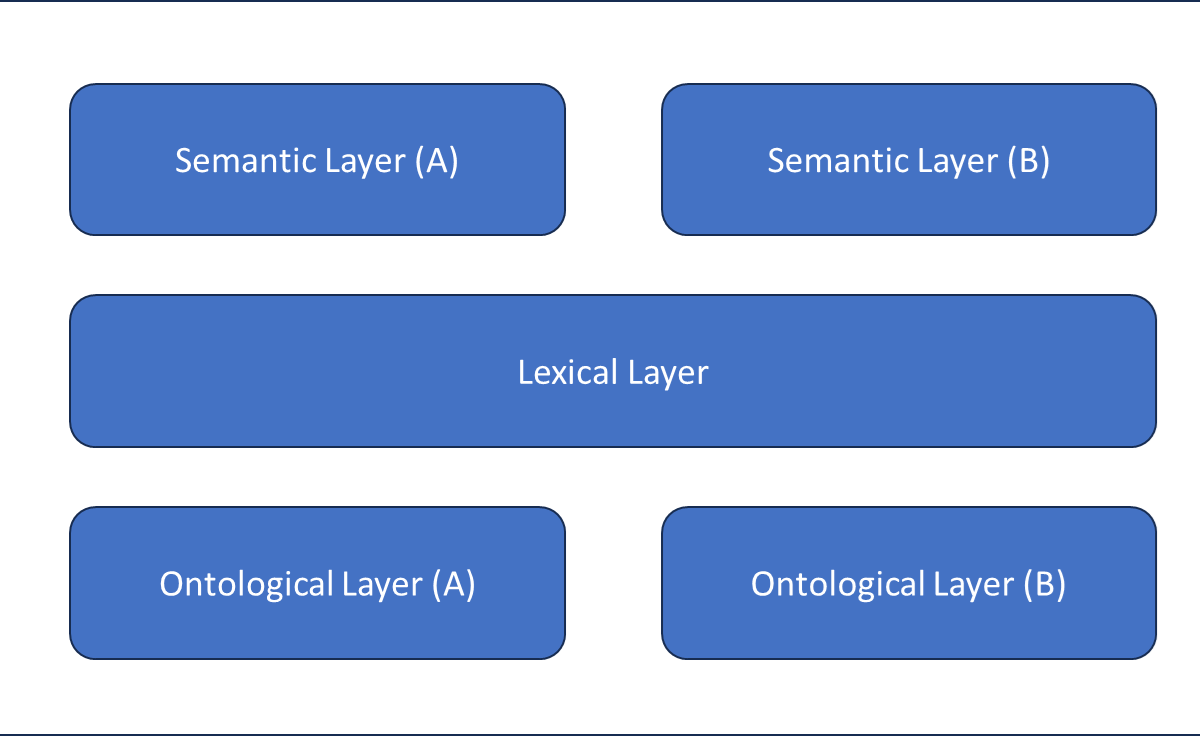
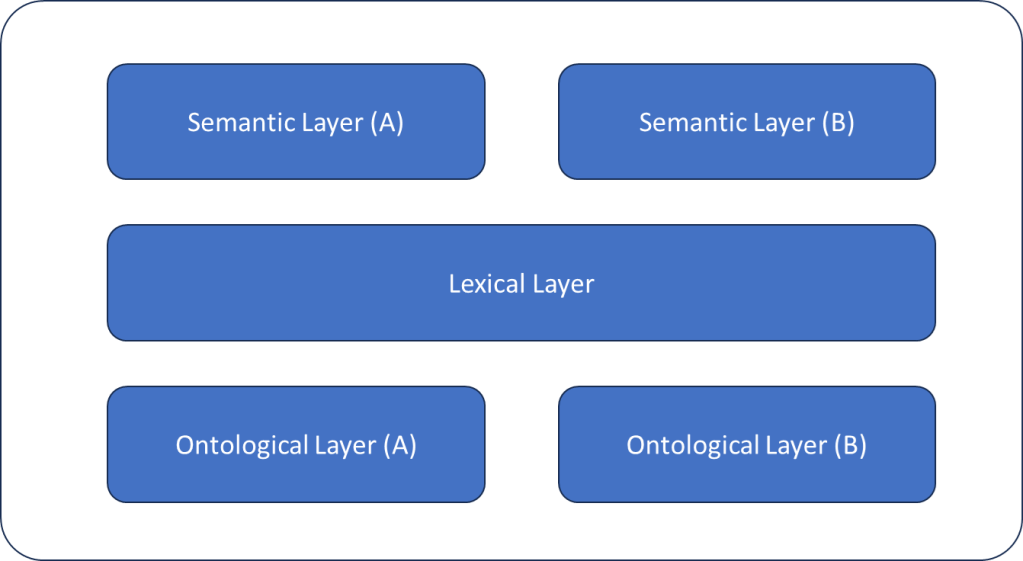
Image: This figure illustrates a simplified layered model of moral and political disagreement. Agents share a common lexical layer, enabling communication and the appearance of mutual understanding. Beneath this surface, however, ontological orientations diverge, structuring salience, legitimacy, and relevance prior to articulation. Semantic interpretation emerges downstream of these ontological commitments, producing divergent meanings despite shared vocabulary. The model highlights why disputes persist even under conditions of factual agreement and linguistic overlap: the instability lies not in words themselves, but in the ontological substrates from which semantic projections are drawn.

It’s more involved than this, but at a 50,000-foot level, it conveys the essence of my hypothesis.

I am also working on this logical expression:

where,

Also, in a particular context:

This will all make more sense in time. I’ll be publishing a manuscript as I study supporting research and develop my own perspectives.