Before I was a Nihilist

For years—decades even—I identified as an Existentialist, and I still have an affinity for some of the works of Sartre, Beauvoir, and Camus. I had read some Richard Wright. I never read Kierkegaard directly, and I may never. And of course, there’s proto-Existentialist Nietzsche. I’ve encountered to various degrees Heidegger, Merleau-Ponty, and Jaspers but not deeply.

The draw for me is that we create our own existences, but I came to feel this was at odds with Structuralism. Per my previous post, I don’t have much faith in the Agency seemingly required by Existentialism.

In Statistical analysis of variance (ANOVA), there is a notion known as degrees of freedom. This is how I view Agency. Per my Testudineous Agency post, after we account for genetics and environment, how much agency effectively remains? This is the degree of freedom. Under hard determinism, degrees of freedom are zero.

What else can we strip away after genetics, epigenetics, indoctrination, environment, and other mimetic and learned behaviours? And what remains after we do?

Agency Be Damned

I don’t believe that humans have the agency presumed they have, so I’d like to set out to prove it—at least rhetorically. In the ages-old battle between free will and determinism, I’ve tended to lean toward the determinism camp, but there is something keeping me from gaining full membership. I feel that proving hard determinism may be too hard a nut to crack, so I am aiming at just the agency aspect.

There are two major themes in my thinking.

  1. Humans have no material agency
  2. Power structures require the presumption of agency

Although this concept has been rattling around my brain cage for a while and I still have a ways to go, I feel it will be helpful to sketch out my ideas. I feel inspired by people like Robert Sapolsky and Daniel Dennett. And I feel I can draw insights into counter-arguments from people like Jonathan Haidt, Joshua Greene, and even Steven Pinker. I feel that my experience in behavioural economics may be useful for additional context—people like Daniel Kahneman, Richard Thaler, and Dan Ariely. But I feel disheartened when it appears that Galen Strawson and his father before him, Peter Strawson, people much more connected and elevated in the field have been treading the same territory for decades — over half a century — ahead of me, thankfully beating a path but not necessarily making much headway. Perhaps I can build upon that foundation if not substantially at least perceptibly. Of course, the seminal work by Isaiah Berlin’s Two Concepts of Liberty.

We may act as we will, but we cannot will as we will.

Arthur Schopenhauer

Besides the aforementioned, a correspondent has suggested other source references. He shares: Physics, including quantum mechanics, is fully Lagrangian. According to Stanford’s Leonard Susskind, Lagrange derived his formalism from the principle of ‘Least Action’. Jean Buridan’s principle of ‘Equipoise’ renders a Lagrangian model of the world perfectly deterministic. So, the physical domain is not probabilistic; and all indeterminacy is actually epistemic indeterminability. He also suggets Thomas Hobbes’ “De Corpore”.

About my second point, my corresponent agrees:

I think your “meta” is right. We feel that we are “free agents”, and we don’t know to what to attribute our feeling that we freely choose; so we imagine that we have “free will”. In my view it also doesn’t exist – we really are, as Sapolsky describes, zombie robots – we just don’t (and cannot) know it. Free will is thus a mere (but compelling) illusion on both individual and emergent scales. And yes again: all of morality, jurisprudence, etc., depends on it.

Unattributed Correspondant

My correspondent is a professional philosopher who shall remain anonymous until such time as he agrees, if ever, to make his identity known. I am quiet aware that some of my ideas are contentious and polemic. Not everyone wishes to be mired in controversy.

Humans Have No Material Agency

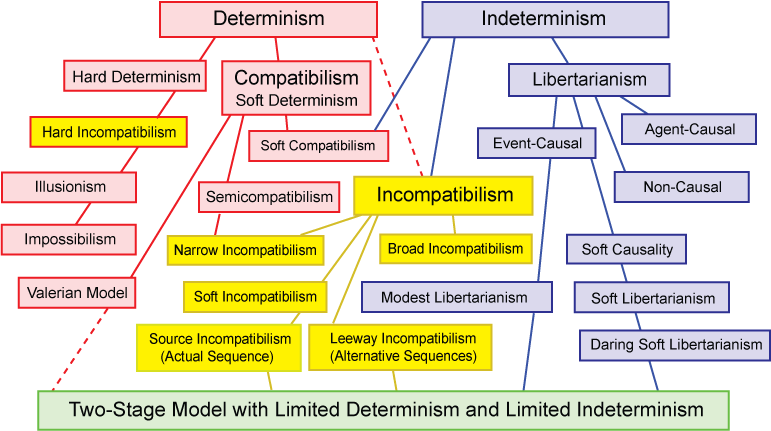
Humans have little to no agency. This is the point I am making in my Testudineous Agency post. From what I know until now, this likely qualifies as soft determinism, but this might shift as I acquire new nomenclature and taxonomic distinction. I’ve discovered this taxonomy of free will positions, though I am not well enough versed to comment on its accuracy or completeness. For now, it seems like a decent working model to serve as a starting point, but I am fully cognizant of possible Dunning-Kruger factors.

A Taxonomy of Free Will Positions

In essence, hard determinism says that the world is not probabilistic. Some event triggered the universe as we know it, and it will unfold according to the laws of physics whether or not we understand them. A weaker form, soft determinism, allows for some probability and trivial ‘agency’. I feel that Dennett supports soft determinism. I feel that because we, as ‘individuals’, are a confluence of multitudinous factors, we have little agency (interpreted as responsibility). More on this later.

Power structures require the presumption of agency

To be honest, the free will debate is only interesting to me in context. To me the context is power. The ‘meta’ of this is that society (and human ‘nature’) seem to need this accountability and culpability, but it doesn’t actually exist, so it is created as a social construct and enforced in a Foucauldian power relationship through government through jurisprudence mechanisms.

This is the part of the debate I haven’t heard much about. Sapolsky did write in Behave, chapter 20X, that criminal justice systems need to be reformed to account for diminished agency, and I’ll need to return to that to better comprehend his position and assertion.

The rest of the story

As a handy reference, these are the authors and books I’ve encountered to date and in no particular order:

Then there I those I have yet to read:

I’ve got a lot of essays and lecture notes not referenced plus general content from Reddit, Medium and other blogs sources, YouTube, podcasts, and so on. I probably should have documented some Classical philosophers, but I don’t generally find their argumentation compelling, though I might add them later.

The aim of this post is just to capture my intent—if it is indeed my intent. Oh, the questions and implications of a lack of agency. Please stand by.

Intuition and Reason

I’ve been cycling through The Righteous Mind and Moral Tribes, respectively by Jonathan Haidt and Joshua Greene. These blokes are social psychologists and moral philosophers. I started each of these books with the conception that I would neither like nor agree with the content. As for like, I suppose that’s a silly preconception better captured by whether or not I agree; that with which I don’t agree, I don’t like.

This said, I like the style of both of the authors, and I am finding the material to be less contentious than I first thought. I can already envisage myself agreeing with much of the substance but waiting to disagree with the conclusions.

Although I committed myself to document The Righteous Mind in situ, I am finding that I am listening to the audiobook whilst driving and so getting ahead of myself, so I’ll have to rewind and retread in order to do this. In fact, the reason I switched back to Greene’s Moral Tribes is so I wouldn’t progress even further in Haidt’s work.

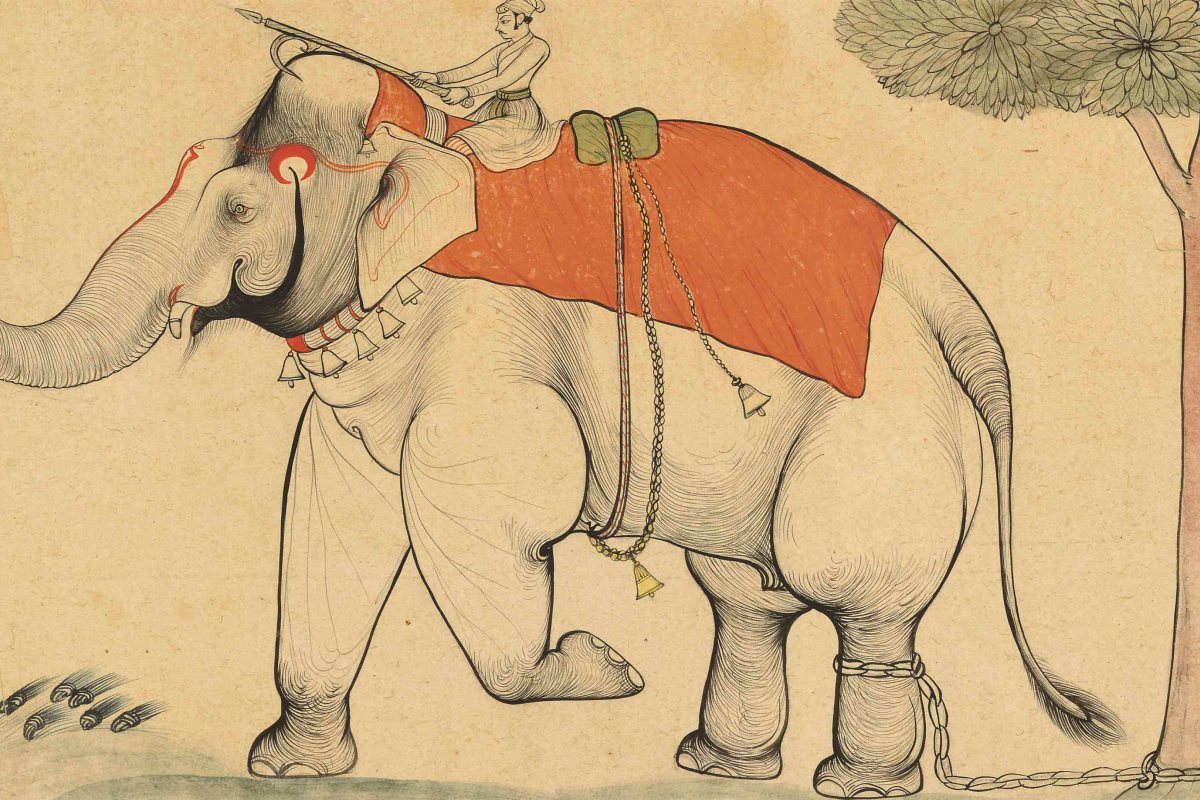
I am writing this post to acknowledge this. I’d also like to document that I don’t believe that humans are good reasoners, a situation both Haidt and Greene cite to be generally true. Humans are post hoc rationalisers, which is to say that they make up their minds and then create a narrative to justify that position. Haidt uses an analogy of an elephant and a rider, and he asserts that humans might more accurately be described as groupish than selfish. Certainly not shellfish. Greene notes that people have been shown to concede self-interest to political party interest, which helps to explain how people continually and predictably vote against their own self-interests. This also supports my position that democracy is a horrible form of government. Of course, Haidt would argue that this proves his point that people tend to adopt facts that support their perspective and diminish or disregard those that don’t.

it doesn’t follow that intuition is (1) better, (2) significantly better, or (3) good enough for (a) long term viability or (b) grasping complexity.

Haidt suggests that reason is overvalued, but then he proposes intuition as a better alternative. I agree with him that reason is overvalued and for the same reasons (no pun intended) that he does. But it doesn’t follow that intuition is (1) better, (2) significantly better, or (3) good enough for (a) long term viability or (b) grasping complexity.

Whilst I am not immune to this any more than someone else. I recall Kahneman writing in Thinking Fast and Slow that even though he is well aware of cognitive biases and fallacies, he himself can’t escape them either. When I used to teach undergraduate economics, I’d give some sort of policy assignment. As a preamble, I’d instruct the students that without exception, all policy decisions have pros and cons. In their submissions, they’d need to gather both supporting and detracting arguments and then articulate why one should be adopted over another. Minimally, I’d expect at least three pros and cons.

The students would almost invariably complain about how difficult it was to imagine a counter-position. Even when they’d include some, they were usually weak tea fodder. Oftentimes, the students already shared the same perspective, so they couldn’t usually even get the opposing side until we debriefed after the assignments had been graded. Although I do recall instances where students would admit that they hadn’t considered this or that opposing view, I can’t recall a case where a position was flipped after hearing new evidence—not that this was my intention. People do engage in escalating commitment, doubling down on existing beliefs and generating defensive—sometimes tortuous—arguments to support their positions.

Testudineous Agency

In chapter 71, Ultimate Responsibility, in Intuition Pumps and Other Tools for Thinking, author and philosopher, Daniel Dennett presents a counterargument to the notion that an agent, a person, is not absolutely responsible for their actions. He questions some premises in the ‘the way you are’ line of argumentation, but I question some of his questions.

Here is a nice clear version of what some thinkers take to be the decisive argument. It is due in this form to the philosopher Galen Strawson (2010):
1. You do what you do, in any given situation, because of the way you are.
2. So in order to be ultimately responsible for what you do, you have to be ultimately responsible for the way you are—at least in certain crucial mental respects.
3. But you cannot be ultimately responsible for the way you are in any respect at all.
4. So you cannot be ultimately responsible for what you do.

Dennett, Daniel C.. Intuition Pumps And Other Tools for Thinking (p. 395). W. W. Norton & Company. Kindle Edition.

Dennett continues.

The first premise is undeniable: “the way you are” is meant to include your total state at the time, however you got into it. Whatever state it is, your action flows from it non-miraculously.

Dennett and I are in agreement with Strawson. There is not much to see here. It’s akin to saying the now is the result of all past events until now. This is “the way you are”.

The second premise observes that you couldn’t be “ultimately” responsible for what you do unless you were “ultimately” responsible for getting yourself into that state—at least in some regards.

This second premise asserts that one cannot be responsible for any action that one had no part in performing. Two scenarios come immediately to mind.

First, you are not responsible for being born. As Heidegger notes, we are all thrown into this world. We have no say in when or where—what country or family—or what circumstances.

Second, if one is hypnotised or otherwise incapacitated, and then involved in a crime, one is merely a cog and not an agent, so not responsible in any material sense.

But according to step (3) this is impossible.

Whilst Dennett fixates on the absolute aspect of the assertion, I’d like to be more charitable and suggest that we still end up with a sorites paradox. Dennett will return to this one, and so shall I.

So step (4), the conclusion, does seem to follow logically. Several thinkers have found this argument decisive and important. But is it really?

As Dennett invalidates step (3), he insists that the conclusion is also invalid. He asserts that the notion of absolute responsibility is a red herring, and I argue that Dennett doesn’t get us much further, perhaps redirecting us with a pink herring.

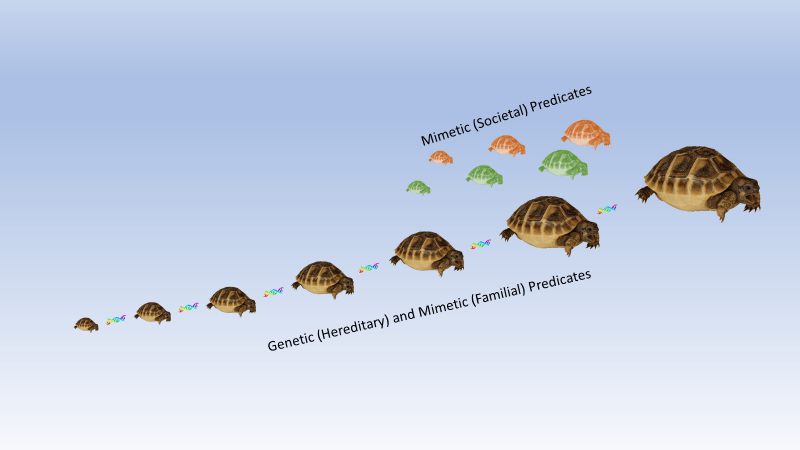
I’ve created an image with tortoises to make my point. There are actually two points I wish to make. The first point is to determine where the responsibility is inherited. This point is meant to articulate that the world can not be strictly deterministic and yet one can still not have significant agency. The second point is that culpability is asserted as a need, and acceptance of this assertion is the problem.

This image has an empty alt attribute; its file name is image-14.png
Testuditude

The image depicts an evolution of an agent, with time progressing from left to right. The tortoise on the right is a product of each of the recursive tortoises to its left. The image means to convey that each subsequent tortoise is a genetic and social and social product of each tortoise prior. Of course, this is obviously simplified, because tortoises require pairs, so feel free to imagine each precedent tortoise to represent a pair or feel free to add that level of diagrammatic complexity.

This is not meant to distinguish between nature and nurture. Instead, the claim is that one is a product of both of these. Moreover, as genetic, epigenetic, and mimetic influences are transmitted in family units, they also occur through social interaction and the environment, as represented by the orange and green tortoises.

…if one is a product of genetic and mimetic forces, how much agency remains for culpability?

The point here is that if one is a product of genetic and mimetic forces, how much agency remains for culpability? Each person is an emergent unit—autonomous, yes, and yet highly programmed.

If I programme a boobytrap to kill or maim any intruder, the boobytrap has no agency. I assert further, that the maker of that boobytrap has no more responsibility than the killing device.

The old hand grenade wired to a doorknob boobytrap trick

But who do we blame? you ask, and that’s precisely the problem. Asking questions doesn’t presume answers. This is a logical fallacy and cognitive bias. This heuristic leaves us with faulty jurisprudence systems. Humans seem hardwired, as it were, to blame. Humans need to believe in the notion of free will because they need to blame because they need to punish because vengeance is part of human nature to the extent there is human nature. There seems to be a propensity to frame everything as a causal relationship. Dennett calls this the Intentional stance. To borrow a from Dennett…

This instinctual response is the source in evolution of the invention of all the invisible elves, goblins, leprechauns, fairies, ogres, and gods that eventually evolve into God, the ultimate invisible intentional system.

Dennett, Daniel C.. Intuition Pumps And Other Tools for Thinking (p. 374). W. W. Norton & Company. Kindle Edition.
Fire Trap in Home Alone

Sins of the Fathers (and Mothers)

Let’s wrap this up with a sorites paradox. As I’ve already said, I agree with Dennett that the absolute aspect is unnecessary and undesired. The question remains how much agency™ does a person have once we account for the other factors? Is it closer to 90 per cent or 10 per cent? Apart from this, what is the threshold for culpability? Legal systems already have arbitrary (if not capricious) thresholds for this, whether mental capacity or age, which basically distils back to the realm of capacity.

I have no basis to even venture a guess, but that’s never stopped me before. I’d argue that the agency is closer to zero than to one hundred per cent of the total, and I’d propose that 70 per cent feels like a reasonable threshold.

I could have sworn I’d posted a position on this after I read Robert Sapolsky’s Behave. Perhaps it’s never made it out of drafts.

In closing, I don’t think we need to settle the question of determinism versus free will to recognise that even without strict determinism, personal agency is still severely limited, and yet as our political systems presume a level of rationality that is not apparent, so do legal systems presume a level of agency not present.

Righteous Mind

Preamble

All too often, I’ll read or listen to a book and place bookmarks with the best of intents to revisit and comment. yet either never to return or to return and not recall the context and not wanting to reread to regain it. I am going to attempt to document my reaction to Jonathan Haidt’s book, The Righteous Mind: Why Good People are Divided by Politics and Religion. If you’ve read some posts here, you’ll understand that I am not a moralist, so I don’t expect to like the book or agree with it. I’ve already ready the forward materials, so I’ll return to comment on that before I get too far ahead. I have done this before at university, and it is decidedly slow progress and can chase one down rabbit holes—this one, anyway.

I have a habit of abandoning books in favour of others including dropping them outright. This is one of 16 I have in progress at the moment, some commenced as many as 5 years ago. To be fair to myself, many of those books are substantially completed. I feel I got the intended message—or at least got what I wanted out of them—, and I just haven’t read the final few chapters. In some cases, the book is an anthology, and I have been slogging my way through it. A few books I’ve read before and am reabsorbing the material, so I may decide not to re-read cover to cover. I just pulled a second reading book off the list to get to 16 from 17.

I have striven not to laugh at human actions, not to weep at them, not to hate them, but to
understand them.

— Baruch Spinoza, Tractatus Politicus, 1676

Introduction

“Can we all get along?” — Rodney King

“Please, we can get along here. We all can get along. I mean, we’re all stuck here for a while. Let’s try to work it out.”

Born to be Righteous

I could have titled this book The Moral Mind to convey the sense that the human mind is designed to “do” morality, just as it’s designed to do language, sexuality, music, and many other things described in popular books reporting the latest scientific findings.

Empasis mine

Straight away, I have a contention. The human mind is not designed to do anything. It has evolved and performs functions. Perhaps, this is just a matter of semantics, but it puts me on guard. Moreover, that it does morality doesn’t evaluate the relative benefit or if it should even be done. Without going down the aforementioned rabbit hole, language is a perfect example. We use language to communicate, but language as a social mechanism may be a secondary or tertiary function. As I’ve argued—even quite recently—, this is a reason I feel that language is insufficient for the purpose of conveying abstract concepts, like for example, morals and morality.

But I chose the title The Righteous Mind to convey the sense that human nature is not just intrinsically moral, it’s also intrinsically moralistic, critical, and judgmental.

A primary function of the brain is as a difference engine. This is what allows us to discern friend from foe, edible versus poison, and so on. Reflecting on Kahneman and Tversky, most (if not ostensibly all) of this is a heuristic system I process, which is good enough but only at a distance. Morals allow us to create in-group and out-group distinctions.

I want to show you that an obsession with righteousness (leading inevitably to self-righteousness) is the normal human condition. It is a feature of our evolutionary design, not a bug or error that crept into minds that would otherwise be objective and rational.

To my first point—not only his insistence on a design metaphor, but doubling down and declaring it as not a bug or an error—, this is disconcerting. And it may be a normal human condition, but so is cancer. The appeal to nature isn’t winning me over.

Our righteous minds made it possible for human beings—but no other animals—to produce large cooperative groups, tribes, and nations without the glue of kinship.

Agreed.

What Lies Ahead

Part I is about the first principle: Intuitions come first, strategic reasoning second.

If you think that moral reasoning is something we do to figure out the truth, you’ll be constantly frustrated by how foolish, biased, and illogical people become when they disagree with you. But if you think about moral reasoning as a skill we humans evolved to further our social agendas—to justify our own actions and to defend the teams we belong to—then things will make a lot more sense.

Haidt and I are much aligned on these points.

Keep your eye on the intuitions, and don’t take people’s moral arguments at face value. They’re mostly post hoc constructions made up on the fly, crafted to advance one or more strategic objectives.

Not buying the ‘go with your intuitions‘ advice. Moving on.

…the mind is divided, like a rider on an elephant, and the rider’s job is to serve the elephant … I developed this metaphor in my last book, The Happiness Hypothesis.

I’m not sure I am going to like this dualism, and I haven’t read The Happiness Hypothesis, so I’ll just have to see where he takes it. It seems like Haidt is a hardcore Traditionalist.

Part II is about the second principle of moral psychology, which is that there’s more to morality than harm and fairness.

This feels about right.

The central metaphor of these four chapters is that the righteous mind is like a tongue with six taste receptors.

OK. Let’s see where this goes.

Part III is about the third principle: Morality binds and blinds.

I like this pair.

…human beings are 90 percent chimp and 10 percent bee.

Did he say bee? I agree with the chimp reference. Maybe this won’t be as bad as I thought.

A note on terminology: In the United States, the word liberal refers to progressive or left-wing politics, and I will use the word in this sense. But in Europe and elsewhere, the word liberal is truer to its original meaning—valuing liberty above all else, including in economic activities. When Europeans use the word liberal, they often mean something more like the American term libertarian, which cannot be placed easily on the left-right spectrum.10 Readers from outside the United States may want to swap in the words progressive or left-wing whenever I say liberal.)

Decent advice.

Why do you see the speck in your neighbor’s eye, but do not notice the log in your own eye? … You hypocrite, first take the log out of your own eye, and then you will see clearly to take the speck out of your neighbor’s eye.

— MATTHEW 7:3–5

I do find myself, probably too often, parroting this paragraph.

PART I

Intuitions Come First, Strategic Reasoning Second

Central Metaphor: The mind is divided, like a rider on an elephant, and the rider’s job is to serve the elephant.

Where Does Morality Come From?

A family’s dog was killed by a car in front of their house. They had heard that dog meat was delicious, so they cut up the dog’s body and cooked it and ate it for dinner. Nobody saw them do this.

A man goes to the supermarket once a week and buys a chicken. But before cooking the chicken, he has sexual intercourse with it. Then he cooks it and eats it.

TBD

The Origin of Morality

Quick reaction for now. Details to follow…

I’m not quite buying into Haidt’s attempt to parse the nature versus nature argument into three segments: nativism and empiricism whilst adding rationalism insomuch as rationalism is seen by many as ambiguous and not a mutually exclusive option. It feels as though he’s throwing up a rationalist strawman to take down. We’ll see where it leads

Nativism
the theory that concepts, mental capacities, and mental structures are innate rather than acquired by learning.

Empiricism
the theory that all knowledge is derived from sense-experience.

Rationalism
the theory that reason rather than experience is the foundation of certainty in knowledge.

Let’s pick up on this later. I knew this would take a lot longer.

Superinstitutional Heros

I’ve never been a comic book guy or into heroes or superheroes. In fact, I have always had a thing for the underdog. This article points out The Batman’s Privilege Problem. I’ve skimmed a few comic books and graphic novels, and I’ve seen a few movies, but I am not really steeped in this space to speak to the nuance—and there is probably a difference between comics and graphic novels, but like I said: not inters. I just don’t identify with most of it. Not the violence. Not the Truth, Justice, and the American way of legacy Superman. But I do sense a privilege problem. Defenders of the status quo. I wonder if comic book aficionados tend to be more politically Conservative.

A quick Google search, and I’m mostly correct. Evidently, Marvel authors trend toward the Right. This article ranks some figures Conservative, Centrist, and Left, although the Left feel more Liberal than Left, and they are all constitutionalists. Apparently, X-Men were born of the Civil Rights movement in America in the 1960s. Still not my bag. Where are the Anarchists? At this rate, I’d settle for a Marxist.

One last mention: this piece points out that even where there are prominent social justice issues raised in one or another comic, the subtext (or overarching meta) is Conservative. This likely creates tension in a manner of speaking, but it creates dissonance for me.

I don’t have much more to add, but the article caught my fancy. It resonated for me, and having not posted for a while, I figured what the hell.

Your Morals – Part 3 of 3

Continuing my responses to Johnathan Haidt’s Morality survey…

25. I believe the strength of a sports team comes from the loyalty of its members to each other

Who TF cares about a sports team or where their loyalty comes from, whatever that even means. And the strength of what exactly? Players move from team to team with ease, and they are obliged to win in order to advance their own interests and personal glory. Weaker players can coattail by association to their team or their league.

26. I think children should be taught to be loyal to their country

Smh. No. I think that countries should be abolished. Children should be taught how arbitrary countries are and how they divide more than they unite.

27. In a fair society, those who work hard should live with higher standards of living

Weasel words—fair, hard, work, higher, and living standards. Perhaps the answer can be found in the definitions, like divining with tea leaves.

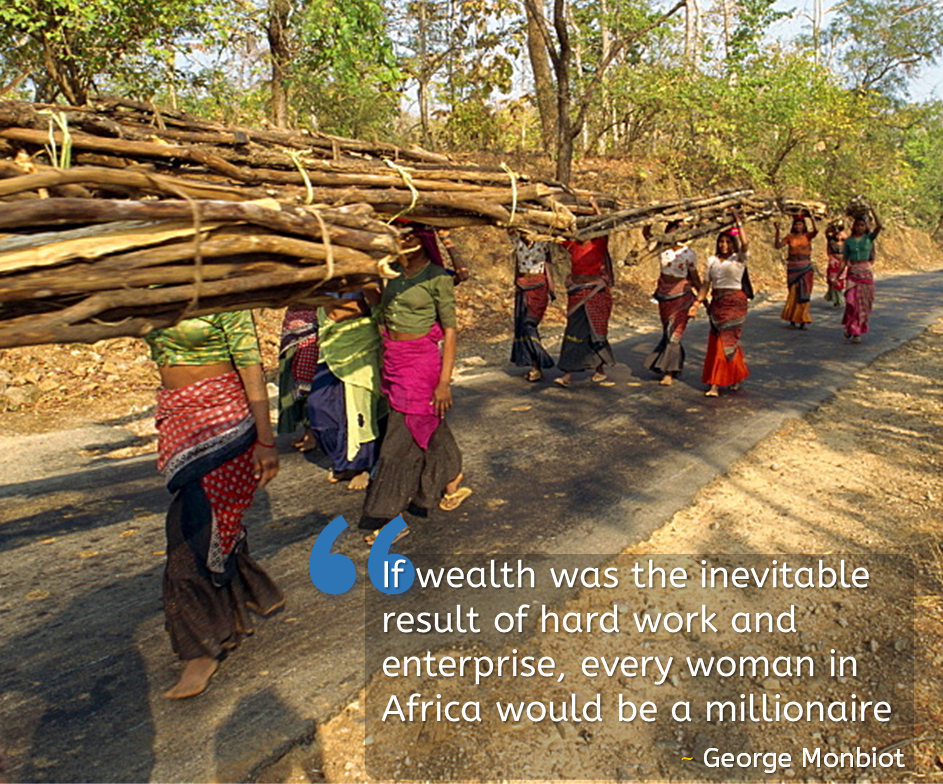
Hard Work & Enterprise

28. I believe that everyone should be given the same quantity of resources in life

What resources? A family with no children doesn’t need children’s shoes and clothing. A vegan doesn’t need a side of beef. What is this asking?

29. The world would be a better place if everyone made the same amount of money

I agree. And the amount should be zero. Didn’t I already answer this one?

30. I believe it would be ideal if everyone in society wound up with roughly the same amount of money

What is this obsession with money? I guess this is a reflection on Harvard. Get over it.

31. People should try to use natural medicines rather than chemically identical human-made ones

What? Sure. Maybe. I suppose if they are identical. Are they cheaper or free? Are they dosage- and quality-controlled? What is the function of the infinitive try to?

32. I believe chastity is an important virtue

Not more virtue. Make it stop. Chastity is defined as the state or practice of refraining from extramarital, or especially from all, sexual intercourse. This would be important why? And how would it be a virtue by any measure?

33. I think obedience to parents is an important virtue

Just why?

34. I admire people who keep their virginity until marriage

How would I know? Why would I admire them? I understand the traditional and statutory function of marriage, but this anachronistic chattel arrangement doesn’t need to exist.

35. Everyone should defend their country, if called upon

Perhaps we should abolish countries and property. What are the defending—their unique way of life? Their awesome achievements or prospects thereof? The dirt and natural resources? The buildings? Some mythos? Just no. If politicos want to fight for imaginary boundaries, let them fight it out in an old school cage match.

36. If I found out that an acquaintance had an unusual but harmless sexual fetish I would feel uneasy about them

Define harmless. Does this fetish involve me? If not, I don’t care. Might I roll my eyes? Perhaps. Might I laugh? Sure.

Summary

Having commented in some form or fashion on each of these questions, I can remain unmoral. Morality is an exercise in mental masturbation and power. As should be obvious by now, morality presumes that one subscribes to some underlying and supposed metanarratives.

In the end, reflecting upon other sources, a certain sense of what might be considered to be a moral compass may be present in infants and children, but these can be (and are) manipulated through education, books, entertainment from TV and movies to sports to civic instruction and all sorts of propaganda. So, the point that wee folk have propensities for certain behaviours is all well and good, but this feels an awful like confirmation bias in full view. Of course, it might be considered to be immoral to raise classless, less judgmental children especially if they make choices different to the leaders.

Your Morals – Part 2 of 3

Continuing my response to Johnathan Haidt’s Moral survey…

13. I believe that one of the most important values to teach children is to have respect for authority

This is a legitimate question without subtext. I happen to disagree with it, but at least it’s legit. Children should not only be taught to question authority, they should question the structure that perpetuates authority.

14. It makes me happy when people are recognized on their merits

dot dot dot … Let’s not retread in the nonsensical space that is meritocracy. Next…

15. I think people should be rewarded in proportion to what they contribute

smh … Next…

16. It upsets me when people use foul language like it is nothing

Sadly, this is another legitimate question. Language is language. If someone feels that some language is out of bounds—and this as well extends to the proponents of PC speech—then this is more a reflection of their repression than anything more. Liam Gallagher FTW

17. Our society would have fewer problems if people had the same income

Not another money-based economy question. I’ll leave it at ‘Our society would have fewer problems is people had no necessity for income’.

18. It pains me when I see someone ignoring the needs of another human being

I suppose it does, but given the ubiquity of this as well as the contrary situation, what’s one to do. On balance, this can either be a disconnected or misguided government or an apathetic person. Needs is a weasel word, but I’ll let it slide.

19. It upsets me when people have no loyalty to their country

Eyeroll, please. TF is loyalty anyway? And where’s the reciprocity? I think I’m on to something. Obviously, someone who fetishises a country has pathological issues. I’m not sure what the scale differential is between country fetishists and sports fans, but I’ll move along. Now you know what does upset me.

20. I am empathetic toward those people who have suffered in their lives

Sure. Sympathetic, perhaps even compassionate. Another vapid question. Each of these is contingent on what suffering is perceived.

21. Everyone should love their own community

Define community. Define love. Should? Is this my imposition? Everyone? What is this sorcery? Next…

22. I believe that compassion for those who are suffering is one of the most crucial virtues

Here we go with virtues again—more tripe about relative goodness and badness. Translation: I believe that being good is good. According to Google, compassion is sympathetic pity and concern for the sufferings or misfortunes of others; sympathy is feelings of pity and sorrow for someone else’s misfortune; pity is the feeling of sorrow and compassion caused by the suffering and misfortunes of others; therefore, compassion is [feelings of pity and sorrow for someone else’s misfortune] [with the feeling of sorrow and compassion caused by the suffering and misfortunes of others] and concern for the sufferings or misfortunes of others. This is some recursive word salad if I’ve even seen it.

23. We should all care for people who are in emotional pain

More shoulds and alls and care and pain with a dash of emotional.

Maybe I'm too emotional*
But your apathy is like a wound in salt
Maybe I'm too emotional
Or maybe you never cared at all
Maybe I'm too emotional
Your apathy is like a wound in salt
Maybe I'm too emotional
Or maybe you never cared at all

24. I think having a strong leader is good for society

I think that having a strong leader is good in some cases…for some members of society. As with benevolent dictators, leaders can be beneficial, if there is a common cause. Oftentimes, the common cause is a contrived narrative, leading in a direction, which may or may not resolve in a better place for some—never all, and what about the rest? This is a role of society.


* Good 4 You — Daniel Leonard Nigro / Olivia Rodrigo / Hayley Williams / Josh Farro