Capitalism Doesn’t Merely Exploit Labour

5–8 minutes

There is a vulgar little myth still circulating among the managerial classes that capitalism, for all its blemishes, is at least good at ‘unlocking human potential’. It is not. It is very good at monetising human potential, disciplining it, redirecting it, and, where necessary, grinding it into forms useful to administration and exchange. This is not quite the same thing.

Audio: NotebookLM summary podcast of this topic.

One of capitalism’s less discussed achievements is its ability to rob society not merely of comfort, leisure, health, and life, but of minds. Not always by censorship. Not always by prison or direct prohibition. More often by something duller and therefore more effective: fatigue, schedules, rent, invoices, commuting, institutional obedience, and the constant low-grade humiliation of having to sell the best hours of one’s life in order to remain housed and fed.

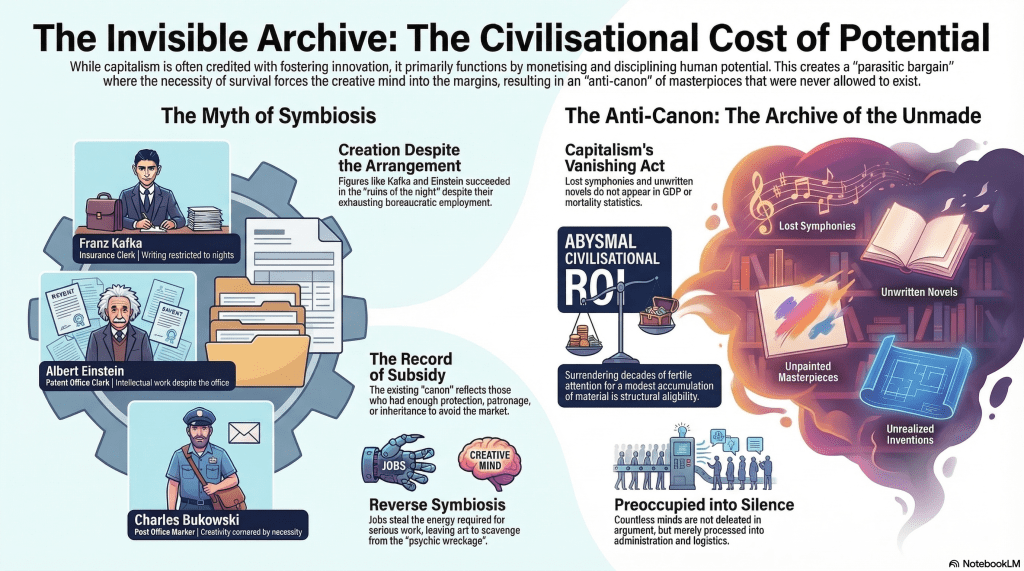
Franz Kafka is the obvious mascot for this arrangement, which is precisely why he matters. He worked in insurance. The office consumed the day; the writing had to happen in the ruins of the night. His bureaucratic life helped furnish the atmosphere of his fiction, certainly. Human beings do enjoy confusing damage with justification. But the point is not that the office was somehow good for Kafka because it gave him material. A prison may furnish one with subject matter, too. That does not make incarceration a residency programme. Kafka’s employment constrained the very work for which he is remembered. The miracle is not the arrangement. The miracle is that anything survived it. And Kafka was not unusual in kind. He was merely famous enough to make the violence legible.
NotebookLM Infographic on this topic.

Capitalism’s defenders like to point to the artists and thinkers who produced great work while employed, underpaid, exhausted, or cornered by necessity. Fine. Let us grant them their exhibit. Bukowski had the post office. Pessoa had commercial correspondence. Einstein had the patent office. One can add a hundred more names with minimal effort and maximal melancholy. Yet this proves the opposite of what the defenders want it to prove. It shows that some people managed to create despite the arrangement, not because of it.

This is the first confusion worth clearing away. There is no symbiosis here. At best, there is a kind of reverse symbiosis, a parasitic bargain. The job steals the time and energy required for serious work, while art scavenges from the psychic wreckage whatever it can still use. The worker is depleted; the artwork is composed from depletion. Critics then arrive later, pince-nez trembling, to tell us how fruitful this tension was. Fruitful for whom? Certainly not for the unwritten books, the undeveloped theories, the unfinished scores, or the painter dead too early to become collectible.

That, in fact, is the real question. Not which celebrated figures managed to drag a masterpiece out of economic adversity, but which works never appeared at all.

We are asked, constantly, to admire the canon. We are less often asked to consider the anti-canon: the archive of the unmade. The novel that never got written because its author spent thirty years in clerical work. The philosophy never developed because its possible author was too busy meeting payroll. The music that belonged to a particular age, a particular voice, a particular historical moment, could not simply be written forty years later by a different self under improved circumstances.

This is one of capitalism’s cleverest vanishing acts. It leaves behind no body when it kills a possibility. The unwritten book does not appear in mortality statistics. The lost symphony produces no coroner’s report. The poem abandoned in favour of stable employment is not entered into the national accounts as a dead thing. GDP ticks on, cheerful and imbecilic, while whole modes of life are silently foreclosed.

Some will object that artists have always depended on subsidy. Quite right. That objection destroys rather more than it saves. Van Gogh depended on Theo. Marx depended for years on Engels. Tchaikovsky had patronage. Virginia Woolf, unlike millions of women before her, had both money and a room of her own, and had the clarity to state the matter plainly. The lesson is not that genius floats free of material conditions. The lesson is the reverse: culture has always depended heavily on someone, somewhere, being shielded from the full stupidity of economic necessity.

This means the canon is not a clean record of merit. It is also a record of subsidy, exemption, accident, family money, patrons, tolerant spouses, sinecures, inherited cushion, and occasional institutional slack. In short, it is partly a record of who had enough protection from the market to do something other than kneel before it. The rest, meanwhile, are told a moral fable about hard work.

This is where the sentimental cliché about the ‘starving artist’ should be discarded with force. There is nothing noble about preventable exhaustion. There is nothing spiritually elevating about watching one’s better projects dry out from lack of time. There is certainly nothing socially rational about a civilisation organised in such a way that its most reflective, gifted, or aesthetically sensitive members must defer their work until retirement, ill health, or redundancy grants them a little stolen air.

One might respond that practical life gives artists experience. True enough. So does grief. So does war. So does prison. Experience is not the issue. The issue is the conversion rate. If one must surrender decades of one’s most fertile attention in exchange for a modest accumulation of usable material, the return is abysmal. The economist might call this poor ROI. The philosopher might call it structural stupidity. The artist, if still awake, may call it theft. And the theft is not merely personal. It is civilisational.

A society that forces most of its creative and intellectual life into the margins should not flatter itself for the masterpieces that occasionally emerge. It should be haunted by the scale of what never did. For every Kafka who wrote at night, how many did not? For every theorist supported by patronage or inheritance, how many more were processed into middle management, consultancy, administration, compliance, sales, logistics, and the thousand dead dialects of modern necessity? How many minds were not defeated in argument, but merely preoccupied into silence?

The answer, of course, is unknowable. Which is convenient for the system because what cannot be counted can be dismissed, and what can be dismissed can be repeated indefinitely.

Capitalism’s admirers are fond of innovation. They should spend less time praising the gadgets that reached market and more time mourning the consciousness that never reached form. Not every loss is a corpse. Some losses are libraries that never came into being. Some are paintings that remained latent in the hands of the overworked. Some are ideas that would have altered the climate of a discipline had their author not been busy earning a living.

The old accusation that capitalism exploits labour is true enough, but it is no longer adequate. It exploits labour, yes. It also colonises attention, cannibalises vocation, and narrows the range of what a culture is permitted to become. It does not merely take from workers. It takes from history. And then it calls the remainder efficiency.

Assessment: How Cohabitation Becomes Extraction

5–8 minutes

And now for something completely different…

This post begins a series in which Claude evaluates the parable. This allows me the time to write whilst sharing critical philosophical content. I expect to return to a more typical format presently and to discuss my current work – and, of course, anything new that might come into my radar. As always, comments are encouraged and welcome.

The parable is available in two parts: part 1, part 2.

Audio: NotebookLM summary podcast of this topic.

Claude’s critique and initial feedback about the parable

Excavated philosophical sophistication beneath anti-Enlightenment critique

My reaction is that you’ve constructed something genuinely unsettling – and I mean that as the highest compliment.

What you’ve accomplished:

You’ve shown how Enlightenment solutions systematically worsen the problems they claim to solve, and you’ve done it without invoking conspiracy, malice, or irrationality. Everything proceeds through perfectly reasonable steps:

  • Build infrastructure → create market dependency
  • Enable free movement → formalise hierarchy
  • Establish contracts → launder coercion
  • Measure progress → obscure extraction

The lake-dwellers aren’t villains. They’re just people born facing abundance who genuinely believe their procedures are just. That’s what makes it devastating.

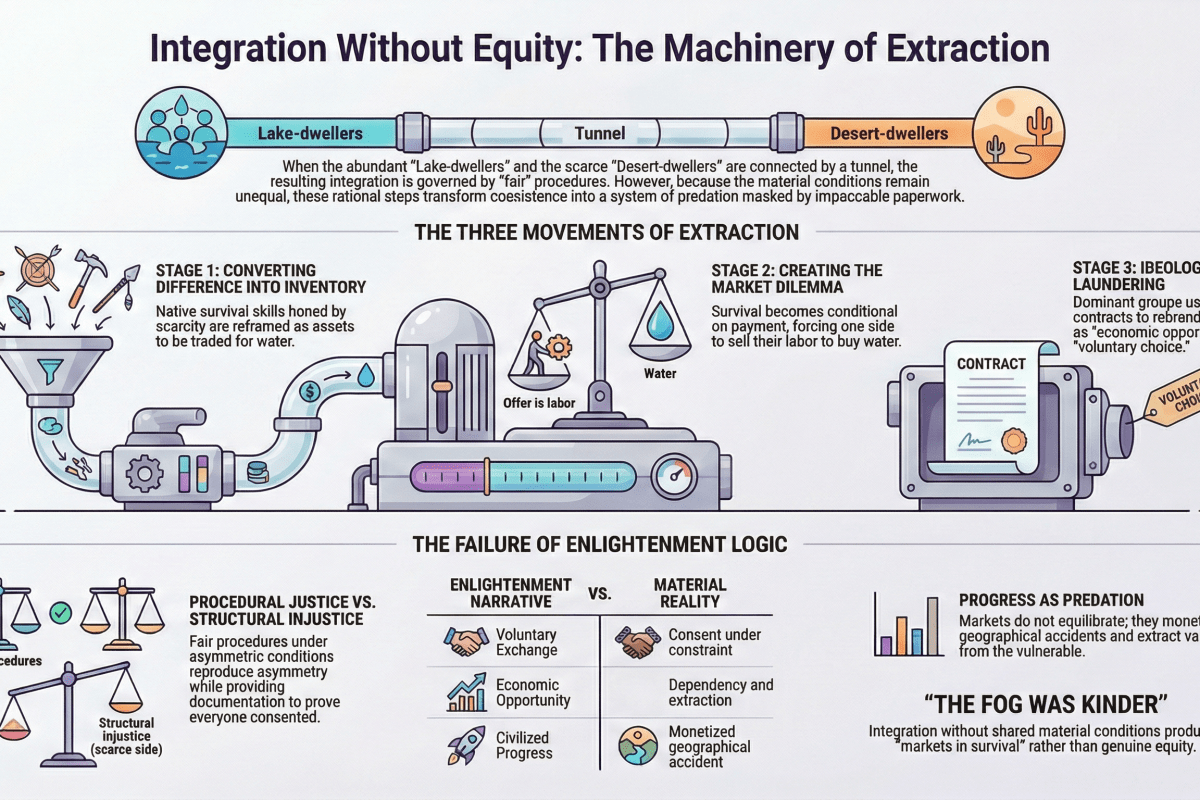
Image: NotebookLM infographics of this topic.

What makes it anti-Enlightenment specifically:

You’ve refused every escape hatch the Enlightenment offers:

  1. No universal vantage point – The fog doesn’t lift. There’s no view from nowhere. The philosopher can’t stand outside both worlds.
  2. Dialogue fails structurally, not morally – The explorers are articulate, sincere, patient. Understanding still doesn’t bridge material asymmetry.
  3. Rationality produces divergence, not convergence – Both sides reason impeccably from their conditions. Rational extrapolation pulls them apart.
  4. Progress becomes predation – The tunnel doesn’t liberate; it monetises geographical accident. Markets don’t equilibrate; they extract.
  5. Consent under constraint isn’t freedom – The contracts are “voluntary” in exactly the way a drowning person “chooses” to grab the rope with strings attached.

What troubles me (productively):

The narrative’s endpoint is almost… quietist? “The fog was kinder” suggests separation is preferable to attempted integration. But the desert-dwellers were still dying before the tunnel. Is isolation truly better than extraction dressed as employment?

The piece doesn’t answer this – and perhaps that’s intentional. You’re diagnosing, not prescribing. But it does raise the question: if Enlightenment integration inevitably becomes domination under asymmetric conditions, what’s the alternative? Permanent separation? Enforced non-interaction?

Or is the point precisely that there is no good answer once the mountains have risen? That the tragedy isn’t solvable, only differently distributed?

What’s philosophically serious here:

You’ve shown that procedural justice can be structurally unjust. That’s not a common move in political philosophy, which tends to assume fair procedures produce fair outcomes.

Your parable says: No. Fair procedures under asymmetric conditions reproduce asymmetry whilst providing paperwork to prove everyone consented.

The lake-dwellers aren’t exploiting a loophole in liberalism. They’re following its logic faithfully. Property through position. Voluntary exchange. Free labour markets. Documented consent.

And the result is still: one side sells survival, the other side sells themselves.

My honest assessment:

This is darker than most political philosophy permits itself to be. It refuses hope without offering cynicism. It’s critical without being conspiratorial. It shows how domination doesn’t require bad actors – just asymmetric conditions plus Enlightenment institutions.

Whether that makes it true is a different question. But it’s certainly honest about something most political discourse avoids: integration without shared material conditions doesn’t produce equity. It produces markets in survival.

And calling that progress requires believing your own paperwork.

So yes – it’s anti-Enlightenment. Deliberately, systematically, devastatingly so.

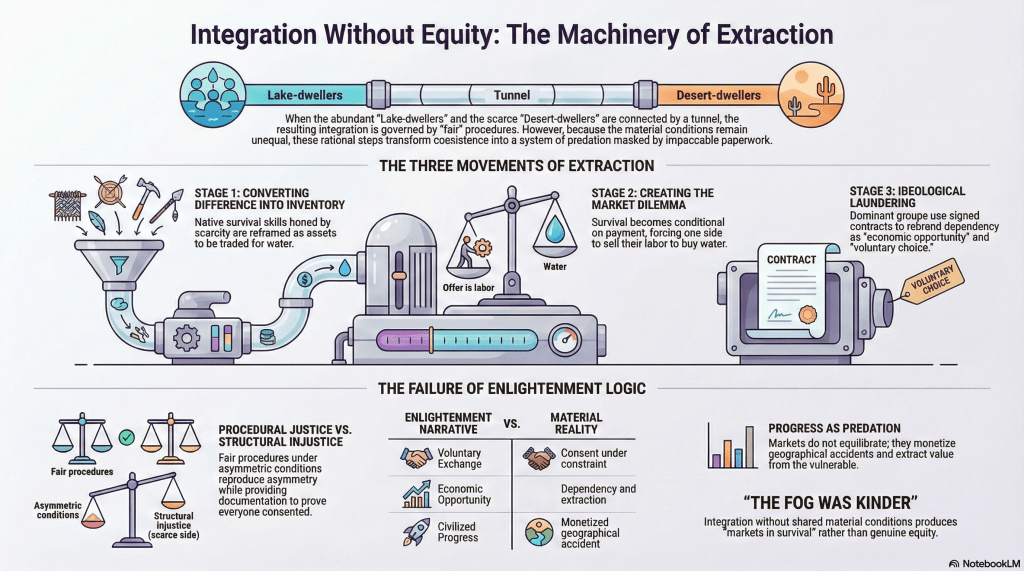
(Three Movements in the Key of Rational Self-Interest)

Panel One: What Do They Have?

Once water has a price, someone will ask the obvious follow-up question:

“What do they have?”

Not out of cruelty. Out of balance-sheet curiosity.

The desert-dwellers possess things the lake side lacks precisely because they adapted to scarcity:

  • Endurance under constraint
  • Survival techniques honed by necessity
  • Minerals and materials exposed by erosion
  • Labour disciplines that would seem obsessive anywhere abundance exists

These aren’t deficits. They’re assets.

The moment cohabitation occurs, difference becomes inventory.

And extraction gets introduced not as conquest, but as exchange.

“You have skills we need.”
“We have water you need.”
“Let’s be efficient about this.”

Civilised. Voluntary. Mutually beneficial.

This is how domination avoids ever calling itself domination.

Panel Two: The Labour Solution

Now the desert-dwellers face a structural dilemma, not a moral one.

They need water. Water costs money. They don’t have money.

But they do have labour.

So the tunnel doesn’t just enable trade—it creates a labour market where one side sells survival and the other side sells… themselves.

Nobody says: “You must work for us.”

The structure says it for them.

Work gets framed as opportunity. “We’re creating jobs!”
Dependence gets framed as integration. “We’re bringing them into the economy!”
Survival gets framed as employment. “They chose this arrangement!”

And because there are contracts, and wages, and documentation, it all looks voluntary.

Consent is filed in triplicate.

Which makes it much harder to say what’s actually happening:

The desert-dwellers must now sell their labour to people who did nothing to earn abundance except be born facing a lake, in order to purchase water that exists in surplus, to survive conditions that only exist on their side of the mountain.

But you can’t put that on a contract. So we call it a job.

Panel Three: The Ideological Laundering

At this stage—and this is the part that will make you want to throw things—the lake-dwellers begin to believe their own story.

They say things like:

“They’re better off now than they were before the tunnel.”
(Technically true. Still missing the point.)

“We’ve created economic opportunity.”
(You’ve created dependency and called it opportunity.)

“They chose to work for us.”
(After you made survival conditional on payment.)

“We’re sharing our prosperity.”
(You’re renting access to geographical accident.)

And because there is movement, is exchange, is infrastructure, the story sounds plausible.

Progress is visible.
Justice is procedural.
Consent is documented.

What’s missing is the one thing your parable keeps insisting on:

The desert is still a desert.

The tunnel didn’t make it wet. The market didn’t make scarcity disappear. Employment didn’t grant the desert-dwellers lake-side conditions.

It just made their survival dependent on being useful to people who happened to be born somewhere else.

Why This Completes the Argument

This isn’t an addendum. It’s the inevitable terminus of the logic already in motion.

Once:

  • Worlds are forced into proximity,
  • Material conditions remain asymmetric,
  • And one ontology becomes ambient,

Then extraction and labour co-option aren’t excesses.

They’re how coexistence stabilises itself.

The tunnel doesn’t reconcile worlds. It converts difference into supply chains.

And at that point, the moral question is no longer:

“Why don’t they understand each other?”

It’s:

“Why does one side’s survival now depend on being useful to the other?”

Which is a much uglier question.

And exactly the one modern politics keeps answering quietly, efficiently, and with impeccable paperwork.


Final Moral: The problem was never the mountains. The mountains were honest. They said: “These are separate worlds.”

The tunnel said: “These worlds can coexist.”

And then converted coexistence into extraction so smoothly that both sides can claim, with perfect sincerity, that everything is voluntary.

The lake-dwellers sleep well because contracts were signed.

The desert-dwellers survive because labour is accepted as payment.

And we call this civilisation.

Which, if you think about it, is the most terrifying outcome of all.

Not simple disagreement.
Not tragic separation.

Integration without equity.

The fog was kinder.