This is the part where I announce my latest book, When Language Fails. I anticipate publishing more content related to the ideas put forth presently.
Marketing Blurb
Some conflicts persist not because we refuse to listen, but because we inhabit different worlds.
Why do some arguments never resolve? Why do intelligent people talk past one another, armed with the same words but reaching incompatible conclusions?
In When Language Fails, philosopher Bry Willis argues that these impasses are not simply the result of poor reasoning or bad faith. They are structural. Building on his earlier work, A Language Insufficiency Hypothesis, Willis contends that certain concepts fail to converge because they arise from different ontological grammars—distinct, historically sedimented frameworks that shape what counts as real, coherent, and meaningful.
What appears to be irrationality is often misalignment. What feels like moral failure may be ontological divergence.
Moving beneath surface disagreement, When Language Fails explores the limits of translation between conceptual worlds. Drawing on philosophy of language, hermeneutics, and social theory, Willis challenges the assumption that clearer definitions or better arguments will always bridge divides.
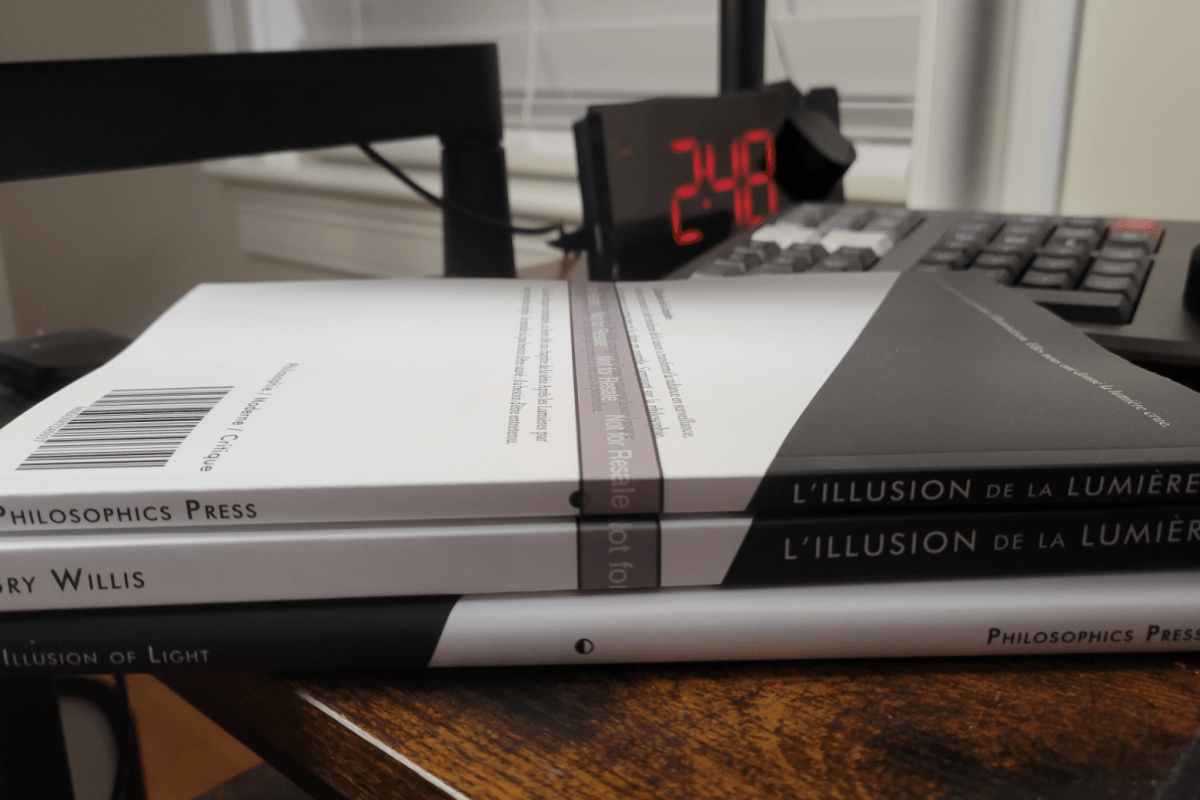
This is the proof copy of The Illusion of Light. I reviewed it, approved it, and signalled ‘good to go’. This is being printed and distributed through KDP. I’ve used them before. They’ve been reliable.
EDIT: On the upside, I’ve been notified that the hardback version is available, but it doesn’t appear to be available in France and Canada, two target regions. Hopefully, it becomes available outside of the U.S. soon.
EDIT : J’ai été informé que la version reliée est désormais disponible. Malheureusement, elle ne semble pas encore l’être en France ni au Canada, les deux régions que je visais en priorité. Espérons qu’elle franchira bientôt les frontières du système et sera distribuée ailleurs qu’aux États-Unis.
International marketplaces. It takes 3-5 business days for your hardcover to show as in stock.
Until now.
My approval triggered a workflow. I know workflows. I used to design them. I also know how dumb they can be.
KDP’s process flagged an error: the text on the spine might not be on the spine. ‘Might’. Theoretically. It could be offset, cut off, or printed on a fold. I understand their reasoning – high-speed printers, mechanical variance, and return risk. I also understand statistics, and a single observation doesn’t make a trend. But anyone with eyes can see at least a couple of millimetres of clearance at the top and bottom. This isn’t a case of ‘maybe’. It’s fine.
What fascinates me here is the ritual of compliance. Once a process is codified, it becomes self-justifying. The rule exists; therefore, it must be obeyed. There is no appeal to reason – only to the flowchart.
In the 1980s, when I was an audio engineer recording to two-inch magnetic tape, some of us liked to record hot, pushing the levels just past the recommended limits. You learned to ride the edge, to court distortion without collapse. That’s how I designed the spine text. Within tolerance. With headroom.
The problem is that modern systems don’t tolerate edges. There’s no “override” button for informed judgment. My remediation path is to shrink the type by half a point, resubmit, and pretend the machine was right.
What’s absurd is the timing. The same system that generated the proof approved this layout days ago. An automated OCR scan could have caught this phantom error earlier. Instead, the machine waits until the human signs off, then throws a flag so the process can justify its existence.
KDP is still faster and saner than IngramSpark. But this is capitalism distilled: survival by being marginally less incompetent than your competitor. Optimisation, not in the sense of best possible, but of barely better than worst acceptable.
The lesson, as always, is that processes begin as aids and end as prisons. The workflow, like the Enlightenment, believes itself rational. But the longer it runs, the less it serves the human at the console and the more it worships its own perfection.
Want to talk about meta? This underscores the contents of the book itself. What the Enlightenment once called Reason, modernity now calls Process. Both pretend to neutral objectivity while enshrining obedience as virtue. The bureaucracy of light has become digital – its catechism written in checkboxes, its priests replaced by automated validators. Every workflow promises fairness; each only codifies submission. The real danger isn’t that machines will replace judgment, but that we will stop noticing when they already have.
The Story Continues: Behind the Scenes
Image: Screenshot of Illustrator layout
I’ve reduced the font size on the spine from 14 points to 13.5. It still technically bleeds over a guideline. I hope I am not forced to reduce it to 13. A reason for text on the spine is to make it visible. Hopefully, the black-and-white vertical separation will help in this regard. Fingers crossed.




 Philosophics