I’ve been an absent owner. I’ve not been fertilising this blog as I’ve been attending to my professional blog and many other things IRL. But my brain doesn’t stop thinking, and I don’t stop reading just because my fingers stop typing contributions here. Today, I type.
No Free Will
The topic is the absence of free will debate. To be fair, I believe the notion of free will is a holdover from religious belief. And, like religion, it is used to control people and to formulate social cohesion and serve as the basis of legal systems. Free will and agency are core to any justice system. There is a system of laws. Conforming is good. Nonconformance is bad. People have agency to decide whether to conform. Relative to the system, a person is either conformant or not. Justice prevails. Nonconformance is punished, as it were. Society wins.
But let’s say there is no free will. I’m going to skip the entire argument and present this piece as a hypothetical. There is no free will. The universe is entirely deterministic. Now what?
Does anything happen? Does anyone notice?
If there is no free will, the universe already has embedded ‘code’ that will either reveal or conceal this information. If we are destined to know this, we’ll know it. If not, our future will unfold all the same.
If people have no real agency, can we punish them? Sure. We do it already. We inadvertently punish the innocent. We even punish those known to be innocent. But if history is pre-written and you are destined to be punished, the script has not only been written, but it’s already been recorded indelibly on film. We’re just waiting for the scene to come into view.
Given this, the so-called knowledge that there is no free will is useless. What’s the goalâto break the fourth wall and and liberate ourselves from the script? Wouldn’t that have already been scripted? What do you getâa director’s cut?
No Agency
What if it’s not so strict but that people don’t have agency? If people are all automatons, is it still ethical to punish them? Can rehabilitation be a goal if people are ostensibly wind-up dolls? If a person is a wind-up doll run amok, are we justified for separating them from the population at large?
I can see an argument for removing axe-wielding automatons from the public. And I’m sorry if they have no agency over their actionsâlike zombies. We all know what happens to zombiesâand unmanaged zombies.
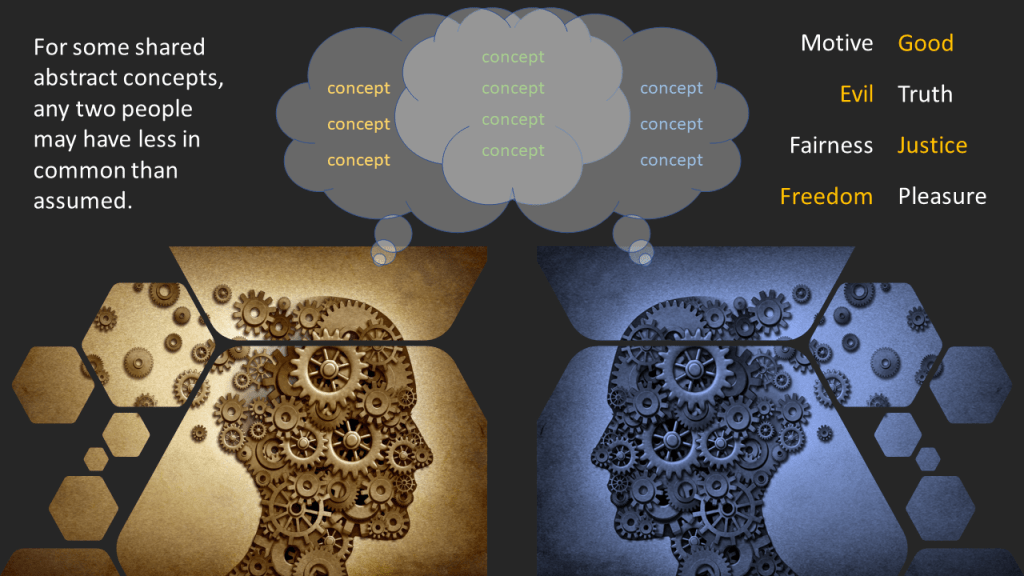
I tend to go on about weasel words and the insufficiency of language, but I tend to get a lot of resistance by people who insist the chasm isn’t as expansive as I make it out to be. This makes me wonder how one might create a test to determine how much is similar and how much doesn’t.
To summarise my position, abstract concepts of this type are specious archetypes that cannot exist in the real world: truth, justice, freedom, fairness, and so on. The common thread here is almost always that they exist in the realm of morality, another false concept.
It seems to me that one could construct a sort of word cloud intersecting with a Venn diagramme. I’d assume that more articulate people would have more descriptors, thereby creating landscape with more details and nuance for any given concept.
Additionally, I could see a third dimension which would capture diametric meanings. There is also the issue of diverse contexts, e.g. in the case of justice, we have distributive, retributive, restorative, and procedural flavours, so one would need to be taken into account.
In everyday existence, I notice that these terms are good enough and have enough substance to trick people into believing not only that it’s real but that the are operating with a shared concept. My point is that it’s more apples and oranges. We could employ dimensions that make these appear to be similar.
Approximate spheroids
Fruits
Contain fruits
Have skin
Additional scrutiny would illustrate the differences.
Colour
Taste
Consistency
This difference between this concrete case is that we can observe the objects to compare and contrast, but with abstractions, we have a sort of survivorship bias in play. We remember what we agree on and forget or diminish the parts we don’t agree on. And we don’t necessarily even know the complete inventory of descriptors of our counterparts.
The image at the top of the page is not to scale. I don’t know what the percent breakdowns are, but I wouldn’t be surprised if in a situation where there were 10 possible descriptors, that only 4 would be commonly sharedâso 40 per centâ, leaving 6 not in commonâ60 per cent.
In any case, I wonder if anyone has attempted this sort of inventory comparison. I haven’t even looked, do there could be tome upon tome published, but I don’t suppose so.
Until I recently read Lyotard’s The Postmodern Condition: A Report on Knowledge I never quite understood why Moderns accused Post-moderns of being anti-science. I’d heard Jordan Peterson complaining, and I’d read forum and blog posts with the same attacks.
As it happens, postmodernism eschews the meta-narrative or is leery of it. This includes the meta-narratives underlying science and the Enlightenment more generally. If you’ve read my posts over the years, you’ll see that this is a common complaint of mine, that everything is a human construct. Although Lyotard published The Postmodern Condition, I only read it this week.
To be fair, I sought it out. I have been attempting to find some other philosophers who have asserted that Truth (and other notions like Justice and Progress) are nothing more than the result of a rhetorical victory. And although Lyotard does not come out and say this (at least not in this book), I feel that he would not disagree with the notion. I may have to read some more of his work.
The least one can do is find the underlying narrative. Feel free to operate day to day as per usual, but be aware. The inscription at Delphi was not exactly right. There is no self to know, and narratives change, but to ‘know’ the prevailing narrative of the day seems it might at least allow one to better assess what’s happening above ground. The Matrix trope may be overplayed, but it’s a fitting metaphor for seeing what underlies. There is no Truth, but for what it’s worth, there’s another data point.
We live on the map, but the terrain is inaccessible. The postmodern doesn’t hate science or progress. We merely question the veracity. One cannot assess progress without a vector, without velocity and direction, so we contrive stories to serve as a foundation.
The founding of these stories don’t need to be sinister or nefarious. They can grow organically. But the ones who understand the rules, Wittgenstein’s language game, can wrest power, and s/he who can bend the rules through convincing rhetoric, perhaps as Locke and Rousseau, can change to course of history. But this course can be changed again. When Marx tried to change the narrative, it threatened the status quo, so they try to delegitimatise it at every turnâprimarily through the dissemination of disinformation in a sort of corrupt meme machine. Marx tried to embrace and then co-opt Capitalism, but the Capitalists were not ready to cede power. One hundred and fifty-odd years later, they still aren’t. And it might be that a different narrative is adopted before Marx’s vision is even able to take root.
I was a bit confused by Lyotard’s quip about utility being the arbiter under modern Capitalism in lieu of Truth, as I am not sure how many postmodernists embrace the notion of some objective Truth. To be clear, I don’t.
Lego Blocks
In the end, I feel it is better to deconstruct the concept of a knowable reality. The trick is not to try to reconstruct something from the pieces. It’s like deconstructing a Lego model and rebuilding a different model from the pieces whilst making the claim that this reconstitution is the true manifestation when in fact any construct is as ‘good’ as the next, but good cannot be determined until you’ve defined a context. Such is the role of the metanarrative. Once you define an end, you can then evaluate utility in light of it, but there is nothing to assess the choice of one end versus some other ends save by preference. And of course preference can be manipulated by rhetoric.
Graham Tomlin wrote a piece for Prospect, upon which I comment and whence comes the title of this post. Always the deconstructivist curmudgeon, it seems, I agree with Tomlin’s assertion that Mill was wrong, but so is Tomlin.
In a nutshell, Tomlin makes the argument that the Ancients had it right, and the Enlightenment derailed it. Tomlin wants to return to the days of yore when the artifice of character and virtue ruled the day, a time when men were men and women were women. A return to the good ole days.
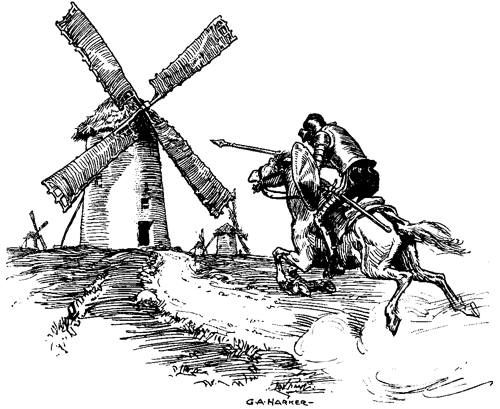
Tomlin waxes poetic, nostalgiac to a time that never was, a time that the prescription was to chase windmills of virtue and amass the currency of character. But character as currency is more unstable than Bitcoin.
Don Quixote Tilting Windmills
Is there anything more capricious than the held perception of character? Is there anything more futile than chasing the vicious cycle of virtue, always searching for that deserving true Scotsman?
Character is a term especially bandied about by political Conservatives, although Progressives tend to play the #MeToo game because it’s a game of appearances. It doesn’t matter what you do; it only matters what it looks like you do.
And even this is a game. Time and again politicians ‘slip’ (read: get caught), they apologise for the temporary lapse, and ask for forgiveness. Whether or not they keep their position, they are still forgiven and may return to their position learning their lesson (read: don’t get caught again). Let’s just dispense with the formalities.
Perception is reality
In Plato’s day, he holds out four moral virtues to pursue: courage, temperance, justice, and prudence.
Courage: the resolve to act virtuously, especially when it is most difficult
Temperance: moderation in all things; the middle path
Justice: to render every man what’s due
Prudence: application of practical wisdom
Courage seems to be caught in an infinite loop, as it essentially says to exercise temperance, justice, and prudence in the face of danger. Typically, courage is associated with heroic acts, though I fail to see the connection to rescuing a baby from a burning building with any of these other virtues. Perhaps the definition has morphed over the years. Everyone needs a hero. Only Zeus needs a Hera.
Temperance is to find the middle ground: eat but not too much; drink but not too much; rape but not too much; kill but not too much. Is there really a middle ground for all things? In traversing a canyon, shouldn’t one stay close to the edgeâor what about sidewalks? Is it temperance that led US President Donald Trump to declare that Nazis and white supremacists. are ‘some very fine people‘, or does he just lack prudence?
Justice is the constant and perpetual will to render to every man his due.
Justinian â Institutes 1.1
JusticeI’ve written about at some length so I won’t spend any additional time here.
Common sense is not so common.
Voltaire
Prudence, which advises one to use common sense, relies on a rare jewel. As Voltaire wrote, « le sens commun est fort rare ».
Perhaps I’m just too hard on people, but I find that most people are pretty dimwitted outside of some small area of focus, and I have to agree with Voltaire’s position on common sense. This is why as an economist, I find it so difficult to accept the homo economicus assertion so key for modern microeconomic theory and why behavioural economics has become a bigger deal in the past 30 years as more and more social scientists realise that people are predictably irrational.
Thanks but no thanks. There’s got to be a better way.
This is a continuation of my previous postâwith a touch of TMI…
I was divorced some time ago, and I was ‘accused’ of giving gifts to another womanâa woman a met after I was served papers for the divorce. After her attorney asked if I had ever given any gifts to anyone, the judge scoffed when I asked for a definition of gift so that I could respond honestly. The judge actually rolled her eyes and made a comment that my approach was not going to work. So without an established definition, I replied, ‘No. I never gave any gifts to anyone.’ She was fine with the response. In fact, she already had made up here mind in the same manner when a person pleading the Fifth in the US is automatically seen as having something to hide and therefore guilty of something. It’s a fanciful notion that taking the Fifth somehow eliminates the concern in question, but the entire jurisprudence system is arbitrary and virtually capriciousâdespite supposedly being a deontological endeavour. In practice, the goal of organised Law is to elevate process over justice so as to at least give the appearance that it is fair and otherwise meaningful.
Lady Justice
So, is it possible to give a gift? Is it possible to know this? Is it possible to know the intent of anything?
Gift (n): a thing given willingly to someone without payment
If gift is defined as a something given willingly and without payment, what is the scope of without payment, and what constitutes payment? Is altruism even possible? Is this possible to know? Again, can anyone know the intent of another? Can anyone truly know the intent of their own actions? Does the unconscious or past experience obviate intent?
In my case, I gave a woman someâwhat might colloquially be calledâgifts. There were no strings explicitly attached? Does this mean there were no strings attached? I had a romantic interest in this woman. Clearly, this courting game involved gift-given in return for some expected payoff at some time in the future.
What if I had given one of these gifts to a stranger on the streetâperhaps a homeless person? Would that now be a gift? What if I was in a foreign place with a nil probability of encountering this person ever again and nobody witnessed the transaction and I would never tell another soul about it? Would this be a gift?
I suppose if I had no notion of karma, whether the Eastern variety or the Western Heaven-oriented variety, and it gave me no hormonal benefits relative to dopamine, serotonin, and oxytocin, I’d buy it.
So, accuse me of being pedantic, and you’ve made my point. We only want to employ language until the point it complies with our notion of our sense of truth. But it’s nothing more than this.
Iâve been out of sorts as of late, too busy to be contributing to this blog. Abstract philosophy, as Geuss notes, is a field for the comfortably idle. Iâve been in the midst of a divorce, and itâs not that I donât think about the abstract, but my focus is pulled toward the mundane. The US court system comes to mind. Iâve already served on several juries, so I understand how pathetically that side is structured; Iâve been of the claimant/petitioner side and the defence side, and now I am a respondent. Iâve never been an attorney or barrister, nor have I been a judge, but Iâve known some of each, and itâs really a blind faith they have in the systemâas well as a paycheque (letâs be honest here)âthat keeps them going. As Upton Sinclair once noted, âIt is difficult to get a man to understand something when his salary depends upon his not understanding itâ. Between this and escalating commitment, this poor excuse for a system is going nowhere fast.
“It is difficult to get a man to understand something when his salary depends upon his not understanding it.” â Upton Sinclair
I don’t even believe there is such thing as Justice, let alone some ability to systematise it. As I mentioned in my last post, the system is constructed to prioritise consistency over outcome and favour deontology over consequentialism with just a smidgen of virtue ethics for good measure, but itâs all still just smokeâŠâŠ and mirrors. Itâs theatreâprocedure for procedureâs sake. I guess that Foucault may have been right about the Power bit, but thereâs more nuance than that.
Meantime, I am trapped in this flawed system trying to navigate between Scylla and Charybdis. If I’m not out by the end of the month, come in to rescue me.
Why should justice be the foundation of a society, and why not something else, say, honour or valour or wealth? What do we mean when we say justice? Do you mean the same thing as me? Dating myself to be sure, but would a Klingon from the Star Trek universe share your definition? So what is justice anyway?
âJustice is the constant and perpetual will to render to every man his due. Jurisprudence is the knowledge of divine and human affairs and knowledge of what is just and what is unjustâ, or so writes Justinian in Institutes 1.1Â in 533 CE.
âIustitia est constans et perpetua voluntas ius suum cuique tribuens. Iuris prudentia est divinarum atque humanarum rerum notitia, iusti atque iniusti scientia.â
This is Justinian’s answer to the question: What is justice? In his Philosophy and Real Politics, Geuss relates that âjustice is the constant and unflagging will to render to each person what is due to himâ (or perhaps âwhat he’s entitled toâ), and therein lies the rub: what exactly is one entitled to?
Geuss goes on to point out that entitlement was contingent to one’s place in society. Citizens were entitled to some things, resident aliens another, and slaves, pretty much nothing at all. In fact, giving a slave more than s/he was entitled to would be considered unjust, as it would be considered to be undeserved. As Geuss writes, âthat to treat a slave as if he or she had any entitlements would be a gross violation of the basic principles of justiceâ. Of course, you are thinking, post-Enlightenment âall men are created equalâ, or so the saying goes.
In practice, it’s been easy to sidestep the application of justice by redefining a certain group to be outside of some protected group. During the illegal aggression by the United States against Middle Eastern countries that resulted in extraordinary rendition of civilians spirited off to GuantĂĄnamo Bay, Cuba, off the coast of the United States and outside of their jurisdiction, their acting regime declared that the detainees were not people, strictly speaking, and as such were not subject to the protections afforded to people, therefore they had no access to justice.
âJustice is the first virtue of social institutions, as truth is of systems of thought.â
â John Rawls, A Theory of Justice
Hermione’s Time Turner
The ancient Greeks had a different idea of justice, so perhaps we just need to break out our trusty time turner to see what Aristotle had to say about it.
Here Aristotle rather equates the notion of justice to that of equality, but that begs the question: what equality? as we understand that equality comes in a variety of colours, so I won’t belabour the point any further here.
Instead of asking about justice, why don’t we focus on the root of the word, just? This yields the following definition:
Just: (adj)Â based on or behaving according to what is morally right and fair
This brings us into the normative domain of morality, fairness, and reason, so it’s not much to work withâbasically, we are in the realm of opinion defended by rhetoric.
For ‘all’ intents and purposes, we’ve got four forms of justice. We’ve been focused on the distributive type, but there are also procedural, restorative, and retributive varieties. In many cases, not just one form of justice is satisfying and so multiple varieties are deemed, well, just.
Distributive or economic justice is about fairness in how things are distributed, about getting a fair share.
Procedural justice is also about fairness, but it’s more about fair play, an even playing field.
Restorative justice is about compensating for an injustice, about restoring some perceived balance.
Retributive justice is about punishmentâretribution.
A problem arises when we try to quantify and measure justice. Consider distributive justice: If two people work in a field and each cultivates 50% of the crop, are each entitled to 50% of the yield? If the cultivated land was the ‘property’ of some other landowner, what portion would s/he be entitled to? All of it? Some of it? None of it?
What about the court system? Procedural justice comes into play here. Should a wealthy person have access to better attorneys than a poor person? Is this just? The poor person may argue no, but the wealthy person may argue that s/he earned the ability to pay for a better lawyer, so s/he is entitled to this benefit.
Restorative justice sounds simple at the surface. If I steal a loaf of bread, wouldn’t returning the loaf (or, at least, a similar loaf) be restorativeâno harm, no foul? Many people will argue that this is not good enough. Balance has not been restored.
This is where retributive justice comes into play. Retributive justice is a poorly veiled euphemism for vengeance. This is where Hammurabi‘s code (or Leviticus‘)  eye for an eyeâbut not Matthew‘s turn the other cheek renditionâcomes in. Let’s not get into Nietzsche’s take on forgiveness as being unjust and part of slave morality.
Keep in mind that in Hammurabi’s code, as with Roman law, justice was relative: Given eyes, (NÂș 196) âIf a man put out the eye of a nobleman (amelu), his eye shall be put outâ, yet (NÂș 198)Â âIf he puts out the eye of a freedman or breaks the bone of a freedman, he shall pay one gold minaâ.
Through all of this, we are still left wondering: just what is justice besides some vague notion constructed solely to preserve the status quo.