Subjective Perception: How Nature Proves We’re Not the Centre of the Universe

perception—My favourite unreliable narrator. We humans love to believe we’ve got nature all figured out. Venomous snakes are brightly coloured to scream “danger.” Butterflies have wings so clever they double as invisibility cloaks. Zebras blend into their herds like barcodes in a supermarket scanner. Simple, right? Evolution explained; case closed.

But then something like this tiger meme smacks you upside the head, reminding you that the animal kingdom didn’t evolve just for our benefit—or our eyes. To a deer or a boar, that glaring orange tiger we associate with breakfast cereal is practically dressed in camouflage green. What we see as flamboyant and conspicuous is, in their dichromatic world, stealth at its finest. It’s not just our story, folks. The world doesn’t revolve around us, no matter how much we try to make it so.

Audio: NotebookLM podcast discussing this topic.

And that’s the punchline here: all those neat evolutionary narratives we’ve packaged up with a bow? They’re “just-so” stories built on our limited sensory toolkit. What if the zebra’s stripes aren’t just for blending into the herd but also for confusing a lion’s depth perception? What if those venomous snakes’ colours aren’t only a warning but also a mating ad in wavelengths we’ll never see? What if we’re just projecting human logic onto a planet with millions of other perspectives—each living in its own bespoke version of reality?

The meme about the tiger is a perfect metaphor for this broader idea. It’s not just about what we see; it’s about what others—be they animals, cultures, or people—experience. The tiger isn’t orange to them. What feels blindingly obvious to one perspective might be invisible to another. It’s a simple truth with profound implications, not just for understanding nature but for navigating the world we humans have made.

Take any argument—politics, culture, morality—and you’ll find the same principle at play. Everyone’s a trichromat in their own little world, convinced they’ve got the full spectrum of truth, when in reality, they’re missing entire wavelengths. Just like the deer who doesn’t see orange, we’re all blind to what we’re not built to perceive.

So next time someone insists their worldview is the only valid one, you might want to remind them that to some creatures, even the loudest tiger is just part of the scenery. Nature didn’t evolve for human eyes alone, and neither did the truth.

Jargon, Brains, and the Struggle for Meaning

6–9 minutes

Specialised Languages: Academia’s Jargon Olympics

If you thought normal language was confusing, let’s take a moment to appreciate the true champions of linguistic obscurity: academics. Welcome to the world of specialised languages, where entire fields of study have developed their own language games that make even Wittgenstein’s head spin.

Here’s how it works: Every discipline—science, law, philosophy—creates its own jargon to describe the world. At first, it seems helpful. Instead of using vague terms, you get precise definitions for complex ideas. But what started as a way to improve communication within a field quickly turned into a linguistic arms race, where the more obscure and convoluted your terms are, the smarter you sound. You’re not just a lawyer anymore—you’re someone who’s ready to throw “res ipsa loquitur” into casual conversation to leave everyone else in the room wondering if they’ve missed a memo.

The problem? If you’re not part of the club, good luck understanding what anyone is talking about. Want to read a physics paper? Prepare to learn a whole new vocabulary. Need to get through a legal document? You’ll be knee-deep in Latin phrases before you even get to the point. And don’t even try to decipher a philosophical text unless you’re ready to battle abstract nouns that have been stretched and twisted beyond recognition.

It’s not just the words themselves that are the issue—it’s the sheer density of them. Take “justice” for example. In philosophy, you’ve got theories about distributive justice, retributive justice, restorative justice, and a hundred other variations, each with its own set of terms and conditions. And that’s before we even touch on how “justice” is defined in legal circles, where it becomes an even more tangled mess of case law and precedent. Every field is playing its own version of the “justice” game, with its own rules and definitions, and none of them are interested in comparing notes.

This is the academic world in a nutshell. Each discipline has built its own linguistic fortress, and unless you’ve spent years studying, you’re not getting in. But here’s the kicker: even within these fields, people are often misunderstanding each other. Just because two scientists are using the same words doesn’t mean they’re on the same page. Sometimes, it’s more like a game of intellectual one-upmanship—who can define the most obscure term or twist a familiar word into something completely unrecognisable?

And let’s not forget the philosophers. They’ve turned linguistic acrobatics into an art form. Good luck reading Foucault or Derrida without a dictionary (or five) on hand. You might walk away thinking you understand their points, but do you really? Or have you just memorised the jargon without actually grasping the deeper meaning? Even scholars within these fields often argue over what was really meant by a certain text—Barthes, after all, famously declared the “death of the author,” so it’s not like anyone really has the final say on meaning anyway.

So here we are, knee-deep in jargon, trying to communicate with people who, technically, speak the same language but are operating within entirely different rulesets. Every academic discipline has its own secret code, and if you don’t know it, you’re lost. Even when you do know the code, you’re still at risk of miscommunication, because the words that look familiar have been stretched and shaped to fit highly specific contexts. It’s like being fluent in one dialect of English and then suddenly being asked to write a thesis in legalese. Good luck.

In the end, academia’s specialised languages don’t just make things harder—they actively create barriers. What started as a way to improve precision has turned into an obstacle course of incomprehensible terms, where the real challenge is just figuring out what anyone’s actually saying. And let’s be honest, even if you do figure it out, there’s no guarantee it’s going to mean the same thing next time you see it.

Neurolinguistics: Even Our Brains Can’t Agree

So far, we’ve seen how language is a mess of miscommunication, cultural differences, and academic jargon. But surely, at least on a biological level, our brains are all on the same page, right? Well, not exactly. Welcome to the wonderful world of neurolinguistics, where it turns out that even the very organ responsible for language can’t get its act together.

Here’s the deal: Neurolinguistics is the study of how the brain processes language, and while it’s fascinating, it’s also a bit of a buzzkill for anyone hoping for consistency. See, your brain and my brain don’t process language in the same way. Sure, we’ve got similar hardware, but the software is wildly unpredictable. There are individual differences, cultural influences, and developmental quirks that all affect how we understand and produce language. What’s simple for one brain might be completely baffling to another.

Take, for example, something as basic as syntax. Chomsky might have told us we all have a universal grammar hard-wired into our brains, but neurolinguistics has shown that how we apply that grammar can vary significantly. Some people are wired to handle complex sentence structures with ease—think of that friend who can follow 10 different clauses in a single breath. Others? Not so much. For them, even a moderately tricky sentence feels like mental gymnastics. The brain is constantly juggling words, meanings, and structures, and some brains are better at it than others.

But the real kicker is how differently we interpret words. Remember those abstract nouns we’ve been wrestling with? Well, it turns out that your brain might be interpreting ‘freedom’ or ‘justice’ completely differently from mine – not just because of culture or upbringing, but because our brains physically process those words in different ways. Neurolinguistic studies have shown that certain regions of the brain are activated differently depending on the individual’s experience with language. In other words, your personal history with a concept can literally change how your brain lights up when you hear or say it.

And don’t even get me started on bilingual brains. If you speak more than one language, your brain is constantly toggling between two (or more) linguistic systems, which means it’s running twice the risk of misinterpretation. What a word means in one language might trigger a completely different association in another, leaving bilingual speakers in a constant state of linguistic flux. It’s like trying to run two operating systems on the same computer—things are bound to get glitchy.

But here’s the real kicker: Even within the same person, the brain can’t always process language the same way all the time. Stress, fatigue, emotional state—all of these factors can influence how well we handle language on any given day. Ever tried to have a coherent conversation when you’re tired or angry? Good luck. Your brain isn’t interested in nuance or deep philosophical ideas when it’s in survival mode. It’s just trying to get through the day without short-circuiting.

So, not only do we have to deal with the external chaos of language – miscommunication, different contexts, shifting meanings – but we also have to contend with the fact that our own brains are unreliable interpreters. You can use all the right words, follow all the right grammar rules, and still end up with a garbled mess of meaning because your brain decided to take a nap halfway through the sentence.

In the end, neurolinguistics reminds us that language isn’t just a social or cultural problem – it’’’s a biological one too. Our brains are doing their best to keep up, but they’re far from perfect. The very organ that makes language possible is also responsible for making it infinitely more complicated than it needs to be. And if we can’t rely on our own brains to process language consistently, what hope do we have of ever understanding anyone else?


Previous | Next

Testudineous Agency

In chapter 71, Ultimate Responsibility, in Intuition Pumps and Other Tools for Thinking, author and philosopher, Daniel Dennett presents a counterargument to the notion that an agent, a person, is not absolutely responsible for their actions. He questions some premises in the ‘the way you are’ line of argumentation, but I question some of his questions.

Here is a nice clear version of what some thinkers take to be the decisive argument. It is due in this form to the philosopher Galen Strawson (2010):
1. You do what you do, in any given situation, because of the way you are.
2. So in order to be ultimately responsible for what you do, you have to be ultimately responsible for the way you are—at least in certain crucial mental respects.
3. But you cannot be ultimately responsible for the way you are in any respect at all.
4. So you cannot be ultimately responsible for what you do.

Dennett, Daniel C.. Intuition Pumps And Other Tools for Thinking (p. 395). W. W. Norton & Company. Kindle Edition.

Dennett continues.

The first premise is undeniable: “the way you are” is meant to include your total state at the time, however you got into it. Whatever state it is, your action flows from it non-miraculously.

Dennett and I are in agreement with Strawson. There is not much to see here. It’s akin to saying the now is the result of all past events until now. This is “the way you are”.

The second premise observes that you couldn’t be “ultimately” responsible for what you do unless you were “ultimately” responsible for getting yourself into that state—at least in some regards.

This second premise asserts that one cannot be responsible for any action that one had no part in performing. Two scenarios come immediately to mind.

First, you are not responsible for being born. As Heidegger notes, we are all thrown into this world. We have no say in when or where—what country or family—or what circumstances.

Second, if one is hypnotised or otherwise incapacitated, and then involved in a crime, one is merely a cog and not an agent, so not responsible in any material sense.

But according to step (3) this is impossible.

Whilst Dennett fixates on the absolute aspect of the assertion, I’d like to be more charitable and suggest that we still end up with a sorites paradox. Dennett will return to this one, and so shall I.

So step (4), the conclusion, does seem to follow logically. Several thinkers have found this argument decisive and important. But is it really?

As Dennett invalidates step (3), he insists that the conclusion is also invalid. He asserts that the notion of absolute responsibility is a red herring, and I argue that Dennett doesn’t get us much further, perhaps redirecting us with a pink herring.

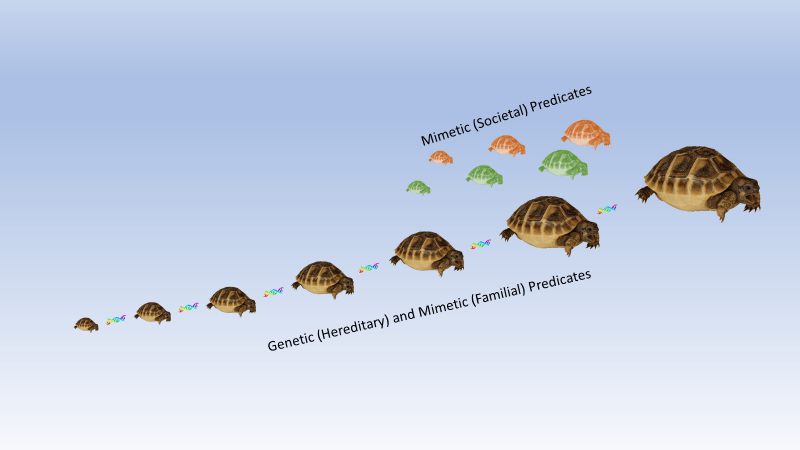
I’ve created an image with tortoises to make my point. There are actually two points I wish to make. The first point is to determine where the responsibility is inherited. This point is meant to articulate that the world can not be strictly deterministic and yet one can still not have significant agency. The second point is that culpability is asserted as a need, and acceptance of this assertion is the problem.

This image has an empty alt attribute; its file name is image-14.png
Testuditude

The image depicts an evolution of an agent, with time progressing from left to right. The tortoise on the right is a product of each of the recursive tortoises to its left. The image means to convey that each subsequent tortoise is a genetic and social and social product of each tortoise prior. Of course, this is obviously simplified, because tortoises require pairs, so feel free to imagine each precedent tortoise to represent a pair or feel free to add that level of diagrammatic complexity.

This is not meant to distinguish between nature and nurture. Instead, the claim is that one is a product of both of these. Moreover, as genetic, epigenetic, and mimetic influences are transmitted in family units, they also occur through social interaction and the environment, as represented by the orange and green tortoises.

…if one is a product of genetic and mimetic forces, how much agency remains for culpability?

The point here is that if one is a product of genetic and mimetic forces, how much agency remains for culpability? Each person is an emergent unit—autonomous, yes, and yet highly programmed.

If I programme a boobytrap to kill or maim any intruder, the boobytrap has no agency. I assert further, that the maker of that boobytrap has no more responsibility than the killing device.

The old hand grenade wired to a doorknob boobytrap trick

But who do we blame? you ask, and that’s precisely the problem. Asking questions doesn’t presume answers. This is a logical fallacy and cognitive bias. This heuristic leaves us with faulty jurisprudence systems. Humans seem hardwired, as it were, to blame. Humans need to believe in the notion of free will because they need to blame because they need to punish because vengeance is part of human nature to the extent there is human nature. There seems to be a propensity to frame everything as a causal relationship. Dennett calls this the Intentional stance. To borrow a from Dennett…

This instinctual response is the source in evolution of the invention of all the invisible elves, goblins, leprechauns, fairies, ogres, and gods that eventually evolve into God, the ultimate invisible intentional system.

Dennett, Daniel C.. Intuition Pumps And Other Tools for Thinking (p. 374). W. W. Norton & Company. Kindle Edition.
Fire Trap in Home Alone

Sins of the Fathers (and Mothers)

Let’s wrap this up with a sorites paradox. As I’ve already said, I agree with Dennett that the absolute aspect is unnecessary and undesired. The question remains how much agency™ does a person have once we account for the other factors? Is it closer to 90 per cent or 10 per cent? Apart from this, what is the threshold for culpability? Legal systems already have arbitrary (if not capricious) thresholds for this, whether mental capacity or age, which basically distils back to the realm of capacity.

I have no basis to even venture a guess, but that’s never stopped me before. I’d argue that the agency is closer to zero than to one hundred per cent of the total, and I’d propose that 70 per cent feels like a reasonable threshold.

I could have sworn I’d posted a position on this after I read Robert Sapolsky’s Behave. Perhaps it’s never made it out of drafts.

In closing, I don’t think we need to settle the question of determinism versus free will to recognise that even without strict determinism, personal agency is still severely limited, and yet as our political systems presume a level of rationality that is not apparent, so do legal systems presume a level of agency not present.

Evolutionary Morality

Listening to the Robert Wright’s audiobook, Moral Animal, it’s become even more apparent that ethics and morality are the results of a later stage of an evolutionary strategy. Not that he’s saying that.

After cognitive abilities came language and then, presumably, ethics then moral proto-structures. Subsequently, gods and God came into fashion.

That morality is the result of evolutionary progression is not particularly controversial, but sociobiologists seem to view the evolutionary development of morals as a parallel to Chomsky’s theory of innate language and universal grammar. My modification is that morality (as distinct from mores, customs, and such) necessarily requires language and cannot exist independent of language.

Given the evolutionary perspective, it is obvious that this concept will not be popular for those who do not support this base position, but it should not much of a stretch for those who do.