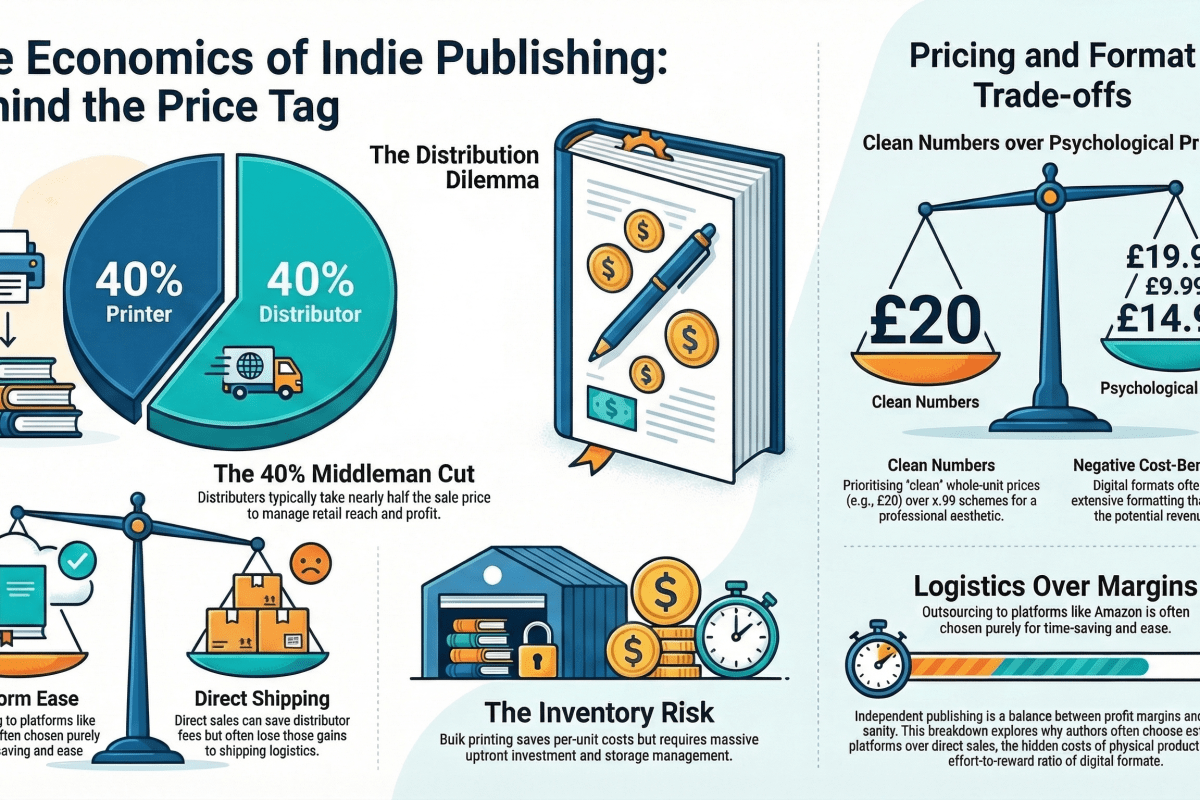
An Architecture of Encounter will be available in the next few days. I’ll make an announcement when it is, but I want to talk about pricing.
Firstly, books cost money to print. This much is obvious. Hardcovers cost more than paperbacks. The ones with dust jackets cost more still. From a financial/economics perspective, one needs to charge more for hardcovers to compensate for the costs.
Secondly, distributors take a cut. They aren’t in business without a profit interest.
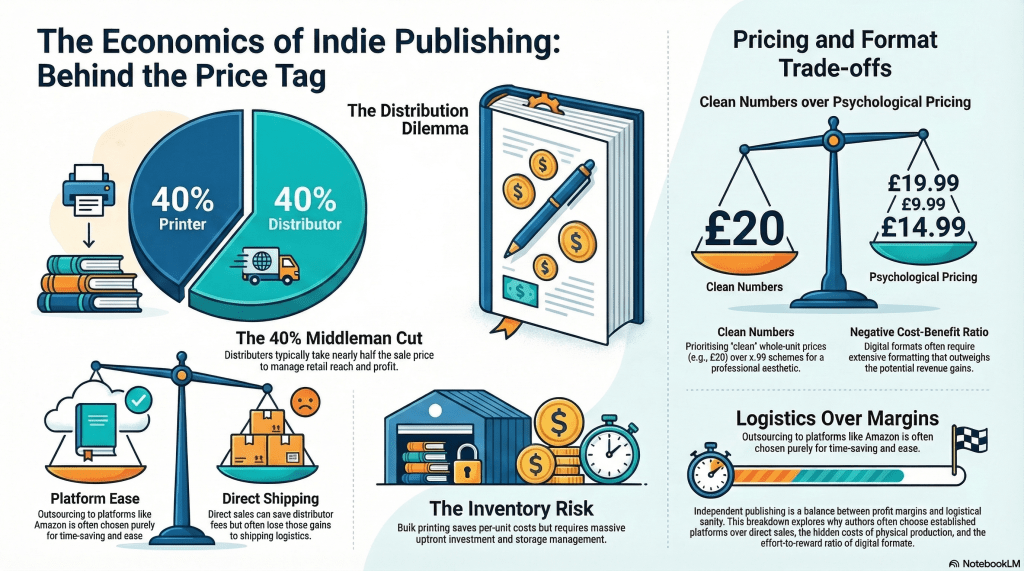
Of course, one might offer directly to the customer to cut out the distribution cost and maybe pocket all or some of the difference, which might be 40-odd per cent of the sale price – 8 from a book priced at 20, where the printer already takes, say, 8. This leaves 4 for the author.
If I were to cut out the middleman to take all of the 8 in this example, I’d likely lose most of it in shipping and handling. (I know because I’ve done this before). Of course, I could pass this expense to the buyer, but this jacks up the price from 20 to 28.
Some sellers offer free shipping, whether by exceeding some minimum order amount or through a programme such as Amazon Prime.
If I am going to eat the 8, I might as well give it to Amazon and let them handle the logistics. Business 101. Barnes and Noble has an even less favourable model as far as publishing is concerned, but they provide different offerings, so I still use them via IngramSpark.
For the record, I’ve used and considered other printers and distribution methods, but they are all more expensive to me from a total cost perspective. Part of this is simply the incremental pricing facility. I don’t want to purchase and manage inventory for 1,000 books at a time. In this case, I’d be out 8K up front. Perhaps I could get a deal and print the books at 6K for committing to a print run, but I’d still have to manage the inventory and logistics, which then takes away from my writing time. I’ve outsourced this before, but I had to pay for warehousing and a handling fee to someone to package the book – and pay for shipping (pass-through or otherwise). Amazon (KDP) is just easier, so it’s my go-to.
As for pricing, I’ve decided that my default prices will be 20 USD for paperback and 30 for hardcover. This is in contrast to a x.99 pricing scheme. I usually set my ex-US prices lower, but honestly, it depends. I try to set prices in each market with no fractional units. If the price had been £14.97, I’ll up it to £15, Sorry. In most cases, it will drop from £15.23 to an even £15. In most markets, I’ll lose margin to provide a clean-looking sales price.
As an economist, I could see that one might arbitrage (in a manner of speaking) and order from Belgium instead of France or vice versa, but I don’t expect the shekels saved would be worth the added effort.
As for bookstores, they can still purchase my titles wholesale from whatever distributor (even Amazon), so you can still support your local bookstore if that’s your ethos.
Anyway, I know I’m just wittering on, but I felt that transparency into the process might be appreciated.
Kindle and other eBook formats
One might think that offering a digital version would be simple, but it’s not as easy as uploading a PDF. A lot of formatting is required to fit the format. An ordinary EPUB is easier than Kindle, which relies on old technology to support its legacy devices. It doesn’t always handle images, charts, and tables nicely, and doesn’t support all fonts, so that creates more work.
Because of this, ebooks are a low priority for me, though I admit they do sell well. It’s up in the air as to whether the increased sales justify the cannibalisation of the physical media.
Audiobooks
I’ve made available a few audiobook versions. I’ve heard that these are a decent portion of many independent authors’ revenue sources, but I haven’t found this to be true. Because of this, offering them is a low priority for me. I’m not anti-digital so much as anti-negative-cost-benefit.
I mentioned recently that I create audio versions for me to review, but these are not necessarily ready for the public. Additional time must be invested in correcting pronunciation, prosody, and odd digital glitches.
Anyway, that’s all I’ve got for now. Cheers.
 Philosophics