I haven’t read this book and am not familiar with Julian, but I’ll share it here as a reminder. From this article, it feels like he is tilting the mechanical hard deterministic windmill. Nothing more to add at the moment.
As I research the agency/free will quandary, I am finding a lot of common minds, as it were. On the free will versus determinism spectrum, I can’t say without reservation that I accept determinism or indeterminism, for that matter, but I can say that free will is weak tea. Causa Sui comes into play, but I’ll get to that.
Audio: NotebookLM podcast on this topic of Causa Sui.
As an aside, similar to the theism versus atheism debate, keep in mind that this debate hinges on free will taking the privileged position occupied by theism. When discussing compatibility versus incompatibilism, it’s whether determinism is compatible or incompatible with free will. I feel that the privilege of free will in this debate is telling insomuch as it reveals a bias on preferred perspective.
If you’ve been reading, I like what Derk Pereboom has to say, but I feel we have a bit of a gap in our accord. But I’m very partial to Galen Strawson’s line of argumentation that doesn’t rely on determinism to declare the free will argument pointless. I believe that there is space to fill in some gaps in his position regarding social responsibility, and maybe there are no gaps; I just am not yet familiar enough with his position. From a strictly deterministic position, I find Robert Sapolsky’s position appealing, but it still ends up being a pissing match. To be fair, I think any position will be a pissing match. I’ll elaborate on this next before I touch on causa sui.
Losing My Religion
In my book, free will is an anachronistic vestige of religion. Not to go too far down a Foucauldian path, religion is a power play. As religion constructs gods, it also constructs notions of free will. Power structures like to leverage these concepts for their own ends.
Interestingly, religion first gave us determinism—at least the Abrahamic monotheistic varieties—, but it needed to construct free will or it would have undermined its ability to cast blame and guilt. When science matured, it said, ‘Hey, hold on there. There’s no room for gods in physics. Everything has a cause and was determined at the start. Your intuition was right at the start. Free will is bollocks.’
Causa Sui
Finally. Causa Sui is the Latin name for a self-caused cause, one that is not the result of prior events. Here is where I really like Galen Strawson’s account. His argument is premised on 4 factors, the first of which is what you do flows from the way you are.
What you do flows from the way you are.
Galen Strawson
In essence, you’ve somehow got to get to be responsible for being the way you are, but you can’t you can’t get back behind yourself in such a way as to be responsible for the kind of person you are. You’ve got to somehow have chosen it, but you can’t choose it unless you already exist as a creature who has preferences.
No Causa Sui
You’d somehow have to get to be the cause of yourself to take fundamental ultimate responsibility for yourself and therefore for your actions that flow from the way you are and therefore free will—indeed more responsibility and free will, and therefore we do not have free will.
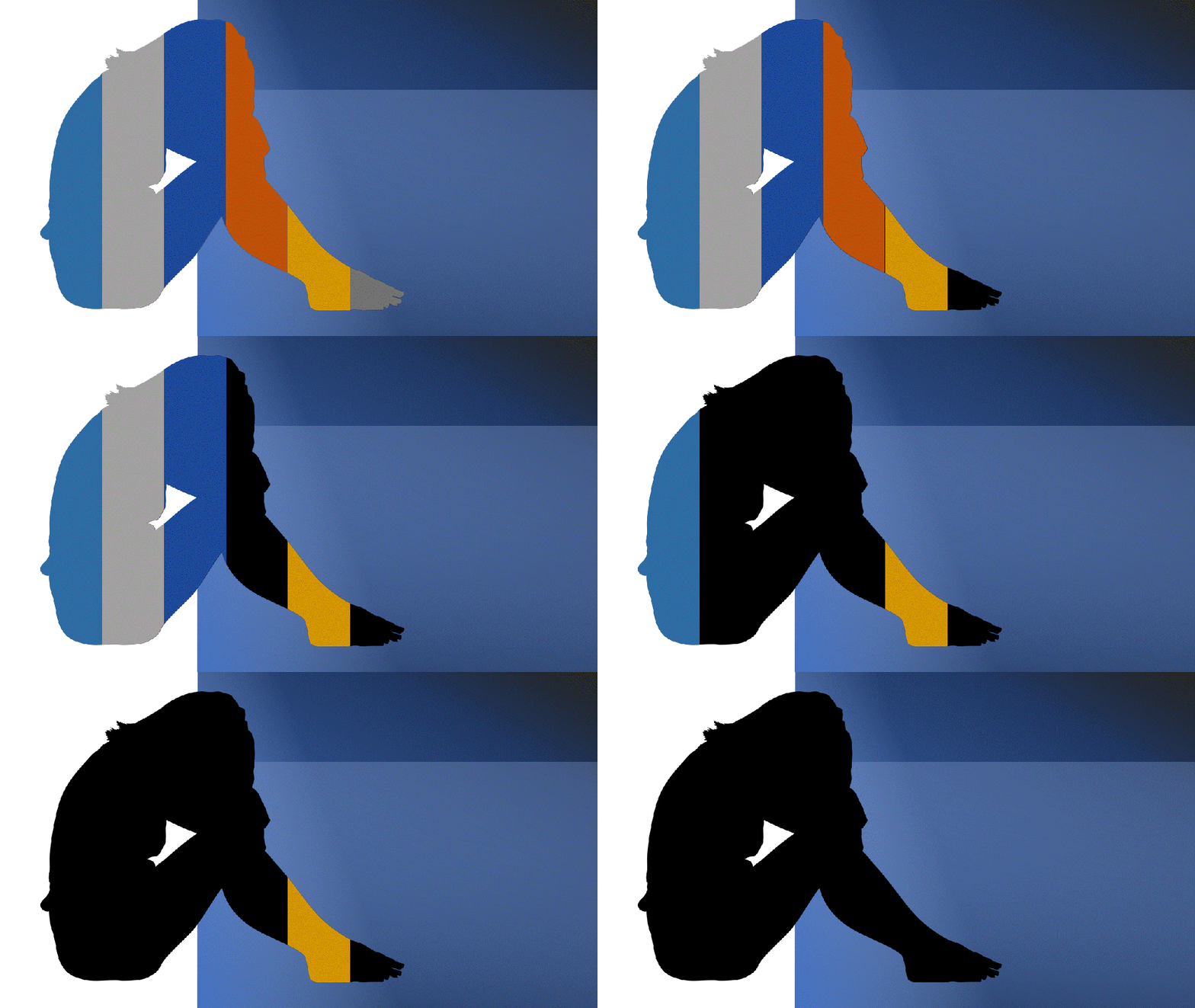
In the diagramme, we see you, and the influence of external forces, but at no point are you ever responsible for your own actions. Even if you did make a so-called conscious effort to do something else, it would still be the result of one of these other sources.
Perhaps an inapt example would be for a homosexual person to ‘decide‘ to be a heterosexual person. This is not to say just to act like a heterosexual person, but to actually be attracted to the opposite sex. It should be obvious that this can’t be done, but if you are having difficulty, imagine the mirror example where you are a heterosexual person and you ‘decide‘ to be attracted to people of your own sex. Of course, this is akin to deciding that you like cilantro when you don’t, deciding you like Justin Beiber when you don’t, or deciding that you don’t actually enjoy chateaubriand when you do. Even if you manage to act the opposite of your sexual orientation, it is still not you who is responsible for the apparent change. It’s a response to social forces and external conditioning. You are the way you are because of the way you are. You’ve had absolutely no say in the matter.
You are the way you are because of the way you are.
So what’s the big deal? you might still be asking yourself. If you’ve just done something morally or legally “wrong” —emphasised by big bold scare quotes, you need to be punished or at least blamed irrespective of how you became you, right? Let’s ignore that I am a moral non-cognitivist at the start and pretend that this moral indignation is otherwise meaningful.
Quarantine Justification Theory
Let’s say that someone has done something outside the bounds of social acceptance in some milieu. To make it even easier to consider, let’s imagine for a moment, instead, an autonomous robot that was designed to seek glass and smash it. This robot has no conscience and no free will. It is just a robot programmed to break windows.
This robot has been unleashed on our community. In one sense, some might blame the robot for breaking the windows, but we know that whoever programmed this robot is to blame. But we don’t know who programmed it. What we do know is that we want to stop the robot from breaking more windows.
So we track down the robot and we disable it—or perhaps it’s designed in such a way that it can’t be turned off. Even though the robot is not to blame, it is a menace and we’ve collectively decided to disarm it or quarantine it. We build a glassless room and sequester it away so it can do no more damage.
Some people find this scenario a reasonable justification to quarantine the actor, but I think that this has at least one problem, I’ll mention two considerations I have.
Not a Robot
So, let’s revisit quarantine justification theory with a human actor, and let’s presume no causa sui. As we can’t blame the robot actor, neither can we blame the person actor. As with the robot, the goal is not to punish but to quarantine.
Not to Blame
Now let’s add a dose of reality. This human is not on a window-breaking rampage. Instead, s/he vandalised the window of a shop for some reason; let’s say that s/he was short-changed and wanted to exact damage equal to the shorted change. A police officer witnesses the act and takes the perpetrator into custody. What should the judge do? Remember, the person did not create themself, but s/he did the act s/he was accused of.
The image below shows two scenarios. In scenario A, you are integrated with society; in scenario B, you are quarantined. The question is what is the justification for quarantining you.
Quarantine Justification Model
It’s difficult to argue that this person should be quarantined because this was a tit-for-tat response, not a rampage. It’s unlikely to happen again. One might try to argue that this person should be fined or, in line with quarantine, incarcerated to be made an example, thus acting as a scapegoat to serve as an external social pressure mechanism to disincentivise this retributive action. But this would ostensibly be punishing this person for something beyond their control.
We can even loosen the scenario to consider a person who has robbed a liquor store or kidnapped a child. These events are all too common, but there is nothing to suggest that a person will repeat this activity, so quarantine cum incarceration is hard to justify.
I can envision someone reading this thinking that we need to do something. We can’t let this person get away with it, but if you find yourself drifting in this direction, it’s your programming. You can’t help yourself. You don’t even have this degree of agency.
I haven’t given it enough thought, but it feels like this is similar to the dissonance when one grasps something intellectually, but instinctually or emotionally something just doesn’t sit right. Whilst you try to get outside of yourself, your programming doesn’t allow it.
* If you haven’t sussed it out quite yet, ‘cows are suey’ is how Google’s auto-generated transcript heard causa sui in an interview with Galen Strawson on this topic, and the rest is history.
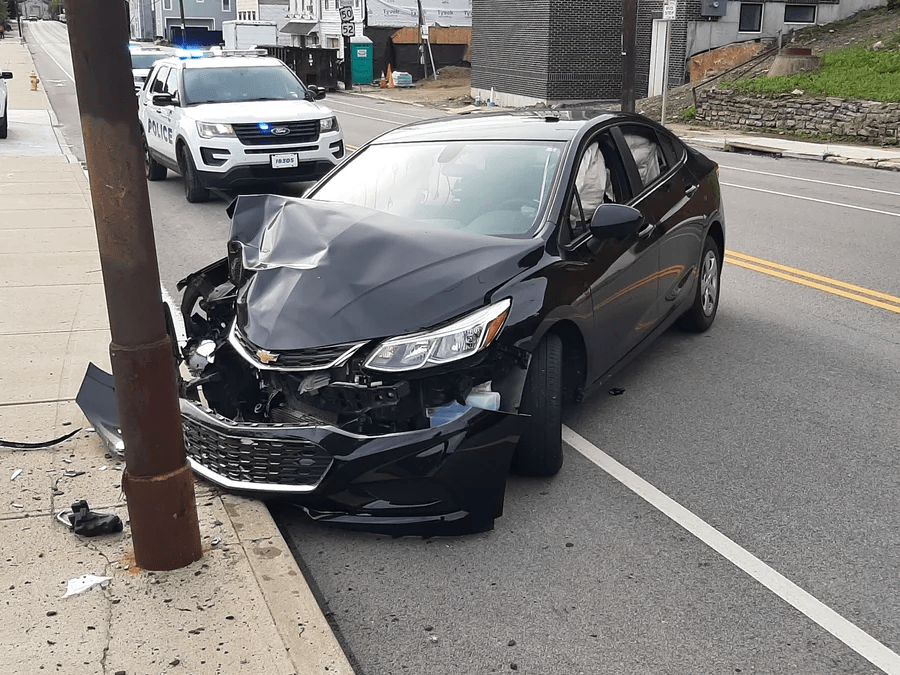
Robert Kane argues that ultimate responsibility (UR) should guide us in determining whether someone is responsible for their actions. He gives the example of a drunk driver who gets into an automobile accident. If the actor tries to skirt responsibility because s/he was intoxicated, hence incapacitated, then [1] we can still rewind to an action taken that caused this intoxicated state and then [2] choosing to drive—a causal relationship articulated by Aristotle. This seems fine, but it’s a specious defence.
According to Kane
According to Kane—noting an issue raised by some—, it doesn’t require an assessment that a person could have done otherwise. This condition has numerous implications for free will.
For example, it doesn’t require that we could have done otherwise for every act done of our own will. But it does require that we could have done otherwise with respect to some acts in our past life histories by which we formed our present characters. Kane calls these self-forming actions (SFAs). According to Kane, [3] we act from a will that’s already formed, but [4] it’s our own free will by virtue of the fact that [5] we formed it by other choices or actions in the past—self-forming actions—, [6] for which we could have done otherwise.
Consider the drunk driver. If this were not the case, there’s nothing we could have ever done differently in our entire lifetimes to make ourselves different than we are—a consequence that’s incompatible with our being, at least to some degree, ultimately responsible for what we are. And that’s what I think free will requires.
Kane’s Challenge
I marked passages in brackets [n], to serve as a reference for my commentary here. Some of my responses may be repetitive, so I’ll try to make any redundancies recursive.
[1] Kane suggests that even if the person is incapacitated at the time of the accident—hence not responsible in the moment—, we can trace events back through time and pinpoint an event that caused the incapacitation. In fact, we can trace it back to the decision to imbibe in the first place. I have two objections here, but I’ll defer the second one to my next reaction.
Kane says we can rewind to some causal event. We are in agreement on this point, but I have a question: why stop there?
In engineering, there exists a concept called root cause analysis, and there is a concomitant heuristic called the 5 Whys. Essentially, using the DUI example as a discussion point, we can refer to the accident as event T0. Then we can trace back.
For the sake of brevity, I’ll ignore trivial or immaterial events such as s/he encountered a detour and so took an unfamiliar route or s/he fell asleep at the wheel, missing a green light, which caused a delay, which meant that she was in a place to happen to hit another vehicle—presuming that if s/he had been a minute ahead of her fateful schedule, there would have been no other vehicle to hit. This might be a logical line of inquiry, but let’s shelf it.
So, tracing back, at T-1, we find our actor already intoxicated and starting the car. At T-2, we find our actor drinking the last of multiple rounds of alcohol. We could trace back all the way back to, say, T-5, where our actor made the decision to take the first drink.
We may have difficulty pinning down where the impairment kicked in. Was it the drink at event T-2 or was it earlier, say, ay T-4, where all subsequent drinks were not assessed rationally? In any case, even if we stop at the last lucid state, T-5, then everything that follows can be said to be related to that event. But I have a problem.
[2] Firstly, if s/he was mentally incapacitated, how could s/he make a rational decision to drive or not? Secondly, even if we say that s/he became mentally incapacitated at event T-4, then the decision at that juncture was not rationally deliberated.
We could introduce a twist here, which is to assign culpability to the drink server. Some local statutes exploit this by making the barkeep culpable for serving a drink to an already intoxicated patron. Of course, this has the same issue noted above because we can’t say with any reliability whether the actor was intoxicated at T-2 or T-4. Let’s not get mired in this. This is not my biggest concern.
My key concern is in stopping there at T-5. Why not go back to why s/he even had the first drink? Why not go back to why she drinks in the first place? Why not keep going back. More on this ahead. Let’s continue.
[3] Kane says that the actor, the decider, already has a formed will. In this, he is introducing another concept—one of the self or the individual. Let’s continue, and I’ll get to that, too.
[4] Echoing the self, Kane doubles down and says that this self has a will, and the actor owns it. As such s/he is responsible for these willed actions, these caused actions. So, let’s dig in.
[5] Kane asserts that we formed this self by other choices or actions in the past that he calls self-forming actions. This is where in my mind this skein of logic unwinds.
Ignoring whether the self is anything but narrative convenience, why should one accept that the actor has any agency in this so-called self-forming? What proof do we have that this actor is just a victim of circumstances—from geworfen until event T0? Even without invoking determinism, I think it’s safe to assume that this actor is a consequence of, at least, hereditary and (monomorphic and polymorphic) genetic traits including temperament. Then we have structural influences, such as family, peers, institutions, and authority figures, societies and cultural norms.
It might be difficult to determine what percentage of the self are formed by this, but it would be disingenuous to defend this as self-forming rather than formed by some crucible.
[6] Kane’s final point is about whether one might have done otherwise. He downplays this point, and so shall I. If someone insists that this is important, I’ll address it at that time.
Enfin
I left out some key points that I’ll likely return to in future. Essentially, Kane is a traditionalist who pines for virtue and character, two concepts I feel of figments intended to act as tools of power maintenance. I feel this will get us down a rabbit hole, and I am rabbitted out, so let’s end here.
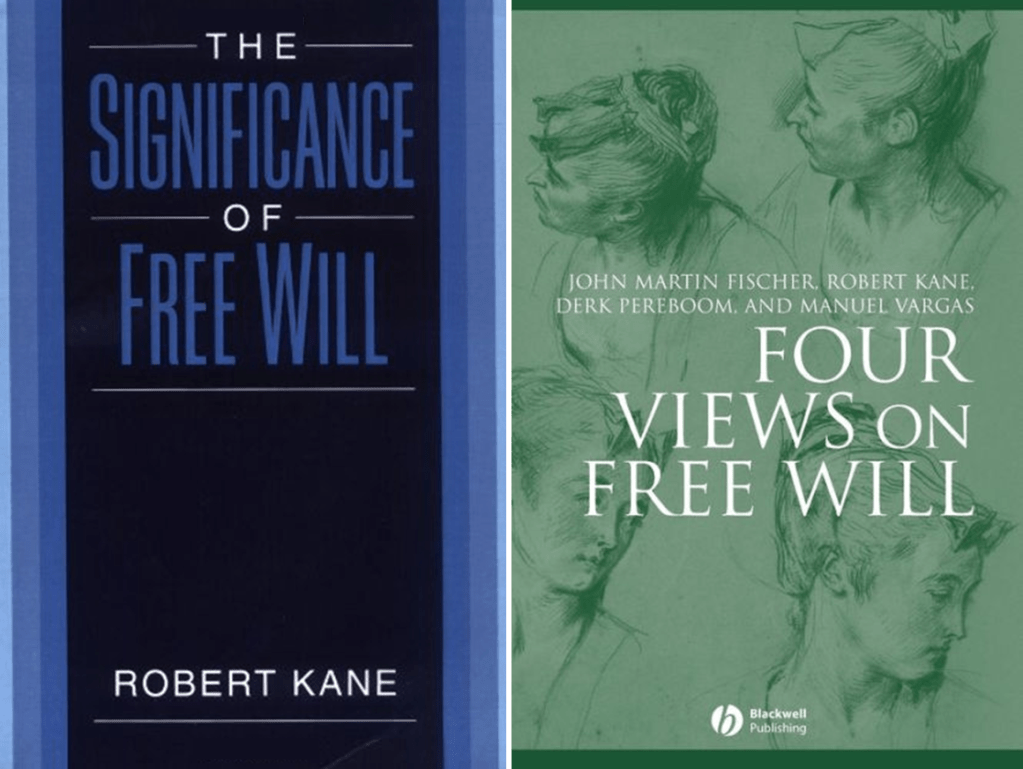
I’ll probably read the Four Views on Free Will content first. Meantime, Derk Pereboom, who also contributed to Four Views, presents Kane’s position in a video, so I’ll illustrate Perebooms perspective as well as how my own thoughts might dovetail.
Meaning in Life & the Illusion of Free Will (Derk Pereboom)
…a lot of prominent advocates perhaps most notably Immanuel Kant didn’t think that he could show that we have libertarian freedom, but he did think that we should believe that we have it for the sake of morality…
The libertarian perspective is that we look at all causation in terms is events, and some people believe that all causation is by way of events so, in the case of agents, they can be the cause of events.
Freedom consists in the fact that when decisions are caused, they’re caused indeterministically by other events.
Pereboom coveying Kane’s libertarian concept of freedom
This is the idea of indeterministic causation. Not all causations in deterministic, but yet all causation is by way of events so events indeterministically cause decisions, and this is what allows them to be free.
Pereboom explaining indeterministic causation
Borrowing Pereboom’s rendition of Kane’s account, Anne is on her way to work, and she sees a woman being accosted.
Choices
At this moment, she has a choice of taking one of two possible options:
Prudential Choice: Continue going to her office (desire to please her boss) [p = 50%]
Moral Choice: Intervene in the molestation (desire to help the victim) [p = 50%]
Pereboom’s Critique
What settles whether Anne stops to help or continues to the office?
the agent can’t have enough control for freedom in the event-causal picture
Derk Pereboom
Whether she stops or not is not up to these agent-involving events to settle whether she stops or not; after all the agent involving events render the two decisions equally probable, fifty-fifty, in our simplified example. So the answer, Pereboom thinks, has to be nothing; there isn’t anything that settles which way the decision goes because the only causation involving the agent consists in events evolving the involving the agent. and by hypothesis, all the events involving the agent conspire to render each of the two possible decisions equally probable. So, Pereboom wants to say that in the event-causal picture nothing settles which decision occurs—and in particular, the agent doesn’t settle which of the decisions occurs, so he believes that the agent can’t have enough control for freedom in the event-causal picture. There’s not any event-causal picture that solves this problem.
The problem with this event-causal libertarian view is that the agent disappears at the crucial time. We want the agent to settle which way the decision goes, but the event causal picture doesn’t allow this. So, we should reintroduce the agent in a different guise. And as agent—or as agent cause—we’re gonna say look not all causation is by way of events some causation is by way of agent, so as a substance not just as involved in events causes the decision. So, we’re going to give Anne, as agent-cause, the power to settle which way this decision goes; and we’re going to give her this power in the following guise: we’re going to say she’s got the power to settle which way the agent—which way the decision—goes. By what? By causing a decision; and by causing a decision without being causally determined to cause it. This is what Immanuel Kant calls transcendental freedom, and he thinks that this is the only kind of freedom that’s going to get us moral responsibility. It’s giving to the agent qua agent—not as involved in events but giving the agent qua agent—the power to cause an action without being causally determined to cause it. Now this is a very special sort of power.
Do we have this kind of power? Kant said, ‘Well, we have no evidence that we have this kind of power. We can’t even show that it’s possible that we have this kind of power, but we can show that it doesn’t contradict anything we believe, so we should believe it for moral reasons.’ He thought, It’s really important for us to believe that we’re morally responsible. And he also thought that the moral law kind of falls away unless we’re free in this sense. Kant thinks we have ample practical reason to believe that we’re agent-causes.
Pereboom (simplified), op. sit. ( cue @ 21:30 )
But there are certain kind of empirical worries that Kant was well aware of for the hypothesis that we’re agent-causes.
Kant says the physical world is governed by deterministic laws. So, suppose we believe that we as agents have this power of transcendental freedom— the power to cause an action without being causally determined to cause it. At some point there’s going to be an interaction between the agent as cause and the deterministic world—maybe at the juncture between the agent and the agent’s brain. Maybe you can think of agent-causes as non-physical things that can affect the physical world. Suppose we think of it that way. Kant says the physical world is governed by deterministic laws.
Suppose this free agent causes the decision to raise her hand without being causally determined to cause it. Kant says it has to be reconciled with the following fact that we know from Newtonian physics—the physical world is governed by deterministic laws. How can this be? It would seem that if the free agent freely, in Kant’s sense, causes the decision to raise their hand that the hand raising isn’t going to be causally determined. But Kant said that physics shows that the laws are deterministic and that all physical events are governed by deterministic laws.
Pereboom (simplified), op. sit.
One thing you can say is that it just so happens that every free decision ever made just happens to dovetail nicely with a determined physical world so each of the how many free decisions have been made in human history according to, say, 17 trillion. Each of the 17 trillion decisions happens to dovetail with the way that physical bodies have been causally determined since the beginning of the universe
Pereboom (simplified), op. sit.
Pereboom says this involves coincidences too wild to be believed. It’s not really credible. Kant at a certain point says well this problem can be solved because when an agent—a free agent—makes a decision, that free agent changes the universe back to the beginning of time. Kant says that in his The Critique of Practical Reason. I say that’s a pretty high price to pay for a belief in transcendental freedom. It seems implausible.
Quantum Physics
At 26:26 Pereboom turns his attention to indeterminism and quantum physics—the main premise being that quantum mechanics replaced the mechanistic certainty of determinism with probability.
If I don’t expand this copy past here, you’ll just have to watch the vid.
Next, I want to pick up on criminal punishment and retributive justification. Pereboom suggests that we can adopt a sort of quarantine approach to criminals even if we can’t assert that they deserve it, but I have serious concerns of the lack of justification here. (cued for me @ 30:15)
Wrong-doing, indignatio, and emotion. Emotion: Non-reactive. Problem with Love.
In the debate between free will and determinism, we have a second layer, perhaps better characterised as a meta-dimension we tend to label compatibilism and incompatibilism.
Saving any technical definitions of free will and determinism, these things are generally seen as mutually exclusive situations, which is to say that if we have free will, then the happenings of the universe and of us by extension are not determined. If the universe is deterministic, then we have no free will. This is incompatibilism.
Compatibilism is the belief that free will and determinism can simultaneously coexist. I’ll spare the details for now.
Free will and moral responsibility — Derk Pereboom (11:42)
Cornell philosopher Derk Pereboom presents his position here. I’ve only recently been exposed to Pereboom by a colleague, who recommended Pereboom’s Free Will, Agency, and Meaning in Life when I told him about my Anti-Agency pursuits. Pereboom’s name began to crop up more and more frequently as I dug deeper, but I want to give credit where credit’s due.
Ostensibly, Pereboom defends Spinoza’s position ‘that due to very general facts about the nature of the universe we human beings lack the sort of free will required for moral responsibility in the sense at issue.’*
Compatibilism is a synonym for hard determinism, but Pereboom calls ‘the resulting variety of scepticism about free will ‘hard incompatibilism’. Naming it ‘hard determinism’ would be inaccurate, since [he’s] not committed to determinism, so a new term is needed.’* He also informs us in a footnote that the ‘term ‘hard determinism’ originates in William James (1884).‘*
In closing, Pereboom lists some prominent free will sceptics that I share here:
Baruch Spinoza (1677/1985)
Paul d’Holbach (1770);
Joseph Priestley (1788/1965)
John Hospers (1950, 1958)
Paul Edwards (1958)
Galen Strawson (1986)
Bruce Waller (1990, 2011)
Derk Pereboom (1995, 2001, 2007)
Daniel Wegner (2002);
Shaun Nichols (2007)
Stephen Morris (2009)
Neil Levy (2011)
Thomas Nadelhoffer (2011)
Tamler Sommers (2012)
Gregg Caruso (2012)
Benjamin Vilhauer (2012)
I would add Daniel Dennett and perhaps Sam Harris to this list.
* Pereboom, Free Will, Agency, and Meaning in Life, 2014
As Cicero noted in his On Divination, Stoics were determinists who believed in an all-knowing God. This allowed them to be indifferent or resigned to their fate because they felt they couldn’t change it. Like watching a horror suspense movie that has already been recorded, one might be tempted to believe that there is some probability operator determining if a monster is behind a closed door, but in fact, there is no probability. Whether the monster is there or not has already been determined. It’s a certainty, as a viewer of a prior showing can attest. It only appears to be chance.
Stoics believed that, since everything happens by fate, if someone could observe the interconnection of all causes, then s/he could know the future because s/he necessarily knows how everything will unfold cause by cause, frame by frame.
Stoicism an ancient Greek school of philosophy founded at Athens by Zeno of Citium. The school taught that virtue, the highest good, is based on knowledge; the wise live in harmony with the divine Reason (also identified with Fate and Providence) that governs nature, and are indifferent to the vicissitudes of fortune and to pleasure and pain.
This intersects with my research on determinism. I capture this because I find there are a lot of people I encounter on Facebook who are self-proclaimed Stoics, yet they are not necessarily religious or determinists. They simply feel they can will their emotions.
One reason I prefer to look at agency is to avoid the claims and counterclaims of proponents of free will and of determinism, each having factions causing the other side of clinging to an illusion. As I’ve noted previously, at present I am a self-described soft-determinist insomuch as I declare myself to be agnostic.
My hypothesis is that humans have little or negligible agency. Under hard determinism, this would collapse from nil to zero. In either case, it is criminal to presume to be able to assign moral responsibility to any person.
Illusionism
Determinists charge free will advocates of being fooled.
Illusionism is the position that free will does not exist and is merely an illusion.
Many ancient and modern thinkers have made this claim. They have usually been strong determinists, from Hobbes to Einstein.
Since the discovery of irreducible quantum mechanical indeterminism, most scientists and some philosophers have come to understand that determinism is a dogmatic belief unsustainable from the evidence.
Nevertheless, most philosophers remain compatibilists, even as the evidence of indeterminism has caused them to declare themselves agnostic on the truth of determinism or indeterminism.
Adequate determinism is an emergent property in a universe that was initially chaotic and which remains chaotic at atomic and molecular levels. Consequently all physical processes are statistical and all knowledge is only probabilistic. Strict determinism is an illusion, a consequence of idealization.
Statistical knowledge always contains errors that are normally distributed according to a universal law that ultimately derives from the discrete quantum nature of matter.
The existence of this universal distribution law of errors convinced many scientists and philosophers that the randomness of errors was not real, that strict deterministic laws would be found to explain all phenomena, including human beings.
To the extent that randomness is needed to break the causal chain of strict physical determinism, many philosophers continue to think that free will is the illusion.
Peter Strawson said he could make no sense of ideas like free will and determinism. In this regard he was one with those English-speaking philosophers who, following Ludwig Wittgenstein, thought such questions were pseudo-problems to be dissolved by careful attention to actual language use.
Strawson made a contribution to the free will versus determinism discussions by pointing out that whatever the deep metaphysical truth on these issues, people would not give up talking about and feeling moral responsibility, praise and blame, guilt and pride, crime and punishment, gratitude, resentment, and forgiveness.
To be fair, I feel that Peter Strawson and I agree on the insufficiency of language to settle the matter of whether the universe offers free will or is deterministic, that questions such as this are pseudo-problems.
For years—decades even—I identified as an Existentialist, and I still have an affinity for some of the works of Sartre, Beauvoir, and Camus. I had read some Richard Wright. I never read Kierkegaard directly, and I may never. And of course, there’s proto-Existentialist Nietzsche. I’ve encountered to various degrees Heidegger, Merleau-Ponty, and Jaspers but not deeply.
The draw for me is that we create our own existences, but I came to feel this was at odds with Structuralism. Per my previous post, I don’t have much faith in the Agency seemingly required by Existentialism.
In Statistical analysis of variance (ANOVA), there is a notion known as degrees of freedom. This is how I view Agency. Per my Testudineous Agency post, after we account for genetics and environment, how much agency effectively remains? This is the degree of freedom. Under hard determinism, degrees of freedom are zero.
What else can we strip away after genetics, epigenetics, indoctrination, environment, and other mimetic and learned behaviours? And what remains after we do?
I don’t believe that humans have the agency presumed they have, so I’d like to set out to prove it—at least rhetorically. In the ages-old battle between free will and determinism, I’ve tended to lean toward the determinism camp, but there is something keeping me from gaining full membership. I feel that proving hard determinism may be too hard a nut to crack, so I am aiming at just the agency aspect.
There are two major themes in my thinking.
Humans have no material agency
Power structures require the presumption of agency
Although this concept has been rattling around my brain cage for a while and I still have a ways to go, I feel it will be helpful to sketch out my ideas. I feel inspired by people like Robert Sapolsky and Daniel Dennett. And I feel I can draw insights into counter-arguments from people like Jonathan Haidt, Joshua Greene, and even Steven Pinker. I feel that my experience in behavioural economics may be useful for additional context—people like Daniel Kahneman, Richard Thaler, and Dan Ariely. But I feel disheartened when it appears that Galen Strawson and his father before him, Peter Strawson, people much more connected and elevated in the field have been treading the same territory for decades — over half a century — ahead of me, thankfully beating a path but not necessarily making much headway. Perhaps I can build upon that foundation if not substantially at least perceptibly. Of course, the seminal work by Isaiah Berlin’s Two Concepts of Liberty.
We may act as we will, but we cannot will as we will.
Arthur Schopenhauer
Besides the aforementioned, a correspondent has suggested other source references. He shares: Physics, including quantum mechanics, is fully Lagrangian. According to Stanford’s Leonard Susskind, Lagrange derived his formalism from the principle of ‘Least Action’. Jean Buridan’s principle of ‘Equipoise’ renders a Lagrangian model of the world perfectly deterministic. So, the physical domain is not probabilistic; and all indeterminacy is actually epistemic indeterminability. He also suggets Thomas Hobbes’ “De Corpore”.
About my second point, my corresponent agrees:
I think your “meta” is right. We feel that we are “free agents”, and we don’t know to what to attribute our feeling that we freely choose; so we imagine that we have “free will”. In my view it also doesn’t exist – we really are, as Sapolsky describes, zombie robots – we just don’t (and cannot) know it. Free will is thus a mere (but compelling) illusion on both individual and emergent scales. And yes again: all of morality, jurisprudence, etc., depends on it.
Unattributed Correspondant
My correspondent is a professional philosopher who shall remain anonymous until such time as he agrees, if ever, to make his identity known. I am quiet aware that some of my ideas are contentious and polemic. Not everyone wishes to be mired in controversy.
Humans Have No Material Agency
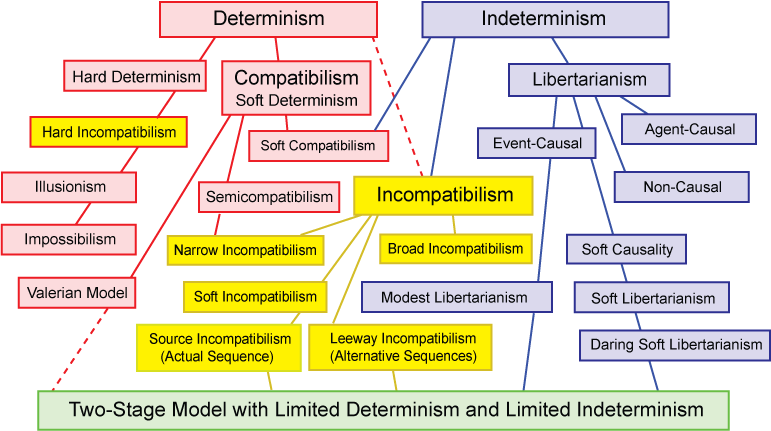
Humans have little to no agency. This is the point I am making in my Testudineous Agency post. From what I know until now, this likely qualifies as soft determinism, but this might shift as I acquire new nomenclature and taxonomic distinction. I’ve discovered this taxonomy of free will positions, though I am not well enough versed to comment on its accuracy or completeness. For now, it seems like a decent working model to serve as a starting point, but I am fully cognizant of possible Dunning-Kruger factors.
A Taxonomy of Free Will Positions
In essence, hard determinism says that the world is not probabilistic. Some event triggered the universe as we know it, and it will unfold according to the laws of physics whether or not we understand them. A weaker form, soft determinism, allows for some probability and trivial ‘agency’. I feel that Dennett supports soft determinism. I feel that because we, as ‘individuals’, are a confluence of multitudinous factors, we have little agency (interpreted as responsibility). More on this later.
Power structures require the presumption of agency
To be honest, the free will debate is only interesting to me in context. To me the context is power. The ‘meta’ of this is that society (and human ‘nature’) seem to need this accountability and culpability, but it doesn’t actually exist, so it is created as a social construct and enforced in a Foucauldian power relationship through government through jurisprudence mechanisms.
This is the part of the debate I haven’t heard much about. Sapolsky did write in Behave, chapter 20X, that criminal justice systems need to be reformed to account for diminished agency, and I’ll need to return to that to better comprehend his position and assertion.
The rest of the story
As a handy reference, these are the authors and books I’ve encountered to date and in no particular order:
I’ve got a lot of essays and lecture notes not referenced plus general content from Reddit, Medium and other blogs sources, YouTube, podcasts, and so on. I probably should have documented some Classical philosophers, but I don’t generally find their argumentation compelling, though I might add them later.
The aim of this post is just to capture my intent—if it is indeed my intent. Oh, the questions and implications of a lack of agency. Please stand by.
In chapter 71, Ultimate Responsibility, in Intuition Pumps and Other Tools for Thinking, author and philosopher, Daniel Dennett presents a counterargument to the notion that an agent, a person, is not absolutely responsible for their actions. He questions some premises in the ‘the way you are’ line of argumentation, but I question some of his questions.
Here is a nice clear version of what some thinkers take to be the decisive argument. It is due in this form to the philosopher Galen Strawson (2010): 1. You do what you do, in any given situation, because of the way you are. 2. So in order to be ultimately responsible for what you do, you have to be ultimately responsible for the way you are—at least in certain crucial mental respects. 3. But you cannot be ultimately responsible for the way you are in any respect at all. 4. So you cannot be ultimately responsible for what you do.
Dennett, Daniel C.. Intuition Pumps And Other Tools for Thinking (p. 395). W. W. Norton & Company. Kindle Edition.
Dennett continues.
The first premise is undeniable: “the way you are” is meant to include your total state at the time, however you got into it. Whatever state it is, your action flows from it non-miraculously.
Dennett and I are in agreement with Strawson. There is not much to see here. It’s akin to saying the now is the result of all past events until now. This is “the way you are”.
The second premise observes that you couldn’t be “ultimately” responsible for what you do unless you were “ultimately” responsible for getting yourself into that state—at least in some regards.
This second premise asserts that one cannot be responsible for any action that one had no part in performing. Two scenarios come immediately to mind.
First, you are not responsible for being born. As Heidegger notes, we are all thrown into this world. We have no say in when or where—what country or family—or what circumstances.
Second, if one is hypnotised or otherwise incapacitated, and then involved in a crime, one is merely a cog and not an agent, so not responsible in any material sense.
But according to step (3) this is impossible.
Whilst Dennett fixates on the absolute aspect of the assertion, I’d like to be more charitable and suggest that we still end up with a sorites paradox. Dennett will return to this one, and so shall I.
So step (4), the conclusion, does seem to follow logically. Several thinkers have found this argument decisive and important. But is it really?
As Dennett invalidates step (3), he insists that the conclusion is also invalid. He asserts that the notion of absolute responsibility is a red herring, and I argue that Dennett doesn’t get us much further, perhaps redirecting us with a pink herring.
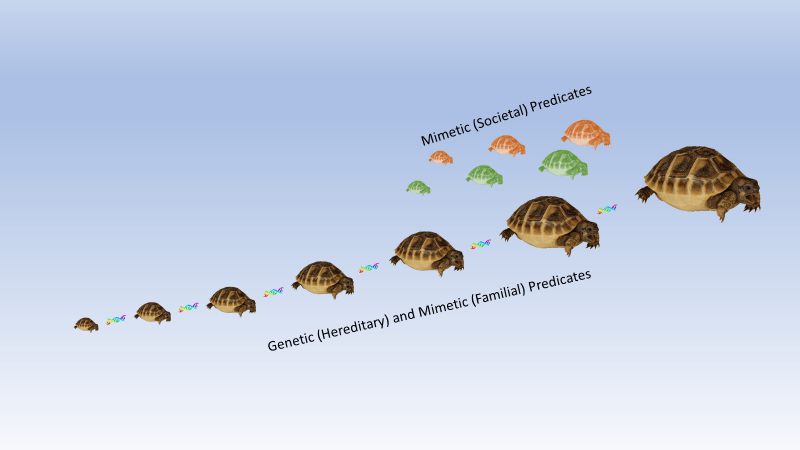
I’ve created an image with tortoises to make my point. There are actually two points I wish to make. The first point is to determine where the responsibility is inherited. This point is meant to articulate that the world can not be strictly deterministic and yet one can still not have significant agency. The second point is that culpability is asserted as a need, and acceptance of this assertion is the problem.
Testuditude
The image depicts an evolution of an agent, with time progressing from left to right. The tortoise on the right is a product of each of the recursive tortoises to its left. The image means to convey that each subsequent tortoise is a genetic and social and social product of each tortoise prior. Of course, this is obviously simplified, because tortoises require pairs, so feel free to imagine each precedent tortoise to represent a pair or feel free to add that level of diagrammatic complexity.
This is not meant to distinguish between nature and nurture. Instead, the claim is that one is a product of both of these. Moreover, as genetic, epigenetic, and mimetic influences are transmitted in family units, they also occur through social interaction and the environment, as represented by the orange and green tortoises.
…if one is a product of genetic and mimetic forces, how much agency remains for culpability?
The point here is that if one is a product of genetic and mimetic forces, how much agency remains for culpability? Each person is an emergent unit—autonomous, yes, and yet highly programmed.
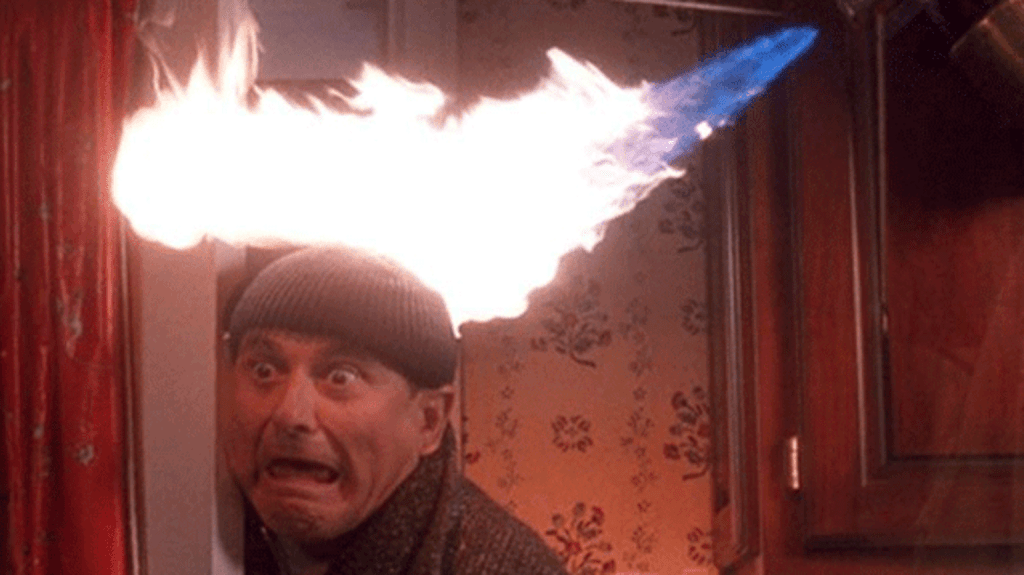
If I programme a boobytrap to kill or maim any intruder, the boobytrap has no agency. I assert further, that the maker of that boobytrap has no more responsibility than the killing device.
The old hand grenade wired to a doorknob boobytrap trick
But who do we blame? you ask, and that’s precisely the problem. Asking questions doesn’t presume answers. This is a logical fallacy and cognitive bias. This heuristic leaves us with faulty jurisprudence systems. Humans seem hardwired, as it were, to blame. Humans need to believe in the notion of free will because they need to blame because they need to punish because vengeance is part of human nature to the extent there is human nature. There seems to be a propensity to frame everything as a causal relationship. Dennett calls this the Intentional stance. To borrow a from Dennett…
This instinctual response is the source in evolution of the invention of all the invisible elves, goblins, leprechauns, fairies, ogres, and gods that eventually evolve into God, the ultimate invisible intentional system.
Dennett, Daniel C.. Intuition Pumps And Other Tools for Thinking (p. 374). W. W. Norton & Company. Kindle Edition.
Fire Trap in Home Alone
Sins of the Fathers (and Mothers)
Let’s wrap this up with a sorites paradox. As I’ve already said, I agree with Dennett that the absolute aspect is unnecessary and undesired. The question remains how much agency™ does a person have once we account for the other factors? Is it closer to 90 per cent or 10 per cent? Apart from this, what is the threshold for culpability? Legal systems already have arbitrary (if not capricious) thresholds for this, whether mental capacity or age, which basically distils back to the realm of capacity.
I have no basis to even venture a guess, but that’s never stopped me before. I’d argue that the agency is closer to zero than to one hundred per cent of the total, and I’d propose that 70 per cent feels like a reasonable threshold.
I could have sworn I’d posted a position on this after I read Robert Sapolsky’s Behave. Perhaps it’s never made it out of drafts.
In closing, I don’t think we need to settle the question of determinism versus free will to recognise that even without strict determinism, personal agency is still severely limited, and yet as our political systems presume a level of rationality that is not apparent, so do legal systems presume a level of agency not present.











 Philosophics