I’ve been pondering the notion of democracy. This is not new for me. I’ve looked around and asked myself, ‘If democracy is so great, why is it not more widely adopted’. I don’t mean why don’t other countries try it? And I don’t mean to confound the issue by arguing that a republic is not a democracy, the last refuge of the desperate.
Democracy is a pathetic belief in the collective wisdom of individual ignorance.
What I wonder is why, if it’s so good, why don’t companies structure democratically? Why not the military? I’ve always found this particularly humorous: An autocratic, socialised structure defending democracy. Some of the biggest democratic flag-wavers are military and ex-military.
I know that most military members in the US would be lucky to work flipping burgers at McDonald’s. Some speak of the mental illness and homelessness of military veterans, but this misses the direction of the arrow of causation. These people had a free ride, room, and board on Uncle Sam’s dime in the States—some other denomination elsewhere. It’s really no wonder that one wouldn’t want to give these people a voice in military affairs, and yet they do get a voice in civilian affairs. It’s a good thing almost half of Americans eligible to vote don’t.
The best argument against democracy is a five-minute conversation with the average voter.
Winston Churchill
I’ve already mentioned that democracy is a sham and its best feature is the illusion of control. I suppose if I come up with something better, I might write about it. Until then, it’s just one of many mediocre options.
Interestingly, some people’s options are asinine. Frank Karsten hawking his book and ideology on Beyond Democracy thinks that downsizing is the answer. Hans-Hermann Hoppe agrees, as he posits in several essays in Democracy: The God that Failed. I don’t disagree, but his basic point seems to be that 300MM people deciding is too much, so perhaps 10MM or 20MM might work better. What’s the limit? Why not 150? How is conflict among this smaller political units adjudicated? With this downsizing, how does the system control the urge for upsizing? In the end, this feels like more Libertarian, anarcho-capitalistic mental masturbation, which as I type this feels redundant. Unfortunately, the common denominator is people, and that’s Achilles’ heel.
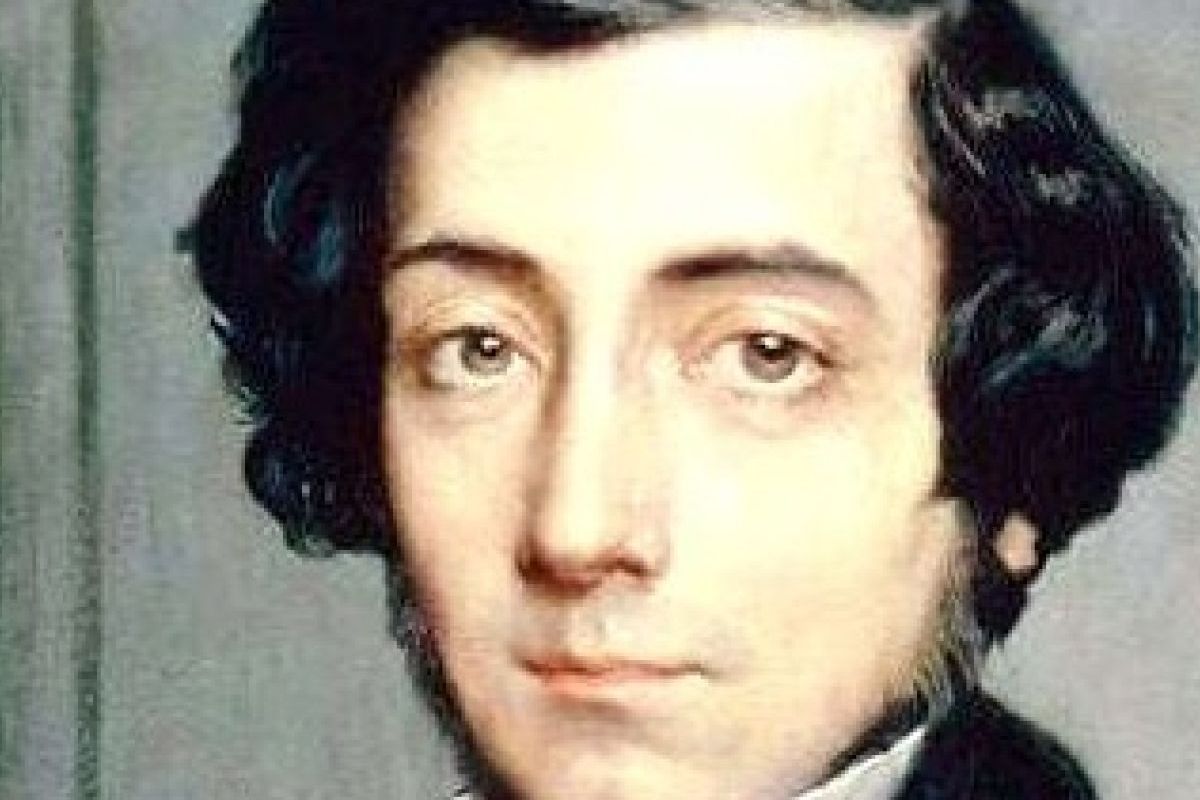
In the furtherance of my critique of Democracy, I’ve gone back to re-read de Tocqueville’s Democracy in America, an original critique, though with much promise at the time.
In the introductory chapter, de Tocqueville notes the tradeoffs democracy makes. Essentially, he recognises the mediocrity, but he senses it’s somehow worth it. I break up his paragraphs and italicise for emphasis.
I admit that, in a democratic State thus constituted, society will not be stationary; but the impulses of the social body may be regulated and directed forwards;
Here de Tocqueville presumes the metanarrative of progress and all it entails.
if there be less splendor than in the halls of an aristocracy, the contrast of misery will be less frequent also;
The middle class served this purpose, but this benefit is being eroded as the acquisitive classes have learnt how to game the system and pillage the public coffers.
the pleasures of enjoyment may be less excessive, but those of comfort will be more general;
Here he considers the masses, but he fails to distinguish them from the aristocracy, now manifest as the 1%.
the sciences may be less perfectly cultivated, but ignorance will be less common;
Literacy may be elevated under this system, perhaps owing as much to the needs of Capitalism than of Democracy. In the US, the pair are inextricable.
Here, de Tocqueville is spot on. I won’t defend science or progress, but if this is a goal, the post-truth era is testament to the need for cultivation. Science is like investing: there is a compounding effect. Failing to progress effects downstream advancements, not linearly, but geometrically.
the impetuosity of the feelings will be repressed, and the habits of the nation softened;
there will be more vices and fewer crimes.
Interesting point, but I won’t linger; vices are morality plays, and crimes are tautological—though I suppose he is hinting that the demos will consider fewer situations to qualify as crimes, and so they’ll be relinquished to the realm of vices.
In the absence of enthusiasm and of an ardent faith, great sacrifices may be obtained from the members of a commonwealth by an appeal to their understandings and their experience;
each individual will feel the same necessity for uniting with his fellow-citizens to protect his own weakness; and as he knows that if they are to assist he must coöperate, he will readily perceive that his personal interest is identified with the interest of the community.
The nation, taken as a whole, will be less brilliant, less glorious, and perhaps less strong
Alexis de Tocqueville
The nation, taken as a whole, will be less brilliant, less glorious, and perhaps less strong;
Indeed.
but the majority of the citizens will enjoy a greater degree of prosperity, and the people will remain quiet, not because it despairs of amelioration, but because it is conscious of the advantages of its condition.
Tocqueville gets partial credit for this insight.
If all the consequences of this state of things were not good or useful, society would at least have appropriated all such as were useful and good;
Tocqueville misses the mark a bit here, tripping himself up on a somewhat Utilitarian—if not Pollyanna—worldview.
and having once and for ever renounced the social advantages of aristocracy, mankind would enter into possession of all the benefits which democracy can afford.
But here it may be asked what we have adopted in the place of those institutions, those ideas, and those customs of our forefathers which we have abandoned.
The spell of royalty is broken, but it has not been succeeded by the majesty of the laws;
the people has learned to despise all authority, but fear now extorts a larger tribute of obedience than that which was formerly paid by reverence and by love.
Here de Tocqueville appears to suggest a citizenry that fears rather than reveres its government in classic Machiavellian splendour.
I perceive that we have destroyed those independent beings which were able to cope with tyranny single-handed;
the weakness of the whole community has therefore succeeded that influence of a small body of citizens, which, if it was sometimes oppressive, was often conservative.
the Government that has inherited the privileges of which families, corporations, and individuals have been deprived
Alexis de Tocqueville
but it is the Government that has inherited the privileges of which families, corporations, and individuals have been deprived;
Ever the Madisonian, de Tocqueville shows concern of the consolidation of power.
the weakness of the whole community has therefore succeeded that influence of a small body of citizens, which, if it was sometimes oppressive, was often conservative.
The division of property has lessened the distance which separated the rich from the poor;
Although there was more egality…
but it would seem that the nearer they draw to each other, the greater is their mutual hatred, and the more vehement the envy and the dread with which they resist each other’s claims to power;
…and Tocqueville was prescient here—, the enmity of the haves of the moneyed classes crashes full-force into the have nots as the fabric of separation becomes more and more threadbare, as with Samhain this weekend.
the notion of Right is alike insensible to both classes, and Force affords to both the only argument for the present, and the only guarantee for the future.
The poor man retains the prejudices of his forefathers without their faith, and their ignorance without their virtues;
he has adopted the doctrine of self-interest as the rule of his actions, without understanding the science which controls it, and his egotism is no less blind than his devotedness was formerly.
If society is tranquil, it is not because it relies upon its strength and its well-being, but because it knows its weakness and its infirmities;
a single effort may cost it its life;
everybody feels the evil, but no one has courage or energy enough to seek the cure;
Alexis de Tocqueville
everybody feels the evil, but no one has courage or energy enough to seek the cure;
the desires, the regret, the sorrows, and the joys of the time produce nothing that is visible or permanent, like the passions of old men which terminate in impotence.
I’ve been thinking a lot lately about Democracy and thinking that the emperor is wearing no clothes, but in dialogue, I am having difficulty getting people to understand that I am talking about democracy as a concept—the very essence of democracy—, not how some place or another has implemented it. My point is that democracy is a silly system built on false hope, smoke, and mirrors.
Some get it, and they fall back to the Churchill quote:
‘Many forms of Government have been tried, and will be tried in this world of sin and woe. No one pretends that democracy is perfect or all-wise. Indeed it has been said that democracy is the worst form of Government except for all those other forms that have been tried from time to time…’
—Winston S Churchill, 11 November 1947
But this misses the point.
First, Churchill’s logic is limited to ‘forms that have been tried‘, a minuscule set to be sure.
Next, perhaps he is talking a position of not letting perfection be the enemy of the good. Except there is no one seeking perfection. The question is: what is good enough? Is Democracy in and of itself good enough? And it doesn’t end there, are there systems—even theoretically—better than democracy? And then, how might these systems fair when humans populate the model?
The problem is a systems thinking optimisation problem—and then there’s the question of what democracy is attempting to optimise. Clearly, this is a multifactor model, so what outputs are being optimised? It’s not likely that this would be a steady state model, and much of this relies on an unstable preference theory, so what is optimal today might no longer be optimal tomorrow—or in ten minutes.
how does one optimise a heterogeneous model?
As anyone who follows me know, I have a problem with the notion of progress as well, so participants can vote on various definitions of progress and various initiates toward that end, and, of course, other participants would prefer the comfort zone of the nostalgic and familiar instead. So, how does one optimise a heterogeneous model?
In the business world or entertainment, we are all familiar with the concept of death by committee, the slow deliberative process that mostly yields diluted results—results that might make the participants feel that they had a voice (perhaps), but—that would be ineffectual.
I am not eschewing coöperation.
I am not eschewing coöperation. I’m of the age where the Beatles were a big influence on me—and the Rolling Stones—, so I cherish the partnerships of Lennon-McCartney and Jagger-Richards. Their solo material paled miserably. The collaboration was synergetic. But there is a reason Ringo and Charlie were not asked to participate in the song-writing process. Their inputs would not have improved the output. Even imagine listening to an album of Ringo tunes: Act Naturally, Yellow Submarine, Octopuses Garden, What Goes On, Don’t Pass Me By, and Boys? Really? Right? And he only contributed to two of these anyway, save for lending his vocal instrument.
consider the concept of diminishing marginal returns
As I continue down this stream of consciousness, I consider the concept of diminishing marginal returns. So, even if there were a democratic system that could theoretically be optimised, it would have to face the human factor—and that would be subject to the diminishing marginal return of knowledge and information—, as we’d go down the participation pool from highly knowledgeable to low-information voters. And this doesn’t even address vested interests and conflicts of interest. It doesn’t even touch on the point that people are predictably irrational.
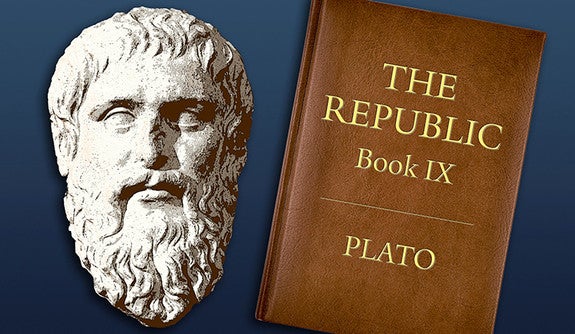
Plato’s Republic, in all of its elitist glory, offered a solution for this—aside from the philosopher-leader: a republic of the meritorious and virtuous (as if these were meaningful or measurable concepts). At least we wouldn’t be scraping the bottom of the barrel—or would we be?
merit being honed is how to gain and exert powerand political competency
The problem with Plato’s meritocratic approach is that the merit being honed is how to gain and exert power and political competency—how to play the game of politics. And notion of virtue was nothing more than a façade, so rhetoric and the decorum of appearance is all that matters in this model.
Clearly, this stream is coming to an end, so I’ll disembark here and reembark later.
As I research notions of democracy during this election cycle, I found several flavours of order by people, a core tenet of democracy.
As it happens, most people assume ‘order by people’ to mean order by the masses or the public-at-large, but there is not such magnitude provision for democracy. Ostensibly, it’s just people ruling people.
Historically, it is used to differentiate between anarchy, monarchy, oligarchy, and so on—though to be fair, save for anarchy, all of these involve people ruling people. And even anarchy is people exercising individual sovereignty.
Democracy’s Athenian origins had citizen-people ruling in a direct democracy. The catch, is that the definition of citizen excluded the majority of people—women, slaves, persons younger than 20, and so on—, so clearly it was not intended to be all-inclusive.
Another people-oriented order is demarchy—rule by the randomly selected. No modern country has ever adopted this form of government, but it should be noted that randomness has been used as part of selecting leaders in the past. Sortition, another term for random selection, was used for a hundred years in ancient Athens to choose members of the legislative council.
To be honest, given the political climate—at least in the United States —, random selection feels like a better alternative to the current system of meritocracy [sic].
Let’s face it and be honest: Democracy is not a great system of governance. In fact, it’s as mediocre as the outcomes it generates.
Plato hated it. He preferred a Republic, but all that does is kick the can down the proverbial kerb. A mob of demos voting for self-interested politicos with the gift of gab and self-promotion.
Alexis de Tocqueville noted that Democracy requires an education populace, but that’s the least of its shortcomings, and, man, was he spot on.
Democracy is the worst form of government, except for all the others.
— Winston Churchill
Winston Churchill is to have said, “Democracy is the worst form of government, except for all the others.” Except he didn’t get out much and probably hadn’t survey all the others he demeaned. I don’t reckon he was very imaginative at the start.
Kenneth Arrow demonstrated with his Impossibility Theorem that no voting system would work even if the concept was otherwise solid, so that’s just adding insult to injury.
to what extent is democracy simply playing on the cognitive illusion of control?
Democracy sounds good on paper, but to what extent is democracy simply playing on the cognitive illusion of control? I’d imagine that the more one feels able to control outcomes (or happen to be in sync with the decided outcomes), the more favourable one feels towards it. But as much one might assume the disenfranchised to be disillusioned by it—and against all logic—, many still defend it.
The problem, is course, is people, so what are the alternatives? Besides Democracy, some people are easily enamoured by the Beneficent Dictator, but the shortcomings of that have been debated for centuries. For the most part, monarchies have run their historical course—at least as far as to demonstrate that they are not a solution either.
Some have raised Artificial Intelligence as a solution, but unless AI can unlearn the human elements, it’s not much of an improvement. It’s just faster and more efficient within a sub-optimal system. And humans are fearful of how another superior entity might treat them—especially given how poorly humans treat encountered ‘inferior’ entities.
To be fair, I don’t have an answer, but any system that outputs Vladimir Putin, Boris Johnson, or Donald Trump is in serious need of an overhaul—especially simultaneously.
* I included the Democracy Now!’s logo in this post. Democracy Now! is neither affiliated with this blog or this post. Still, I suggest you check it out.
What’s an anarcho-syndicalist supposed to do in the advent of artificial intelligence, process automation, and robots?
Wikipedia relates anarcho-Syndicalism as follows:
Anarcho-syndicalism (also referred to as revolutionary syndicalism)[1] is a theory of anarchism that views revolutionary industrial unionism or syndicalism as a method for workers in capitalist society to gain control of an economy and thus control influence in broader society. Syndicalists consider their economic theories a strategy for facilitating worker self-activity and as an alternative co-operative economic system with democratic values and production centered on meeting human needs.
Anarcho-syndicalists view the primary purpose of the state as being the defense of private property, and therefore of economic, social and political privilege, denying most of its citizens the ability to enjoy material independence and the social autonomy that springs from it.[3] Reflecting the anarchist philosophy from which it draws its primary inspiration, anarcho-syndicalism is centred on the idea that power corrupts and that any hierarchy that cannot be ethically justified must either be dismantled or replaced by decentralized egalitarian control.[3]
As a matter of preference, I’ve leaned toward anarcho-syndicalism. I don’t have a lot of faith in humans or humanity to govern or self-govern. The arguments for this, whether monarchies, democracies, plutocracies, or even anarchies are each rife with its own sets of problems. Still, I favour a system where there is no class of governors, though I am more of a fan of Proudhon over Marx.
Mind you, I don’t think humans make very good judgements and are as bad in groups as individuals but for different reasons—and especially where complexity or too many choices are available. That we’ve survived this long is, quite frankly, a miracle.
This said, it isn’t my problem. My contention is with the syndicalist aspect. If all of this human as worker displacement occurs as some are forecasting, there will be precious few workers. I am not saying that this is inevitable or will ever happen. My concern is merely conditional. If this were to happen, the idea of a worker-centric system is daft.
Do we just defer to people categorically, where we arrive at simple anarchism? Without delving, there are different flavours of, and I have neither the time nor the inclination to debate, for example, the merits of anarco-capitalism (an oxymoron if there ever was one) versus anarcho-communism or anarcho-transhumanism for that matter.
Although, I like how Kant identified four kinds of government…
Law and freedom without force (anarchy)
Law and force without freedom (despotism)
Force without freedom and law (barbarism)
Force with freedom and law (republic)
…the whole notion of freedom is another weasel word, and laws without force are unenforceable—pun intended. At least the syndicalism felt like it was intentional or purposeful. I understand why Plato despised the rabble, but as with the sorites paradox in the heap-hill distinction, where to the rabble distil down to something meaningful?
Indeed, it has been said that democracy is the worst form of Government except for all those other forms that have been tried from time to time.
Sir Winston Chirchill
I am not a defender of or apologist for Democracy. Any system is only as strong as its weakest link, but save for the rhetorical promises Democracy is nothing but weak links. Turtles all the way down. It’s another failed Enlightenment experiment. Sure, you can argue that the Ancient Greeks invented democracy—or at least implemented it at any scale—, but specious Enlightenment ideals pushed it forward into the mainstream.
The Achilles’ heel of Democracy is the principle-agent problem, the same one that separates management (CEOs) from owners (shareholders). Incentives are different.
Achilles’ Heel
Plato published his solution is Republic, but this proposal was naive at best. The notion that meritocracy is something real or that we can appropriately understand dimensions and measures in order to create the right incentives is another weak link.
Plato’s Republic
We see the same problem controlling elected officials. Time and again, we elect them, and time and again, they disappoint. We, the People, are the principles, and the elected are our agents. People in the US (and in so-called ‘democratic’ societies) have the vote, and yet—per the oft-cited definition of insanity—, they perform the same action and continue to expect different results; in fact; they are always surprised). At its core, it’s an incentive and accountability problem.
Kenneth Arrow wrote about the Impossibility Theorem, where he proved mathematically that no voting system would yield optimal results. Democracy is cursed with mediocrity. We like to soft-pedal the notion of mediocrity with the euphemism of compromise, another Ancient Greek legacy of moderation. If this makes you feel better, who am I to break the delusion? Cognitive dissonance is a powerful palliative.
μηδέν άγαν
Do Nothing in Excess, Delphic Oracle Inscription
Interestingly enough, many people clamour for term limits (a subversion of democracy) because they can’t help themselves from voting for the same shit politicians over and again. They rationalise it and say it is to defend against the other guy’s vote because they’d have never voted for shit representation.
This is often couched as ‘save me from myself’, but it is just as aptly cast as ‘save me from democracy’. I suppose a heroin addict might have the same thoughts.
We take property for granted. John Locke espoused life, liberty, and property. Rousseau observed that “The first man who, having fenced in a piece of land, said “This is mine”, and found people naïve enough to believe him, that man was the true founder of civil society. From how many crimes, wars, and murders, from how many horrors and misfortunes might not any one have saved mankind, by pulling up the stakes, or filling up the ditch, and crying to his fellows: Beware of listening to this impostor; you are undone if you once forget that the fruits of the earth belong to us all, and the earth itself to nobody.”
The first man who, having fenced in a piece of land, said “This is mine,” and found people naïve enough to believe him, that man was the true founder of civil society.
But property and its defence is nothing more than some accepted rhetoric. Libertarians presume this to be some inviolable right, and Anarchists and Socialists believe that property—well, private property anyway; real property—is a common good.
I have an issue with ownership of real property, though I don’t have such a strong opinion on possession. In reality, this is more of a practical matter than a defensible philosophical position. It has emotivist roots. As Hobbes noted (or I’ll paraphrase liberally), even animals in his state of nature have possessions, but there is no right to these possessions (which belong to the monarch anyway in society); there is only the ability to try to retain ownership through force.
In practice, this is what society does. Insomuch as the force is more potential than kinetic, allowing the state or community to exercise this force by proxy, it is not dissimilar to our consumption of meat products at arm’s length by sheltering the violent reality by intermediary grocers.
And we shelter ourselves through language. We don’t eat cows and pigs, we eat beef and pork, chateaubriand and bacon.
Returning to property, real property, it’s yours as long as you possess it, but it is not yours from a distance, and it’s not yours to bequeath. If we are to embrace capitalism—which I don’t, but for the sake of argument—, we should allow the property to go to the purpose that will provide the greatest utility. History as a judge demonstrates that it is unlikely to happen to be the someone’s heirs.