
Disinterested

I must have missed the memo. Disinterested has merged into uninterested. Disinterested used to mean you mean impartial; now it means not interested. Whereas uninterested means not interested in a topic.

I am not strictly a prescriptivist when it comes to language, but it does provide a certain level of efficiency in communication. Descriptively, one needs to interpret conversation through some local lens, but one can’t persist a description for too long because it might have drifted the next time you try to apply it. Imagine having to negotiate meaning and intent every time we engage in communication.

Uninterested means not interested in a topic.

A car was a vehicle last week, but those are now called ABC because this week car means XYZ—only to have to reevaluate this shared meaning in the next contextual engagement.

Disinterested used to mean not being interested in the outcome.

Disinterested used to mean not being interested in the outcome. But that’s changed. It seems that now, in order to provide clarity of communication, we need to use the word impartial so as not to introduce the ambiguity now embedded in disinterested.

Recently, I was speaking with a well-educated linguaphile, and I mentioned that I was looking for a disinterested person to mediate a debate. This man is in his eighties, yet he immediately interpreted disinterested as uninterested. When I shared my understanding of the meaning, he conveyed that he was unfamiliar with that parsing. This came as a surprise to me because he is a psychiatrist and psychoanalyst—quite the word wordsmith in a Jungian sort of way. I presumed that he would have understood the distinction and nuance in the interpretation. Once I clarified, he adopted my meaning—at least within the scope of our conversation. This said, I might drop disinterested from my vocabulary altogether. I’ll retain uninterested in the way a always have, and I’ll employ impartial where I would have heretofore employed disinterested.

Did you get this memo? Do you use disinterested and uninterested as close synonyms or do you retain the nuance?
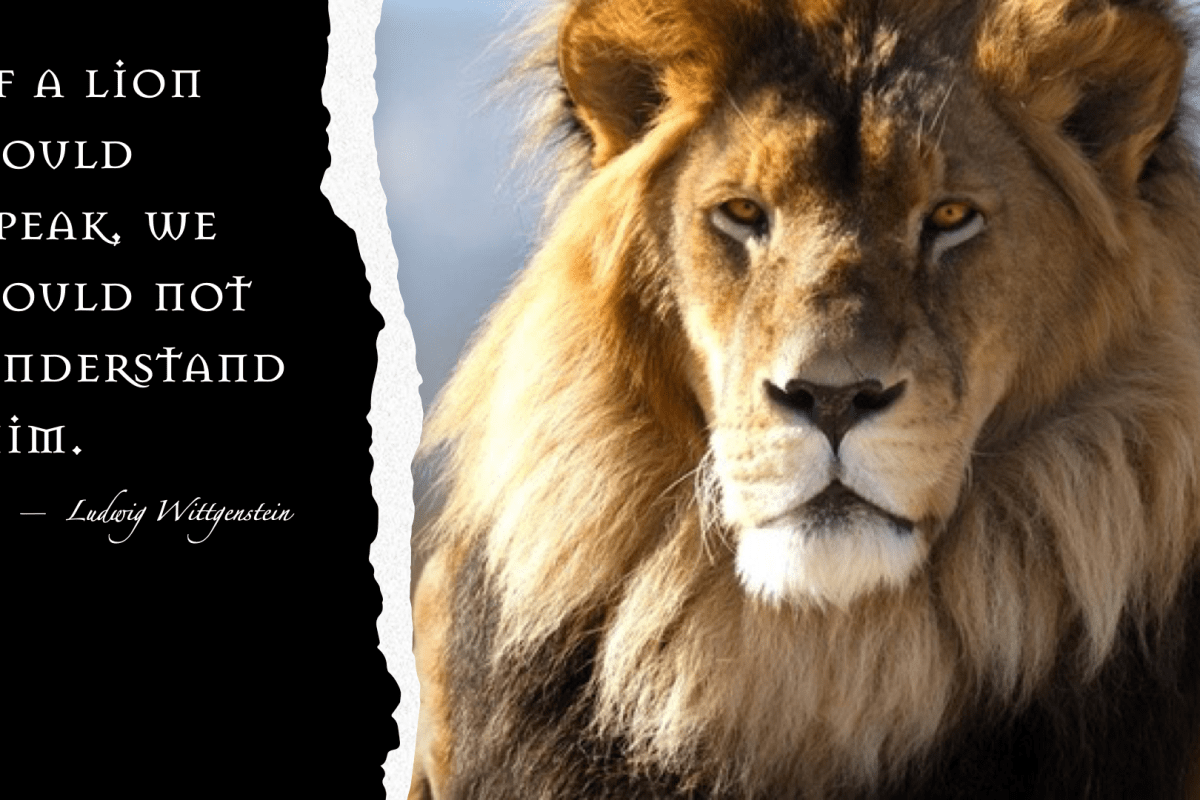

If a lion could speak

If a lion could speak, we could not understand him.

— Ludwig Wittgenstein

As much as I love Wittgenstein’s quote on language, I find it vastly more amusing aside the lion of Gripsholm Castle in Sweden. Because as talking lions come, this one is certainly more unintelligible than most.

If a lion could speak (Gripsholm Remix)

I also appreciate Daniel Dennett’s retort that if we could manage to communicate with this one talking lion—not, of course, this lion in particular—that it could not speak for the rest of lionity. (Just what is the equivalent of humanity for lions?)

If a lion could speak (traditional)

Ludwig Wittgenstein famously said, “If a lion could talk, we could not understand him.” ( [Philosophical Investigations] 1958, p. 223) That’s one possibility, no doubt, but it diverts our attention from another possibility: if a lion could talk, we could understand him just fine—with the usual sorts of effort required for translation between different languages—but our conversations with him would tell us next to nothing about the minds of ordinary lions, since his language-equipped mind would be so different. It might be that adding language to a lion’s “mind” would be giving him a mind for the first time! Or it might not. In either case, we should investigate the prospect and not just assume, with tradition, that the minds of nonspeaking animals are really rather like ours.

Daniel Dennet — Kinds of Minds: Toward an Understanding of Consciousness (p.18)

Misunderstanding

As part of my indictment against language and its insufficiency to facilitate precise and accurate transmission of abstract concepts, I happened upon a quote by Karl Popper:

It is impossible to speak in such a way that you cannot be misunderstood.

—Karl Popper

“However, the problem still remains: what should we do in order to make our meaning clearer, if greater clarity is needed, or to make it more precise, if greater precision is needed? In the light of my exhortation the main answer to this question is: any move to increase clarity or precision must be ad hoc or ‘piecemeal’. If because of lack of clarity a misunderstanding arises, do not try to lay new and more solid foundations on which to build a more precise ‘conceptual framework’, but reformulate your formulations ad hoc, with a view to avoiding those misunderstandings which have arisen or which you can foresee. And always remember that it is impossible to speak in such a way that you cannot be misunderstood: there will always be some who misunderstand you. If greater precision is needed, it is needed because the problem to be solved demands it. Simply try your best to solve your problems and do not try in advance to make your concepts or formulations more precise in the fond hope that this will provide you with an arsenal for future use in tackling problems which have not yet arisen.

— Unended Quest: An Intellectual Autobiography, Karl Popper

Popper’s point here is more that some people won’t understand what you are saying, which differs from my concept that some ideas just can’t be conveyed. Some people will assume their interpretation is the true meaning, but this assumption may be incorrect. Even more problematic is when different people assume to know the true meaning, yet their definitions differ materially.

Charles makes another point commenting on this quote on his Thing Finder blog.

And there will be even more who deliberately choose to misunderstand you. The man in search of truth will always be at risk from the man of conviction.

Charles Bayless, Thing Finder blog

Some if not most of this deliberate misunderstanding is captured in Upton Sinclair’s quip:

It is difficult to get a man to understand something, when his salary depends upon his not understanding it!

—Upton Sinclair

But this still doesn’t capture the point the some concepts are actually nebulous; there is nothing there there.

I’ll leave this post with a quote from Le Petite Prince:

Language is the source of misunderstandings.

—Antoine de Saint-Exupéry

Indeed, language is simultaneously expanding and limiting, but like faith in technology, faith in language may lead to an untimely end.