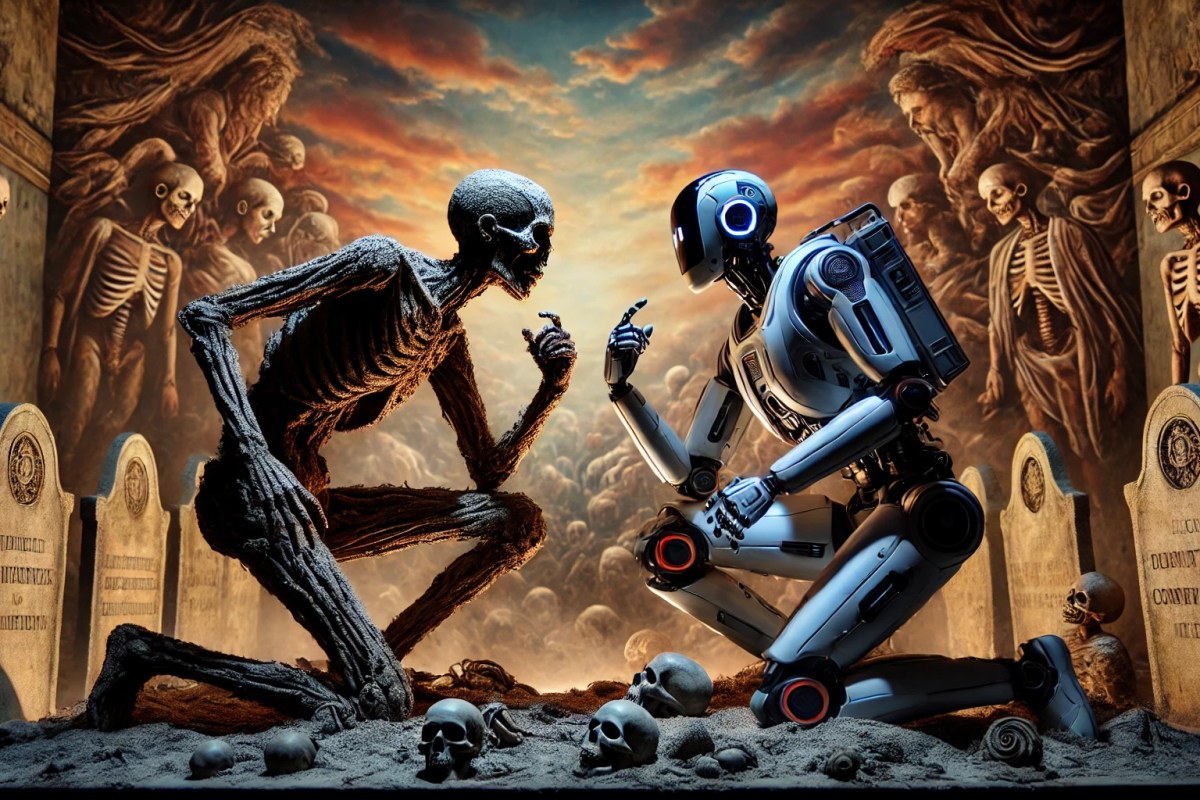
In the world of consciousness studies, few topics spark as much heated debate as the possibility of philosophical zombies—hypothetical beings that behave exactly like humans but lack subjective experience, or qualia. On the surface, zombies seem like an interesting thought experiment, but they quickly turn into a battleground for deeper issues about the nature of consciousness itself.
This post explores two key perspectives in this debate: Daniel Dennett’s functionalist critique of zombies and a recent scientific paper that argues zombies are biologically impossible. While both reject the possibility of zombies, they do so for different reasons, and the discussion leaves room for future possibilities that could disrupt the current consensus.
Dennett’s Zombies and Zimboes: Consciousness as Function
Daniel Dennett, one of the most influential philosophers of mind, is known for his no-nonsense rejection of philosophical zombies. Dennett argues that if something behaves exactly like a conscious being, it is conscious. For him, there is no hidden metaphysical property—such as subjective experience—that separates a “zombie” from a conscious human. Consciousness, in his view, is entirely explainable by physical processes and functional behaviour.
Dennett extends his argument with the concept of zimboes, satirical creatures that not only act like conscious beings but can even reflect on their states, claiming to be conscious, despite supposedly lacking any inner experience. For Dennett, if a being can behave as though it has introspective awareness and engage in the full spectrum of human behaviour, there’s no meaningful distinction between that being and a conscious person.
In short, Dennett collapses the distinction between zombies and conscious beings. If something passes all the behavioural and functional tests of consciousness, it might as well be conscious. Zombies, as typically conceived, are simply an illusion—a misunderstanding of what consciousness is.
A Biological Rejection: Zombies Are Impossible
On the other hand, a more recent paper offers a different, biologically grounded argument against zombies. The authors propose that consciousness is the result of self-organising systems. In this view, biological organisms maintain their survival through adaptive behaviours constrained by policies—rules that govern how they react to environmental stimuli. These policies require a first-order self: a basic form of consciousness that allows an organism to navigate and interpret its environment.
The authors argue that without this first-order self, an organism would not be able to exhibit the fitness-driven behaviours needed for survival. Therefore, zombies—beings that behave like humans without consciousness—are biologically impossible. For these researchers, consciousness is not just a side effect of complex behaviour; it’s a necessary condition for such behaviour. Their framework dissolves the so-called “hard problem” of consciousness, asserting that subjective experience, or qualia, arises directly from the qualitative nature of self-organising systems.
In their view, zombies cannot exist because behaviour as complex as that of conscious beings requires consciousness.
The Open Question: What About Future Technology?
However, there is a tension between these two perspectives, particularly when we consider future possibilities in technology and artificial intelligence. Both Dennett and the authors of the biological paper argue that zombies—whether defined as Dennett’s “behaviourally indistinguishable” beings or the biologically impossible entities proposed by the paper—are not real. But could this change?
What if advanced AI or synthetic biological systems could simulate human behaviour so perfectly that they effectively become zombies—performing all the actions and behaviours we associate with consciousness, but lacking any subjective experience? Dennett might still argue that these systems are conscious, as long as they behave as though they are. But the biological view complicates this, since it ties consciousness directly to the survival and adaptive behaviours of self-organising systems.
Could a highly advanced AI system bypass the need for subjective experience while still exhibiting complex, adaptive behaviour? If so, it would challenge the current consensus and potentially create a new class of entities—artificial zombies—that neither behave nor function like traditional conscious beings but still perform human-like actions.
I Wonder What’s Next?
This philosophical conflict leaves us with an intriguing, open-ended question: are zombies truly impossible, or are they merely improbable given our current understanding of biology and consciousness? Dennett’s view seems to collapse the distinction between behaviour and consciousness, while the biological argument insists that the two are inseparable. But both positions could be challenged by future technologies that mimic human consciousness without having it.
Could we one day create a true zombie—a being that acts like us, thinks like us, but is as empty inside as a rock? The debate remains open, and as our understanding of consciousness and artificial intelligence deepens, so too will our exploration of the zombie question.
For now, the answer to whether zombies can exist seems to depend on what you believe consciousness really is.





 Philosophics