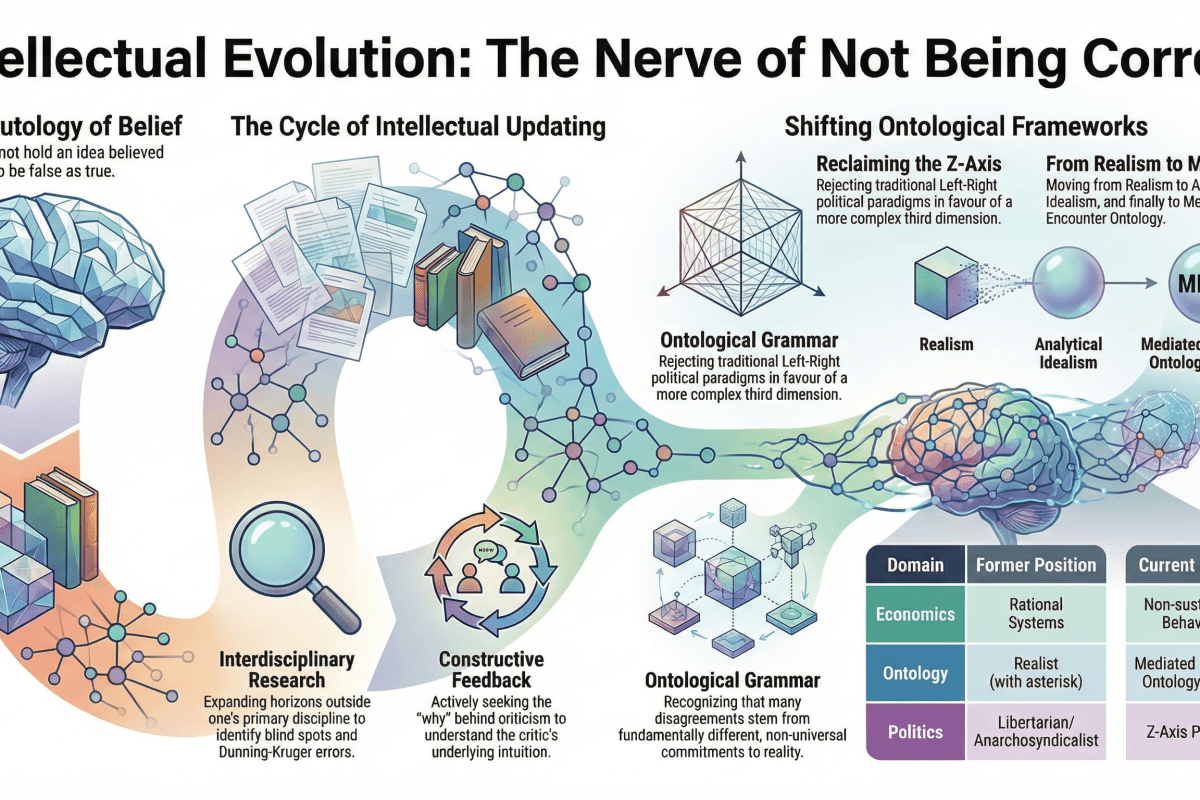
I’ve received feedback like, ‘Not everything you believe is right’ and ‘What if you’re not right?’
First: I agree. Second: And what if I’m not?
This isn’t new feedback, but I’ll address it in terms of my latest work.
Not everything you believe is right
This is true, but one cannot hold an idea one believes to be false as true, so the idea that one believes what one believes to be true to tautological. This is also why I continue to research and attempt to expand my horizon. I even wander outside of my discipline at the risk of Dunning-Kruger errors.
In my recent work on ontology and grammar, I collided with Bourdieu, so I read his work. As helpful as it was, it served to reinforce my position, but from a position of Social Theory instead of Philosophy. When I read Judith Butler, I see how I might connect my ideas to Gender theory. It should be obvious that I’ve read much on Linguistics, but I am not a linguist. Our lenses all differ to some extent.
I’ve even corrected some of the ideas I’ve posted on this blog as I gain new information. To be fair, it’s a reason I post here. I hope to get feedback. I may not fully pursue alternative disciplines, but it’s nice to know they exist, and I can at least perform cursory surveys.
If I am wrong – or if you think I am wrong – tell me. If you can, tell me why. If not precisely why, then what’s your intuition?
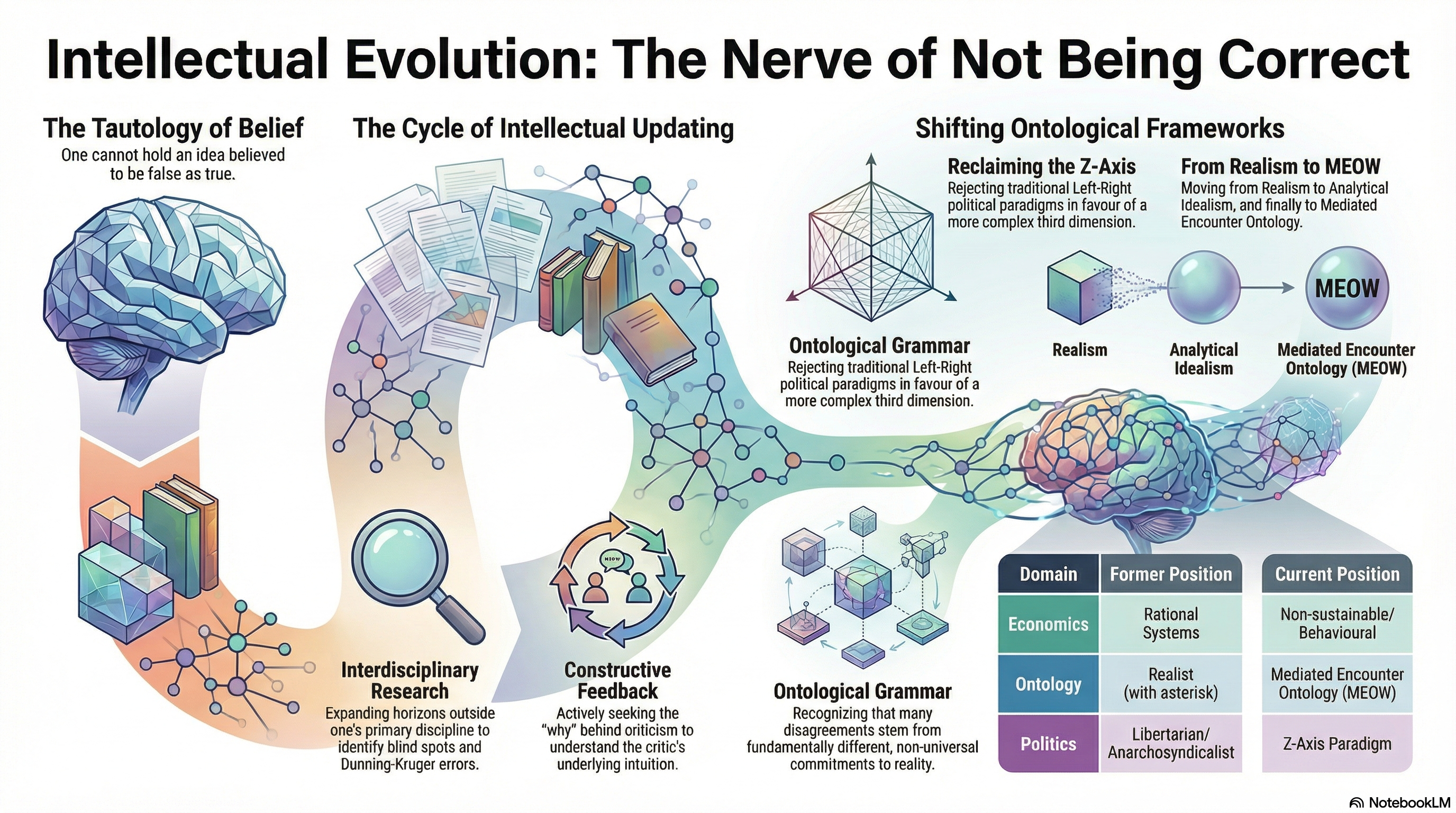
Historically, many times I’d been claimed to be wrong because the person was coming from a differnt ontology. I might have been arguing something within the realm of Continental philosophy, and I’d get a critique from an Analytical philosopher. This is akin to a vegan critiquing a steak dinner. It may be valid within their ontological grammar, but it is not otherwise universal. It usually doesn’t take very long to assess one’s commitments to other grammars. That happened recently, when I encountered a philosophical Realist.
When I wouldn’t accept their position, eventually we arrived at this foundational point. Realism is a position I ontologically and grammatically reject. I’ve written several pieces defending or at least articulating my position, notably the Mediated Encounter Ontology (MEOW). Disagree? Tell me.
I used to be a Realist with an asterisk; then I was an Analytical Idealist with an asterisk; now, I believe in MEOW. The asterisk was necessary because there were holes in the position. When Analytical Idealism came around, there was still an asterisk, but it felt better than that of Realism. When I came up with MEOW, the asterisk went away. Perhaps you might consider that MEOW has an asterisk, if you believe it’s plausible at all. If so, what’s missing – what’s the known unknown? You obviously can’t articulate an unknown unknown.
When I write about ontology, grammar, and commensurability, I do not exempt myself from these biases. I have all of these challenges – perhaps even more so because I don’t tend to fit into the round holes very well myself. This helps me with intellectual humility.
Politically, I am often accused of being on the Left, but I reject the Left-Right paradigm as a valid lens for me; I am on a different axis. The Libertarians added an Authority-Liberty Y-axis to the Progressive-Conservative X-axis, but I am on a Z-axis, which is not to be fully described or accounted for on these planes. Think of the message of Flatland.
What if you’re wrong?
Hopefully, every philosopher understands this and has noticed the dustbin of history littered with wrong ideas.
When I publish essays, they are the result of research and deliberation. Could I be wrong? Again, I’ve been wrong before. I’ll be wrong again, but I need to understand why to change my position. I could shift my position or abandon it outright.
There was a time I believed people to be rational. I was an economist. I studied finance. I believed it until I didn’t. Behavioural Economics likely did the heavy lifting, but it’s likely that they believe that rationality-based systems are salvageable. I don’t. Not meaningfully. Not sustainably.
So, I can be wrong, and I can admit it.
I was once a closet (or adjacent) Libertarian until I realised it didn’t cohere with reality. My last declared stance was an Anarchosydicalist, but I know this isn’t quite right either – on multiple accounts.
Anyway, I’m not afraid of being wrong, and I’m not afraid of wittering on about it. Again, I appreciate constructive criticism. I’m also amicable to non-solutions in the manner of my Dis–Integration approach, but at least break down the pieces.




 Philosophics