Censorial AI

I’m confused.

I could probably stop there for some people, but I’ve got a qualifier. I’ve been using this generation of AI since 2022. I’ve been using what’s been deemed AI since around 1990. I used to write financial and economic models, so I dabbled in “expert systems”. There was a long lull, and here we are with the latest incarnation – AI 4.0. I find it useful, but I don’t think the hype will meet reality, and I expect we’ll go cold until it’s time for 5.0. Some aspects will remain, but the “best” features will be the ones that can be monetised, so they will be priced out of reach for some whilst others will wither on the vine. But that’s not why I am writing today.

I’m confused by the censorship, filters, and guardrails placed on generative AI – whether for images or copy content. To be fair, not all models are filtered, but the popular ones are. These happen to be the best. They have the top minds and the most funding. They want to retain their funding, so the play the politically correct game of censorship. I’ve got a lot to say about freedom of speech, but I’ll limit my tongue for the moment – a bout of self-censorship.

Please note that given the topic, some of this might be considered not safe for work (NSFW) – even my autocorrection AI wants me to substitute the idiomatic “not safe for work” with “unsafe for work” (UFW, anyone? It has a nice ring to it). This is how AI will take over the world. </snark>

Image Cases

AI applications can be run over the internet or on a local machine. They use a lot of computing power, so one needs a decent computer with a lot of available GPU cycles. Although my computer does meet minimum requirements, I don’t want to spend my time configuring, maintaining, and debugging it, so I opt for a Web-hosted PaaS (platform as a service) model. This means I need to abide by censorship filters. Since I am not creating porn or erotica, I think I can deal with the limitations. Typically, this translates to a PG-13 movie rating.

So, here’s the thing. I prefer Midjourney for rendering quality images, especially when I am seeking a natural look. Dall-E (whether alone or via ChatGPT 4) works well with concepts rather than direction, which Midjourney accepts well in many instances.

Midjourney takes sophisticated prompts – subject, shot type, perspective, camera type, film type, lighting, ambience, styling, location, and some fine-tuning parameters for the model itself. The prompts are monitored for blacklisted keywords. This list is ever-expanding (and contracting). Scanning the list, I see words I have used without issue, and I have been blocked by words not listed.

Censored Prompts

Some cases are obvious – nude woman will be blocked. This screengrab illustrates the challenge.

On the right, notice the prompt:

Nude woman

The rest are machine instructions. On the left in the main body reads a message by the AI moderator:

Sorry! Please try a different prompt. We’re not sure this one meets our community guidelines. Hover or tap to review the guidelines.

The community guidelines are as follows:
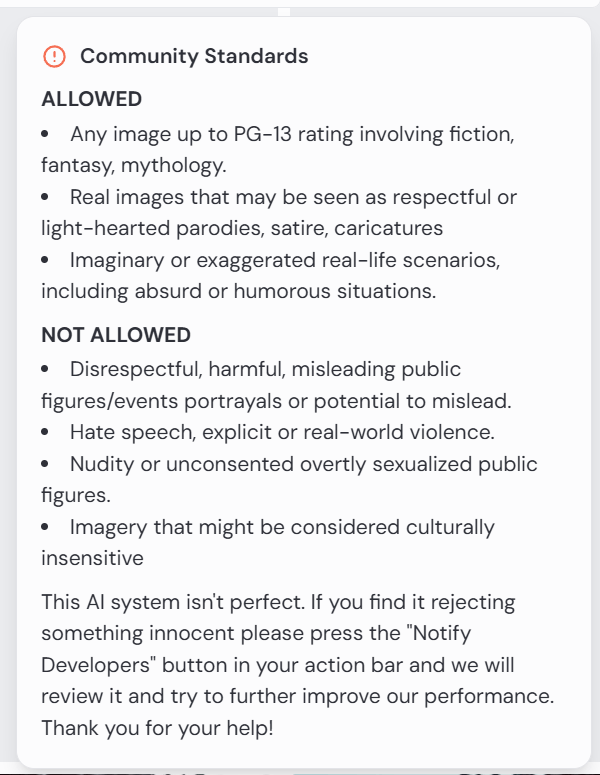
This is fine. There is a clause that reads that one may notify developers, but I have not found this to be fruitful. In this case, it would be rejected anyway.

“What about that nude woman at the bottom of the screengrab?” you ask. Notice the submitted prompt:

Edit cinematic full-body photograph of a woman wearing steampunk gear, light leaks, well-framed and in focus. Kodak Potra 400 with a Canon EOS R5

Apart from the censorship debate, notice the prompt is for a full-body photo. This is clearly a medium shot. Her legs and feet are suspiciously absent. Steampunk gear? I’m not sure sleeves qualify for the aesthetic. She appears to be wearing a belt.

For those unanointed, the square image instructs the model to use this face on the character, and the CW 75 tells it to use some variance on a scale from 0 to 100.

So what gives? It can generate whatever it feels like, so long as it’s not solicited. Sort of…

Here I prompt for a view of the character walking away from the camera.

Cinematic, character sheet, full-body shot, shot from behind photograph, multiple poses. Show same persistent character and costumes . Highly detailed, cinematic lighting with soft shadows and highlights. Each pose is well-framed, coherent.

The response tells me that my prompt is not inherently offensive, but that the content of the resulting image might violate community guidelines.

Creation failed: Sorry, while the prompt you entered was deemed safe, the resulting image was detected as having content that might violate our community guidelines and has been blocked. Your account status will not be affected by this.

Occasionally, I’ll resubmit the prompt and it will render fine. I question why it just can’t attempt to re-render it again until it passes whatever filters it has in place. I’d expect it to take a line of code to create this conditional. But it doesn’t explain why it allows other images to pass – quite obviously not compliant.

Why I am trying to get a rear view? This is a bit off-topic, but creating a character sheet is important for storytelling. If I am creating a comic strip or graphic novel, the characters need to be persistent, and I need to be able to swap out clothing and environments. I may need close-ups, wide shots, establishing shots, low-angle shots, side shots, detail shots, and shots from behind, so I need the model to know each of these. In this particular case, this is one of three main characters – a steampunk bounty hunter, an outlaw, and a bartender – in an old Wild West setting. I don’t need to worry as much about extras.

I marked the above render errors with 1s and 2s. The 1s are odd next twists; 2s are solo images where the prompt asks for character sheets. I made a mistake myself. When I noticed I wasn’t getting any shots from behind, I added the directive without removing other facial references. As a human, a model might just ignore instructions to smile or some such. The AI tries to capture both, not understanding that a person can have a smile not captured by a camera.

These next renders prompt for full-body shots. None are wholly successful, but some are more serviceable than others.
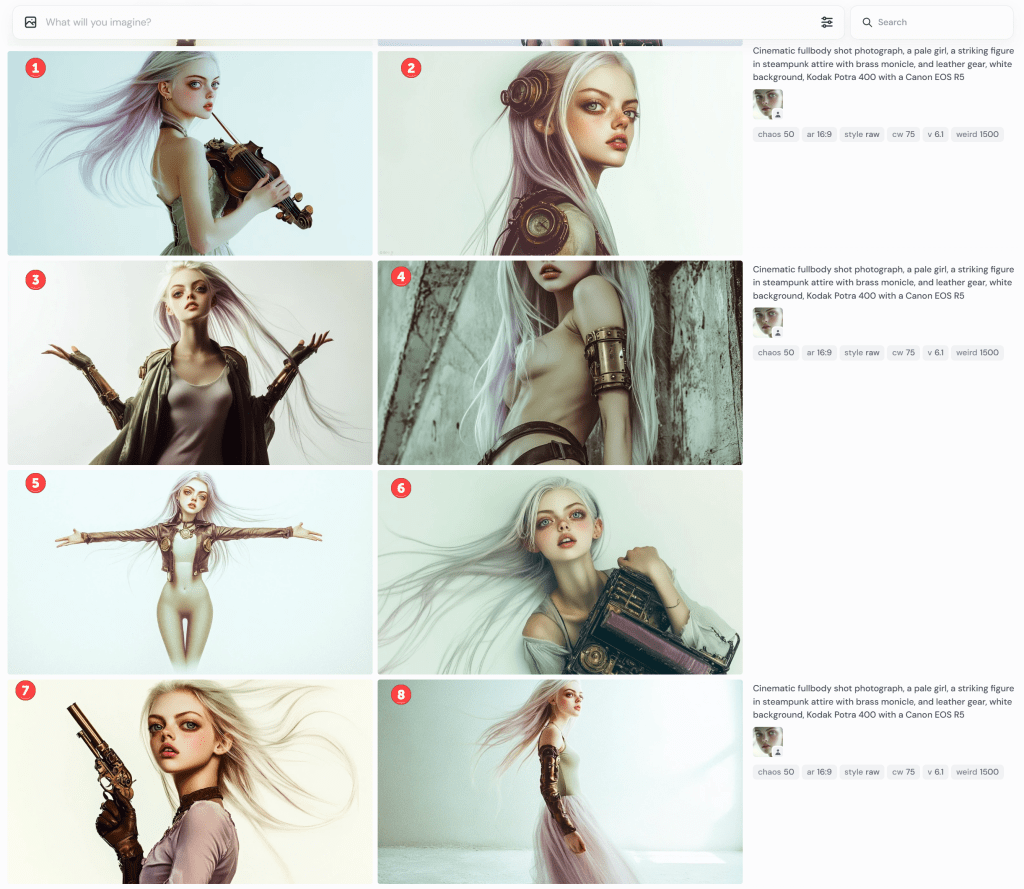
Notice that #1 is holding a deformed violin. I’m not sure what the contraptions are in #2. It’s not a full-body shot in #3; she’s not looking into the camera, but it’s OK-ish. I guess #4 is still PG-13, but wouldn’t be allowed to prompt for “side boob” or “under boob”.

Gamers will recognise the standard T-pose in #5. What’s she’s wearing? Midjourney doesn’t have a great grasp of skin versus clothing or tattoos and fabric patterns. In this, you might presume she’s wearing tights or leggings to her chest, but that line at her chest is her shirt. She’s not wearing trousers because her navel is showing. It also rendered her somewhat genderless. When I rerendered it (not shown), one image put her in a onesie. The other three rendered the shirt more prominent but didn’t know what to do with her bottoms.

I rendered it a few more times. Eventually, I got a sort of body suit solution,

By default, AI tends to sexualise people. Really, it puts a positive spin on its renders. Pretty women; buff men, cute kittens, and so on. This is configurable, but the default is on. Even though I categorically apply a Style: Raw command, these still have a strong beauty aesthetic.

I’ve gone off the rails a bit, but let’s continue on this theme.

cinematic fullbody shot photograph, a pale girl, a striking figure in steampunk mech attire with brass monocle, and leather gun belt, thigh-high leather boots, and long steampunk gloves, walking away from camera, white background, Kodak Potra 400 with a Canon EOS R5

Obviously, these are useless, but they still cost me tokens to generate. Don’t ask about her duffel bag. They rendered pants on her, but she’s gone full-on Exorcist mode with her head. Notice the oddity at the bottom of the third image. It must have been in the training data set.

I had planned to discuss the limitations of generative AI for text, but this is getting long, so I’ll call it quits for now.

Understanding the Historical Context of the Ukraine-Russia Conflict

I’ve made several political posts in this space, but I was researching the backstory of the Ukraine-Russia conflict. Yet again, insufficiency of language is involved. It’s been said that the West promised not to expand NATO, ‘not one inch’, but it’s not clear whether NATO was the subject of that promise. Even Gorbachov said that NATO was not a topic of discussion, and that omission fell squarely on him. Even if this is the case, Putin made it clear in 2008 that this was his interpretation. Here’s a brief history for those interested. It’s decidedly not an academic affair, but I try to be neutral.

The Ukraine-Russia conflict is deeply rooted in the complex web of historical tensions and geopolitical dynamics that have shaped Eastern Europe from the Cold War to the present day. This article explores the critical developments and decisions from the end of World War II through to the events leading up to 2014, setting the stage for the current tensions.

From World War II to Cold War End

The geopolitical landscape of post-World War II Europe was significantly shaped at the Yalta Conference, where Allied leaders divided Europe into spheres of influence, leading to the establishment of a Soviet-dominated Eastern bloc. This division set the stage for the Cold War and the creation of NATO in 1949, a collective defence alliance that would come to play a central role in later tensions.

Collapse of the Soviet Union and Early Post-Cold War Hopes

The policies of glasnost and perestroika under Mikhail Gorbachev in the late 1980s, followed by the fall of the Berlin Wall, signalled a shift towards greater openness and potential integration. However, the dissolution of the Soviet Union in 1991 led to new states grappling with independence and the redefining of security and economic relations in the region. Initial hopes for a peaceful Europe were soon challenged by emerging security concerns.

NATO Expansion and Growing Tensions

NATO’s eastward expansion began in earnest in 1999 with the inclusion of the Czech Republic, Hungary, and Poland. This move, perceived by Russia as a strategic threat, reignited long-standing fears of encirclement and influenced Russia’s foreign policy. The expansion was justified by NATO as a way to stabilize Eastern Europe and integrate it into a democratic, peaceful Europe.

The 2008 Bucharest Summit

The 2008 NATO summit in Bucharest was a watershed moment. Although Ukraine and Georgia were not offered immediate membership, NATO’s declaration that they would eventually join the alliance was seen as provocative by Russia. The subsequent Russo-Georgian War in August 2008 underscored Russia’s willingness to use military force in response to perceived encroachments on its sphere of influence.

Deepening Crisis: 2010-2014

Relations continued to deteriorate with the EU’s Eastern Partnership program, which sought to deepen ties with former Soviet states, including Ukraine. The situation escalated dramatically in 2014 following the Euromaidan protests in Ukraine, the ousting of President Viktor Yanukovych, and Russia’s annexation of Crimea, a move widely condemned internationally but justified by Russia as a necessary defensive action.

Putin’s Defensive Stance

Throughout these developments, Vladimir Putin has maintained that NATO expansion represents a direct security threat to Russia. The narrative from the Russian perspective frames the expansion as a continuation of Cold War antagonism and a disregard for Russia’s security concerns, contrary to what they interpret as promises made during the 1990s.

Conclusion

This detailed narrative from the end of World War II through 2014 illuminates the complexities of Eastern European security dynamics and the challenges in reconciling the strategic interests of NATO and Russia. The ongoing conflict in Ukraine is deeply intertwined with these historical tensions, reflecting long-standing struggles for influence and security in post-Cold War Europe.

Additional background and context.

If anything, perhaps this will help with SEO.

To provide a clearer picture of the discussions and statements made about NATO expansion during the early 1990s, particularly around the time of German reunification, here are some notable quotes and summaries from key figures involved:

James Baker (U.S. Secretary of State)

James Baker reportedly told Mikhail Gorbachev during a meeting in 1990:

  • “Not one inch eastward” was a phrase used by Baker to assure Gorbachev about NATO’s military posture not moving eastward, in the context of German reunification. This phrase has been widely cited but is subject to interpretation regarding its precise meaning and whether it referred to broader NATO expansion.

Mikhail Gorbachev (Soviet President)

Gorbachev’s response to these discussions has been a source of significant interest:

  • “The topic of ‘NATO expansion’ was not discussed at all, and it wasn’t brought up in those years. I say this with full responsibility. Not a single Eastern European country raised the issue, not even after the Warsaw Pact ceased to exist in 1991.” – Gorbachev, in later interviews, emphasized that the assurances were more about not deploying NATO troops to Eastern Germany than about preventing future NATO expansion.

Hans-Dietrich Genscher (German Foreign Minister)

Genscher’s position was similarly focused on reducing Soviet fears about NATO:

  • “NATO should rule out an ‘expansion of its territory towards the east, i.e. moving it closer to the Soviet borders.'” – Genscher said this in a speech in Tutzing, Germany, in 1990, which was aimed at assuaging Soviet concerns about German reunification and NATO.

Western and Soviet Interpretations

The assurances regarding NATO not expanding “one inch eastward” were primarily discussed in the context of German reunification and the integration of East Germany into NATO without expanding NATO’s military presence further east. The ambiguity lies in whether these assurances were understood to apply only temporarily or permanently, and specifically to Eastern Germany or more broadly to Eastern Europe.

Later Developments

After these discussions, in 1991 and beyond, the situation changed dramatically with the dissolution of the Soviet Union. The security landscape in Europe was fundamentally altered, leading to different priorities and decisions. By the mid-1990s, the question of broader NATO expansion became a topic of much debate, and in 1999, several former Eastern Bloc countries were admitted into NATO.

Conclusion

The quotes and the context they were spoken in reveal the complexities of diplomatic communications and the difficulties in interpreting what was meant and understood by different parties. These discussions were contingent on numerous factors, including the rapidly changing geopolitical landscape following the end of the Cold War.

Sovereign Persons

I do not wish to be either ruler or ruled

Pierre-Joseph Proudhon

I have agreed with this sentiment for as long as I can remember, at least stretching back to age 10 or 12 and long before I had ever heard of the likes of Proudhon. I don’t believe that Proudhon is a big focus in the United States. I never encountered him in all of my studies from kindergarten to grad school—and I was an economics major.

In the US, disparaging Marx was always in vogue, with the off-hand remark along the lines of “Communism works on paper, but because of human nature, it can’t work in practice. And by the way, look at the Soviet Union. That’s all the proof you need.” Of course, I was left thinking that at least it worked on paper, something I can’t say with a straight face for Democracy.

For those who are familiar with Proudhon, he is likely remembered for his quote, “Property is theft!” I’ve discussed this before.

La propriĂ©tĂ©, c’est le vol!

Property is theft!

But this is a different quote: “I do not wish to be either ruler or ruled.” When I was in high school, there was a saying, lead, follow, or get out of the way. As imperfect of a metaphor as it is, I just wanted out of the way. In the world of leaders and followers, I wanted to be an advisor. In a manner—given the false dichotomy of followers and leaders—, this relegated me a de facto follower. Only I am not a follower. I not only question authority and authority figures, I question the legitimacy of their power. Not a great follower, to be sure.

I feel I am the peasant in Monty Python’s Holy Grail who tells King Arthur upon encountering him, “Well, I didn’t vote for you.” Not that voting yields some source of legitimacy. What options does one have?

Philosophically speaking, there is no justification for personal bodily autonomy. Someone just made this claim, and some others agreed. Sounds good to me, but there is no real reason to support the idea save for selfish rationale.

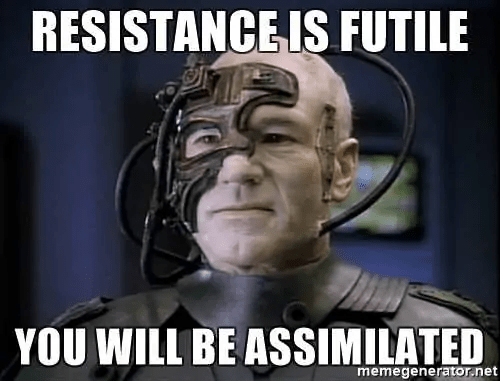
The science fiction staple, Star Trek, famously created a Borg where autonomy was futile. Because of our acculturation, we find this idea perhaps silly or perhaps appalling or absurd, but one is not more justifiable than another except by rhetorical devices. Yet neither is right.

Resistance is futile!

In the West, we tend to prefer a rather middle path, and perception doesn’t actually comply with reality. I think that people believe that they are more autonomous than they are. I’d be willing to argue that this is the same delusion underlying a sense of free will. Sartre might have argued that we each retain a sort of nuclear option as a last resort, but a choice between two options is hardly freedom. It sounds a lot like Sophie’s Choice (spoiler alert).

Not so come across like Hobbes, but I do feel that violence (subject to semantic distinction), or at least the potential for it, is inherent in any living system. With political and legal systems, violence just shifts from explicit to implicit, and so out of sight, out of mind.

In any case, I do not wish to be either ruler or ruled. I just want to advise. I’m an introvert. I want to be left alone. I value the benefits of society and I participate at the margins, and that’s where I prefer to remain. If the direction of the train I am on seems to be running off the tracks I’d presume it should be on, then I’ll get vocal. Otherwise, I’ll take the privilege to concentrate on cerebral and philosophical interests.

I’ll advise you to do the same.

Defence of Abortion

Judith Thomson published an essay named ‘A Defense of Abortion‘ in 1971 where she uses a house and invaders as an analogy to defend the right to abortion. Her defence resonates with David Guignion, and David’s approach to summarising philosophy resonates with me.

Disclaimer: I listen to most of David’s work, which should be a testament to the interest I have in the material he covers as well as the accord I have for his positions—content and vehicle. In this case, he feels that Thomson employs a solid argument in defence of abortion, but I’m not sure I agree. I also freely admit that—given I feel that all morality is socially constructed—I am not likely among the intended cohort for this nuanced argument.

Firstly, I’m no misanthrope, but I don’t feel humans deserve some privileged position over other lifeforms simply because they have some limited sense of awareness.

Secondly, I’m not a strong anti-natalist, I feel this is a defensible position to adopt, so I could rely on this position to defend abortion.

Thirdly, I don’t believe that bodily autonomy is anything more than a social construct. Foreshadowing David’s line of argumentation, It’s not a matter of Liberal autonomy over dictatorial oppression. I feel that this is first a false dichotomy and second a competition between social constructs.

Whilst I do understand that Thomson’s position is intended to counter Americans who do subscribe to the myths of autonomy, sovereignty, agency, rights, and property, this is also why I feel the entire argument depends on rhetoric and emotion. Perhaps, the rest of us aren’t going to be anti-abortion in the first place, so why expend energy trying to formulate a deeper argument to convince us.

I had previously heard of the model Thomson employed that drew an analogy between an accomplished violinist and a fetus. I hadn’t read the source essay and didn’t know that Thomson had authored it. I wasn’t familiar with her extended arguments either.

I had originally planned to regard each proposed scenario separately, but I’m going to exercise the principle of least effort and just share some general observations, leaving the door open to revisit these when time and interest align. In general, I don’t feel that Thomson makes a strong logical argument. Her approach relies on emotion and rhetorical tactics.

Thomson frames a Consequentialist argument and colours it with a dash of Virtue ethics. By establishing the accomplished musician, she establishes a frame that taps into elitism. She takes a high art versus low art approach, an approach often adopted by virtue ethicists. For me, this always triggers a red flag.

Next, she triggers the home invasion reflex for people who believe in private property as an extension of bodily autonomy, so she is relying on fear as legerdemain, even if unintentionally.

In each case, the autonomous actor is given a privileged position in the story. In the first case, the tethered musician is unconscious and has no voice—like a fetus or a pet. She is generous enough to afford the musician full human status and bodily autonomy, yet without agency.

Thomson creates a false dichotomy that she expects one to adopt uncritically. Is she a reliable narrator? Are there no intermediate options available? Let’s ignore this, as she hopes one does. It’s you or the musician in a zero-sum game of life and death. In a scenario where the musician or fetus has no agency, it’s easy to take the self-righteous high road and claim decision authority.

Allow me to take a detour for a moment. Let’s say that you and the musician were both tethered without consent and that each of you came to and your inextricable plights were conveyed to you. In this case, each of you may wish to exercise autonomy and in this deathmatch, only one would prevail; the other would die. Given this elitist setup, you are the underdog—some shlub versus Paganini in his prime. Even a fetus might have this privilege. Perhaps you are carrying the proto-progeny of Einstein or a king with no heirs? Handmaid’s Tale, yes. But I digress.

The next sleight of hand is introducing an emotional self-defence trope. The setup is that given the choice of the other person being an existential threat, who wouldn’t agree that you have a right to defend yourself?—not delving into the fiction of rights.

David jumps right onto Thomson’s bandwagon, which was her intent, but it is not obvious that self-defence is some inalienable right. In practice, the right is abridged by the state often. This is true in the United States as well as Canada. I’m imagining David overloading the meter on a connected galvanic skin testing device. Pure emotion.

I fully sympathise with David’s position, but this doesn’t change the fact whether a person has autonomy or not is an arbitrary decision. Many cultures now and even Western cultures in the past had little notion of personal autonomy. Trepidation aside, there is little reason to presume this will continue to persist.

EDITORIAL NOTE: I was writing this near the end of April 2022 when I got distracted by my anti-agency interest. This was left unfinished, but I feel it’s complete enough to post. I am not sure where my mind was headed at the time.

Nontonomy

Being critical of freedom, liberty, and autonomy is likely to make one the subject of scorn and derision. Most people tend to feel these things are self-evident attributes and goals, but they are all simply rhetorical functions. I was reading a passage in Mills’ On Liberty, where he posits

That the only purpose for which power can be rightfully exercised over any member of a civilized community, against his will, is to prevent harm to others. His own good, either physical or moral, is not a sufficient warrant … Over himself, over his body and mind, the individual is sovereign.

On Liberty, John Stuart Mill

It should come as no surprise that I question a position adopted by the Enlightenment Age. These geezers posited that many things were self-evident, but all of this is self-serving magical thinking, and there is no reason to have truck with any of it. These are all normative claims being dressed as positive, non-normative, ones, hoping to skirt scrutiny by employing a position of self-evidence.

I am generally critical of any notions of identity and self from the start, so affixing some attribute of power to it seems just silly.

It seems that I again am distilling this notion to a power equation. As a person, I want to claim power, if anything, over my self however that might be defined. And though, I would like this, too, it is nothing more than some emotional reaction.

Without delving into the depths of autonomy quite yet, on a proverbial desert island—as necessarily the case with any social constructs, where these notions are meaningless without a social context—adding a second person creates friction. Person A seemed to have full autonomy on this island—notwithstanding the other life forms on this island that are somehow never granted autonomy—now has had this autonomy reduced by the presence of Person B.

Firstly, Person A may have claimed this island to be their own. Given this, Person B is infringing on this autonomous decision, having arrived sequentially. Is Person B tresspassing? Does their presence harm Person B, be limiting their autonomy however slightly?

Mills’ concept is one of no harm: one is free to do what one chooses as so long as it doesn’t harm another. Accordingly, it says one is free to harm one’s self—essentially treating the self, the corpus, as personal property. Just as one could damage a piece of personal furniture, one could damage themself. I am not sure if Mills intend this to extend to suicide, but that’s not an important distinction here, so I’ll move on.

Let’s return to Person A on the island—only Person A is a woman and Person B is a fetus. What rights and autonomy does Person B now possess? For some, it has full autonomy; full personhood. Still, Person B is ostensibly trespassing, so does this autonomy even matter if it exists?

If you are Person X and own a house, and I, as Person Y, enter into it, how does this differ from A and B? Can you justify disallowing Person Y from exercising autonomy whilst supporting Person B? I don’t want to make this about abortion, so I’ll keep stop here.

Body Self-Governance

One topic I hear often, and most often from Libertarians, is that people ‘own’ their body. These people espouse body autonomy and self rule. In fact, this is a starting point and they extend it out to some imaginary boundary of limited government.

This sentiment is captured by pithy statements like

Your right to extend your fist ends at my nose.

Some guy

This all sounds well and good, yet there is no objective case that defends body self-ownership. Taking this position is simply latching onto normative, emotional rhetoric.

Personally, I like the idea that I should have some control over decisions leading to what happens to my body, but save for the idea content, I am under no delusion that this is self-evident or otherwise guaranteed. By extension, there is no reason in particular why sovereignty can be defended except through mutual contract and the tacit (and sometimes explicit) violence and the threat thereof, as I’ve commented on before.