
A Masterpiece of Dog Whistle Rhetoric
Thomas Sowell once opined:
“Ours may become the first civilisation destroyed, not by the power of our enemies, but by the ignorance of our teachers and the dangerous nonsense they are teaching our children. In an age of artificial intelligence, they are creating artificial stupidity.”
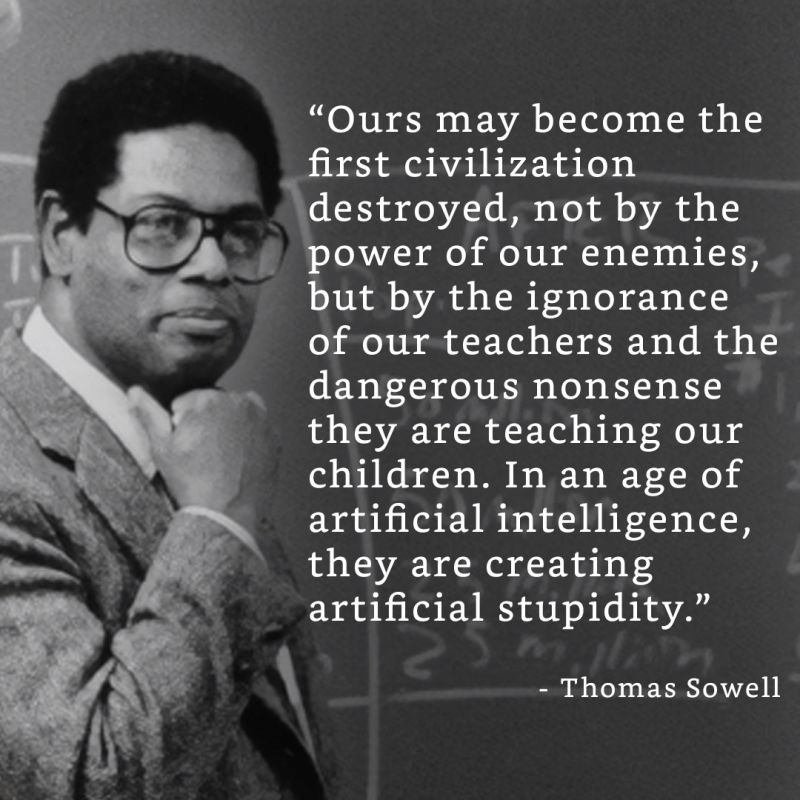
What a delightfully loaded statement. Sowell—a man whose intellectual credentials are as impeccable as his sweeping generalisations – manages, in a single breath, to malign teachers, dismiss contemporary education, and suggest that we’re hurtling towards some dystopian abyss because children today aren’t being taught…what, exactly? Latin declensions? The works of Burke? Perhaps the art of deference to authority? He never specifies. And why should he? Specifics would ruin the vibe.
This statement is a masterpiece of rhetorical dog-whistling. To those predisposed to Sowell’s worldview, it’s just common sense. Teachers are ignorant, modern education is a farce, and our children are doomed to a future of robotic ineptitude. It sounds plausible enough, provided you don’t stop to ask pesky questions like, “Which teachers? What nonsense? How, exactly, does one create artificial stupidity?”
The Cult of Common Sense
Let’s take a moment to examine the talismanic invocation of “common sense,” a concept as revered as it is elusive. Voltaire’s quip that “common sense is not so common” seems particularly apt here. What Sowell calls common sense is really shorthand for a monolithic worldview where civilisation is a neatly defined entity under siege by radical educators and their progressive agendas.
The problem? This worldview collapses under even cursory scrutiny. Civilisation is not a singular, static entity but an ever-evolving tapestry of conflicting ideas, cultures, and innovations. Teachers are not a homogenous cabal conspiring to dismantle society but an underpaid, overworked group trying their best to navigate a minefield of bureaucracy and societal expectations. And as for the “dangerous nonsense” being taught? Well, your guess is as good as mine. Critical thinking? Equity? Heaven forbid, empathy?
Ignorance as a Natural State
Sowell’s fans bristle at any suggestion that their intellectual idol might be guilty of hyperbole. But let’s consider the claim that teachers are “creating” stupidity. This presupposes that stupidity is an artificial construct rather than the natural baseline of humanity. The average IQ is, after all, 100 by design. For Americans, it hovers slightly below that at 97. This isn’t new. Stupidity doesn’t need to be created; it’s the default. Education’s job is to chip away at this deficit, not conjure intelligence ex nihilo.
To cast educators as villains in this endeavour is a disingenuous sleight of hand. Are there systemic issues in education? Of course. But to claim that teachers are actively fostering stupidity is akin to blaming firefighters for the existence of fires.
The Paradox of Intellectual Elitism
Here’s the kicker: Sowell himself is an intellectual. An elitist, no less, if we’re using his own fans’ definition. Yet his critique of intellectuals resonates with his audience precisely because they perceive him as an exception to the rule. “He’s one of us,” they say, failing to notice the irony. It’s the classic populist manoeuvre: position yourself as the voice of the people while enjoying all the privileges of the elite.
This paradox is not unique to Sowell. It’s the same dynamic that fuels the cult of Jordan Peterson, another intellectual who rails against intellectualism while wielding its tools. The result is a rhetorical echo chamber where dissent is dismissed as ignorance and agreement is lauded as truth.
The Dog Whistle Symphony
Sowell’s statement is, at its core, a symphony of dog whistles. It’s designed to resonate with those who already believe that modern education is a hotbed of progressive indoctrination. To this audience, it’s not a call to debate but a rallying cry. The terms – civilisation, ignorance, nonsense, artificial stupidity – are intentionally vague, allowing listeners to project their own fears and grievances onto them.
This vagueness is both the strength and the weakness of the argument. It’s compelling to those who share Sowell’s worldview but collapses under scrutiny. What is civilisation? What constitutes dangerous nonsense? Without definitions, these are just buzzwords masquerading as profundity.
Reframing the Conversation
So, how do we engage with such rhetoric? First, by refusing to accept its premises without question. Who are these teachers, and what are they allegedly teaching? What does Sowell mean by “civilisation”? Without specifics, his statement is not an argument but an incantation.
Second, by exposing the contradictions. If intelligence is the antidote to societal decline, as Sowell implies, then dismissing intellectuals wholesale is self-defeating. If education is the solution, then scapegoating teachers undermines the very people tasked with implementing it.
Finally, by recognising the emotional appeal at play. Sowell’s rhetoric taps into a deep-seated fear of change and loss. Addressing this fear requires empathy and nuance – qualities absent from his statement but essential for meaningful dialogue.
Conclusion
Thomas Sowell’s warning about “artificial stupidity” is less a diagnosis of societal decline than a litmus test for ideological allegiance. It’s a brilliant piece of rhetoric but a poor substitute for critical analysis. By unpacking its assumptions and exposing its contradictions, we can move beyond the echo chamber of dog whistles and engage in the kind of nuanced, constructive debate that Sowell’s own critique ostensibly calls for.
But then, nuance has never been common sense, has it?
 Philosophics