My expanded direction has roots in the works of George Lakoff, Jonathan Haidt, Kurt Gray, and Joshua Greene. These people circle around the problem, even identify it, but then summarily ignore it.
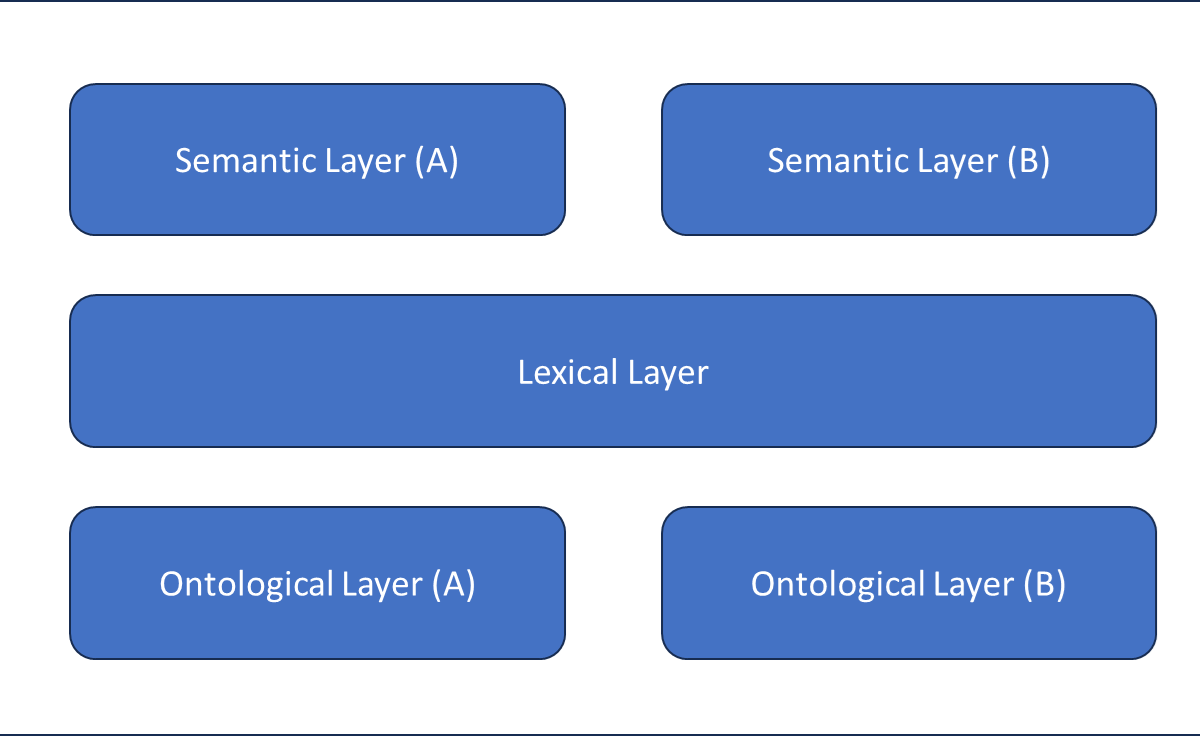
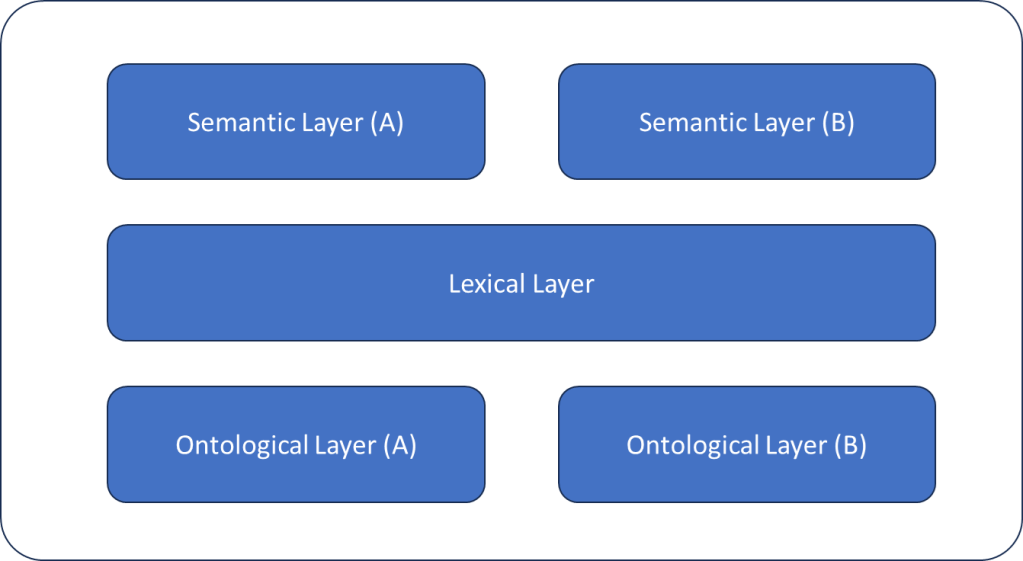
Image: This figure illustrates a simplified layered model of moral and political disagreement. Agents share a common lexical layer, enabling communication and the appearance of mutual understanding. Beneath this surface, however, ontological orientations diverge, structuring salience, legitimacy, and relevance prior to articulation. Semantic interpretation emerges downstream of these ontological commitments, producing divergent meanings despite shared vocabulary. The model highlights why disputes persist even under conditions of factual agreement and linguistic overlap: the instability lies not in words themselves, but in the ontological substrates from which semantic projections are drawn.
It’s more involved than this, but at a 50,000-foot level, it conveys the essence of my hypothesis.
I am also working on this logical expression:
∀ outcomes I(E), ∃ i,j such that Jᵢ ≠ Jⱼ
where,
Jᵢ = f(Oᵢ, E, I, RNG)
Also, in a particular context:
This will all make more sense in time. I’ll be publishing a manuscript as I study supporting research and develop my own perspectives.

 Philosophics