Video: Architecture of Grammatical Compromise. (Duration: 10:30)
In this video, I define Ontology, Grammar, and Commensurability before I use abortion as a poster child. Then, I discuss what happens when ontological grammars are incommensurable.
These thinkers follow:
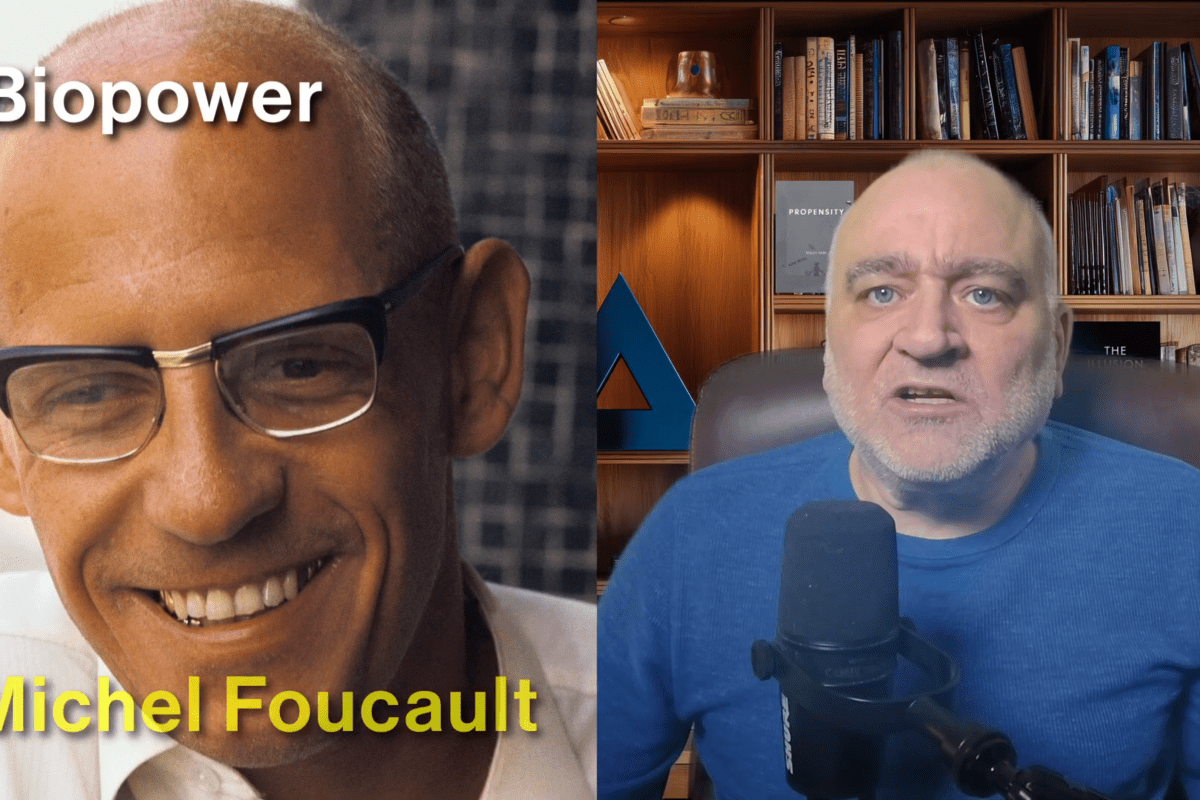
Michel Foucault: Biopower, notably The History of Sexuality, Volume I.
Bernard Williams: Thick Moral Concepts from Ethics and the Limits of Philosophy.
Pierre Bourdieu: Habitus, notably from Outline of a Theory of Practice.
Karl Popper: Paradox of Intolerance.
I discuss the challenge of the promise of compromise and its three possible outcomes, none of which are true compromises.
Watch the video for context. Read the essay for fuller details.
Abortion rights and a woman’s right to choose are on quick repeat in the latest news cycles as the SCOTUS has signalled that it wished to remove a woman’s right to choose. For most of us, it’s plainly obvious that this is codifying religious moral doctrine into law—Judeo-Christian beliefs to be more precise. This Christian belief is predicated on the notion that life is sacred.
In the West or at least in the United States citizens are inundated with this religious tripe, literally from infancy. It’s presented as sacrosanct, but this is not a universal belief.
One of my favourite stories in David Graeber’s Debt: The First 5,000 Years was the recounting of French philosopher Lucien Levy-Bruhl’s anecdotal observation that a man saved from drowning proceeded to ask his rescuer for remuneration for having saved his life.
As Graeber puts it, a man saved from drowning who proceeded to ask his rescuer to give him some nice clothes to wear, or another who, on being nursed back to health after having been savaged by a tiger, demanded a knife. One French missionary working in Central Africa insisted that such things happened to him on a regular basis:
You save a person’s life, and you must expect to receive a visit from him before long; you are now under an obligation to him, and you will not get rid of him except by giving him presents.
In the early decades of the twentieth century, the French philosopher Lucien Levy-Bruhl, in an attempt to prove that “natives” operated with an entirely different form of logic, compiled a list of similar stories: for instance, of a man saved from drowning who proceeded to ask his rescuer to give him some nice clothes to wear, or another who, on being nursed back to health after having been savaged by a tiger, demanded a knife.
The interesting thing for me is the way this flips the sanctity of life narrative on its head. As Westerners, it is not only beat into our heads—whether secular or sectarian—, and this sanctity becomes the crux of the pro-life [sic] anti-abortion argument. But this sanctity is just another human construct. Part of the ‘be fruitful, go forth and multiply’ logic. This is arguably just more human hubris.
Of course, this is a slippery slope. Start undermining this narrative, and you start to see eugenic apologists coming out of the woodwork. In fact, we aren’t really that far removed from this notion. Whenever we encounter common enemies, one of the first tactics is to vilify and dehumanise them, so as to soothe the psyche, making it justify killing these subhuman species. In the end, the human mind is very facile.
Judith Thomson published an essay named ‘A Defense of Abortion‘ in 1971 where she uses a house and invaders as an analogy to defend the right to abortion. Her defence resonates with David Guignion, and David’s approach to summarising philosophy resonates with me.
Disclaimer: I listen to most of David’s work, which should be a testament to the interest I have in the material he covers as well as the accord I have for his positions—content and vehicle. In this case, he feels that Thomson employs a solid argument in defence of abortion, but I’m not sure I agree. I also freely admit that—given I feel that all morality is socially constructed—I am not likely among the intended cohort for this nuanced argument.
Firstly, I’m no misanthrope, but I don’t feel humans deserve some privileged position over other lifeforms simply because they have some limited sense of awareness.
Secondly, I’m not a strong anti-natalist, I feel this is a defensible position to adopt, so I could rely on this position to defend abortion.
Thirdly, I don’t believe that bodily autonomy is anything more than a social construct. Foreshadowing David’s line of argumentation, It’s not a matter of Liberal autonomy over dictatorial oppression. I feel that this is first a false dichotomy and second a competition between social constructs.
Whilst I do understand that Thomson’s position is intended to counter Americans who do subscribe to the myths of autonomy, sovereignty, agency, rights, and property, this is also why I feel the entire argument depends on rhetoric and emotion. Perhaps, the rest of us aren’t going to be anti-abortion in the first place, so why expend energy trying to formulate a deeper argument to convince us.
I had previously heard of the model Thomson employed that drew an analogy between an accomplished violinist and a fetus. I hadn’t read the source essay and didn’t know that Thomson had authored it. I wasn’t familiar with her extended arguments either.
I had originally planned to regard each proposed scenario separately, but I’m going to exercise the principle of least effort and just share some general observations, leaving the door open to revisit these when time and interest align. In general, I don’t feel that Thomson makes a strong logical argument. Her approach relies on emotion and rhetorical tactics.
Thomson frames a Consequentialist argument and colours it with a dash of Virtue ethics. By establishing the accomplished musician, she establishes a frame that taps into elitism. She takes a high art versus low art approach, an approach often adopted by virtue ethicists. For me, this always triggers a red flag.
Next, she triggers the home invasion reflex for people who believe in private property as an extension of bodily autonomy, so she is relying on fear as legerdemain, even if unintentionally.
In each case, the autonomous actor is given a privileged position in the story. In the first case, the tethered musician is unconscious and has no voice—like a fetus or a pet. She is generous enough to afford the musician full human status and bodily autonomy, yet without agency.
Thomson creates a false dichotomy that she expects one to adopt uncritically. Is she a reliable narrator? Are there no intermediate options available? Let’s ignore this, as she hopes one does. It’s you or the musician in a zero-sum game of life and death. In a scenario where the musician or fetus has no agency, it’s easy to take the self-righteous high road and claim decision authority.
Allow me to take a detour for a moment. Let’s say that you and the musician were both tethered without consent and that each of you came to and your inextricable plights were conveyed to you. In this case, each of you may wish to exercise autonomy and in this deathmatch, only one would prevail; the other would die. Given this elitist setup, you are the underdog—some shlub versus Paganini in his prime. Even a fetus might have this privilege. Perhaps you are carrying the proto-progeny of Einstein or a king with no heirs? Handmaid’s Tale, yes. But I digress.
The next sleight of hand is introducing an emotional self-defence trope. The setup is that given the choice of the other person being an existential threat, who wouldn’t agree that you have a right to defend yourself?—not delving into the fiction of rights.
David jumps right onto Thomson’s bandwagon, which was her intent, but it is not obvious that self-defence is some inalienable right. In practice, the right is abridged by the state often. This is true in the United States as well as Canada. I’m imagining David overloading the meter on a connected galvanic skin testing device. Pure emotion.
I fully sympathise with David’s position, but this doesn’t change the fact whether a person has autonomy or not is an arbitrary decision. Many cultures now and even Western cultures in the past had little notion of personal autonomy. Trepidation aside, there is little reason to presume this will continue to persist.
EDITORIAL NOTE: I was writing this near the end of April 2022 when I got distracted by my anti-agency interest. This was left unfinished, but I feel it’s complete enough to post. I am not sure where my mind was headed at the time.


 Philosophics