There is a battle being waged in the United States today, but it is not centred on the lack of separation of Church and State. I suppose this may be a uniquely American issue given its Constitutional roots, but the root cause is rather a lack of separation between Natural and Supernatural, not between Church and State.
Separation of Church and State
Tomorrow America is celebrating Independence Day [sic], but until we are independent of religion, we cannot be independent. The only real independence is for the politicians who are independent of British control. There is nothing more substantial than this, and nothing for the ordinary citizen, who might as well be taking orders from England. Canada doesn’t look any worse for the wear and tear. I’m not a Monarchist, but it’s no less ridiculous than the Oligarchy or Plutarchy in play today.
I’ve got nothing again churches, per se. I don’t prefer the brainwashing that passes as organised religion, but neither am I fond of the brainwashing that is organised politics. And why is it called ‘brainwashing’? It’s clearly mind-muddling. I digress.
I do believe that it’s in the best interest to separate Church and State, not least because I need freedom from religion. It is already force-fed down my throat and codified into laws. We need less, not more.
Of course, a key topical debate is the abortion issue. This is strictly a religious issue. Even if you want to argue that it’s a moral rather than religious issue, it is still the result of supernatural beliefs. This is where the separation needs to happen.
Why won’t it happen? It won’t happen because people who believe in supernatural forces—especially active supernatural forces—are easy to manipulate. This has been true historically as well as contemporaneously. It’s too convenient for politicians to pull the old Santa Claus trick—if you aren’t good, Santa won’t give you any presents; and if you’re bad, he’s going to bring you coal instead.
I’ve said my peace. In the end, I don’t really even care if you believe in the supernatural, but if you believe that you (or anyone) can interpret these forces, I claim foul and out of bounds. This belief is not different to believing that you can understand what your dog or cat is ‘saying’—or your pet unicorn in the garden. It’s certifiable.
I know that other countries have to contend with this interference. Some even don’t mind the union. Is this a problem in other countries? Is it a problem in yours? Or do you consider it to be a necessary solution?
DISCLAIMER: This post has absolutely nothing to do with the Supernatural television series.
I am trying to avoid commenting on the recent SCOTUS decision and how it is symptomatic of how the United States remains a failed state—at least a zombie state—, so this preamble should suffice for now.
I was chatting politics into the wee hours with my son, who’s been on this earth for almost 25 years now. I consider myself to be on the left of traditional political scales. He considers himself to be on the right, but he’s trying to make sense of the scales and dimensions. He had two questions: First, ‘What are the crucial dimensions and positions that define left and right?’ Second, ‘Where do Liberals fit into the equation?’
Knowing me, he wanted to provide some context and confer with me his knowledge that would also serve to frame and anchor the conversation. A key point was to have clarified the adopted nomenclature and positioning on a theoretical map.
We started with the origins of the left-right distinction, which was barely a valid dichotomy even as it was coined in France. There was no duolith. Those on the left or right had features in common but taken holistically, this was a reductionist categorisation, as tends to happen. Exacerbating this, as it does today, still, the politicians with voices remained to the right of the unvoices masses.
He asked about the difference between freedom and liberty because his sources differentiate the two. Whilst connotation and nuance may enter the picture, etymologically speaking, freedom is a native English word whilst liberty is French via Latin. Connotatively, freedom is an absolute measure whilst liberty is granted within a political framework. Positive and negative liberties aside, liberty is an attenuator. It restricts freedom even if it allows most of the signal through. Effectively, liberty is permission by the state to act in certain ways.
By the end of the conversation, he was framing the key difference around notions of national identity and nationalism—I versus we. I shared my thoughts on the construction of identity, thus making for a poor foundation, though we both agreed that national narratives have been the impetus for much activity. (I am reluctant to insert the word progress here.)
After our conversation, I began researching dimensions established or otherwise proposed by political science. This led me to a place I found interesting—the distinction between radical, progressive, conservative, and reactionary positions. For some reason, this never really occurred to me.
I’m not sure one can employ these terms in general discussion without definition and qualification, but I feel they are useful in their own right. Typically, I view the political landscape—at the highest level and with a US-bent—as Left (communists, socialists, anarchists, progressives) and Right (conservatives, liberals, and fascists). I also know that this is imprecise, but maps always are.
This new vocabulary helps by distilling the map to this—ordered differently:
Right
Conservative
Reactionary
Left
Progressive
Radical
Conservative
Conservatives want to maintain the status quo. This is interesting usage adoption. Fundamentally, advocates of this view want to promote and to preserve traditional social institutions and practices. In Western culture, conservatives seek to preserve a range of institutions such as organized religion, parliamentary government, and property rights. Conservatives tend to favour institutions and practices that guarantee stability and evolved gradually. Adherents of conservatism often oppose progressivism and seek a return to traditional values
In Western culture, conservatives seek to preserve a range of institutions such as organized religion, parliamentary government, and property rights.
My first thoughts when I hear the term are a harkening back to the old ways—the Ozzie and Harriott mythos, white picket fences, Mom and apple pie. But this is different. Effectively, rather than reaching back, it wants to preserve the current moment in time. Where it gets more nebulous, I think, is that some people include nostalgia in the now. Duratively, perhaps a person might remember some aspect of their childhood. Though this has been lost by now, they imagine it as part of their identity. This can also extend further back as they wish some other historical aspects can be cherry-picked. Perhaps the white conservative wishes to be able to subjugate women as was the practice in the 1950s of America, but to not conserve high union participation and high marginal tax rates, as affronts to freedom (or whatever). This ends up being an exercise in selective memory and revisionist history-making.
This needs to be distinguished from a so-called traditional conservativism in the tradition of Burke or Hobbes, who want to conserve some sense of fundamental morality they feel derives from nature.
Reactionary
Reactionaries oppose whatever is in effect at the moment—the petulant toddler—but with a twist. Like the conservatives, there is a conservation effort but rather than a focus on the status quo, the focus is on status quo ante, which is a return to the old ways, tried and true.
Progressive
Progressives support social reform. Ostensibly, they don’t oppose tradition, but they feel that old structures need to be reimagined and reinterpreted in face of social and technological change. An underlying metanarrative is the notion of progress. I am not going to comment on progressivism generally and the nuances evident in the American flavour of it.
During the 20th century, radical politicians took power in many countries across the world. Such radical leaders included Vladimir Lenin and Joseph Stalin in Russia, Mao Zedong in China, Adolf Hitler in Germany, as well as more mainstream radicals such as Ronald Reagan in the United States and Margaret Thatcher in the United Kingdom. Of course, Donald Trump is a more recent example in the United States.
Summary
To me, these terms operate on a gravity to now. Conservatives are heavily anchored in the familiar and seek stability. Then they see factors in the past that they imagine will also serve this purpose, so they wish to incorporate these and carry them forward. Conservatives are not unaware of the need for change, they just want to not create waves in the process.
Likewise, although placing a heavier weight on the past than even conservatives, reactionaries are not fundamentally opposed to retaining what is working currently. The term working is subjective and perspectival, so they may wish to retain something that works for them at the expense of others. This is a challenge for conservatism as well. Just because racial segregation seemed to work for an equivalent person in the past doesn’t mean it worked well for the excluded.
Like reactionaries, progressives aren’t afraid of keeping a foot in the present—and there may be plenty of lessons to learn from the past—, but they feel that given the change in the underlying terrain, some refactoring is in order.
And then there are the radicals. I suppose that radicals have different motivators, but in essence, they feel that the current implementation is substantially broken, and it needs more than a few small tweaks and a fresh coat of paint. These people are renovating rather than redecorating. They may even want to throw the baby out with the bath water. Some may wish to keep the baby.
As for me, I usually place myself in the Progressive camp, but under the definition, I am more of a radical. The system is broken. We don’t just need to delete it, we need to install a new one.
Thomas Jefferson said that the United States should rewrite the Constitution every 19 years. Why 19 years? Who knows? Given the intransigence in American politics, this would have been a disaster. And given the powers that be, the debate would be over which parts to conserve and which to progress. Being the cynic that I am, my guess is that it would devolve to worse than we have now.
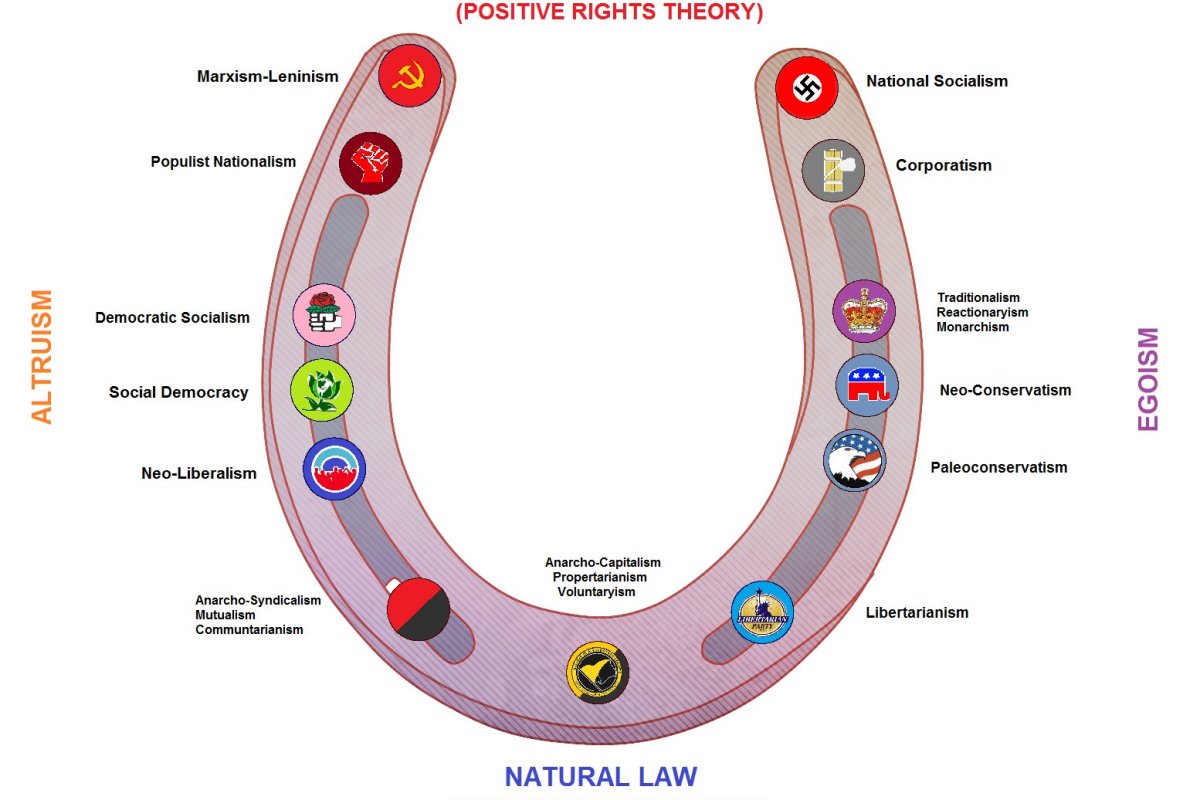
DISCLAIMER: For the record, I don’t endorse the placement of the political ideologies on the horseshoe image, but I find it interesting and it grabbed my attention. I hope it grabbed yours, too.
Agency is going through the same fits as religion. When Nietzsche regarded society around him at the time, he declared that God is dead and asked now what? This is precisely the same challenge in different clothes.
Preserving “law and order” without a concept of real responsibility is a daunting task.
Dan Dennett
Without a God to use as a bully pulpit and mechanism of fear, how could we keep people in line in cohesive societies? Without the notion of human agency to allow for responsibility and blame, how can we keep people in line in cohesive societies? Only the predicate has changed, but the question remains, do we persist in lying for the so-called greater good? This is similar to the Santa Claus myth to keep young children in line.
If nobody is responsible, not really, then not only should the prisons be emptied, but no contract is valid, mortgages should be abolished, and we can never hold anybody to account for anything they do. Preserving “law and order” without a concept of real responsibility is a daunting task.
—Dan Dennett, “Reflections on Free Will” (naturalism.org)
One might like to think that lying is psychologically pathological, but it seems to be a significant part of the human condition. The fundamental question doesn’t appear to be ‘should I tell the truth’, but rather ‘Can I get away with lying?’ Despite all the talk of Truth and integrity, this seems to be the default state of humans. This renders integrity just another lie. But you knew that already, but let’s not fall into another Foucauldian rabbit hole.
We no longer have any sympathy today with the concept of ‘free will’: we know only too well what is is — the most infamous of all the arts of the theologian for making mankind ‘accountable’. . . Everywhere accountability is sought, it is usually the instinct for punishing and judging which seeks it… the doctrine of will has been invented essentially for the purpose of punishment, that is of finding guilty.
— Twilight of the Idols: ‘The Four Great Errors’, 7
I am a racist. Well, to the extent that there is only one extant human race but some choose to construct races out of ethnicities, skin colour, and other allele expressions, I am a racist. It’s difficult to escape the distinction that the perpetrators and targets or victims of these fabricated races.
The haters need to create a target group to feel superior over. The do-gooders need to be able to identify groups who have been harmed or historically underserved. Of course, there is a right way and then there’s this wrong way. In a manner of speaking, it’s an easier effort to broad-brush people into race categories. No mind that they have no basis in biology or in science more broadly. These people have issues with science, mainly because they don’t feel fully included in their designation as soft scient and social science. They get pretty defensive when they get called out as pseudoscience, but if the shoe fits. Playing these race games only underscores the pseudoscience charge.
All of this said—or by this tepid definition—, I am a racist. Here’s why.
I am a racist
When I see a person from a designated group, I consciously reflect: that’s a human who’s been identified as an other—sort of like an endangered species, they need to be protected. Sure they can protect themselves, but they need assistance. Besides, they deserve extra attention because of so many centuries of not only neglect but of malice. Perhaps not that person in particular, but since we’re broad-brushing.
Where my racism comes into play is that I’ll smile and nod; I’ll engage in phatic exchange; I’ll hold a door; I’ll recognise them as a person—as a human; I’ll feel a slight boost of empathy and compassion. I’ll see this person as different, whereas without this constructed designation, I’d only see another person. But I’ve been instructed to see them as different.
Growing up around Boston in the 1970s, a time of desegregation and forced bussing, my best friend was a negro. That’s how we labelled blacks or African-Americans or whatever the latest label is. He was very aware of his colour. We’d joke about it as kids tend to do. He was coloured. I was a cracker. To us, his colour (or race, if you prefer) meant nothing to us.
My family were racist, though they’d deny it. To them, Lenny, my friend, wasn’t an individual. He was a part of that larger race construct. Sure, he was an individual, too. He was my friend who played baseball with me and shot hoops in the driveway. But to me as a child, race didn’t yet exist. I hadn’t yet been indoctrinated into the race nonsense. Lenny may have experienced things differently.
Don’t get me wrong, looking back, Lenny did conform to racial stereotypes. His dad was an absent parent, an alcoholic shipworker, who spent more time at the shipyard and in bars. I barely even saw him. His mum was a large woman, who was very nice to me but was frustrated with her lot in life and the lack of emotional support from her husband.
Lenny was the youngest of three brothers, but he had a younger sister, Karen. His brothers were high school basketball stars, as it were, in a suburb. Tookey was the oldest and tallest. His given name was Raymond, but only his parents called him Ray. Steve* was also a football star, who went on to play at Boston University during the Doug Flutie years.
It wasn’t until I joined the military that I learned about race. This was mainly about the people of colour who had joined the military owning to economic necessity and the promise of a better life. This outlook was not unique to what we now refer to as BIPOC. The majority of enlisted personnel were victims of the system they at least tacitly believed in. If I were to be so bold, I’d say there were two flavours, the bitter and the hopeful. I won’t elaborate further.
Eventually, I moved to Los Angeles and was steeped in Hispanic/Latino culture—primarily from Mexico and Central America. Again, I was an observer. I participated with people connected to this culture. I don’t particularly abide by any culture. I don’t view it as important, but this also means that I have no culture to defend either. Maybe that’s a significant difference. If I’ve got no cultural ego to defend, then I am not threatened by other cultures that I might feel as encroaching.
Don’t get me wrong. Whilst I tolerate cultural expression and say ‘to each their own‘, I do find traditional clothing and rituals to be silly or quaint. But so do I find some of this silly in what would be said to be my cultural heritage, whether ethnically to Norway or nationally to the United States. I’ll spare the commentary.
I picked up enough conversational Spanish to get by—mostly phatic speech and politesse—, so if I am interacting with a Spanish speaker, I will use what words I know: gracias, de nada, compromiso, desculpa, por favor, and even pendejo doesn’t go to waste. I’ve also been known to utter merci, danke, spasibo, xièxiè nǐ, or domo arrigato (mister roboto, cuz let’s be honest here).
This is my racism or my sensitivity to culture. To be honest—and why not be honest, am I right?—, this has not always been without controversy. Arbitrarily, I might spam gracias, merci, or domo to a whitebread American. In most instances, they’ll nod and acknowledge the intent and accept it or respond with no problem, you’re welcome, or even de nada or de rien. I’ve even gotten a German bitte in response to a domo, so I suppose I am not alone.
I think it’s safe to say that most Americans know what grazie or merci mean. Perhaps not domo. In one encounter, I said domo to a non-Japanese Asian and was immediately derided with an I’m not Japanese. From her perspective, she may have felt that she had been homogenised into being Asian and she wanted to be identified as whatever her heritage was. She never shared this information with me. Perhaps she was Korean or Cambodian, Vietnamese or Laotian, Chinese or whatever. But she did communicate that she wasn’t Japanese. She might have been under the impression that from my perspective, I saw that all Asians look alike.
From my perspective, I could have as alternatively exchanged a merci. This would not have likely triggered the same emotional response—I’m not French. On the one hand, I felt bad for triggering her—despite that not having been my intent. On the other hand, I didn’t feel I needed to engage her free-floating rage. So I’m a racist.
In my own defence, studies show that people are more able to discern people within their own ethnicity. I’ve shared this story before. When I lived in Tokyo, I was dating a woman whose dad was Japanese and her mum was Chinese. I had met her once, and I was to meet her at a train station. I’d be lying if I told you I had no trepidation about not being able to recognise her in a crowd. My, perhaps narcissistic, consolation was that she’d recognise me being taller and ‘Caucasian’. I can’t really say ‘whiter’ because although I was brought up to identify Asians as yellow (and Indigenous Americans as red), most Japanese were a lighter shade of pale than I (or most so-called ‘white’ Americans) were. I’ve always been suspicious of these colour attributes, but I won’t go even further down this rabbit hole.
In the end, I see colour. I see the history.
In the end, I see colour. I see the history. Even though my family didn’t even move to the United States until World War II, somewhat exempting me from culpability, I still recognise the injustice that still prevails. With empathy, I want things to be better—to be more inclusive—, but cultural homogenisation is not the approach I support. I support tolerance.
If I feel that a certain costume is silly, so be it. I don’t have to wear it. When I was growing up in the 1970s, I felt that my own clothing options were silly—polyester and bellbottoms? No thank you. This is just a preference thing. I don’t like to wear headcovers—hats or caps. Do I care if you wear a headcover? No. Might I think you look silly? Sometimes. Do you want to know what else I think looks silly? Beards? What’s even worse? Moustaches—or as I am more apt to call them, pornstaches. Am I going to judge you are being less of a person because of any of these? No. I could go on and on about my reaction to certain accoutrements, but I’ll let you in on a secret: I have worked and interacted with people who prefer to present themselves in these ways, and these people have risen to the occasion and disappointed in the same ratio as people who dressed like me or looked more like me, so clearly it’s not a factor.
In summary—and despite the fact that there is only one human race—, I admit to being a racist. I do recognise that negative and positive stereotypes exist, as well as I know that these are vague generalisations. I know white people who can dance and Asians who suck at maths. I know Mexicans who aren’t gardeners and Italians who couldn’t cook to save their lives. I even know black people who can swim—but not my friend Lenny; he can’t swim. Sometimes stereotypes happen to encapture a person.
* As I was writing this, I decided to perform a Google search for Lenny. We lost contact decades ago because he adopted Jehova’s Witness religious beliefs that didn’t allow him to socialise with persons outside of his religion, so we parted ways. But I did locate Steve. I reached out to Steve on LinkedIn. Unless I’m mistaken, we probably haven’t communicated with each other since 1978—that’s 44 years— when he went off to college. I always admired Steve, the way we sometimes admire our big brothers. Steve was Lenny’s big brother, and Lenny looked up to both of his big brothers.
Steve responded on LinkedIn. We exchanged best wishes. Maybe one day I’ll ask him about his experience with race. It doesn’t seem to be a topic one can engage in because of the lack of shared perspective and the hot button triggers just waiting to be tripped.
I don’t believe that humans have the agency presumed they have, so I’d like to set out to prove it—at least rhetorically. In the ages-old battle between free will and determinism, I’ve tended to lean toward the determinism camp, but there is something keeping me from gaining full membership. I feel that proving hard determinism may be too hard a nut to crack, so I am aiming at just the agency aspect.
There are two major themes in my thinking.
Humans have no material agency
Power structures require the presumption of agency
Although this concept has been rattling around my brain cage for a while and I still have a ways to go, I feel it will be helpful to sketch out my ideas. I feel inspired by people like Robert Sapolsky and Daniel Dennett. And I feel I can draw insights into counter-arguments from people like Jonathan Haidt, Joshua Greene, and even Steven Pinker. I feel that my experience in behavioural economics may be useful for additional context—people like Daniel Kahneman, Richard Thaler, and Dan Ariely. But I feel disheartened when it appears that Galen Strawson and his father before him, Peter Strawson, people much more connected and elevated in the field have been treading the same territory for decades — over half a century — ahead of me, thankfully beating a path but not necessarily making much headway. Perhaps I can build upon that foundation if not substantially at least perceptibly. Of course, the seminal work by Isaiah Berlin’s Two Concepts of Liberty.
We may act as we will, but we cannot will as we will.
Arthur Schopenhauer
Besides the aforementioned, a correspondent has suggested other source references. He shares: Physics, including quantum mechanics, is fully Lagrangian. According to Stanford’s Leonard Susskind, Lagrange derived his formalism from the principle of ‘Least Action’. Jean Buridan’s principle of ‘Equipoise’ renders a Lagrangian model of the world perfectly deterministic. So, the physical domain is not probabilistic; and all indeterminacy is actually epistemic indeterminability. He also suggets Thomas Hobbes’ “De Corpore”.
About my second point, my corresponent agrees:
I think your “meta” is right. We feel that we are “free agents”, and we don’t know to what to attribute our feeling that we freely choose; so we imagine that we have “free will”. In my view it also doesn’t exist – we really are, as Sapolsky describes, zombie robots – we just don’t (and cannot) know it. Free will is thus a mere (but compelling) illusion on both individual and emergent scales. And yes again: all of morality, jurisprudence, etc., depends on it.
Unattributed Correspondant
My correspondent is a professional philosopher who shall remain anonymous until such time as he agrees, if ever, to make his identity known. I am quiet aware that some of my ideas are contentious and polemic. Not everyone wishes to be mired in controversy.
Humans Have No Material Agency
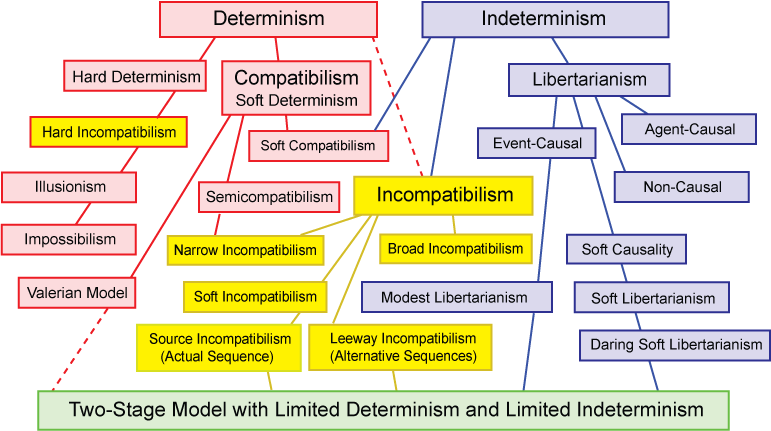
Humans have little to no agency. This is the point I am making in my Testudineous Agency post. From what I know until now, this likely qualifies as soft determinism, but this might shift as I acquire new nomenclature and taxonomic distinction. I’ve discovered this taxonomy of free will positions, though I am not well enough versed to comment on its accuracy or completeness. For now, it seems like a decent working model to serve as a starting point, but I am fully cognizant of possible Dunning-Kruger factors.
A Taxonomy of Free Will Positions
In essence, hard determinism says that the world is not probabilistic. Some event triggered the universe as we know it, and it will unfold according to the laws of physics whether or not we understand them. A weaker form, soft determinism, allows for some probability and trivial ‘agency’. I feel that Dennett supports soft determinism. I feel that because we, as ‘individuals’, are a confluence of multitudinous factors, we have little agency (interpreted as responsibility). More on this later.
Power structures require the presumption of agency
To be honest, the free will debate is only interesting to me in context. To me the context is power. The ‘meta’ of this is that society (and human ‘nature’) seem to need this accountability and culpability, but it doesn’t actually exist, so it is created as a social construct and enforced in a Foucauldian power relationship through government through jurisprudence mechanisms.
This is the part of the debate I haven’t heard much about. Sapolsky did write in Behave, chapter 20X, that criminal justice systems need to be reformed to account for diminished agency, and I’ll need to return to that to better comprehend his position and assertion.
The rest of the story
As a handy reference, these are the authors and books I’ve encountered to date and in no particular order:
I’ve got a lot of essays and lecture notes not referenced plus general content from Reddit, Medium and other blogs sources, YouTube, podcasts, and so on. I probably should have documented some Classical philosophers, but I don’t generally find their argumentation compelling, though I might add them later.
The aim of this post is just to capture my intent—if it is indeed my intent. Oh, the questions and implications of a lack of agency. Please stand by.
The lamb spends all its time worrying about the wolf and ends up being eaten by the shepherd.
— Unknown
I think one could look at this from several perspectives or through different lenses.
We worry about the wrong things.
At some level, this is about trust.
We trust the wrong people. Those whom we most entrust do us in. But I feel this is contextual.
One might feel this shepherd is Capitalism or the State or organised religion. Perhaps it’s culture or identity cohorts. Or all or these or none of these.
On another level, it recalls the inevitability of death. This shepherd reaper is always waiting in the wings whether or not one worries.
I’ve never been a comic book guy or into heroes or superheroes. In fact, I have always had a thing for the underdog. This article points out The Batman’s Privilege Problem. I’ve skimmed a few comic books and graphic novels, and I’ve seen a few movies, but I am not really steeped in this space to speak to the nuance—and there is probably a difference between comics and graphic novels, but like I said: not inters. I just don’t identify with most of it. Not the violence. Not the Truth, Justice, and the American way of legacy Superman. But I do sense a privilege problem. Defenders of the status quo. I wonder if comic book aficionados tend to be more politically Conservative.
A quick Google search, and I’m mostly correct. Evidently, Marvel authors trend toward the Right. This article ranks some figures Conservative, Centrist, and Left, although the Left feel more Liberal than Left, and they are all constitutionalists. Apparently, X-Men were born of the Civil Rights movement in America in the 1960s. Still not my bag. Where are the Anarchists? At this rate, I’d settle for a Marxist.
One last mention: this piece points out that even where there are prominent social justice issues raised in one or another comic, the subtext (or overarching meta) is Conservative. This likely creates tension in a manner of speaking, but it creates dissonance for me.
I don’t have much more to add, but the article caught my fancy. It resonated for me, and having not posted for a while, I figured what the hell.
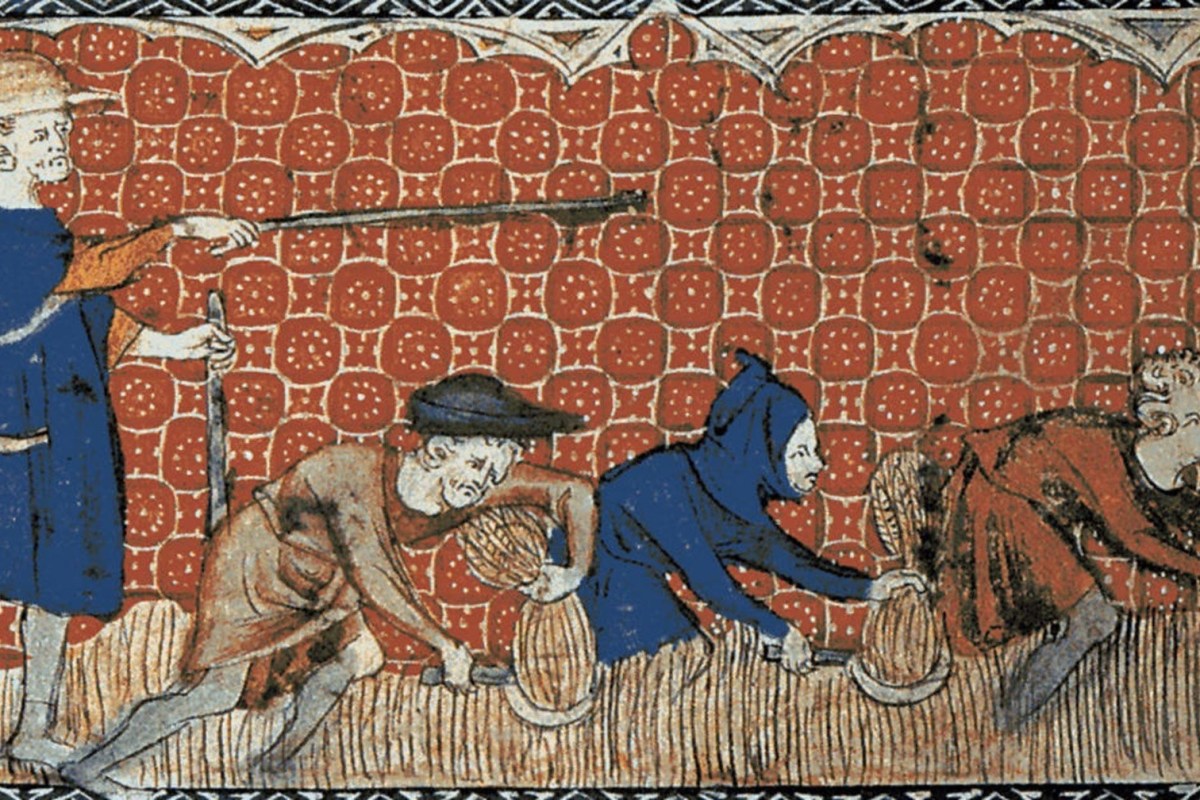
It seems that Capitalism took a wrong turn and is retracing The Road to Serfdom. Hayek worried about government intervention in business, but he did not imagine a world where corporate leaders would grow large enough to not only be able to control government power through money and influence, but it could actually ignore governments altogether—or at least to a large extent.
The last time government was challenged at this level was by the Church. In the end, it resolved into a tenuous stalemate. But this next conflict will be ostensibly bloodless, opting to be fought with political weaponry.
serf master cap
To the workaday people, it doesn’t change much. Denial is an interesting bed partner anyway. As most deny being wage slaves, they now just deny being serfs. In their minds, they are free, just inches from the goal line. I’m not the one to break it to them that the goal line away from in inches is the wrong one. They’re an entire field’s length to reach their goal. Thank goodness for denial and mechanisms that assuage cognitive dissonance. Ignorance is indeed bliss.
For some, the COVID response doubled down on the transition from Capitalism to Communism. For others, it was a reinforcement of the strength of Capitalism—and if in the milieu of fighting between authoritarians and Libertarians. But the phoenix rising from the dust—hardly flames—seems to rather be a sort of neo-feudalism. This seems to be a more likely future than Capitalism in a nation-state world. I assume that Nation-states will continue to exist, but they will serve only to contain the commoners, the ones who can’t afford to escape the fetters.
I don’t have much to add to the discussion at this time, but this article sums up some of my perspectives. My question is how the Capital aspect is extricated from the system. The serf part is easy.
Think about it: The average person has an IQ of 100. Essentially, half of the people have lower and half have higher. Not a good hand to be dealt. I don’t particularly buy into the whole IQ thing, but it serves this line of logic. Adopting this framework and reflecting on normal or so-called Gaussian distributions, this means (pun initially unintended) that within one standard deviation of the mean, 68 per cent of the population falls, which is to say having an IQ between 85-115.*
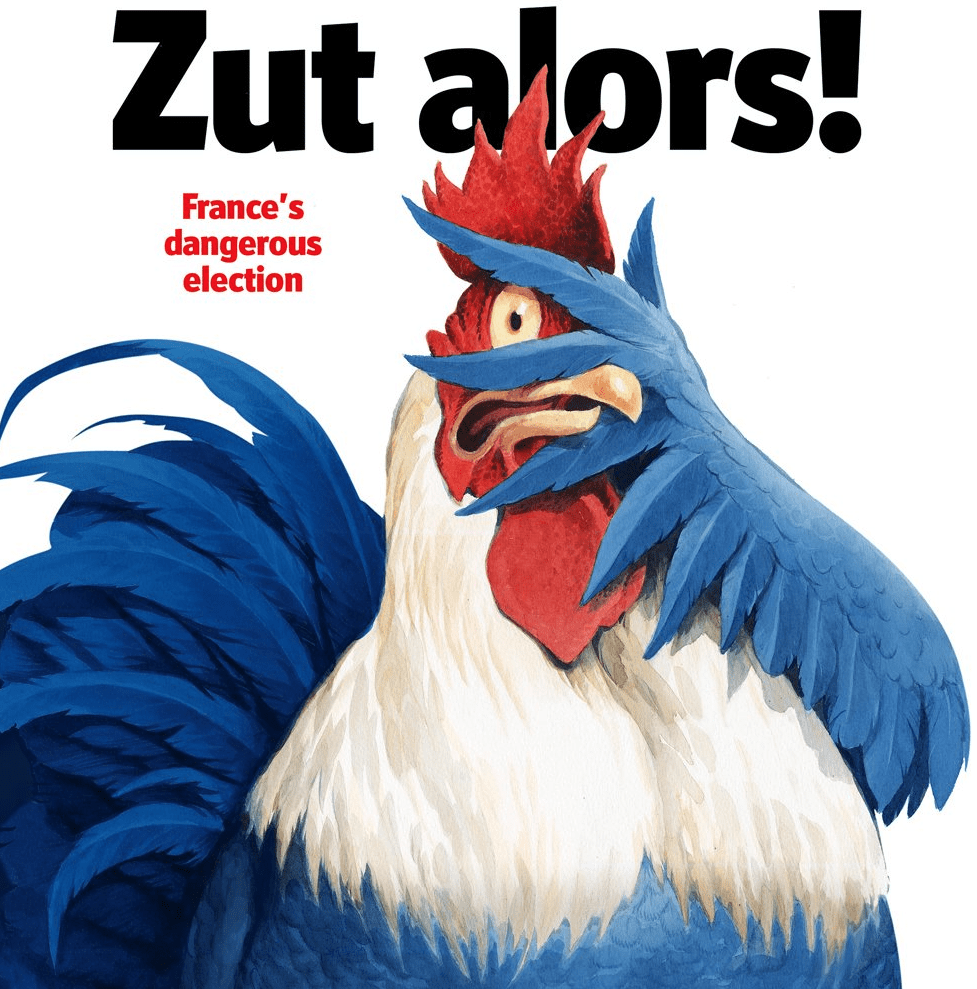
Zut Alors!
An IQ score of 100 wouldn’t be that bad if it was calibrated to Einstein or Hawking, but it’s not. The average police officer in the US has an IQ of around 103. Think about it. This is who democracy is asking to be in charge; this is who we expect to make good voting decisions. Amor fati. Memento mori.
Continuing on my It’s People riff, I am further struggling with options. As a Disintigrationist, I don’t feel compelled to provide answers, but as a personal matter, it seems that I am stuck in the middle. Idiocracy was supposed to be satire, but it’s serious.
So, accuse me of being an elitist. Call me a misanthrope. But it’s more patho-anthropy. It’s pity. Dunning-Kruger, be damned. On the one hand, a hierarchical structure leaves us with self-interested opportunists, megalomaniacs and narcissists; on the other, we get to know the political opinions of the Paul Blart‘s and Homer Simpson‘s of the world. And there’s nothing in between.
The Devil You Know
Following Plato’s Republic, the current system presumes a sort of meritocracy that elevates those who excel at politics to rise to the top. Optimistically, this is precisely what happens; pessimistically, this is precisely what happens. This is as good as it gets—self-serving politicos doing all they can to maintain their positions.
But what about the other people? Surely some honourable people are attracted to the political calling, right? Some who make it into the system are spat out by it; some are marginalised; the remainder are corrupted by it.
Then there’s the other side of the coin. There’s something to consider with local democracy. At least you know the idiots you are dealing with, but that’s not really a consolation. Here, Plato noted the benefits of rhetoric.
Police break up an illegal poker match—doggy style
Given the limited prospects for even a third-tier suboptimal solution, we might be better off by adopting RNG as a ruling system. No boundaries. No parameters. Remove any interference by humans. They’ll only muck it up.
Where to Go from Here
Hyperbole aside, what is the solution? Nazi Germans took a stab at it, but of course, they were idiots, too. Plain and star-bellied Sneetches. Pots calling the kettles black. People have tried literacy testing, income and wealth testing, lots, and any other number of approaches. The challenge is to have a system with no human intervention. Sadly, even this system would necessarily be constructed by humans, so we’re pretty much doomed.
Sneetches
Finally, to silence those who might label me an elitist, no, I don’t think that a society comprised and governed by people only with IQs at and above, say, 160 would fare much better because the problem is broader than facile intelligence.
* If your reaction is ‘but my IQ is in this range’, you may now get my trepidation.
Much of jurisprudence is based on logic founded on faulty premises of regurgitated theological concepts shrouded in naturalistic theory and pseudoscience. This is not about the defund the police social trend of 2020. This is to say that the justice system is smoke and mirrors writ large. It’s ostensibly built on anachronistic concepts such as volition, evil, soul, blame, and forgiveness that should be tossed into the dustbin of history along with phrenology, humours, and will.
The titleof this post is taken from Robert Spapolsky’s proposed chapter concept for Behave, published in 2017, where until now, it’s languished on my Want to Read list, having entered via the vector of my interest in behavioural economics. Chapter 16 was eventually published with the title of Biology, the Criminal Justice System, and (Oh, Why Not?) Free Will.
I’ve been writing for years about the nonesensical attachment to these notions, so it gives me comfort in solidarity to discover others who share, at least to some degree my perspective, knowing, of course, that this doesn’t make this perspective any more correct.
To be fair, I’ve held a low opinion of so-called justice (and government) systems pretty much since I was taught about them almost 50 years ago. In the US, much teaching is really propagandising about how fair these systems are and how peers and reasonable persons concepts make is superior. In my mind, those were the being failings. Later, when I hopped onto my language insufficiency bandwagon, it only fell apart more. Kafka’s The Trial represents the internal workings of most justice systems than the logic and reason of propogated but proponants.
Stopping here. Much to do. I recommend reading Behave. If you’ve read it, I’d love to see what you thought about it.












 Philosophics