Monopoly on Reparations

Many places have histories of exploiting a group or groups to the advantage of others. Although this scenario applies to these people in a similar manner, I am thinking specifically of the exploitation and reparations due to the black and indigenous people of colour, BIPOC, in the United States.

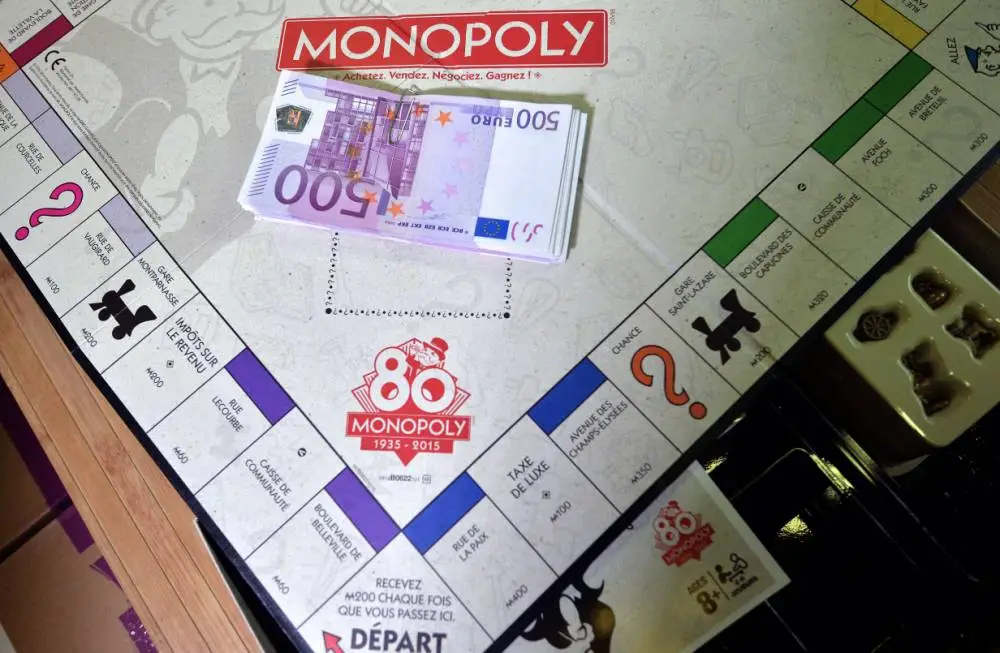
I believe that many people are familiar with Monopoly, the board game where, among other things, one accumulates properties and extracts rents from the other players. My intent is to illustrate with Monopoly the need for reparations, to illustrate why reparations are necessary to restore justice. This is a twist on John Rawls’ veil of ignorance thought experiment.

Slave auction advertisement

I have heard some people say that the past is the past, or if there were injustices in the past, that was ages ago, and now everyone has an equal chance. No special accommodations or affirmative actions are necessary. I don’t agree that this is true, but let’s just say for the sake of this exposition that opportunities are equal for everyone in a given society.

There are parallels between a game of Monopoly and the way we are thrown into this world. No one differs in this regard. We are all subject to a loin lottery.

Imagine that I already own all of the properties. You own none. Irrespective of how the game came to this condition, your chances of winning are nil to none. Now imagine that the reason for the disparate ownership was the result of a system of injustice perpetrated by the player I inherited my position from on the player you inherited yours.

No matter how fairly the game is from now until the end, if your starting place leaves me with all of the property and you without, your chances of winning are slim to none. Favouring tradition and inheritance already benefits some people over others, but when the benefit is the result of a pattern of injustices, it feels more egregious. Worse yet, even if I ‘give’ you Whitechapel Road, Baltic Avenue, or Rue Lecourbe and keep the rest, your chances have only slightly improved.

With the end of US Civil War and the emancipation proclamation, affected blacks were promised 40 acres and a mule. For most, this never happened. This remains an outstanding debt. And whilst 40 acres in some places would be a boon, not many today really need a mule, so descendants of slaves need to be made whole. Reparations are a way to accomplish this.

Reparations are payments in arrears to attempt to compensate for the centuries of an unbalanced playing field. And reparations should allow you to recover more than Whitechapel, Baltic, or Rue Lecourbe properties. At least get Bond Street, Pennsylvania Avenue, or Boulevard des Capucines. If you’ve played Monopoly, you’ll understand that this is still not enough.


Note to Self #2

Hopefully, I get past these self-notes, but for now, I’m busy…

I don’t know if this is a good thing or not, but as I was structuring my thoughts critical to democracy, I discovered (recovered?) a structure I created several years ago. The structure was centred on the premise that democracy is a specious concept that retains life through the illusion of control. My latest concept is that people are just too dumb for democracy—not that it would matter if they weren’t.

I still question why I expend the effort. Who wants to read a piece whose premise is that the reader is likely too stupid to merit participating in a democratic process? Even worse, who wants to read a piece that claims the weakest link in any political process is people. I’m a sad panda.

On the upside, there’s some content crossover. And now I need to settle on a new centre. Please stand by.

Note to Self #1

Humans are much less rational than commonly assumed and the presumed ability to reason is either hubris or wishful thinking. Dan Ariely has brought attention to being predictably irrational, but that’s just the tip of the iceberg. Basing societies and legal systems on the premise of rational actors is a massive structural error.

— Bry Willis

I’ve got too much distraction to make progress on this, but I’ll save thoughts now and again so I don’t lose them…unless it’s deliberate.

Neo-Feudalism

It seems that Capitalism took a wrong turn and is retracing The Road to Serfdom. Hayek worried about government intervention in business, but he did not imagine a world where corporate leaders would grow large enough to not only be able to control government power through money and influence, but it could actually ignore governments altogether—or at least to a large extent.

The last time government was challenged at this level was by the Church. In the end, it resolved into a tenuous stalemate. But this next conflict will be ostensibly bloodless, opting to be fought with political weaponry.

serf master cap

To the workaday people, it doesn’t change much. Denial is an interesting bed partner anyway. As most deny being wage slaves, they now just deny being serfs. In their minds, they are free, just inches from the goal line. I’m not the one to break it to them that the goal line away from in inches is the wrong one. They’re an entire field’s length to reach their goal. Thank goodness for denial and mechanisms that assuage cognitive dissonance. Ignorance is indeed bliss.

For some, the COVID response doubled down on the transition from Capitalism to Communism. For others, it was a reinforcement of the strength of Capitalism—and if in the milieu of fighting between authoritarians and Libertarians. But the phoenix rising from the dust—hardly flames—seems to rather be a sort of neo-feudalism. This seems to be a more likely future than Capitalism in a nation-state world. I assume that Nation-states will continue to exist, but they will serve only to contain the commoners, the ones who can’t afford to escape the fetters.

I don’t have much to add to the discussion at this time, but this article sums up some of my perspectives. My question is how the Capital aspect is extricated from the system. The serf part is easy.

Slotrocket

Being in a band is hard. It’s like being married to a bunch of partners, and if you are a band and not just some cat with some supporting characters, you’ve got artistic differences to consider. This is where I soured on direct democracy.

Slotrocket is the name of one of the bands I performed with. We played under this name exactly once, but let’s rewind to the democracy bits.

Skipping a lot of the details, I played bass in this line-up. It was a 3-piece with a focus on alt-post-grunge-nu-metal, but we all came from different places musically. The drummer came from speed metal, death metal, and maths rock. The guitarist-vocalist came from Classic Rock, Grunge and Nu-Metal. I came from all sorts of places, but I wanted to focus this project on the post-grunge thing. For the uninitiated, this is the likes of Seether, Three Days Grace, Breaking Benjamin and so on.

We didn’t have a name. Since we only played with friends and at parties and sometimes provided the backing for live karaoke, it was just us. We did arrive at the name of Breached, but it turned out that a Canadian band was already calling dibs on that, so we just let it slide—especially when they released an EP in the vein of early Incubus.

But then the guitarist-vocalist didn’t want to hold both roles. Too much effort. He didn’t care which. In the end, they found a female singer who was interested. It seems that there was a mixup in communication. They asked if I minded if she joined us during our next rehearsal. I figured it was just another live karaoke session, so when I said yes, it turns out that she was now a member of the band. Truth be told, I didn’t think a female would cop the vibe I was seeking. She was no Lacy Sturm or Amy Lee. She didn’t know any grunge material as she was more of a Country gal. But that’s not the story.

The story is the name. We deliberated for well over a month to settle on a name. We decided to create a spreadsheet. We’d all force rank the entries. And each of us had infinite veto votes to kill an offending entry from the list.

Skipping ahead a few chapters, I liked Rapeseed. It was a benign word that sounded edgy. The boys were fine with it. Notsomuch, the girl. There was no particular rush until we booked a gig—the gig. We’d need a name to promote.

I came up with Slotrocket. Again the boys were fine with it; her notsomuch. However, she didn’t veto—later claiming that she didn’t think we could possibly be serious. Since I booked the date and created the adverts, everything seemed to go under the radar—or under the rug.

A bit before the show, I was distributing material and advertising on our media outlets (as it were) and she caught a glimpse of the promo mats. Let’s just say that she was not amused. Still, when the time came, we performed.

OK, so I skipped over some stuff—the months of pouring over a spreadsheet. Our goal was unanimity. The name didn’t have to be everyone’s top pick, but we did need to attain a consensus view. As it happened, two of the biggest decisions came about by accident, and they both resulted in hard feelings.

It’s not that the 3 or 4 of us couldn’t have eventually come to a unanimous decision amounting to all of our first choices, but this would have taken time—and who knows how much.

One may feel justified accusing me of allowing perfection to be the enemy of the good, but that’s just something apologists tend to say, as they defend their preference for democracy.

Are we too dumb for Democracy?

The road to Hell is paved with good intentions. I wanted to post a fairly robust piece arguing against democracy, but it is proving to be a bit daunting of a task. There is a lot of data and information to support this position. Too much, in fact. I’ve decided to step back and approach supporting this position more academically (which is to say, less blog-like… citations, footnotes, counterpoints, and the rest).

“Democracy don’t rule the world, You’d better get that in your head; This world is ruled by violence, But I guess that’s better left unsaid.”

—Bob Dylan

As it happens, I’ve been spending a lot of prep time reading, reviewing, watching online content, and so on. To be honest—I know, right?—, I’ve been engaging in deliberate selection bias, seeking arguments and evidence to make my case. In fact, it’s not too difficult to locate. The reality is that most people, such as David Moscrop, who asks Are We Too Dumb for Democracy? are creating provocative titles to grab attention, but their punchline is always ‘of course not’ and let me tell you why not by peddling hope and optimism. There is a reason self-help books sell.

Where I am now as 2021 has bled into 2022 is to try to create a structure around my thoughts. So far, it looks like this—not necessarily in this order:

  • Position and setup
  • Prima facie arguments
  • essential strawman counter arguments
  • historical backdrop – pre-enlightenment until now (pro-dem args)
    • Celebrity supporters (Marx, Churchill)
    • Celebrity anti-dem peeps (Plato, Churchill, Washington, Adams)
  • Shaky grounds and necessarily suboptimal outcomes: Arrow’s Impossibility Theorem
  • Possible people-based solutions
    • Are we too dumb for Democracy? (David Mascop’s defence)
      • Reconciling worldviews: Individualism versus Collectivism
      • Dealing with rational ignorance and unknown unknowns
    • Against Democracy (Jason Brennan’s proposed epistocracy solution)
      • Effective mob rule (better voters: or how to avoid learning from Jim Crow era mistakes)
    • The representatives (what about better-qualified representatives: or Plato was a dumbass)
      • Jeremy Benthem’s Panopticon — watching the watchers
  • People-based counter arguments
    • US / UK politics (your country likely sucks, too)
    • SCOTUS partisanship (SCROTUS? — evidently, this term already exists. Now I feel bad)
    • Jury systems
    • Rittenhouse – Pathetic paternalism and subverting outcomes
  • What about…?
    • Anarchy and Libertarianism
    • Deliberative Democracy
    • Republicanism
    • Epistocracy
    • Sortition 
    • Tea Leaves
  • And so what? Where to go from here?

Special guest appearances by…

  • Irrationality, cognitive dissonance and other biases and deficits, logical fallacies, and hubris
  • Misanthropy versus pity
  • Limits of intelligence and IQ

Obviously, this is a work in progress, so the structure and contents may change and discovery may lead me down different paths.

We’re All Conservatives These Days

I’ve always taken the Libertarian Political Compass to be a bit interesting, like fortune cookies and tarot readings. Along with other tests like MBTI and IQ tests, it feels like it might be useful. In fact, it is. It facilitates signals tribal affiliation. Whenever I take the test, I always trend to the lower-left corner, so I can smugly reaffirm my Leftist leanings—if you interpret leanings as up against the wall and on the floor.

When I commented on a forum that I felt that (presuming the X-Y axes of this scale without even mentioning it) Liberals and Conservatives in the United States are each Right of Centre and Conservative—they just want to Conserve different things, someone replied with a link to this video by Halim Alrah. Whilst I won’t comment on his class materialism claim—at least not now—, I do feel it makes me not only double down on my claim but to toss more into the Conservative bucket list.

Besides noting that each aspect is defined in the abstract, he tacitly makes a point with which I agree: all professional and most amateur politics are Conservative: Conservatives want to conserve the 1950s; Liberals want to conserve the 1960s and some of the 1930s and ’40s; Leftist Marxists want to conserve the missed opportunities of the 19-teens, and I suppose the Progressives want to conserve the 19-teens as well. Bully!

all professional and most amateur politics are Conservative

Politics are inherently backwards-looking and fraught with appeals to tradition, each cherry-picking which traditional narrative fits their bill whilst suffering from selective blindness in areas that didn’t quite work out or fit the narrative. Or they want to cash in a mulligan and try again. Or they feel with 20/20 hindsight, they can Groundhog Day the hell out of it. In some hundreds of generations, we’ll be bound to get it right. Even Libertarians and Anarchists cling to ideas of the past. As I’ve mentioned before, I am an anarchosyndicalist, and though that has never been instantiated to scale, it is nonetheless an idea almost two hundred years old. Hardly novel.

I am not a traditionalist, but neither I am not claiming that every tradition is rubbish. But what worked in the past may not actually work in the present or in the future. As the title of a book that I am fond of reminds us, What Got You Here Won’t Get You There, so these political armchair quarterbacks are operating on bad assumptions. All are operating on nostalgia and historical reconstructions of what might have been. Perhaps they excel at Risk or Sid Meyer’s Civilisation. Whatever the mindset, it’s taking a rearview mirrored approach.

So, what’s in a name anyway? If Conservatism doesn’t denote anything and only connotes a bunch of old white guys as a synonym for Tories in the UK and Republicans in the US; and where the Republicans and Democrats could both merge into a single Oligarchy Party (or Kleptocratic Party depending on one’s mood)?

In the end, we need a new way to describe the political sphere if we wish to promote discussion and build alliances, but perhaps that’s never been the goal.

Post Truth?

Foucault should be a reminder that the culture wars are not new and post-truth can’t exist because there was never a truth at the start. This is similar to Latour’s question asking if we’ve ever been modern. And the answer remains ‘no’. There is no post-truth as there is no post-modern as each of these is predicated on a fantastical claim. Many humans defend the notion of truth, but they are fighting windmills.

We are therefore at war with one another; a battlefront runs through the whole of society, continuously and permanently, and it is this battlefront that puts us all on one side or the other. There is no such thing as a neutral subject. We are all inevitably someone’s adversary.”

— Michel Foucault, Society Must Be Defended

In these culture wars, each side is fighting for its version of the truth. The truth of rights and freedoms and the correct construct of societies. But there is not one culture war. There are myriad culture wars, and there are few opportunities to be allied across all of these dimensions with another person. For the congruent dimensions, one needs to operate in the mode of the enemy of my enemy is my friend whilst deciding how to ally on other disagreed dimensions later.

But never forget that the wars are intentional. They are a feature of the system of normalisation, not a bug. More importantly, don’t think for a moment that your truth is the truth. The same goes for your adversary.

Ternary Chart

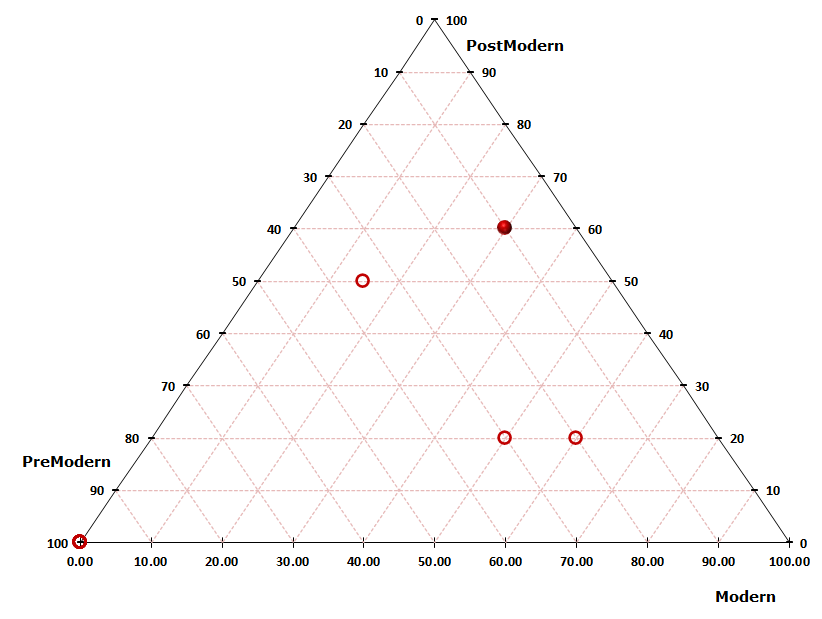
I am working toward fleshing out my Modernity Triangle. Since I want to illustrate placement graphically, I’ve settled on using a ternary plot—at least for now. I’ve borrowed an existing Excel template, which already contained the simple maths and charting. This is really just the tip of the iceberg as creating appropriate dimensions, measures, and weights is the heavy lifting.

I may work on the aesthetics, but this is the underlying framework. I’ve already commenced a scoping conversation in a previous post. In a nutshell, there are three primative movements—the spectra are Premodern to Modern, Modern to Postmodern, and Postmodern to Premodern.

This chart is meant to be discriptive. As the adage goes, there is no correct placement. If you identify as a Modern, you may wish the dots to bias in that direction, but the same is true if you occupy one of the other corners. For those who prefer moderation as a stance—the Middle Path—, you may be tempted to find comfort in a dot occupying the centre. That’s fine. I’m not judging your worldview.

Taking a moment to mention prescription, the best I can offer at this point is that if you feel you should or want to occupy a particular place. Feel free to create a vector from where you are to where you aspire to be. My only caveat at this point is that sometimes it is hard to reverse tack once the genie’s been let out of the bottle. An example might be agriculture. Humans progressed from Hunter-Gatherers to Aggrarians. Some have ‘progressed’ to Industrial and Postindustrial worldviews. However, not all humans have taken these paths. But due to encroachment of Premodern humans by Moderns, the habitat of Premoderns has made hunting and gethering an untenable lifestyle, so in the contemporary world, only Hunter-Horticulturalist remain.

In the accompanying ternary chart, I clumsily place myself where I self-identify, though I could be way off base. As a matter of example, this dot could represent a single dimension as well as some aggregation of dimensions. At the most abstract level, the view should interpret as a person espousing a tendency toward Postmodernism over Modernism fairly far removed from Premodernism. The lower leftmost dot on the Premodern corner could represent a typical pre-Enlightenment peasant as well as a member of some contemporary indigenous tribe such as the Sentinelese.

In the contemporary Western world, I’d image that they might be represented by the 2 dots on the second horizontal, fairly Modern, a smidgeon of PostModern, and more PreModern than they’d likely be comfortable to admit.

Political Compass

I was inspired by the Political Compass conceived by Libertarians attempting to differentiate themselves from a strict Left-Right political frame. My intent is to create something similar. I don’t feel that I have four points to work with, so I settled for three. I discuss how Metamodernism fits into this model elsewhere. Here is how the Political Compass situated the UK parties in the 2019 general election.

Emperor’s New PoMo Clothes

I was engaged in an online conversation where the participants were anti-Postmodern—one person in particular.

The conversation hinged on democracy. My postition remained that it is not a particularly functional form of government and tends toward mediocracy and oligarchy, neither of which is very appealing. At least oligarchy accrues benefits to the oligarchs. If you happen to be one, good on you. Mediocracy benefits no one in particular.

Cutting to the chase, I was basically accused of revealing the soft underbelly of democracy—hence the relationship to the Emperor’s New Clothes. Some Moderns such as this chap osensibly understand that Democracy is a specious proposition. His defence is basically ‘don’t point it out because that would ruin everything’. I was the kid who told your kid there is no Santa Claus. Oh, the horrors. Ignorance is indeed bliss.

Besides the connection to the Emporer’s New Clothes, is reminds me of a Woody Allen joke: The food here is terrible, and the portions are too small.

The essence of the experience is bad, and yet some complain that there’s not enough. Yes, the emporer is naked, but the emporer is us, and we don’t want to know. Or, don’t embarrass the emporer. If he’s OK, just let him be. No use in pointing out his shortcomings.

In any case, the critique turned from my perspective is wrong to “Shht. Don’t tell anyone.”