Words are not arbitrary

Words have inherent meaning. Unlike the common wisdom, the meaning of words is not arbitrary. Embedded in them is a relationship to the real-world experience. Or so Iain McGilchrist would have you believe. I’m afraid, I am not ready to buy into this assertion.

Podcast: Audio rendition of this page content (except the last bit at the bottom)

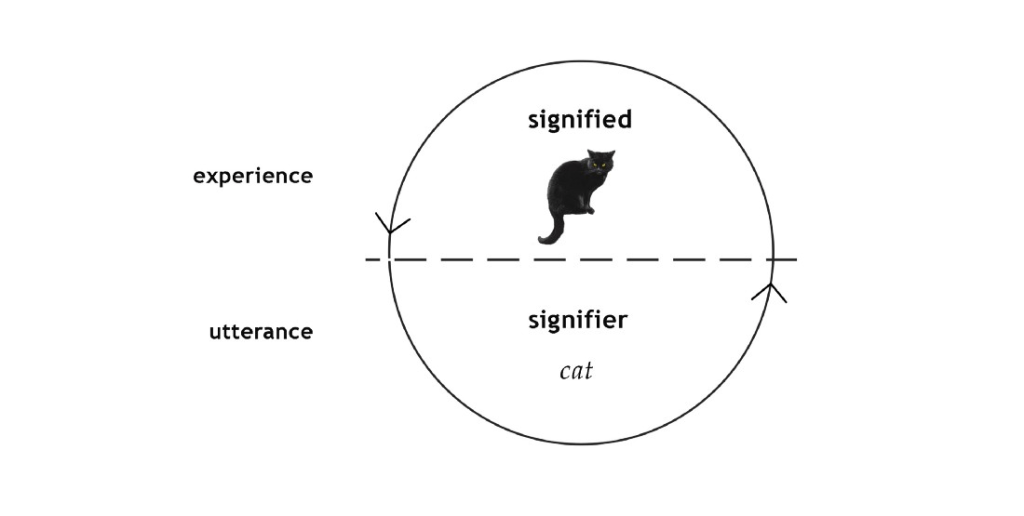
In chapter three of The Master and His Emissary, McGilchrist informs the reader that Ferdinand de Saussure is wrong in articulating there are referents and references, symbols and symbolised, signifiers and signified, or in his native French, signifiant and signifié. This falls into the realm of symbols and symbolic language, the domain of the left hemisphere. If you’ve been following along with my summary of The Matter with Things, you’ll know that this is not a flatter. To call someone left-brained is to accuse them of being out of touch and wrong. They are narrow, myopic thinkers, always trying to reduce the world to maps and symbols, which is of course precisely what Saussure does.

Let’s turn back the clock to July 2022. It was about then I had been introduced to the work of McGilchrist. In Intuition Showdown, I wrote about my reluctance to engage with it. I could sense that psychology was going to stake a claim to have the real perspective on reality. I wasn’t wrong. And it gets worse.

Effectively, McGilchrist establishes the left hemisphere as the village idiot. It’s a useful idiot and a halfway reliable emissary, but it’s closer to Lenny than George or a less fortunate Forrest Gump. And now he tosses Saussure into the pile. Here’s the kicker: To defend someone who’s been given this scarlet letter, is to be relegated to this category by association. Your defence is an admission that you, too are a left hemisphere dolt.
Be that as it may, I am standing in solidarity with Saussure on this one. I should probably wait until I’ve read chapter five, as Iain informs, there is more on the topic of language to come. For one reason, McGilchrist’s assertion rests on a sketchy study. To be fair, I’ve not delved deeply into the topic nor have I read the original study or evaluated the methodology, but here is how Iain portrays it.

There is, however, plenty of evidence that the sounds of words are not arbitrary, but evocative, in a synaesthetic way, of the experience of the things they refer to. As has been repeatedly demonstrated, those with absolutely no knowledge of a language can nonetheless correctly guess which word – which of these supposedly arbitrary signs – goes with which object, in what has become known as the ‘kiki/bouba’ effect (‘kiki’ suggesting a spiky-shaped object, where ‘bouba’ suggests a softly rounded object). [ref] However much language may protest to the contrary, its origins lie in the body as a whole. And the existence of a close relationship between bodily gesture and verbal syntax implies that it is not just concrete nouns, the ‘thing-words’, but even the most apparently formal and logical elements of language, that originate in the body and emotion. The deep structure of syntax is founded on the fixed sequences of limb movement in running creatures.111 This supports evidence that I will examine in Chapter 5 that the very structures and content of thought itself exist in the body prior to their utterance in language.

Image: Recreation of kiki and bouba shapes

He cites Wittgenstein as well, who wrote about the disconnexion between language and the real world.

Without becoming mired in the details of this kiki/bouba effect study, as a former statistician donning my statistician hat, I find this study to be suspect. Although there appears to be a general tendency for neurotypical people to identify the spiky shape as kiki and the curvy shape as bouba, it’s quite a stretch to then conclude that all symbolic language has a similar basis. Although most (but not all) cultures conform to pairing these shapes with these nonce words generally, it would be more meaningful to extend this to at least a dozen shapes to see if this persists. Even then, this doesn’t connect this concept to common vocabulary words, whether spoken or written.

I do believe that conceptual thought precedes articulated language. I just don’t believe that these conceptual notions materially shape the words chosen to represent them. Proto-Indo-European theories aside, there is too much language diversity to account for this progenerative hypothesis.

I may return convinced after reading chapter five, but I somehow doubt it unless there is a lot more empirical support. For now, this is one of several disagreements I have with McGilchrist, though I probably agree with ninety-odd per cent of his work. I’ll keep reading The Master and His Emissary as well as The Matter with Things. I recommend that you do as well.


Seeking an image to illustrate Saussure’s signified and signifier, I happened upon a nice summary of semiotics. I also found this extension of Saussure by Roland Barthes. If you visit the site, you’ll also discover how Charles Sanders Pierce envisaged it,

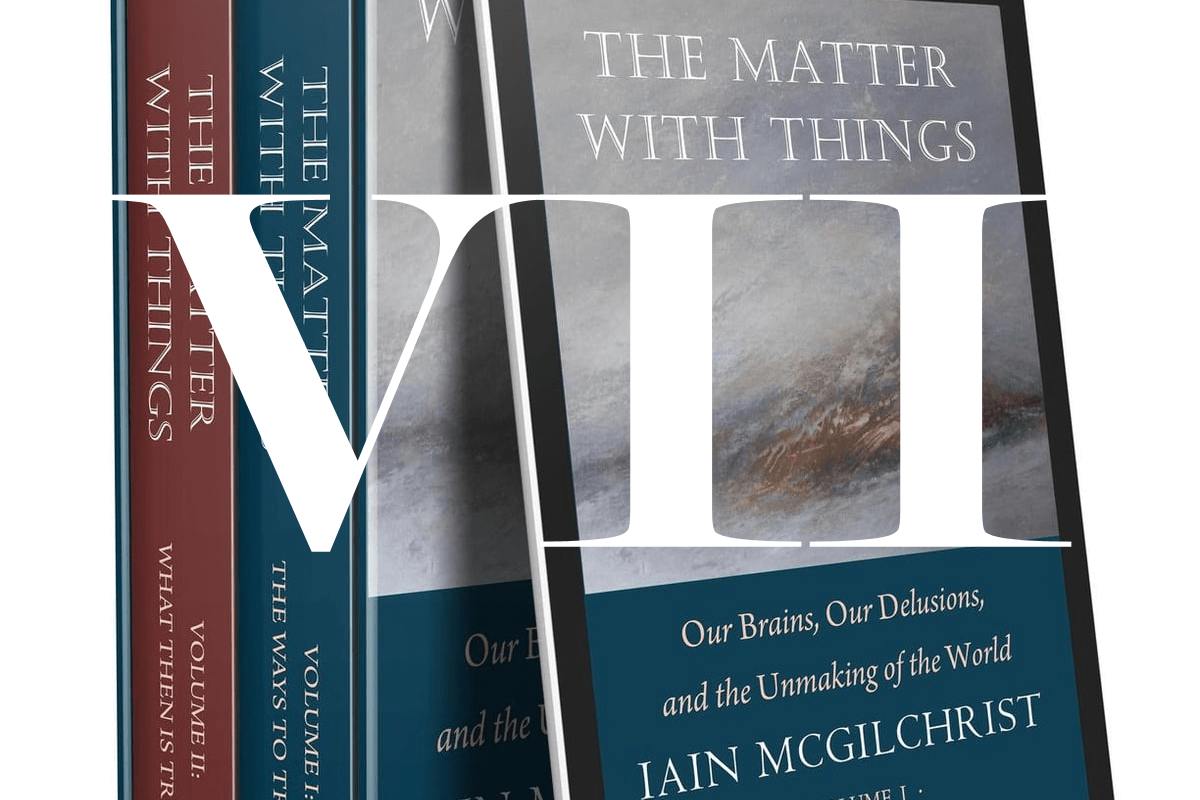
Photo: Connotative Level of Semiotics by Roland Barthes

The Matter with Things: Chapter Seven Summary: Cognitive Intelligence

Index and table of contents

Following Emotional and Social Intelligence and the rest, Chapter 7 of The Matter with Things is Cognitive Intelligence.

In the last chapter, we learned that Emotional and Social Intelligence are the provinces of the right hemisphere. In this chapter, we discover more of the same. Whilst the left hemisphere has its duties and functions, it’s primarily a delegate. Let’s jump right in.

Podcast: Audio rendition of this page content

Under the old pseudoscientific mode of thinking, the left hemisphere was the logical side whilst the right hemisphere was creative. It turns out that this is not correct.  At its core, intelligence is about understanding. Keep in mind that there are multiple kinds of intelligence—not referring to multiple intelligence theory, per se. Besides the emotional and social sort discussed at length in the last chapter, there is a sort of rote intelligence. This is where the left hemisphere excels. The left hemisphere is symbolic and algorithmic. It has facilitated the making of computers and other instruments that allow us to extend our intelligence, but these are not sources of intelligence. In a conceit to his previous book, The Master and His Emissary, McGilchrist notes that the left brain is effectively the emissary, the junior partner in the relationship, and not really even a partner as the right hemisphere seems to call all the shots when it’s intact.

He tells a story about a geneticist who declared to a biologist that the notion of intelligence was quite meaningless. The biologist retorted that he (the geneticist) was unintelligent, and the two never spoke again. Clearly, the notion is that whilst it may be ill-defined, it nonetheless contains meaning.

I share the working definition of intelligence that he shared, taken from the journal Intelligence and cited in the Wall Street Journal in 1994.

Intelligence is a very general mental capacity which, among other things, involves the ability to reason, plan, solve problems, think abstractly, comprehend complex ideas, learn quickly and learn from experience. It is not merely book learning, a narrow academic skill, or test taking smarts. Rather, it reflects a broader and deeper capability for comprehending our surroundings – ‘catching on’, ‘making sense’ of things, or ‘figuring out’ what to do.

As noted, there are several flavours of intelligence, even if they are attempted to be captured as G, general intelligence. This can be separated into crystallised intelligence (Gc) and fluid intelligence (Gf). Crystallised intelligence is more culturally bound than fluid intelligence and is more the domain of the left hemisphere. Generally, this is what IQ tests aim to measure.

Two criticisms of IQ tests are the cultural bias and the rote nature of the tests. As it happens, trends show that IQ is generally on the rise despite a feeling that people are getting dimmer. This may be because this rise represents the shift toward left hemisphere thinking, an alarming topic he’ll cover more in future chapters. We’re witnessing a trade-off between creative thinkers for intelligent rote automatons—the type of people more easily supplanted by computers and automation. Even as IQs are apparently increasing, undergraduate professors are complaining in higher numbers about how unprepared their incoming students are. I can add my experience anecdotally to this list. I recall chatting with a physics professor who complained that he had to devote some 20 per cent of his class time to teach students the same prerequisite maths, which meant that he had to cut this from his intended time to teach physics.

As a student, one of my physics teachers said he wouldn’t demerit much for maths errors because this was, after all, a physics course. Again, this was a reaction to many students not being prepared. They just had different approaches to handling the deficits. And don’t get me started on grade inflation.

The right hemisphere is the realm of fluid intelligence and is activated more in gifted persons. This affords creative problem-solving.

The right hemisphere is the realm of fluid intelligence and is activated more in gifted persons. This affords creative problem-solving.

Let me editorialise here in place. Sometimes we hear that this or that person is good at maths, but it turns out that this is not a simple declaration. A person who studies geometry, trigonometry, and calculus and can perform the functions may simply perform all of this rote activity in the left hemisphere. Because someone can do maths a few levels above us may feel like this person is good at maths, but this may not make this person actually good at maths.

A few years ago, I read the introduction to a book whose title I’ve long forgotten. In this introduction, the author had excelled at left hemisphere maths and got his bachelor’s and master’s degrees in mathematics. Whilst pondering whether to pursue a PhD, in a moment of self-reflection, he decided not to. He was an A student and the pride of his family, but he had to work hard at maths. Then he considered some of the other classmates who seemed to perform the tasks effortlessly. He could do maths, but they could think maths.

This reminds me of the story of a young Carl Gauss whilst he was still in elementary school. Don’t worry. I’ll get back to the summary presently. Gauss’ teacher was hoping to keep the students occupied, so he assigned them the task of summing the numbers 1 through 100.

Eight-year-old Gauss considered the problem. He noticed a pattern and worked out the answer in his head after a few seconds—5050. Gauss excelled at maths naturally. He noticed that pairing each ascending integer from 0 to 100 created values of 100; 1 and 99; 2 and 98, 3 and 97 … 49 and 51. There are 50 such groupings with a product of 5,000 and 50 left over, so 5,050. Easy Peezy.

And now we return to regularly scheduled programming.

Another interesting characteristic of the hemispheres is that the left hemisphere operates serially whilst the right hemisphere operates in parallel, metaphorically speaking, of course. The right hemisphere is the Gestalt operator, which is a problem as McGilchrist sees it given the leftward shift in the sciences, losing the woods for the trees. Moreover, as we are forced into the constraints of business and bureaucracies, we are forced into a left hemisphere perspective, which may create a vicious epigenetic cycle or a downward spiral.

Perspective

In summary, the right hemisphere not only contributes to the majority of emotional and social intelligence as discussed in the last chapter, but it is also the workhorse of cognitive power.

Before ending, I want to share one more elucidation. I was reading elsewhere about critical thinking, and an example given was an emergency room nurse triaging patients—prioritising the treatment of patients. I wholly disagree. This is algorithmic thinking, not critical thinking. It could easily be done by a computer. In fact, in the late 1980s, I was working with so-called expert systems, which were the AI hype of the day in wave 3.0. We are now in wave 4.0 and it is still hype. Only nowadays it’s deep learning, machine learning, visual recognition, edge computing, and robotic process automation. The only difference is that technology has driven costs down, so they are more accessible to more people and can be run on more powerful computers. For the uninitiated, there is no intelligence in artificial intelligence. So, it’s less artificial and more non-existent.

Yet again, I am left wondering what this left hemisphere is good for.  It seems to do less than 20 per cent of the work and does half of that poorly. Not exactly someone you’d pick for your team. Of course, I wouldn’t want to sacrifice my left hemisphere, but still.

That about wraps up the chapter on Cognitive Intelligence. Next up is chapter eight on Creativity. If you think this will focus more on the right hemisphere, I’ll bet you’re right. I hope you’ll join me.

What are your thoughts on intelligence and the hemispheres’ split duties? Did anything surprise you? Was there anything of particular interest?

Leave comments below.

Bird Brain

In English, bird brain is a pejorative. The top Google search result yields a definition of ‘an annoyingly stupid and shallow person.’ Nonetheless, bird brains and human brains have many similarities. They have structurally divided, bi-hemispheric brains and lateralisation of functions, just like us and most other vertebrates, but how they differ is more interesting.

Podcast: Audio version of this page content

I’ve extracted the majority of information on this page from Iain McGilchrist’s publication The Master and His Emissary with a focus on birds.

Firstly, except for birds of prey—because they have forward-facing eyes—, birds don’t have stereoscopic vision. If you’ve ever noticed a pigeon or a chicken strutting about, they jerk their heads around. This is to render a better perspective of their immediate surroundings.

Recall that the left hemisphere is about contraction and closure. The right hemisphere is open and expansive.

For birds, there is a need to focus attention narrowly and with precision, for example, on a grain of corn. At the same time, there is a need for open attention to guard against a possible predator. But apart from the optical mechanisms involved, there is the cognitive need to focus attention, but it is an impossibility to focus on both simultaneously. There is a trade-off between close focus and wide focus. To do both is to do both poorly. The trade-off is to eat or be eaten, so this is a nontrivial conundrum.

Midjourney render of a pigeon portrait headshot

You can simulate this yourself. Out of doors or in a large-enough indoor space, hold a page at arms’ length and try to read the words on the page and keep the background in focus.

Returning to the birds and remembering that, like us, the left eye is controlled by the right hemisphere and the right eye is controlled by the left. You should suss out by now that this translates into the right eye for getting and feeding and the left eye for environmental vigilance.

Although they are better at detecting predators with the left eye, many types of birds show more alarm behaviour when viewing them with this eye. If they detect a predator with their right eye, they will also choose to re-examine it with their left eye to the extent that they will turn their head to make the visual connexion.

Like humans, chicks preferentially use the left eye (right hemisphere) for gathering social information.

Like humans, chicks preferentially use the left eye (right hemisphere) for gathering social information. They use this eye to differentiate familiar members of the species from one another and from those who are not familiar. Some species seem to operate opposite to this, but they are the exception.

One interesting bird of note is the wry-billed plover of New Zealand. With a beak that curves to the right, it favours the left hemisphere for focusing on feeding.

Wry Bill Plover

McGilchrist notes that “there is a strong right eye (left hemisphere) bias for tool manufacture in crows, even where using the right eye makes the task more difficult”.

Another feature in common between humans and birds is speech vocalisation as it were. In both cases, speech articulation is the domain of the left hemisphere.

The right hemisphere in birds, as in humans, is associated with detailed discrimination and with topography; while the left hemisphere of many vertebrate animals, again as in humans, is specialised in categorisation of stimuli and fine control of motor response.”

The right hemisphere yields broad, vigilant attention, and it is involved in bonding in social animals.

In general terms, the left hemisphere yields narrow, focused attention, mainly for the purpose of getting and feeding. The right hemisphere yields broad, vigilant attention, and it is involved in bonding in social animals.

The right hemisphere underwrites breadth and flexibility of attention, where the left hemisphere brings to bear focussed attention. This has the related consequence that the right hemisphere sees things whole, and in their context, where the left hemisphere sees things abstracted from context, and broken into parts, from which it then reconstructs a ‘whole’: something very different.

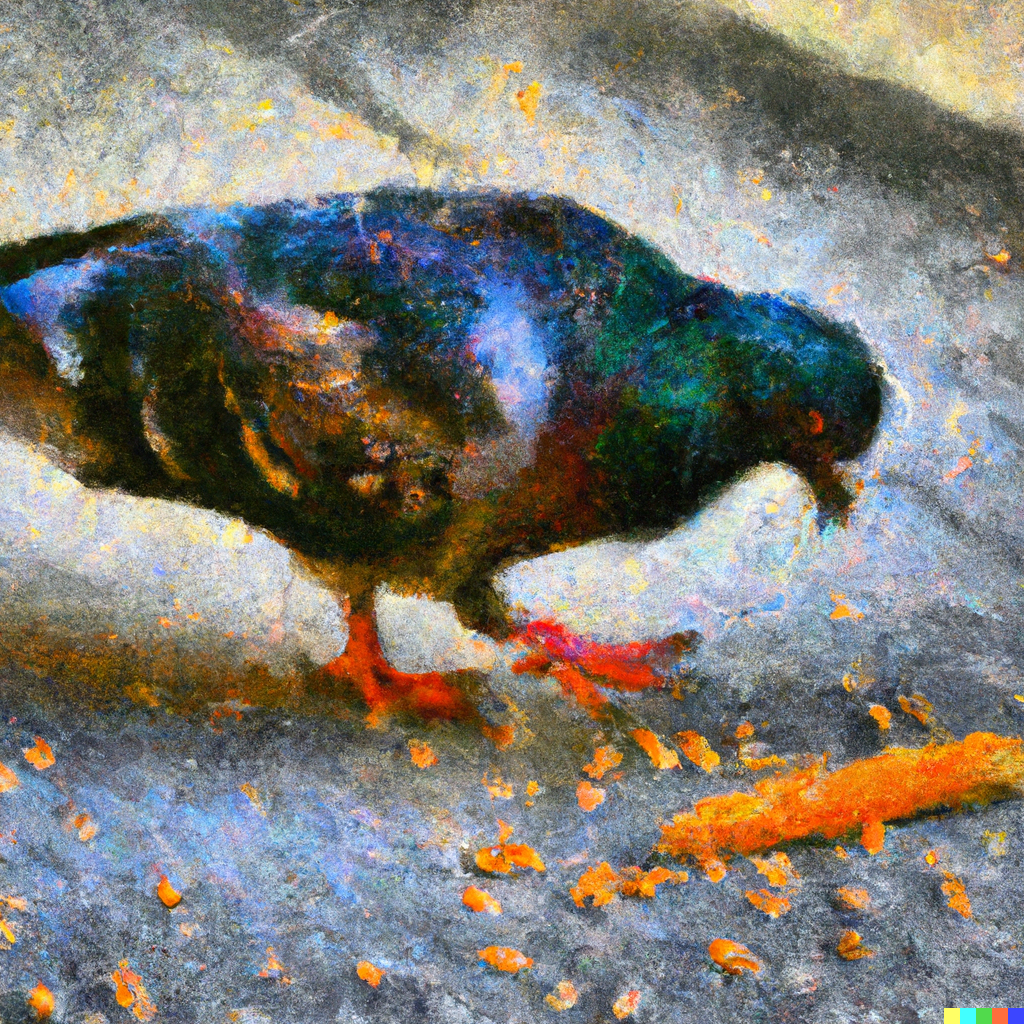
Dall-e-2 render of an Impressionist oil painting of a pigeon eating corn

Limits of Reason and Critical Thinking

Hear me out. The Age of Enlightenment and after is based on the notion that ordinary people are rational, capable of reason, and critical thinking. I may not get out much, but I don’t notice a lot of evidence of this. In fact, I feel that the original proponents of this didn’t get out much either. And when they did, they congregated together.

I’m not talking about rote learning and being functionally literate. I’m talking about being able to suss out solutions to novel challenges. Call me an elitist, but I noticed this in my classmates at both university and grad school. I could count on one hand the number of people I would consider to be more than rote learners. I can report similar results when I taught undergrad economics. And to be honest, even rote learning seemed to be a challenge beyond reach for many.

Some may accuse me of being an elitist or a misanthrope, and I understand the motivation, but I could also be critiqued for claiming elephants to be large land mammals or ice to be cold. To be fair, notions of intelligence are sketchy enough without trying to measure reason and rationality, so I am speaking generically and metaphorically as I have no good measure either. I’m operating on intuitions.

The right hemisphere is about creative problem-solving.

In reading Iain McGilchrist’s books, he might argue that these people are just left-hemisphere dominant. That’s all rote activity. The right hemisphere is about creative problem-solving. I may be wrong, but I think it’s more than that.

As a metaphor, pick your favourite high-performing athlete. I’m not into sports, so I’ll toss out some names. Perhaps you’ve heard of some: Cristiano Ronaldo, Kylian Mbappé, Leo Messi, Virat Kohli, Micheal Jordan, LeBron James, or whomever. Who’s your favourite athlete? Leave a comment.

I might have practised some 10,000* hours a year for decades and I wouldn’t have been able to elevate my skills to the level of any of these. Moreover, even if I were to target someone in the lowest centile of all professional athletes in any given sport, I wouldn’t likely reach that level. I was holding out for curling, but alas, I still don’t think so. If you happen to be a professional athlete, then switch metaphors to music or art and ask if you could then reach the pinnacles of these disciplines.

The point I am trying to make is that when it comes to reason, most people aren’t even rank amateurs. They are more like pigeons playing chess. And let’s be serious, whether these pigeons are playing chess, checkers, go, or croquet, they aren’t going to fare any better.

Phenotypes such as brown eyes or red hair are determined. Aspects such as height and intelligence have propensities.

When a person is born into this world, some aspects are determined outright, whilst others have propensities. Phenotypes such as brown eyes or red hair are determined. Aspects such as height and intelligence have propensities.

At birth, a person’s height is limited by some upper limit under optimal conditions. If I encounter nutritional deficits or some other stressors, this theoretic height may never be reached. I feel the same is true for intelligence and how well we can reason. I don’t particularly agree that IQ scores are a great measure, but I’ll use the notion conceptually since most people likely know of them and generally how they work. In a nutshell, a score of 100 is considered average, give or take a standard deviation in either direction, so roughly speaking about 68.26 per cent of people in a population fall between 85 and 115. This leaves about 16 per cent above and below average. By extension, about 85 per cent of people are average and below.

I’d like to assert is that the majority if not the entirety of this cohort cannot reliably reason or think rationally or critically.

What I’d like to assert is that the majority if not the entirety of this cohort cannot reliably reason or think rationally or critically. They can memorise that 1 + 1 = 2 and Paris is the capital of France, but novelty and synthesis are pretty much out of scope. And they can reason about small things in small doses.

Practically, this means a couple of things. Firstly, on the positive side, they can be trained to be drones. Wage slaves. Most jobs in the world are rote. Insert tab A into slot B. Follow an algorithm or procedure. This is not limited to so-called unskilled labour. This goes all the way up the food chain to doctors and lawyers, two rote professions if there are any.

Secondly, on the negative side, they cannot be trained to participate in democratic processes. This is a failure of insight of the Fathers of the Enlightenment. Is that a thing? Moving on. To be fair, they did notice. Plato noticed, too. This is why, among other reasons, they sought a republic over a pure democracy. The problem, besides bad incentives and ulterior motives, is that many of these people aren’t any, or materially better, thinkers. Recall my previous reference to lawyers. How many politicians are lawyers? Q.E.D. OK, so I’m being irascible, but still.

The problem is that the masses have been taught that participative democracy is both good and a right to be cherished. And it would be if the population were up to par. In the United States, they’ve had challenges in the past with literacy tests to limit access to the polls, but one, this wasn’t testing the right thing, and two, as I said at the start there isn’t really a test for this particular capacity.

Let’s imagine that there was a test. And let’s further imagine that it was somewhat aligned to IQ score. Let’s say that the threshold kicks in just over 115. This would mean that only 15.9 per cent of the adult population would be able to vote. Even if the threshold was met at 100, that would still eliminate 50 per cent of eligible voters. That would not go over very well. Remember these people are rote learners, and they learned that (1) rights are inalienable and sacred and (2) voting is a right. Justified or otherwise, you could expect a revolt, even in America where people are afraid of their own shadows. They aren’t the French showing their numbers in yellow vests. They are much more docile when it comes to things like this. Gun-related violence is another story, but unless they are shooting each other this is where fending for their rights end.

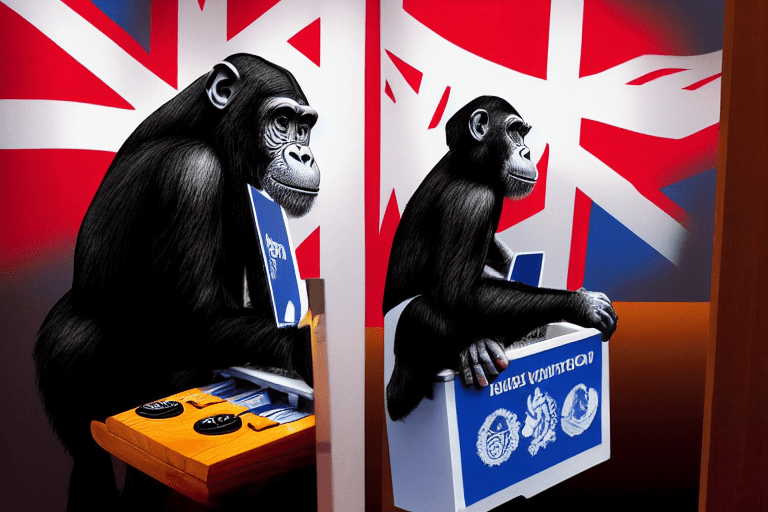
perhaps we could start allowing chimps to participate in the process

And maybe I am wrong, perhaps we could start allowing chimps to participate in the process. I’ve heard a lot of good things about dolphins and octopuses. I look around me, and I see a lot of nice people. People who enjoy life and are nice to talk with, maybe even about the weather. But being affable doesn’t make one a critical thinker. It doesn’t make a great foundation for government or even the selection of government.

Voting Chimps

The 64,000 question is what to do. The problem, as with any challenge involving people, is that it involves people. We could construct a test, and the affluent would find a way to bribe to get a favourable result or pay for the rote information and strategy to pass the test. They already use both of these approaches for college admissions, so I wouldn’t expect anything different here.

On a final note, some including Kant and Chomsky have argued that there are limits to human reason on a global level. I am just applying this to the local level, and there are many more local limits that never come close to encountering this higher global limit. That’s a challenge in and of itself.

In the end, you can rest assured. No one is going to voluntarily give up their voting rights any time soon. No meaningful test is on the horizon. The system will likely implode on itself first. In some places sooner than others.


* Yes, I know there are only 8,760 hours in an earth year. I was hoping you didn’t notice.

Some Republican Perspectives

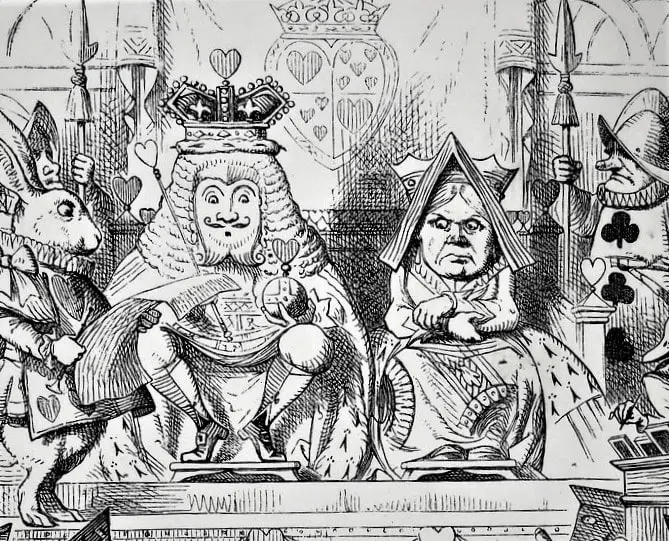
No, as Robert Smith quips, not the so-called Republican party in the United States. Real Republicans. The consensus seems to be that Queen Elizabeth served the role admirably and well. For most people, she was just the figurehead of an institution. Sure, the institution carries a lot of baggage, but she was mostly not complicit in creating more. She was pretty much a likeable mum.

But as with benevolent dictators, we don’t know where the benevolence ends. Why not just stop here and not keep rolling the dice? I don’t suppose that Charles has the same brand cache. In any case, family lineage is no system of succession—in State or Commerce, I might add. The world needs fewer dynasties, not more.

In this first piece, world-class writer, Philip Hall, shares his perspective on the dissolution of the Monarchy.

Bring the powerful to heel, don’t glorify monarchs and privilege

by Philip Hall (ARS Notoria)

The idea that Charles III is divinely appointed to rule over us is ridiculously far-fetched. Yet, ultimately, it is the metaphysical idea of the divine right of kings that gives King Charles III his political legitimacy… (click image to continue)

In the next video, Alex O’Connor (AKA Cosmic Skeptic), has some thoughts of his own on the monarchy.

On a lighter note, the Cure’s Robert Smith tells us how he really feels in this compellation compiled in 2021.

If you have any comments, I’d love to hear them—rather, read them, but you know what I mean because you’re clever like that.

Left-Brain, Right-Brain

The hemispheres of the brain have functional differences. I created a short-form video on YouTube, so it’s less than 60 seconds.

Transcript

If you see a face in this image (in the accompanying video), you can thank the right hemisphere of your brain. The right hemisphere is about unity and the whole—a Gestalt. It fills in missing pieces to construct a whole. And it’s usually pretty good at it.

Think of the right hemisphere as Zen. It’s about experiencing the world as presented. It experiences the world without judgment, without attachment, without naming. It’s about openness and options.
The left hemisphere is about division and parts. Where the right hemisphere wants to open up, the left wants to close down. And it’s about creating maps and symbols, then re-presenting these.
Where the left hemisphere of the brain is focused on the trees, the right hemisphere sees the forest or the woods.

The left hemisphere is what creates our sense of self and individuality whilst it would probably not be unfair to characterise the right hemisphere as the Buddhist notion of selflessness and an undivided universe, where ‘self’ is an illusion.
The left hemisphere is literal whilst the right is metaphoric. It is also the realm of poetry and empathy.

Moral Binaries

At heart, I’m an Emotivist. Following Ayer, I don’t believe that morals (and their brethren ethics) convey more than, “I like this, and I don’t like that.” Stevenson’s Prescriptivist extension makes sense, too: “I think this is good, and so should you.”

It seems that Hilary Lawson and I share this perspective. He makes the further point, one I’ll surely adopt, that morals and ethics are effectively ‘designed’ to shut down argument and discussion. It’s akin to the parent telling the kid, “Because I said so”—or “because it’s the right thing to do”.

Podcast: Audio rendition of this page content

I’m a moral non-cognitivist, but people have difficulty enough grasping relativism and subjectivism, so I’m only going to reference moral relativism here. As a moral relativist, right and wrong were both subjective and contextual. One person’s freedom fighter is another person’s terrorist. I won’t derail this with obvious examples. Once one adopts a position, they enjoy the luxury of turning off any critical thinking.

I’ll presume that morals predate religion and deities, but now that the thinking world has abandoned the notion of gods, they’ve replaced it with morals and ethics—and nature, but that’s a topic for another day. The faith-based world retains a notion of gods, but that is fraught with the same relativism of my god is right, and your god is wrong.

As Hilary notes, we’ve transferred the authority, per Nietzsche, from gods to morals in and of themselves, so it again becomes a device for the unengaged. He notes, as I do, that some absolute Truth is a fool’s errand. Echoing Donald Hoffman, what we need is fitness—what Lawson calls usefulness—, not Truth, which is inaccessible anyway—even if it did exist, which of course it doesn’t.

He cites the position Wittgenstein arrives at in his Tractatus. There is and can never be a place where language—words and symbols—intersect with ‘reality’, so the best we can do is to talk about it in a third-person sort of way.

As I consider the works of McGilchrist, it feels like Lawson is establishing moral simplicity as a left hemisphere function. Seeing beyond this is a right hemisphere activity, so that’s not promising. There seem to be few right-brain thinkers and then it comes to convincing the left-brain crowd. In a poor metaphor, the challenge is rather like trying to convey the maths of special relativity to the same crowd. They are going to tune out before they hear enough of the story. The left-brain is good at saying, ”la la la la, la la, la”.  

Without getting too far off track, a major challenge is that systems of government and laws are facile left hemisphere-dominant activities. These are people in power and influential. Rhetoricians have right hemisphere dominance, but they understand that their power depends on defending the status quo that has elevated them to where they are. As Upton Sinclair said, “’It is difficult to get a man to understand something, when his salary depends on his not understanding it.” This holds true for women and non-binary others.

In closing, Lawson asserts that apart from comic book supervillains, people tend to do what they believe to be good, and yet all goods are not created equally, nor all bads. And in the manner that one person’s trash is another’s treasure, one person’s good is another’s bad.

This moral discourse is not benign. It’s dangerous. I don’t want to steep this in contemporary politics, but this is being propagandised in things like the Ukraine conflict or the Covid response. If you’re not with us, you’re against us. This is divisive and creates a rift. That governments are propagating this divide is even more disconcerting, especially when they unapologetically backtrack only a few months later in the wake of people suffering economic impacts, including getting fired, for opposing a position that has turned out to be wrong and that was being asserted in the name of science and yet with little empirical support. These people are politicians and not scientists but attempting to hide behind science like a human shield, it serves to erode trust in science. Trust in science is a separate topic, so I’ll leave it there.

I recommend watching the complete video of Hilary Lawson to gain his perspective and nuance. My point is only to underscore his positions and to say that I agree. What do you think about morals? Are they a device to assert power over others, or is there something more to it than this? If not moral, then what? Leave a comment.

Philosophical Methodology

How do we get from data to theory? And what data qualify? Do the data make the theory, or does the theory lead us to search for data?

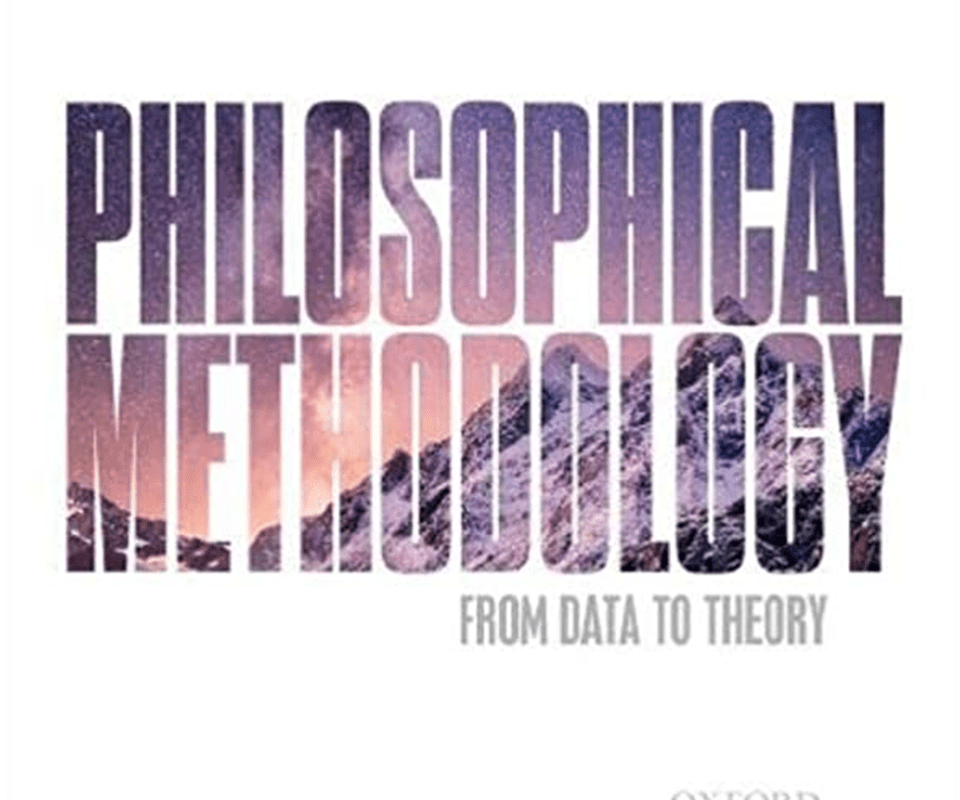
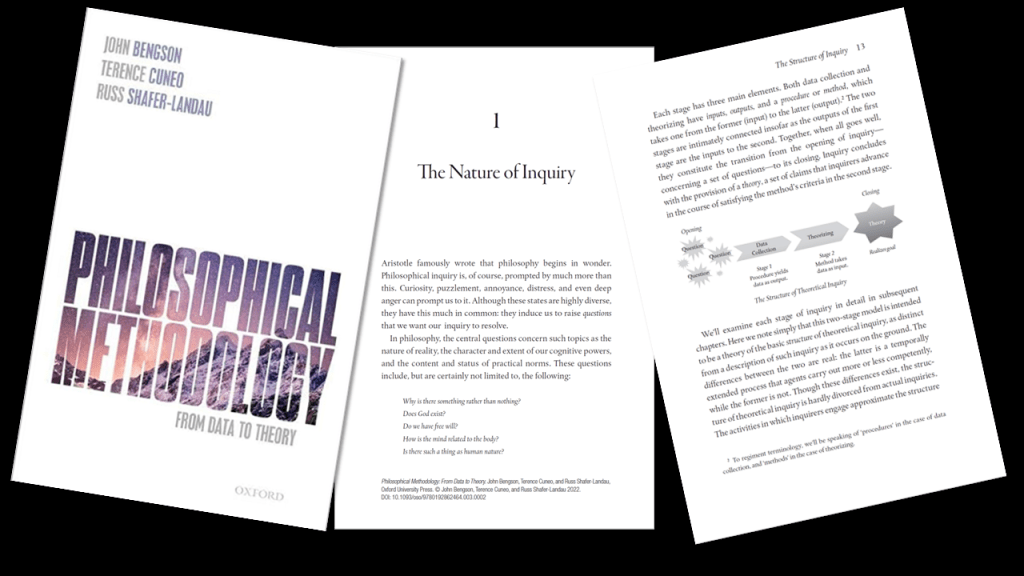
Philosophical Methodology: From Data to Theory by Bengson, Cuneo, and Shafer-Landau

No, I am not ready to delve into another book—at least not quite yet. I just happened across Philosophical Methodology: From Data to Theory by Bengson, Cuneo, and Shafer-Landau, and it felt worth noting. Meantime. I’ve got another book to digest.

Whitewashing Spoken English

An AI startup is facing allegations of racism and discrimination after being accused of manipulating non-American accents to sound “more white.” The company uses speech recognition technology to change the user’s accent in near-real time. (Source)

Podcast: Audio rendition of this page content

Friction is an impediment to a perfect customer experience. Removing this friction is always welcome, but homogenisation by a dominant culture is a bit more sketchy. It’s laudable that someone aims to remove friction from communication. Raze that tower of Babel—or does it need constructing? I’m no biblical scholar. I’m all for fostering communication, but this control should be an option for the customer receiving the call, not the sender—press 1 if you don’t wish to hear a foreign accent.

When it comes down to it, translation services have the same challenge. Which accent comes out the other end? (I’ll guess it is similar to this one.)

And what American accent is being represented? The neutral accent of the flyover states, the Texas drawl, or the non-rhotic accent of Harvard Yard? I’m guessing it’s not California cool or urban Philadelphia or down on the bayou. Press 7 for Canadian English, eh?

It’s bad enough that US English, despite having a minority of speakers, is running roughshod over World English

It’s bad enough that US English, despite having a minority of speakers, is running roughshod over World English spelling and pronunciation, colonising the world via streaming services and infestation on the internet.

The BBC relaxed its RP requirements in 1989 for the purpose of regional cultural inclusiveness. Which direction do we want to go?

In the end, this is another example of businesses being more concerned with business than customers and the human experience.

As for me, I prefer an accent I don’t have to work so hard to discern. But at the same time, I’ve worked with many people whose first language is not English, and though it does take a bit more effort, it’s really not that difficult. Besides, I’ve heard native English speakers with regional accents and dialects that are just as taxing.

I sent a survey a month or so ago asking which regional accent people preferred. As it turned out—and not unsurprisingly—, people preferred the English they are used to hearing. Continental Indians preferred continental English; Americans wanted neutral American English; Jamaicans preferred Jamaican English, and British speakers preferred modern RP. And so it goes.

What’s your take?