Men make their own history, but they do not make it as they please; they do not make it under self-selected circumstances, but under circumstances existing already, given and transmitted from the past. The tradition of all dead generations weighs like a nightmare on the brains of the living.
Karl Marx – The Eighteenth Brumaire of Louis Bonaparte (1852)
DISCLAIMER: This page is an idea dumping ground acting as a scratchpad for me to coalesce ideas related to my agency endevour.
As I consider the relationship between agency and determinism, it will be necessary to define my terms. To this end, I’ll rely on historical citations and definitions. Marx’s quote echoes that of Schopenhauer
We may act as we will, but we cannot will as we will.
Arthur Schopenhauer – On The Freedom Of The Will (1839)
Ostensibly speaking Agency is a sense of freedom in concert with will and volition.
Agency is the capacity of an actor to act in a given environment. It is independent of the moral dimension, which is called moral agency.
https://en.wikipedia.org/wiki/Agency_(philosophy)
Agency may either be classified as unconscious, involuntary behavior, or purposeful, goal directed activity (intentional action). An agent typically has some sort of immediate awareness of their physical activity and the goals that the activity is aimed at realizing. In ‘goal directed action’ an agent implements a kind of direct control or guidance over their own behavior.
https://en.wikipedia.org/wiki/Agency_(philosophy)
Human agency is the capacity for human beings to make choices. It is normally contrasted to natural forces, which are causes involving only unthinking deterministic processes. In this respect, agency is subtly distinct from the concept of free will, the philosophical doctrine that our choices are not the product of causal chains, but are significantly free or undetermined. Human agency entails the claim that humans do in fact make decisions and enact them on the world. Howhumanscometomakedecisions, by free choice or other processes, is another issue.
Stanford Encyclopedia of Philosophy Agency page is as good of a start as any other credible place.
In very general terms, an agent is a being with the capacity to act, and ‘agency’ denotes the exercise or manifestation of this capacity. The philosophy of action provides us with a standard conception and a standard theory of action. The former construes action in terms of intentionality, the latter explains the intentionality of action in terms of causation by the agent’s mental states and events. From this, we obtain a standard conception and a standard theory of agency. There are alternative conceptions of agency, and it has been argued that the standard theory fails to capture agency (or distinctively human agency). Further, it seems that genuine agency can be exhibited by beings that are not capable of intentional action, and it has been argued that agency can and should be explained without reference to causally efficacious mental states and events.
Debates about the nature of agency have flourished over the past few decades in philosophy and in other areas of research (including psychology, cognitive neuroscience, social science, and anthropology). In philosophy, the nature of agency is an important issue in the philosophy of mind, the philosophy of psychology, the debates on free will and moral responsibility, in ethics, meta-ethics, and in the debates on the nature of reasons and practical rationality. For the most part, this entry focuses on conceptual and metaphysical questions concerning the nature of agency. In the final sections, it provides an overview of empirically informed accounts of the sense of agency and of various empirical challenges to the commonsense assumption that our reasons and our conscious intentions make a real difference to how we act.
Schlosser, Markus, “Agency”, The Stanford Encyclopedia of Philosophy (Winter 2019 Edition), Edward N. Zalta (ed.), URL = <https://plato.stanford.edu/archives/win2019/entries/agency/>.
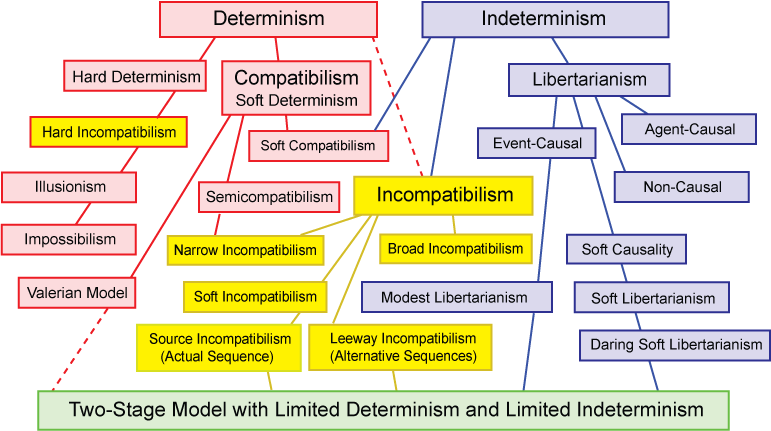
Hume and Kant both believe that freedom is essential to morality. Moreover, both believe that a philosophical theory and vindication of human morality requires reconciling freedom with universal causal necessity (determinism). However, they offer different conceptions of freedom, different ways of reconciling it with necessity, and different ways of understanding why this reconciliation matters for morality. Scholars agree that Hume is a “compatibilist”, but there is no consensus on the correct label for Kant’s position.
Wilson, Eric Entrican and Lara Denis, “Kant and Hume on Morality”, The Stanford Encyclopedia of Philosophy (Fall 2021 Edition), Edward N. Zalta (ed.), URL = <https://plato.stanford.edu/archives/fall2021/entries/kant-hume-morality/>.
Human agency
See also: Action (philosophy)
Human agency is the capacity for human beings to make choices and to impose those choices on the world. It is normally contrasted to natural forces, which are causes involving only unthinking deterministic processes. In this respect, agency is subtly distinct from the concept of libertarian free will, the philosophical doctrine that our choices are not the product of causal chains, but are significantly free or undetermined, but is perfectly in accord with some compatibilist philosophical views. Of course many philosophers have sophisticated deterministic accounts, such as Stawson’s theory of reactive attitudes . Human agency – in its naive psychological interpretation – entails the claim that humans do in fact make decisions and enact them on the world. How humans come to make decisions, by free choice or other processes, is another big issue.
The capacity of a human to act as an agent is personal to that human, though considerations of the outcomes flowing from particular acts of human agency for us and others can then be thought to invest a moral component into a given situation wherein an agent has acted, and thus to involve moral agency. If a situation is the consequence of human decision making, persons may be under a duty to apply value judgments to the consequences of their decisions, and held to be responsible for those decisions. Human agency entitles the observer to ask should this have occurred? in a way that would be nonsensical in circumstances lacking human decisions-makers, for example, the impact of comet Shoemaker-Levy on Jupiter.
In philosophy
In certain philosophical traditions (particularly those established by Hegel and Marx), human agency is a collective, historical dynamic, rather than a function arising out of individual behavior. Hegel’s Geist and Marx’s universal class are idealist and materialist expressions of this idea of humans treated as social beings, organized to act in concert. Also look at the debate, philosophically derived in part from the works of Hume, between determinism and indeterminacy.
In sociology
See also: Structure and agency and Agency (sociology)
Structure and agency forms an enduring core debate in sociology. Essentially the same as in the Marxist conception, “agency” refers to the capacity of individuals to act independently and to make their own free choices, whereas “structure” refers to those factors (such as social class, but also religion, gender, ethnicity, subculture, etc.) that seem to limit or influence the opportunities that individuals have.
Basic Knowledge 101 Agency
a proposal titled “Should the Criminal Justice System Be Abolished?” I argued that the answer was yes, that neuroscience shows the system makes no sense and they should fund an initiative to accomplish that.
Behave (Sapolsky), Chapter 16: Biology, the Criminal Justice System, and (Oh, Why Not?) Free Will
Interestingly, Sapolsky’s reasons for asking if the criminal justice system should be abolished don’t directly consider human agency.
Theories of Agency (Uncerimoniously lifted from Swarthmore College)
Key concepts present within “agency”: the individual, action, will, intentionality, choice, freedom
Key concepts against which “agency” is commonly situated: structure, determinism, society, environment, inevitability
Philosophy
What is the individual, self or person? (e.g., what is the unit of ‘agency’?) What, in contrast, is not-agent (environment, structure, inanimate)?
Postmodernist and poststructuralist skepticism about the individual or “the human subject”.
How does the agent know about the difference between itself and the environment?
Cartesianism: the self is that which knows itself; existence is best understood by radical categorical divisions between mind-body, self-other, etcetera, for heuristic and ontological reasons.
- What is an action?
- Does the agent choose or will its action in the world?
- Does agency exist even if the act changes nothing in the environment? Is there more agency if there is more change?
- Does agency exist if the intentionality of the action and the change bear little or no resemblance to each other?
Social and Behavioral Science
Agency determines everything
Libertarianism and objectivism
Certain forms of Christian theology, both evangelical Protestantism and Deism (with the frequent proviso that God is the “uncaused cause” or prior determination of the individual struggle against sin)
Certain forms of 19th Century liberalism
Structure determines everything (macrostructures or microstructures)
- Calvinist predetermination
- Strong forms of structuralist anthropology, folklore and psychoanalysis (Levi-Strauss, Jung)
- Strong forms of genetic determinism
- Strong forms of developmental or evolutionary psychology (Skinner, Buss)
Functionalism
All practices and behaviors of agents are determined by logics which precede those practices, and which always make rational sense in objective terms outside the perception of human actors (which human actors may or may not be aware of) (Marvin Harris on human diet; Talcott Parsons on human institutions)
Certain forms of teleological Marxism, Hegelianism and other 19th Century social thought.
Structure-Agency feedback loop
Can be strongly determinist or indeterminist, depending on how closed the loop is represented as being. Malthusian thought, for example, is a structure-agency feedback loop, but it is intensely determinist.
Social contract theory
Individuals consent in some initial pre-social state to a foundational understanding of their social rules and institutions; those rules have binding force on individuals and exist outside of their agency until such time as sufficient numbers of individuals choose to withdraw their understood consent to the legitimacy of social structures.
Can have a “negative spin”, as in Hobbes: social institutions as the only constraint which keeps individual agency from producing horrible suffering.
Anthony Giddens and structuration theory
Modernity not as “iron cage” (Weber) or “prelude to utopia” (Marx) but as a condition collectively chosen through the deliberate actions of many people; agency determines structure which determines the possibilities for the expression of agency and so on ad infinitum.
Neoclassical economic thought
Agents act out of self-interest, individually and differentially perceived and measured and achieved; the sum total of individual action is (or ought to be) a well-ordered political economy that maximizes the aggregate opportunities for self-interest even though the results for every individual will not be equally optimal (equal opportunity, non-equal results).
Historicist anti-functionalism and some forms of evolutionary theory
Practices, behaviors and institutions are ‘structure’, but explained largely by the fact of precedent and inertia, not by deeper ‘preset’ functionalism that precedes and trumps change over time; no teleological end to change. “One damn thing after another”.
The “bounded circle” of agency
Agency exists within tight constraints, but is free within those constraints. this is a common way ever since the Enlightenment to describe the agency of individuals: absolutely constrained beyond a certain boundary, absolutely free or devolving upon the individual within it. Sometimes this is only an axiomatic assumption governing social institutions and sometimes it is an ontological assertion about agency. (e.g., you could argue that modern American criminal law assumes absolute individual responsibility for actions once constraints of circumstance and environment are considered, but does not require an ontological assertion about the reality of agency).
“Men make history, but they do not make it just as they please” —Karl Marx
Marx needs this in order to believe in the possibility of revolution, but it has long been debated among Marxists since Marx’s time whether the “humanist” Marx who seems to believe in a limited but critical role for will and agency in choosing a revolutionary moment or the “scientific” Marx who believes in the structural inevitability of revolution.
“Methodological individualism”
Structure exists, and has determinant force, but a conscious heuristic decision that what individuals choose to do, or perceive themselves as choosing, is interesting as an object of study–not the individual as a “case study” of a larger whole, but the individual as exceptional or particular.






 Philosophics