Identifying Identity

“Si Dieu n’existait pas, il faudrait l’inventer.”

— Voltaire

God knows that I am not interested in God, but in the quoted sentence, ‘If God did not exist, it would be necessary to invent him‘, Voltaire has established a pattern: If X did not exist, it would be necessary to invent X. Identity is a possible X. Time and now are other possible Xs.

I’ll focus on identity. That identity is a social construct may be technically correct, but so what? My position is that identity doesn’t exist, yet people–including me–identify. We search for identities that don’t exist. What I was when I looked is no longer there. And if someone invents a new attribute of identity, we tend to evaluate how we relate to it. Among other things, cognition is a difference engine.

“The mirror is a worthless invention. The only way to truly see yourself is in the reflection of someone else’s eyes.”

— Voltaire

When the concept of race is brought up—as invalid of a concept as it may be—, we assess how we relate to it. Sex, gender, self—it’s all the same pattern.

I’ve written on race identity in the past. Given it’s a fiction for the human species, it’s a moving target even within the realm of identity, a moving target in its own right. In my estimation, race is a conflation of colour, class, and culture—evidently, the 3Cs. So, although I don’t believe the concept of race is valid for homo sapiens sapiens, I still have a sense of what the users of this term mean. Besides colour, which I feel is the primary attribute, couched in this notion is cultural affinity as proxied by national original, another nonsensical notion.

In my case, I was raised as a WASP. My family background is white, Anglo-Saxon (Norwegian), and Protestant (Northern Baptist), so in the US I am afforded privilege. Were I to play it up, I should be able to parlay this into better jobs, better housing in better neighbourhoods, with access to better networks, and on and on. And even though I don’t play that game, I still accrue some of these benefits. Others I eschew. But I have options. This is the nature of privilege.

I don’t identify as white, nor do I identify as black or brown. This mantle is cast upon me. I can deny the notion, but I am helpless. Just as the black person can’t escape being identified as being black, the white person is similarly chained to their whiteness. In the United States, historically, a white person can deny the attribute of white, but simpletons will still consider them as white. But this is not a disadvantage to overcome. Some might argue that with a shifting colour landscape these days are coming to an end, but they haven’t ended yet, to the chagrin of the white folk who want to continue to ride the wave of privilege. People of colour, on the other hand, likely want to see this wave crash (and burn, if that’s possible).

But I’ve gone off the plantation—or is that reservation? No matter. Identity is nothing more than a connected locus of stateless states. It’s an n-dimensional snapshot of everchanging moments. The relationship between identity and identification might be viewed by analogy as the relationship between sex and gender, both social constructions in their own right. As with sex, identity is assigned. Except in rare cases, one doesn’t have the option of denying their biological sex. As with gender, identification is a space where you can self-assess. It’s just as pointless, but it somehow makes us feel better.

As with Voltaire’s quip, if the Self did not exist, it would be necessary to invent it. And invent, we do. As with objects in physical space, there is more absent than there, but that doesn’t prevent us from imagining it as real and present. In the end, identification is a heuristic that has survived as an evolutionary fitness trait. For what it’s worth, it affords us the capacity to differentiate between friends and enemies, us and them. But it also can be over-indexed and lead to unwanted or at least unexpected results. The question is how much energy should one expend on identity formation and assessment?


God and State

Despite my formidable reading backlog, I went out of queue and grabbed Mikhail Bakunin’s God and StateDieu et l’état. This book has been on my bookshelf since the ’90s—perhaps the 1890s. I’ve long lost interest in reading arguments that support atheism, but my interest was threefold: first, is the notion of state; second, is Bakunin’s position on anarchism; third, to peer directly into a work of Bakunin.

I’ve gotten about two-thirds through. It’s a relatively short book, which is why I decided to give it a go. I can sense some common ground with Weber and Locke. He goes on about the necessarily corrupting power of the state—of the State. He supports science, but is leery of scientists as administrators, feeling that administrations corrupt people and disengage critical thinking that is trumped by a sort of fealty—my word, not his. Not to discredit his integrity, but Dr Fauci comes to mind in this Age of the Pandemic. (In an admission of a Freudian slip, I spelt Dr Fauci as Dr Fausti in my first go-around. Know you know.)

His arguments seem pedestrian by now, but I am glad I am spending the time to put this one under my belt. There are some memorable quotes.

The idea of God implies the abdication of human reason and justice; it is the most decisive negation of human liberty and necessarily ends in the enslavement of mankind both in theory and practice.

— Mikhail Bakunin

I realised that I was an atheist in about fifth grade—at least this is my first memory. Attending elementary school in the United States, we are expected each morning to pledge allegiance to an American flag. I’ll spare the reader any commentary on Baudrillard. Aside from the nonsensical aspect of obsequiousness, there is a passage in the recital, ‘one nation under God‘. As tasteless is the pledge—and for children, no less; O! the humanity—, this God insertion breaks the proverbial camel’s back—it may have been a dromedary, but I digress.

I refused to utter these words, place my right hand over my ‘heart’ (read: left lung), or even stand, which I was still coerced into doing. I remember being grilled by my grade-five teacher and telling him (in fifth-grader parlance) that I thought the entire affair was quintessential bullshit and that there was obviously no God. He defended that of course there was. This is the world I was raised in.

A little more backstory: I was raised in a fairly affluent suburb south of Boston that was 70 per cent Roman Catholic Italians. My unnamed teacher was part of this cohort, as were my peers, some of whom were second-generation. A few were even first-generation. In any case, this was not a discussion. I was chastised for my position, and the teachers advocated peer pressure. Am I digressing again?

Until I read Dawkins’ The God Delusion, I was on the fence between agnosticism and atheism. In the end, I adopted his scale, leaving open the options that there is a 0.000000000000000000000000000001% chance that I might be mistaken in this belief, thereby being a weak-form flavour—and I may have omitted some zeros between the decimal and the one.

To end this stream of consciousness, where I diverge from Bakunin and most post-Enlightenment thinkers are with the archetypal notions of freedom and liberty. When I get to these passages, my eyes start to glaze over, and I need to grind through in the same manner as one might do in some video games, just to get to the end.

Anyone familiar with my thoughts might even guess that I’d interpret the quote I’ve chosen for this post to be nonsensical. Few humans are capable of reason beyond the most facile definition, and justice is another weasel word. I agree with his take on enslavement…

Roland Barthes on Rereading

Roland Barthes explains that rereading is difficult because when you reread, you are performing a deeply counter-cultural act. He writes that « the commercial imperatives of our society, oblige us to squander the book, to throw it away on the pretext that it is deflowered, so that we may buy another. »

Barthes writes that « rereading is no longer consumption, but play », and that probably says it best.

The new book you’re looking for is probably already on the shelf – right where you left the old one. « Rereading, an operation contrary to the commercial and ideological habits of our society, which would have us “throw away” the story once it has been consumed (“devoured”), so that we can then move on to another story, buy another book, and which is tolerated only in certain marginal categories of readers (children, old people, and professors), rereading is here suggested at the outset, for it alone saves the text from repetition (those who fail to reread are obliged to read the same story everywhere), multiplies it in its variety and its plurality: rereading draws the text out of its internal chronology (“this happens before or after that”) and recaptures a mythic time (without before or after); it contests the claim which would have us believe that the first reading is a primary, naïve, phenomenal reading which we will only, afterwards, have to “explicate,” to intellectualize (as if there were a beginning of reading, as if everything were not already read: there is no first reading, even if the text is concerned to give us that illusion by several operations of suspense, artifices more spectacular than persuasive); rereading is no longer consumption, but play (that play which is the return of the different) ».
— Roland Barthes, SZ : An Essay, Translated by Richard Miller, Hill and Wang 1974

With few exceptions, I don’t reread entire books. I do refer to complex and favourite passages. My justification is that there is so much I haven’t even touched, so is it better to master once-experienced material over the expansion of material? In defence of rereading, sometimes perspective has changed and additional experiences provide different facets for reflection—and this has happened to me—, but how does one determine the value of retrod paths?

No Better Time Than Now

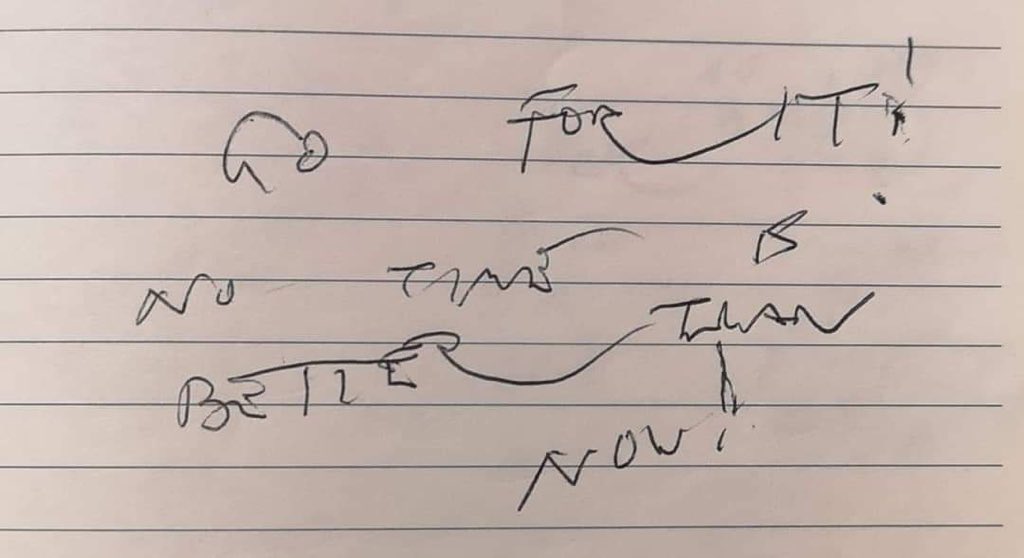
I saw this first on LinkedIn—that Instagram for personal promotion in a sea of vanity and hubris of all flavours—and had been sourced from Twitter, a more free-form universe.

Image

As the narrative went, this was written by a Parkinson’s-afflicted father to his daughter. There are many ways to interpret this. Ostensibly, it’s in line with Nike’s Just Do It tagline of a few decades back or perhaps Joseph Campbell’s advice to follow your bliss, but what is it?

To me, the it involves socially sanctioned activities, whether in commerce or the arts. If the it is robbing banks or shooting fentanyl, perhaps the drive should rather be suppressed. So the do it or go for it operates within boundaries. Nothing new here.

Then there’s the ‘no time is better than now’—exclamation—bit. Why privilege now? Why wouldn’t it have been a better yesterday or last week or tomorrow?

I love quotes—or they pique my interest—if they interest me. But vapid platitudes annoy me to no end. They are beyond being trite. I suppose I can forgive the person who finds solace in this note, but these almost always preach to the choir. They resonate with the daughter—first on an emotional level owing to the familial connection and next to a connection in worldview. I don’t need to point out the connection between worldview and upbringing. Let’s pretend there is no covariance.

Meantime, whatever you’re doing go for it. Just do it. Or not. Take the path on the left. Or the right. Or just sit and meditate. Or turnaround and try something else. But whatever you do, just do it. There’s no better time than now.

Note to Self #2

Hopefully, I get past these self-notes, but for now, I’m busy…

I don’t know if this is a good thing or not, but as I was structuring my thoughts critical to democracy, I discovered (recovered?) a structure I created several years ago. The structure was centred on the premise that democracy is a specious concept that retains life through the illusion of control. My latest concept is that people are just too dumb for democracy—not that it would matter if they weren’t.

I still question why I expend the effort. Who wants to read a piece whose premise is that the reader is likely too stupid to merit participating in a democratic process? Even worse, who wants to read a piece that claims the weakest link in any political process is people. I’m a sad panda.

On the upside, there’s some content crossover. And now I need to settle on a new centre. Please stand by.

Note to Self #1

Humans are much less rational than commonly assumed and the presumed ability to reason is either hubris or wishful thinking. Dan Ariely has brought attention to being predictably irrational, but that’s just the tip of the iceberg. Basing societies and legal systems on the premise of rational actors is a massive structural error.

— Bry Willis

I’ve got too much distraction to make progress on this, but I’ll save thoughts now and again so I don’t lose them…unless it’s deliberate.

Neo-Feudalism

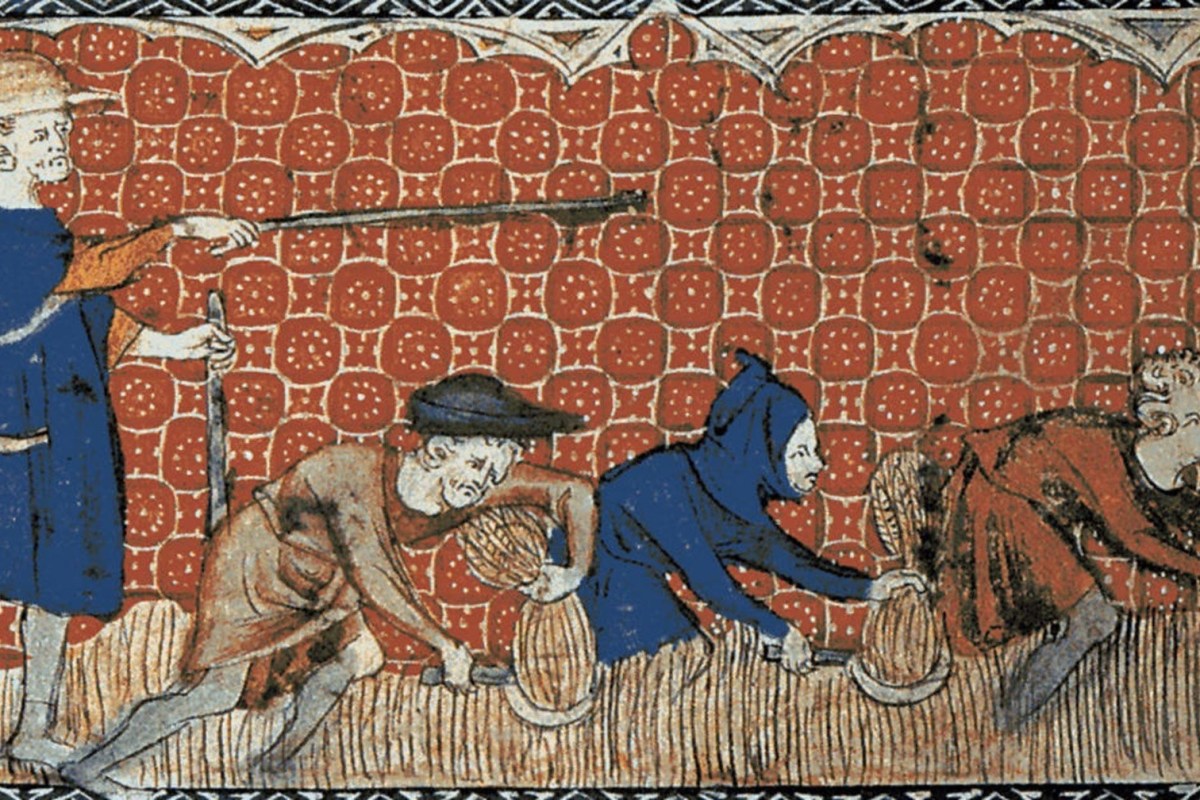
It seems that Capitalism took a wrong turn and is retracing The Road to Serfdom. Hayek worried about government intervention in business, but he did not imagine a world where corporate leaders would grow large enough to not only be able to control government power through money and influence, but it could actually ignore governments altogether—or at least to a large extent.

The last time government was challenged at this level was by the Church. In the end, it resolved into a tenuous stalemate. But this next conflict will be ostensibly bloodless, opting to be fought with political weaponry.

serf master cap

To the workaday people, it doesn’t change much. Denial is an interesting bed partner anyway. As most deny being wage slaves, they now just deny being serfs. In their minds, they are free, just inches from the goal line. I’m not the one to break it to them that the goal line away from in inches is the wrong one. They’re an entire field’s length to reach their goal. Thank goodness for denial and mechanisms that assuage cognitive dissonance. Ignorance is indeed bliss.

For some, the COVID response doubled down on the transition from Capitalism to Communism. For others, it was a reinforcement of the strength of Capitalism—and if in the milieu of fighting between authoritarians and Libertarians. But the phoenix rising from the dust—hardly flames—seems to rather be a sort of neo-feudalism. This seems to be a more likely future than Capitalism in a nation-state world. I assume that Nation-states will continue to exist, but they will serve only to contain the commoners, the ones who can’t afford to escape the fetters.

I don’t have much to add to the discussion at this time, but this article sums up some of my perspectives. My question is how the Capital aspect is extricated from the system. The serf part is easy.

Dialetheic Logic and Reality

It’s too late for me to digest this piece on Graham Priest’s Radical Dialetheic Logic and Reality, but I’m interested enough to bookmark it here.

The word dialetheism comes from the Greek δι (di- ‘twice’) and ἀλήθεια (alḗtheia ‘truth’). It’s the view that there are some statements which are both true and false. In other words, it’s the view that there can be a true statement whose negation is also true. In the literature, these statements are called “true contradictions” or (to use Graham Priest’s neologism) dialetheia.

Paul Austin Murphy

Fais dodo

Slotrocket

Being in a band is hard. It’s like being married to a bunch of partners, and if you are a band and not just some cat with some supporting characters, you’ve got artistic differences to consider. This is where I soured on direct democracy.

Slotrocket is the name of one of the bands I performed with. We played under this name exactly once, but let’s rewind to the democracy bits.

Skipping a lot of the details, I played bass in this line-up. It was a 3-piece with a focus on alt-post-grunge-nu-metal, but we all came from different places musically. The drummer came from speed metal, death metal, and maths rock. The guitarist-vocalist came from Classic Rock, Grunge and Nu-Metal. I came from all sorts of places, but I wanted to focus this project on the post-grunge thing. For the uninitiated, this is the likes of Seether, Three Days Grace, Breaking Benjamin and so on.

We didn’t have a name. Since we only played with friends and at parties and sometimes provided the backing for live karaoke, it was just us. We did arrive at the name of Breached, but it turned out that a Canadian band was already calling dibs on that, so we just let it slide—especially when they released an EP in the vein of early Incubus.

But then the guitarist-vocalist didn’t want to hold both roles. Too much effort. He didn’t care which. In the end, they found a female singer who was interested. It seems that there was a mixup in communication. They asked if I minded if she joined us during our next rehearsal. I figured it was just another live karaoke session, so when I said yes, it turns out that she was now a member of the band. Truth be told, I didn’t think a female would cop the vibe I was seeking. She was no Lacy Sturm or Amy Lee. She didn’t know any grunge material as she was more of a Country gal. But that’s not the story.

The story is the name. We deliberated for well over a month to settle on a name. We decided to create a spreadsheet. We’d all force rank the entries. And each of us had infinite veto votes to kill an offending entry from the list.

Skipping ahead a few chapters, I liked Rapeseed. It was a benign word that sounded edgy. The boys were fine with it. Notsomuch, the girl. There was no particular rush until we booked a gig—the gig. We’d need a name to promote.

I came up with Slotrocket. Again the boys were fine with it; her notsomuch. However, she didn’t veto—later claiming that she didn’t think we could possibly be serious. Since I booked the date and created the adverts, everything seemed to go under the radar—or under the rug.

A bit before the show, I was distributing material and advertising on our media outlets (as it were) and she caught a glimpse of the promo mats. Let’s just say that she was not amused. Still, when the time came, we performed.

OK, so I skipped over some stuff—the months of pouring over a spreadsheet. Our goal was unanimity. The name didn’t have to be everyone’s top pick, but we did need to attain a consensus view. As it happened, two of the biggest decisions came about by accident, and they both resulted in hard feelings.

It’s not that the 3 or 4 of us couldn’t have eventually come to a unanimous decision amounting to all of our first choices, but this would have taken time—and who knows how much.

One may feel justified accusing me of allowing perfection to be the enemy of the good, but that’s just something apologists tend to say, as they defend their preference for democracy.

Descent of Man

Joe Talbert, singer and songwriter for IDLES, shares some of his perspective with us. Cued is a bit on masculinity, particularly the toxic variety.

Interview with Joe Talbert of IDLES

For me, it’s a breath of fresh air. Maybe it’s just nostalgia, but the IDLES bring some of the lost energy back into music. I’m old enough to remember the first Punk wave of the 1970s and the next waves as well as the ripples.

The Descent of Man clearly explains how masculinity as a construct is dangerous, problematic, and … bullshit

Joe Talbert

I’ve always been out of step with my music interests, ability, and availability. In the ’70s, I was raised on the Classic Rock of the day, from the Beatles and Stones in the ’60s, to Zeppelin and Sabbath in the ’70s before focusing more on the likes of Jeff Beck, John McLaughlin, and then Allan Holdsworth. In the mid-’70s, came vapid and syrupy, saccharine pop and the nonsense that was Disco. Thankfully, this was disturbed by Punk on one hand and Eddie Van Halen on the other. Then there was New Wave and the Hair Bands.

When I wanted to play Rock in Japan, I had offers for Country. My mates in Los Angles were into retro when I was into Progressive and Jazz Fusion. I did get on a Blues kick for a while, but I didn’t really feel like I could pull it off—some affluent white kid and all. Besides Hair Bands in the ’80s, there was a Euro-synth wave, but I wanted something more complex and experimental. By the ’90s, I finished grad school and was career-oriented. I fell in love with Grunge and post-Grunge, but that was a personal endeavour. I did finally play that in the 2000s as covers sprinkled with originals, but it was a side-gig not designed as a career. That train had sailed. Nowadays, I still dabble, but I’m not all that motivated to compose much.

Anyway, IDLES is refreshing. I don’t critique it as music. It’s not particularly melodic or harmonic. It’s about the message and the energy. There’s a beat that drives, and there is instrumentation and vocals. It’s an experience.

IDLES – Car Crash (Live on KEXP)

But this isn’t about the music. It’s about the notion of normalcy. In this clip, Joe talks about his longing for normalcy. Maybe that’s just normal, but I’ve never subscribed to the notion of normalcy, so I’ve never longed for it. Truth be told, my preference is for people to realise that it’s all a control mechanism.

Joe was influenced by therapy and The Descent of Man by the artist Grayson Perry. In this book, Perry, clearly giving a nod to Darwin’s earlier work, takes on toxic masculinity and attempts to reframe the very notion of masculinity. Like normalcy, I am not interested in gender roles either.

I worked as a statistician for a couple of years way back when, so it turns out that I have a perspective on normal. The problem with the notion of normal is that deviation for normal is seen as broken. Social sciences and pop-psychology have done this. Foucault wrote a lot on this phenomenon. I won’t address his work here.

Joe viewed himself as broken because he bought into the narrative. He feels better now. He feels he’s in a better place. Perhaps this was necessary for him. I can’t speak to that. It’s not a goal I aspire to. Perhaps I’m privileged. I can’t say. For now, I get to enjoy the respite Joe & Co afford us.