That culture is a social construct is by now a meme. Those who disagree with the notion believe there is some objective measure—who disagree with the notion of cultural relativism—, almost invariable to their own belief systems. My goal is not to convince them otherwise. I’m sure their teacups are full. However, I’ve recently become aware of some data I find interesting. These data consider dimensional pairs of data. For example, do parents of certain cultures foster the message of imagination or hard work.
The caveat here is that no culture is monolithic. In practice, no two people are precisely redundant. People are effectively snowflakes—not the pejorative sort. Just insomuch that even identical twins are not, in fact, identical. What we are examining are generalised stereotypes. For example, the United States finds hard work over-indexing imagination. This comes as no surprise to anyone who takes even a cursory view will note that both political persuasions buy into and propagate this mythos. On the Right, imagination is something that can be explored. In fact, it needs to be propagated if only to buy into supported narratives. Imagination is over-indexed in Left-leaning countries. On the Left, a little more latitude is afforded, but in the end, someone needs to pay for the Volvos and Teslas. Given that the Left basically doesn’t exist in the professional politics of the US, imagination is more lip service than manifest.
Imagination need not apply. Britain, Australia, and Canada are more balanced, but they still favour hard work over imagination. Interesting to me is that the Nordic / Scandanavian countries push imagination more than their peers. I’ve never ‘imagined’ them to be imaginative. Perhaps it’s more an absence of Calvinism. Perhaps I’m judging. The piece suggests that Anime is evidence of Japan’s imagination. Firstly, this feels like a stretch. Secondly, this doesn’t resonate with my experience living in Japan. Perhaps I’m just conflating cultural obsequiousness.
Independence vs Obedience
Another pairing is independence versus obedience. Whilst I focus on the UK, US, and Canada, you may find represented your own country or culture of interest. Across these dimensions, the US, Great Britain, Australia and New Zealand all favour independence over obedience, though I find this a strange dichotomy. Fundamental attribution bias is evident in full force and effect.
I just came across a meme that lauded the Japanese for fostering independence, but cultural obedience is a given. Honour, shame, and shunning are ubiquitous in Japanese, so I’m not sure how this manifests. Cognitive dissonance is strong here. I’m having a difficult time reconciling. Perhaps I need to evaluate the semantics.
Independence versus Obedience
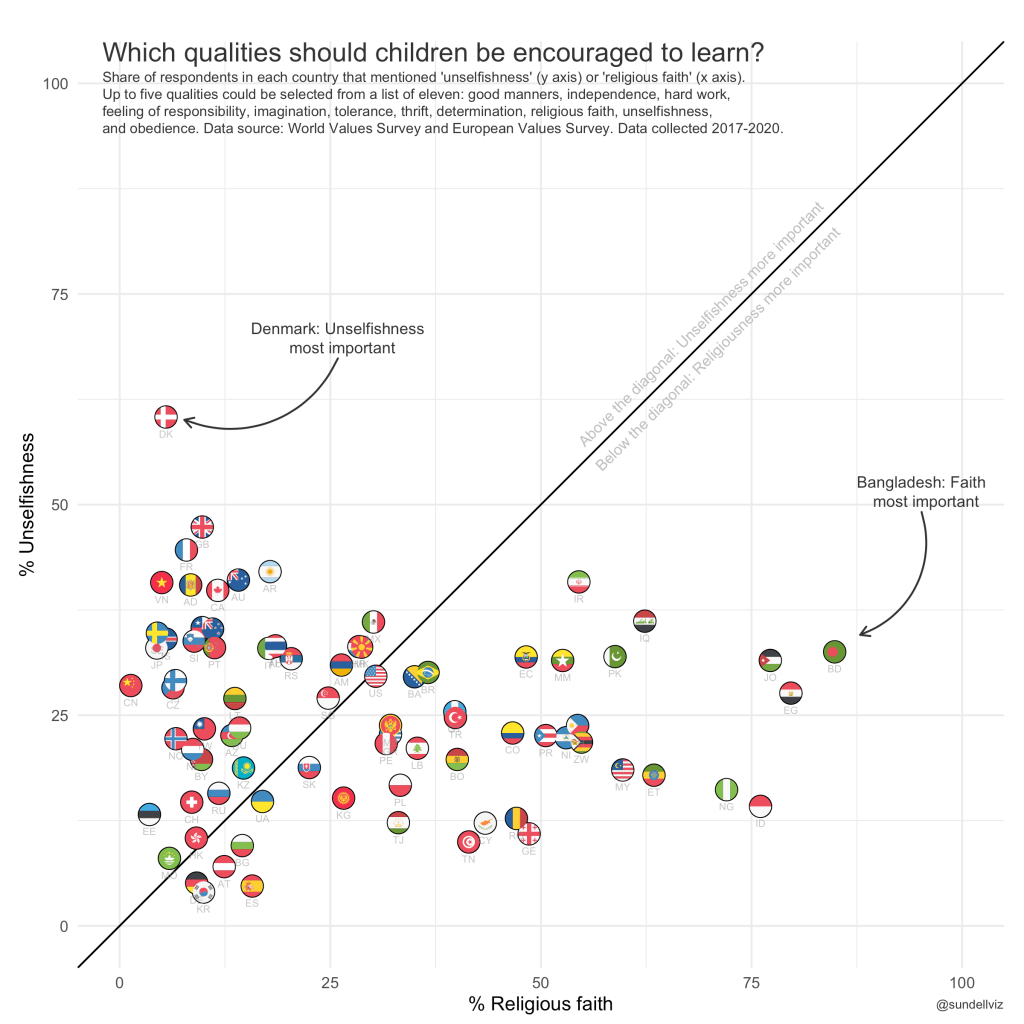
Unselfishness vs Religious Faith
I debated including this dimensional paring. First, it’s an odd dichotomy. Are we trying to claim that the religious are selfish or that unselfish people are areligious? No matter. Let’s keep going.
Unselfishness versus Religious Faith
I suppose this just shows that one can compare anything on a graph and someone can read something into it—like a Rorschach test or tea leaves. Here the US rides the fence. Great Britain and France self-assess as promoting selflessness, and Bangladesh is off the charts with its need for faith. Well, clearly not off the charts because it’s literally on the chart, but it’s trying.
Anyhoo, I feel I need to investigate the raw data and evaluate more parings. For now, I think it’s safe to say that cultural preferences are all over the map. And, even though these preferences have no objective centre, I can admit to having preferences of my own. On these dimensions, I favour imaginative, selfless independence, but that’s just me. Where do you stand?
Someone will have to try very hard to convince me that the classical Greek philosophers were not strictly satirists. I believe I’ve commented on Plato in the past. I try to be well-rounded and not just cherry-pick material that supports my worldview—even though that competes for my available time and creates opportunity costs.
Listen on Spotify
This time, I decided to pick up Aristotle’s Nicomachean Ethics. If there is anything I needed to read to drive another nail into the coffin of Virtue ethics, this does the trick.
Nails in a coffin
Reading Classical philosophical texts feels like reading the Bible or any other religious works. It feels like it is only meant for disciples. It’s just choir preaching. If one agrees with the foundational position, it all works. Otherwise, it all falls apart.
I am not going to deconstruct the text. That would quite literally take several posts. What I want to point out is that within the frame he attempts to establish, his position is entirely heuristic. In this case, if one believes in virtue and honour and how these may or may not connect to happiness, then this is right up your street in much the same way as a Christian knows that s/he will be forgiven because Jesus loves them.
In some ways, it feels that the philosophy underlying Western Civilisation is more insidious than Abrahamic religions. They act in a similar way, attempting to convey an underpinning that simply doesn’t exist. Both are aspirational, but they claim to be foundational.
Like Plato’s Republic, Aristotle’s Nicomachean Ethics comes across (to me) as mental masturbation—some free-association thought experiment. I’m about 60 per cent through and tempted to quit, but on some level, I want to be able to defend that I have read it. Like the Bible, the I Ching, the Bhagavad Gita, and the Qur’an, and other such canon, I want to have read the source material and not just references to it.
So, I’ll take one for the team and see whatever gems I can find.
First page of a 1566 edition of the Nicomachean Ethics in Greek and Latin
UPDATE: I’ve finished the book. It doesn’t get any better. He drifts off into politics as he sets up his sequel. My biggest criticism is that he casts his elitist worldview as reality based on assertions based solely on his opinions and appeals to tradition and authority. Read this if only to understand where certain people derive this moralistic, virtue-laden worldview. I was surprised by the foreshadowing of Descartes’ Cogito—though given how that further led to popularise Dualism, I’m not saying that’s a good thing.
Curse YouTube and Drew—but in a good way. Drew created a video titled I took a Christian class about atheism. It was worse than I expected. Although I don’t find I need to engage with anyone to defend my atheism, I sometimes do. Perhaps, the devil made me do it. I’ve been an atheist for decades—literally for at least half a century. (Man, that’s revealing.)
Spotify Link
The magic gods of social media tossed this gem in my face, and I was fated to watch it—a 45-minute video nonetheless. Who posts long-format content on YouTube these days? Honestly, I didn’t think I was going to watch the entire thing—at least without skipping ahead.
I jotted down my thoughts—on paper no less—as I engaged the content. But before delving into that, I want to say that Greg Koukl is a formidable communicator. He knows how to engage his audience. Drew, the Genetically Modified Skeptic, is a strong communicator himself, employing cogent logic in defence of atheism—well-considered and articulated. Although I was watching the clock—cuz 45-minutes; plus I was stopping to take notes. Capturing a couple dozen bullet points, I’d comment here instead of in situ. I’ll link from there to here when I’ve published my reaction.
Drew responds so well that, generally, I avoid stepping on his responses, with which I am in agreement. Instead, I share my own observations either on topics Drew did not address or that I have a nuanced take on.
Below are the points I make with a time reference to the clip. In some cases, the link starts earlier than the point I am addressing if only to provide a reader with context.
3:25 Greg points out that he is going to focus on areas where Christianity can make sense but atheism cannot.
Response: Things do not have to make sense. This is a belief humans impose on the world. Even if one believes in a world of causes and effects, it does not follow that we have a privileged perspective into these causes. Some effects may be caused by any number of correlated and covariant factors, and to claim that A causes Z, because it’s expedient and somewhat linear over some more complex multifactor causal model, is weak tea. As humans, we want things to make sense. It’s effectively in our nature, but it doesn’t follow that the universe needs to comply with this need. Human psychology compensates knowledge and perception gaps with any number of tricks from Gestalt to apophenia. It may be comforting for some to use gods as putty to fill the cracks, though, in my mind, it’s rather Silly Putty.
3:35 Greg defines the terms theism and atheism. Drew points out the reduced, self-serving definitions Greg tries to slide by.
4:44 Greg tries to frame atheism as an assertion rather than an absence, so he can fabricate a strawman to attack.
Response: As Drew points out, this is sometimes, but not always, true. Here my thoughts (or soul, as the case might be—orthogonal, or otherwise) wandered to the Dawkins Scale, which parses atheism and agnosticism into a spectrum rather than a binary pair. Idiomatically, it’s a non-assertion. If you claim there’s a dog in my yard, it’s incumbent for you to provide evidence. If I claim, there is no dog in my yard, I am under no such obligation. Besides, my looking for evidence of a non-dog in my yard would require additional scrutiny. Perhaps it’s hidden.
Moreover, Greg attempts to make this a semantic issue. Drew points this out. For me, I reflected on the political situation where some cohorts within the US public decried Obamacare (AKA the Affordable Care Act or ACA) and yet were substantially supportive of its features. Obamacare acted as a pejorative to taint the act with negative connotations for Obama detractors. People’s cognitive faculties as deficient as they are, this was super easy—barely an inconvenience. Anarchism triggers the same sort of reaction. I attribute this to an unceasing negative propaganda/indoctrination campaign.
Response: Translation: We have subjective experience, and we are going to pose this as some objective reality.
9:40 Greg asks: Where did everything come from? What caused the beginning of the universe.
Response: Where is thy stuff? I don’t even need to engage this question directly because the chestnut of an argument he is presenting has a recursion problem. If everything needs a beginning, then God needs a beginning. This argument just kicks the can down the kerb. And ‘He just is‘ works just as well as ‘It just is‘. Nuff said.
11:25 Greg recounts a scenario where he purportedly asks a recently converted atheist, Do things exist? to which the subject responded affirmatively.
Response: The nature of existence and reality is not resolved science. ‘“Things” are perceived‘ is about the best we can get to at this moment in time, and this doesn’t even define things very precisely.
11:30Have things always existed? is the question posed next.
Response: I like Drew’s response here. Instead, I went to the definition of time because the notion of time is a social construct. It could be that there was a Biblical void from which the universe sprang whole cloth as depicted in the Genesis version or a Big Bang version. It could as well be that at some point time was invented. An imperfect analogy is the BCE-CE split. CE simply starts at year 1 and we’ve run with it. The universe doesn’t have an equivalent notion of BCE, but perhaps it’s similar to spinning up the universe as a virtual machine. There was a literal void of bits awaiting a cue to instantiate a VM universe. For all intents and purposes, this is the beginning of time for that virtual machine. In this example, we could extend the metaphor to a multiverse, or we could stay with a physical machine and virtual machine metaphor. Sure, the physical machine might be a god or another meta-universe—I refuse to say metaverse—, but the virtual machine has no insights earlier than its own time-zero.
The other things Greg’s approach misses are the notions of quantum mechanics and emergent properties. I won’t spend any time elaborating here.
Response: Without getting into the weeds of Kahneman and Tversky’s Systems 1 and 2, intuition and heuristics have a place, but they are very fallible for all but the most mundane of tasks. They are not very precise and are a poor foundation for any theory. I can feel it in my bones just doesn’t go very far—and that includes intuitions about reality
22:15The problem of evil is apparently the most common objection to the existence of God.
Response: This is a sophomoric position to adopt. Greg tries to frame this as an out-there objective reality affair as opposed to an in-there subjective, emotional problem. He posits that things in the world—including people—are inherently bad or evil. Again, Drew reframes this as a uniquely Christian problem. As for me, I don’t even believe in the existence of evil. Good and bad are functional yet still social constructs. Evil is just trebled bad with a metaphysical twist. The problem with evil is more of a problem with bad narrative than anything more substantive. Somebody created a storyline and didn’t run it by strong editors or continuity reviewers.
26:15 Lawmaker Transcendence: In order for there to be laws to be broken, there have to be laws…
Response: Knowing his intended audience, Greg keeps hammering on the objective reality nail. Whilst this may play well to the choir, as Drew points out, it’s not likely to score any points in a debate with atheists. Morals, as well as laws, are social constructs. And as universals, they don’t map as closely across cultures except at the most abstract of levels.
It should go without saying that even if there were a god passing out commandments, there would be no way to validate the authenticity of this exchange.
32:30 All people have souls… You are not just a piece of meat in motion
Response: Just rambling. I’m not even going to waste my time on this one except to redirect you to my previous response relative to human psychology and apophenia.
Response: This bit is juvenile, too. Here Greg explains that the soul is not the brain, that you can’t disassemble your brain to find thought. But, he doesn’t mind ignoring that your soul is nowhere to be found either. This feels quite similar to the need for a creator, but these evidentiary needs don’t apply to their positions. Drew’s computer analogy is apt here.
39:10 Existential crisis is a problem for Greg and other Christians.
Response: Because Christians are wired the way they seem to be, any modality that severs the connection to meaning sets them off. Greg confuses hubris and ego for something more substantial, attributing meaning to it. As it happens, people also cherish their pets more than some random squirrel.
40:30 Humans feel guilty because humans are guilty.
Interestingly, there is a school of belief, psychologically speaking, that the default state of humans is one of anxiety, but given that I don’t give psychology any more credibility than religion, I’ll just leave that here. People feel guilty because they are indoctrinated to feel guilt. A hypothetical person raised on a desert island or in the woods, like Victor, the feral child of Aveyron, or in the jungle, like Tarzan or Mowgli, would not know guilt, empathy, shame, or any of a host of other social “emotional” responses.
All told, Greg raised nothing new nor offered any new support for Christian belief, let alone a broader theistic defence. Ostensibly, the approach he takes is more akin to choir preaching than any other rhetorical purpose. In the end, he’s promoting a smug superiority complex in believers. He understands that although people will accept blind faith rationale for religious belief—especially those indoctrinated from birth—that people do have a mild penchant for rationality. I don’t think most humans operate beyond a cursory level of reasoning, but it’s enough to exploit and construct social reflection mechanisms as part of personal image-building. This allows Greg to propose a homoeopathic logical, rational framework and have it uncritically adopted as being rational.
As for otherwise rational Christians, they likely see through the charlatanism, but since emotion proceeds reason, they are allowed to check out and compartmentalise this nonsense whilst otherwise simultaneously retaining the ability to process the most challenging and tortuous logical conundrum.
Capitalism and apathy in the United States are leading factors in driving homelessness. Employing Capitalism and apathy is somewhat redundant as a major component of Capitalism is apathy and creating otherness—us and them; haves and have nots. People reaching retirement age—Boomers in the parlance—are finding themselves homeless—or as the sage, George Carlin reminds us, houseless.
The feeling behind this sentiment is that this cohort did this to themselves. They shot themselves in the foot—or the face, as the case might be. They bought into the Darwinist mythos and envisaged themselves as coming out on top—except they didn’t and the music stopped and someone else had all the chairs. In fact, a few people had many more chairs than a person could ever need, leaving more people out of the game than strictly necessary. Illusory superiority is a cognitive fallacy that keeps things like Capitalism alive. And cognitive dissonance masquing mechanisms assuage the delta between perception and reality. And like lottery players, they convince themselves that one day their ship will come in. Yet at some point during the backside of midlife—however one defines that—, comes the foreboding that this is probably not in the cards. You’d gone all in and there was no payoff.
Whilst viscerally, I agree with the sentiment—as I sometimes feel schadenfreude for the people who vote for any major party candidates in election after election and are surprised that their candidate doesn’t move the needle because of [insert excuses here]. When the other party wins, nothing material happens because they don’t understand or don’t have it right. When their party wins and nothing material happens it’s because of entrenched opposition—perhaps, rather, controlled opposition.
Controlled Opposition
But what’s entrenched is not the other party. As I’ve noted before, there is no other party. There are no material choices. I don’t believe the image below is to scale because it makes it appear that they are less alike than they actually are. The image illustrates how the Democratic and Republican parties share the same foundation. I am fairly certain one could swap our Democrats and Republicans for Labour and Conservative, but I won’t speak out of school.
Twin Peaks
Almost nothing anyone can do in the near term can have any effect. In the long run, any real threat will be eliminated, neutralised, or assimilated. They may even allow an independent voice remain, but that is only for the sake of performance. It’s more like improv than scripted, but the impact will be negligible, in the manner of throwing a pillow at an aircraft carrier—even a firm foam pillow.
The most obvious connexion is that both parties—in practice all participating factions—are constitutionalists. Interestingly enough, my spellchecker autocorrected ‘institutionalist’ as ‘constitutionalist’, and that’s another commonality. As for foreign policy, the two are virtually indistinguishable. On domestic affairs, aside from vapid rhetorical and stylistic differences that might amount to some inconsequential veneer of a different tint, but their biggest differences above the water are hot-button items that spawn more words than action—especially from the Democrats.
In the US, there’s a notion of two Santa Clauses. Ostensibly, Republicans run roughshod and spend like drunken sailors when they are in power, but when Democrats are in power, Republican messaging accuses timid Democrats—and let’s be honest here; that’s most of them—of being free-spending liberals. Both parties are unrepentant spendaholics. The only difference is which people get the leftovers. I say ‘leftovers’, because their sponsors are first on queue to get paid.
The meter’s about to run out, so I’ll end my rant here. This is just one of two topics I wanted to get off of my chest. The other relates to racism—and otherness more generally, but that will have to wait for another day.
Does digital technology make students stupid? That’s what a 2019 BigThink article asks. I like to read Big Think, but it seems like PopScience in a negative way—like Pop Psychology. It’s not necessarily directionally wrong. It’s just oversimplified and seeks the lowest common denominator.
On this topic, Plato quipped, voicing Socrates, in his Phædrus 14 dialogue except that his quip was relative to writing and memory. Some historians and Classicists have suggested that modern readers may be missing the satire. I’m no defender of human intelligence, but this is the demise of society because of change—whether due to writing, radio, television, computers, video games, mobile devices, and whatever comes up next.
For this invention will produce forgetfulness in the minds of those who learn to use it, because they will not practice their memory. Their trust in writing, produced by external characters which are no part of themselves, will discourage the use of their own memory within them. You have invented an elixir not of memory, but of reminding; and you offer your pupils the appearance of wisdom, not true wisdom, for they will read many things without instruction and will therefore seem to know many things, when they are for the most part ignorant and hard to get along with, since they are not wise, but only appear wise.
Plato – Dialogue Phædrus 14
Whether or not this claim has merit, my claim is that computers have trebled manufactured consent, so it allows people to be passively active, to have to specious notion of participation in the body politic, and yet are virtually tilting windmills.
It seems that some people have such nostalgia for their apparent way of life that any deviation is considered to be an affront and possible disruption. Perhaps, it’s because I feel there’s possibly as much to shed than to keep in my book, so for me, it’s more good riddance than oh heavens.
Despite its propensity for divisiveness, the Internet still offers a promise of communication exchange. I use Philosophics as a lectern or pulpit to articulate my ideas and solicit feedback. As often as not, it’s just a memorandum repository and sounding board. I also operate on other fora, whether Reddit, Quora, Facebook, or some other blogs.
A recent post on Wittgenstein‘s talking lion generated some discussion. On one Facebook thread, a virtual colleague used this post as a springboard to consider speech as reflected by Pragmatists—particularly Peirce, whose name I reverse the e and the i as often as not. I before e…
Although I have some familiarity with Pragmatists—namely, Peirce and James—, I’ve not read their work directly and intently, so I don’t pretend to be an expert and any points I suss up may have already been answered. But that’s never stopped me before.
As my colleague—let’s name him John—presents—and I quote:
Peirce was a logican but in terms of linguistic representation, he held that our representations of Universals always allow for further determination. In other words since our representations of Universals denote unexamined cases we don’t ever represent them concretely in all of their possible instantations. For example, when we say an apple is red, we do not know every object that will ever have in the past and possible will the future exemplify redness. So in other words any representationation of a Universal that we make is a kind of an uncashed check, that awaits further determination. Peirce goes on to consider such a cashing in as the Final Opinion of all who investigate. This Final Opinion can be taken two ways. First, it can be taken as metaphor for the infinite possibilities of cognitive representations. Second, it can refer to those representations that we have positited with a likelihood of denoting real Universals, that also turn out to be true in spite of their reference to unexamined cases. The first position has the problem that inquiry may be ended before the Final Opinion has been reached: The End of the World possibility. Peirce however has the second option. The idea is that some settled cognitive representations of real things have a high likelihood of denoting real Universals. In fact Peirce claims that we may have already reached the final opinion on many subjects. An example here can be what is called Settled Science. The idea is that some of the classifications of the Sciences likely denote the real properties and relations that an object has. Examples of this are the Periodic Table, and DNA sequences. We sometimes also get things right with our common sense representations of Universals, but these opinions of what counts as being real are more tenuous.
— John
John, Peirce, and I are all in accord that representations of Universals always allow for further determination. I don’t generally believe in universals, but that point is irrelevant or at least obviated by the further determination aspect.
We likely are also all in accord with the red apple example. So far, so good. Then this happens…
Pragmatic vehicle meme
John, Peirce, and I are all heading down the same path, but when it comes to abstract expressions, I need to take the slip road because I don’t feel Pragmatism captures this use case satisfactorily.
REWIND: For those unfamiliar with me or who haven’t read a lot of this blog, I am Nihilist with a fondness for Existentialism (to a point) and Zen Buddhism (as an ethical framework). Despite this, I operate somewhat as a Pragmatist, if only to navigate this world whilst I occupy space upon it.
Can we just dispense with stereotypes? I just want to cuddle. (If only humans could speak.)
In the objective world, Peirce is right* to consider that we may not be able to ever capture all that it is to be a lion or to capture every nuance of disparate lions, but speech affords us a way to categorise things in this world. It even allows us to categorise non-things but to a lesser degree of success.
Regarding danger, language is probably superfluous to expression or gesticulation. Animals without what we would qualify as language can indicate threats with screeches and screams. Some animals can even signal between threats from on high or down low. Variation in alarm calls of a vast number of different species are known to contain information on the type of threat, predator size, distance, location, or the type and urgency of a flight response.
This type of speech has facilitated humans to evolve to the point this blog exists. It’s a communication vehicle wherein one can convey to another, ‘Run, lion’ or ‘Yummy apples’ or ‘soft kitten’ or ‘hard rock’. For two speakers of a shared language, It’s generally pretty good. Even where there is disagreement on meaning, it shouldn’t take long to reach some consensus position. This is the happy path.
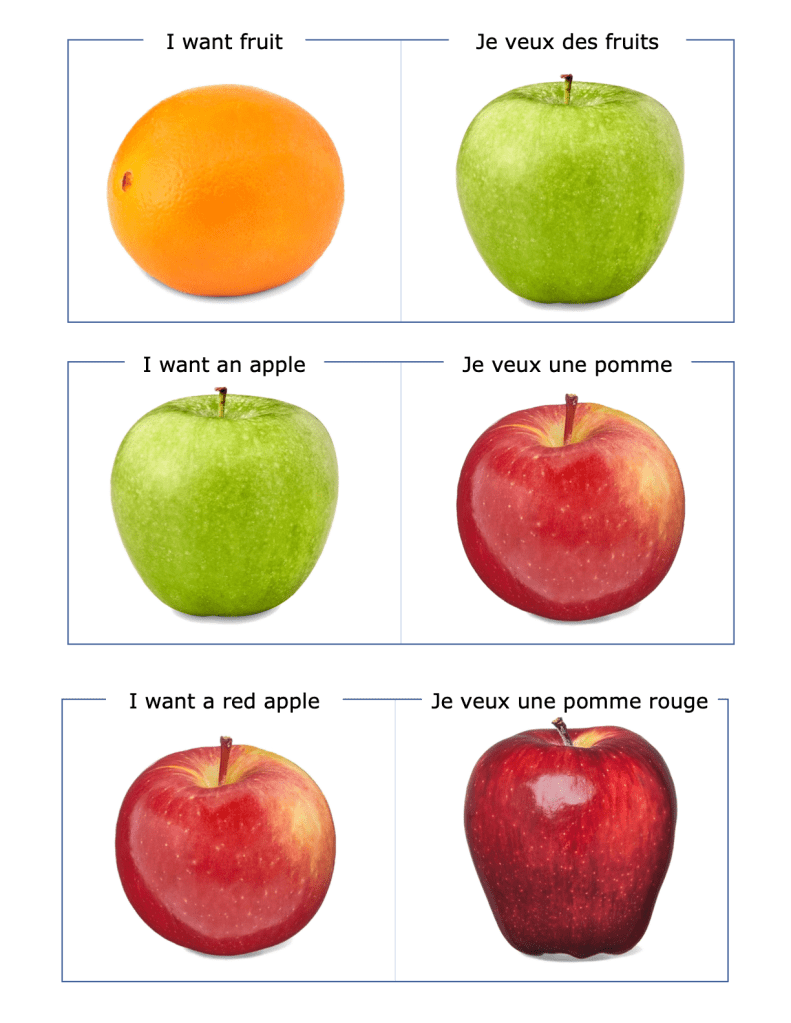
Fruit Dialogue
Two people can quickly navigate this possible dialogue—perhaps Adam and Eve. In response to Adam’s, ‘I want fruit’, Eve’s response result is already limited by the category of fruit. But Adam had something else in mind, so he tells Eve, ‘I want an apple’. He doesn’t want just any fruit, he’d like an apple. However, apples are subcategorised—among other attributes—by colour. Adam wants a red apple. Eve error-corrects, and she offers a Fuji apple or a Red Delicious. By now, Adam indicates that he wants that apple—a particular apple. In fact, he could have wanted that particular apple from the start—the one in the cupboard behind the tin of beans. In any case, it shouldn’t take many steps or iterations or exchanges to reach agreement. For her part, Eve opts for a pomegranate.
So far, so good. Where this all breaks down is for abstract concepts—the words I consider to be weasel words. Not only do these words have ambiguous meanings at one moment in time, but their meanings morph over time. This is particularly problematic when, for example, politicians often hide behind equivocation when they push for fairness, freedom, justice, truth or whatever other chimaerical words we’ve fabricated.
The problem is that unlike a physical apple that we can rather triangulate and interpolate into a position, abstract concepts offer no such vantage. The insufficiency of language prevents us from assessing the other’s nuanced perspective.
Perhaps the biggest problem is that of connotation. Connotation is not unique to abstract concepts. An apple can have symbolic and metaphoric meaning outside of its fruitness—semantic ambiguity. We’ve got the Big Apple, apples of one’s eye, the Biblical allegory, William Tell, Snow White, apple pies, les pommes de terres, et ainsi de suite. But this determination by context in the concrete is not available to the abstract.
Truth is perspective
Consider the perspectival image above. In the spatiotemporal world, one can illustrate the difference—as this does—, or one can change their point of view. This results in an ‘Aha! I see where you are coming from’ resolution. In the abstract world, on the other hand, is simply not possible.
A challenge for abstract concepts is that there is a recursion of connotations. So when one talks of justice, even if one can agree on which flavour of justice, one then needs to come to accord on equality and then on fairness. There’s simply too much to unpack. One might attempt to employ a philosophic approach and coin new terms, but ultimately—in order to facilitate communication—these terms much be defined by existing terms. And though this might succeed in getting us closer, any reader of Heidegger—or even Derrida—will demonstrate the inherent challenge. What happens, in the end, is that these authors are labelled as obtuse and difficult.
Just to sort of wrap it up without actually wrapping it up—but at least to put a finer point on it—, we likely are familiar with the freedom to versus freedom from debate. We’ve got perspectives of the inherent goodness or badness of humans. We’ve got sacred and secular perspectives. Since perspective colours interpretation and peoples’ perspectives are multifaceted, we can never—in my opinion—resolve these concepts, so we will continue to miscommunicate and adopt our own interpretations, forever disappointed of the outcome and left wondering why others just don’t understand these things the way we ourselves do.
EDIT: A problem with writing from a stream of consciousness and not an outline is that sometimes my mental model gets distracted and I forget to include an intended piece. Although minor, I want to include that even in the world of objects, things get classified and reclassified. For example, biological taxonomies are altered as new information becomes available. With the advent of better DNA knowledge, some entities have even changed species. The two examples that come top of mind are (1) that there are three species of what we call electric eels, and (2) some have petitioned chimpanzees to be considered as Homo troglodytes — troglodytes being cave-dwellers. Chimps and bonobos were considered to be the same species until about 1928.
Commencing around 2003, given advances in knowledge of genetics and genomic mapping some have argued that chimps are misclassified. Let’s rewind for a few moments. Orangutans, gorillas, and chimpanzees used to be considered to be part of a homogeneous family Pongidae, which is distinguished from the Hominidae family, where humans are classified. The genus subclassification of the so-called great apes is Pongo (orangutan), Gorilla (gorilla), and Pan (chimps). As every schoolchild is taught at some point, Humans are classified as the genus Homo—as in Homo sapiens or more precisely Homo sapiens sapiens.
It turns out, however, that chimpanzees are more closely related to humans than they are to other great apes. As recently as 2017, this is. an ongoing debate. One major detractor for inclusion is hubris. Humans want to feel they are more unique—more special. On the other hand, some have argued that we might be more conscientious of chimps if we felt they were genetically closer to us—more of an us than a them. Damn, dirty apes. For now, chimps officially remain Pan troglodytes rather than Homo troglodytes.
Keep in mind that science—at least taxonomies—are a matter of consensus opinion. In fact, there is an academy that governs taxonomical changes, so what is classified one way at time-X may be classified another way at time-Y. Moreover, taxonomic systems are a way of dimensionalising a domain. But the one chosen might not correctly segment its contents. In practice, this is where much of the gender debate comes it. For some, gender expression is seen as an extension of biological sex, which has been traditionally seen as binary with some exception for some 2-ish per cent for non-binary inclusion. For others, these are two entirely different maps. Even if they accept some fundamental binary sex definition, there is no reason to retain that same categorisation for socially constructed gender identity. Although this may seem complicated to some, it is still not as intractable as abstract concepts—though one might have a valid argument to consider gender as abstract expression.
Regarding different taxonomical systems, a commonly known problem is that biologically, tomatoes are fruits, botanically they are berries, but by nutritionists they are vegetables. Evidently, tomatoes are vegetables under US law—not surprisingly on commercial grounds. Don’t get me started on the Reagan administration to declare that tomato catsup was also a vegetable in an attempt to make school lunch programmes cheaper whilst maintaining US Department of Agriculture (USDA) nutrition guidelines for children.
A parting shot is a statement uttered by the sentient elephant man, who may have been misclassified.
The Elephant Man: I am not an animal; I am a human being.Example: Attachment ambiguity — Elephant in pyjamas
Reading Dennett has gotten me down a rabbit hole. I decided to take a break from book-reading and spend the day reading essays and blogs and watching YouTube vids such as this one. The question posed by the title is Which Laws of Nature are Fundamental? The topic I find curious is an established dichotomy where intelligent design or multiverses are the only possible reasons why we as humans are here to question our existence.
Full disclosure: I don’t pretend to be a physicist, so although I have tried to keep current on, let’s call it, lay physics, there is much I don’t know. But that doesn’t make me stop questioning propositions.
In the case of intelligent design versus multiverses, I feel that both go overboard. I don’t particularly cherish Occam’s Razor, but I do find it apt here. As David Deutsch states in this piece, intelligent design only manages to kick the can down the kerb.
In a nutshell, intelligent design arrives at a place with a claim that all of this can’t have been the result of chance and random events, so [insert the entity of your choosing] had to have designed and constructed it, leaving open the question of how that entity came to be. This is a spin on the age-old issue that many defenders of intelligent design-like theories seem to cling to: The universe cannot have spawned from nowhere, so its genesis must have been due to an intelligent (read: divine) entity without recognising or admitting the circular reasoning involved.
On the other hand, the multiverse solution—which I don’t entirely rule out—also seems unnecessary. In another nutshell—or perhaps repurposing the first—, the main idea is that there are many if not infinite parallel universes. Given the large number—in the manner of the infinite monkeys typing Shakespeare’s sonnets, at least one is bound to be configured just so to enable life and humans in particular.
Typing Monkeys
I don’t subscribe to intelligent design in the least. I dismiss it as implausible. And whilst multiverses may exist, I fail to see why there can’t be a single universe—this one—that just so happens to be configured. If it had been configured any other way, there would have been no life as we know it—and certainly no human life and no life to question how it get there and why.
In my mind, just because we can ask why doesn’t mean there is an answer or that we can find it. More to the point, even in a world of cause and effect, the results can be emergent on one hand and multlivariant on the other. So whilst we want to discover a causal chain of A ⇒ B ⇒ C ⇒ n, it is not likely so linear. Humans do understand the notions of stochsticism and chaos, but we don’t necessarily know how to deal with them causally. Moreover—and Deutsch has specialised in the quantum space—, our understanding of quantum processes is extremely primative. We are probably operating more from conjecture than knowledge, but one needs to start someplace. The trick is not to believe you’ve reached India when you’ve only just departed Spain.
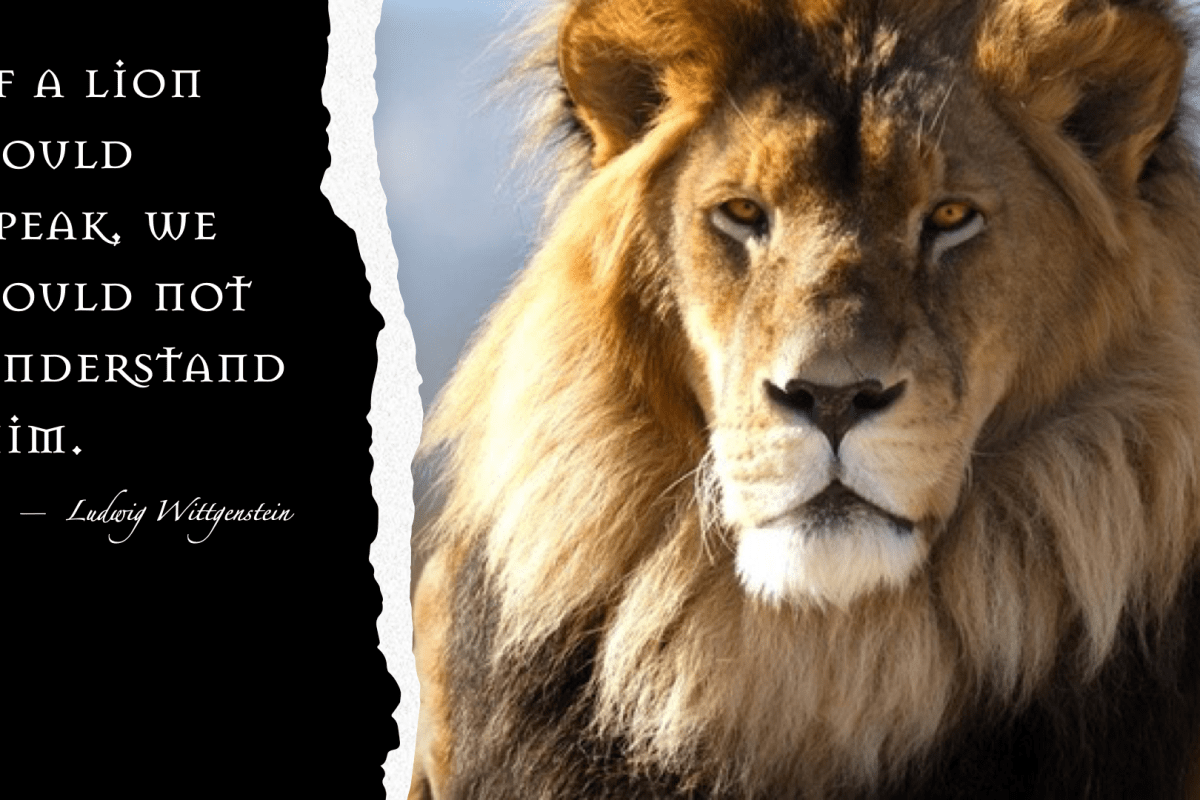
If a lion could speak, we could not understand him.
— Ludwig Wittgenstein
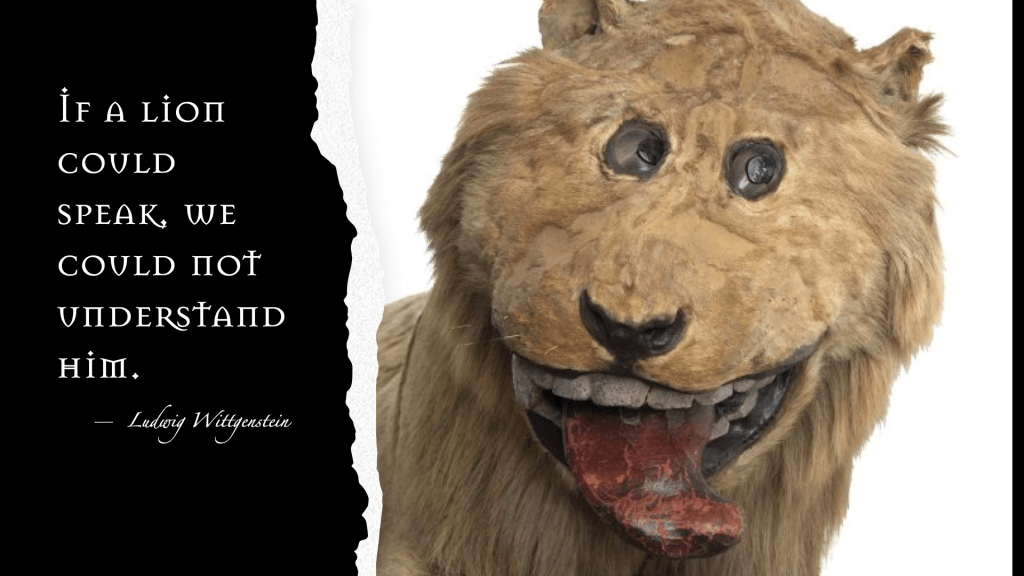
As much as I love Wittgenstein’s quote on language, I find it vastly more amusing aside the lion of Gripsholm Castle in Sweden. Because as talking lions come, this one is certainly more unintelligible than most.
If a lion could speak (Gripsholm Remix)
I also appreciate Daniel Dennett’s retort that if we could manage to communicate with this one talking lion—not, of course, this lion in particular—that it could not speak for the rest of lionity. (Just what is the equivalent of humanity for lions?)
If a lion could speak (traditional)
Ludwig Wittgenstein famously said, “If a lion could talk, we could not understand him.” ( [Philosophical Investigations] 1958, p. 223) That’s one possibility, no doubt, but it diverts our attention from another possibility: if a lion could talk, we could understand him just fine—with the usual sorts of effort required for translation between different languages—but our conversations with him would tell us next to nothing about the minds of ordinary lions, since his language-equipped mind would be so different. It might be that adding language to a lion’s “mind” would be giving him a mind for the first time! Or it might not. In either case, we should investigate the prospect and not just assume, with tradition, that the minds of nonspeaking animals are really rather like ours.
Daniel Dennet — Kinds of Minds: Toward an Understanding of Consciousness (p.18)
Would human extinction be a good thing for the good of the planet? We’re all familiar with the concept of the greater good, but what is the domain of the greater? We presume it to be the domain of all humans or at least our chosen in-group. But if we dilate the aperture, we might encircle the entire biosphere. In my experience, humans rarely extend the circle beyond themselves and barely even do that, opting to extend it to their race or tribe. Whilst some humans are not as self-centred as some narcissists and sociopaths, the radius doesn’t go too far.
Is one a misanthrope if one considers the greater good to be the earth devoid of the human virus? Perhaps, yes, if stated in those terms. But if one calculates that humans do more harm than good, doesn’t the cost-benefit calculus indicate that fewer people or no people would be better for the earth. I’ve long been fond of the late George Carlin’s routine where he proses that we don’t have to save Earth; the earth will remain long after humans no longer inhabit it. It’s been said that 99.9% of species that ever occupied the earth as no longer extant. Humans are past the mean duration of a species. Perhaps it’s time to move on.
I started to write this post some time ago after having had a discussion on antinatalism. Rather, I defended anti-natalism in the course of a conversation on the inherited notion that humans as sacred.
I supposed I am not a strict antinatalist, but neither do I feel that life is somehow sacred. Mine, of course, but except that. Just kidding. If you are reading, yours is, too. Just kidding, not you either. Interestingly, this ties into the post on the narrative gravity of the self.
As I write this in a world with a population of almost 8 billion people dominated by a handful and no picnic for that lot either, there are likely enough people already. I do feel that even if population trends continue upward—given offsetting depopulation trends in some regions—, humans will cap out at around 10 billion anyway. Perhaps in a Malthusian manner, but I am thinking in terms of deer herds and population limiting factors as expressed by equations like Xn-1 = rxn(1-xn).
Life does appear to have at least common characteristics and perhaps only one: the need to procreate. The second is the need to live, but that can probably be reduced to the need to live long enough to procreate. This is core to Richard Dawkins’ Selfish Gene theory. I like Robert Sapolsky’s treatment of the subject in Behave: The Biology of Humans at Our Best and Worst.
The concept of ‘sacred‘ is a religious vestige. I’m not sure why this needed to be codified, but religious dogma seems to capture the notion ‘thou shalt not kill’, as if it needed to be said. I won’t spend any time on the hypocrisy of the many people who espouse this edict.
Except for that motherfucker right there!
It may be a valid position to consider me a misanthrope, but that’s probably overstated, but I’m generally not a fanboy. I guess what bothers me most is the hype and self-promotion. I don’t find it to be particularly inconsistent to see the small positive aspects humans bring and still consider them to be parasitic. This is a compositional challenge–a dimensional consideration that moves away from binary-trending heuristics, the age-old right and wrong, good and bad, good and evil, and on and on.
As with geocentrism, we put ourselves at the centre because this is how we experience life—inside out. All else seems to extend from this model, except there is no centre. It’s just our perspective. I experience life the same way. I’m no exception. Nonetheless, I don’t seem to need to cling to this central notion—this notion of centrality.
When all is said and done—when the last human has made their exit, there will be no epilogue or postscript, afterword, or coda. Humanity is a story in need of a narrator. The ongoing codicil will cease, and to copy-paste the high art of Monty Python’s parrot sketch:
E’s not pinin’! ‘E’s passed on! This parrot is no more! He has ceased to be! ‘E’s expired and gone to meet ‘is maker! ‘E’s a stiff! Bereft of life, ‘e rests in peace! If you hadn’t nailed ‘im to the perch ‘e’d be pushing up the daisies! ‘Is metabolic processes are now ‘istory! ‘E’s off the twig! ‘E’s kicked the bucket, ‘e’s shuffled off ‘is mortal coil, run down the curtain and joined the bleedin’ choir invisible!! THIS IS AN EX-PARROT!!
As with ‘identity’, ‘self’ is a fiction. I’ve commented on this time and again. To be fair, I haven’t done much direct research on the topic. It just always felt a bit specious to me. Yet again, I feel that hubris and apophenia get the best of humans.
And then I am reading Daniel Dennett’s Consciousness Explained—published in 1991 no less. Skimming further, I find he published an article from which I lifted the title of this post.
I’ve long adopted his position on consciousness—well before reading this book some 30-odd-years after it was published—, but to find this was a pleasant surprise.
In a nutshell, the self is a confluence of events. His centre of gravity approach is borrowed from physics. In this television interview, he does the topic better justice than I would.
This is a well-behaved concept in Newtonian physics. But a center of gravity is not an atom or a subatomic particle or any other physical item in the world. It has no mass; it has no color; it has no physical properties at all, except for spatio-temporal location. It is a fine example of what Hans Reichenbach would call an abstractum. It is a purely abstract object. It is, if you like , a theorist’s fiction. It is not one of the real things in the universe in addition to the atoms. But it is a fiction that has nicely defined, well delineated and well behaved role within physics.
Daniel Dennett
Plus, why not hear it from the source?
Before this, I viewed it more as individual frames from a film—appearing to have motion and contiguity but in fact, is an illusion that takes advantage of human sense perception deficits and cognitive gap-filling functions.









 Philosophics