Do what is right, not what is easy. This was posted on LinkedIn, the Instagram of business networking, and these vapid concepts are as ubiquitous as the believers. I don’t know if there is an overlap between these people and the religious, but I have my suspicions.
‘Right‘ is another weasel word. As I like to separate ‘Truth‘ from ‘fact‘, I prefer to distinguish ‘right‘ from ‘correct‘. It seems that one could simply predicate ‘truth‘ and ‘fact‘ with ‘moral’ to yield ‘moral truth‘ and ‘moral right‘ in a similar manner to the way we prefix science as pseudoscience when we want to call out its bullshit nature.
On one level, I understand directionally what these terms mean, but it still irks me. Do what is right translates most directly to ‘Do what I think you should do‘, once removed from ‘Do what I believe my preferred peer group or authority group believes you should do‘. This is what moral right distils down to.
But people who employ these terms and, more importantly, buy into them, feel very strongly that it means more than that. Generally speaking, they believe they have tapped into some universally applicable vein.
Disclaimer: I’ve been reading more of Johnathan Haidt’s Righteous Mind, so it might have tipped my sensitivity meter to 11.
In grappling with anti-agency or non-agency, I am still trying to find apt metaphors. My latest find is the straw that broke the camel’s back. That, or death by a thousand papercuts.
My contention is that because humans have no material agency, they still have no responsibility—even if I were to agree that the world did allow for free will, is determined, semi-determined, or determined.
All of our genetics, epigenetics, and heredity along with our socio-environmental programming, any agency we might have to exert is essentially the straw that breaks the camel’s back. This story is meant to teach that the final straw cannot be seen in isolation. This straw is not responsible for breaking the camel’s back. It’s just one of a thousand papercuts, to switch metaphors for effect. We don’t get to claim that the last straw has some magical powers. If we have agency, it’s homoeopathic and hardly enough to attribute responsibility.
My point is that even if humans are effectively free to choose in the moment as people have proposed, is this sufficient to grant agency cum responsibility? I am reading John Martin Fischer’s Compatibilism chapter in Four Views on Free Will, where he gives an example of not deliberating about whether to jump to the moon because (in part at least) [he] would not successfully jump to the moon, even if [he] were to choose to jump to the moon. I feel the same goes for other non-choices.
If I have only ever watched action movies my entire life or only even drunk Coca Cola, given the choice of an action movie or a romance movie or a Coke or a Pepsi, what choice am I making? It can be said that I can ‘choose’ to watch an adventure movie and a Coke, but in fact, I am habituated to these ‘choices’.
I recall a book by Thomas Moore titled Care for the Soul. In chapter 2, he conveys the story of a man with an alcoholic father, who can either become an alcoholic like his father or abstain. Presumably, he can also moderate a middle path. My contention is that his apparent choice will be pathological. Following is the easiest narrative—monkey-see, monkey-do. If he resists, it’s a reaction, not a choice. Even if he ‘chooses’ a middle path, it’s only reactionary.
An example from my own life experience played out like this. My grandfather was an MIT engineer, but (according to the family narrative), he was a weak man controlled by his wife, who capitalised on real estate purchases during the Great Depression of the 1930s. My dad’s response was to determine that higher education was pointless. He got a high school diploma and became a successful real estate developerõall the while keeping a chip on his shoulder. Whilst my high school classmates were prepping for college with family support, I was told that I would not be supported and that I would have to pay for it myself. (I didn’t qualify for standard loans because my family had too much money. The institutions didn’t care that I had no access to my parents’ money.)
At this point, I just wanted to attend university to acquire knowledge and figure things out. I didn’t even have a major in mind. I just wanted more input because there was nothing I was interested in.
According to Sartre, we always at least have the choice to persist or perish, yet even this isn’t true.
To be honest, I feel like I have choices and have made choices, but I also know I have been fooled by magicians’ illusions. I don’t know the mechanics of these tricks either, but I know that they work because of cognitive flaws or gaps. It’s not much of a leap to accept that free will and agency can operate in the same gaps.
EDIT: As I continue to digest Fischer’s position, I am thinking he is talking about gross motor skills whilst I am trying to focus on fine motor skills, and there’s a disconnect. Free will is gross motor, but agency is fine.
Abortion rights and a woman’s right to choose are on quick repeat in the latest news cycles as the SCOTUS has signalled that it wished to remove a woman’s right to choose. For most of us, it’s plainly obvious that this is codifying religious moral doctrine into law—Judeo-Christian beliefs to be more precise. This Christian belief is predicated on the notion that life is sacred.
In the West or at least in the United States citizens are inundated with this religious tripe, literally from infancy. It’s presented as sacrosanct, but this is not a universal belief.
One of my favourite stories in David Graeber’s Debt: The First 5,000 Years was the recounting of French philosopher Lucien Levy-Bruhl’s anecdotal observation that a man saved from drowning proceeded to ask his rescuer for remuneration for having saved his life.
As Graeber puts it, a man saved from drowning who proceeded to ask his rescuer to give him some nice clothes to wear, or another who, on being nursed back to health after having been savaged by a tiger, demanded a knife. One French missionary working in Central Africa insisted that such things happened to him on a regular basis:
You save a person’s life, and you must expect to receive a visit from him before long; you are now under an obligation to him, and you will not get rid of him except by giving him presents.
In the early decades of the twentieth century, the French philosopher Lucien Levy-Bruhl, in an attempt to prove that “natives” operated with an entirely different form of logic, compiled a list of similar stories: for instance, of a man saved from drowning who proceeded to ask his rescuer to give him some nice clothes to wear, or another who, on being nursed back to health after having been savaged by a tiger, demanded a knife.
The interesting thing for me is the way this flips the sanctity of life narrative on its head. As Westerners, it is not only beat into our heads—whether secular or sectarian—, and this sanctity becomes the crux of the pro-life [sic] anti-abortion argument. But this sanctity is just another human construct. Part of the ‘be fruitful, go forth and multiply’ logic. This is arguably just more human hubris.
Of course, this is a slippery slope. Start undermining this narrative, and you start to see eugenic apologists coming out of the woodwork. In fact, we aren’t really that far removed from this notion. Whenever we encounter common enemies, one of the first tactics is to vilify and dehumanise them, so as to soothe the psyche, making it justify killing these subhuman species. In the end, the human mind is very facile.
Judith Thomson published an essay named ‘A Defense of Abortion‘ in 1971 where she uses a house and invaders as an analogy to defend the right to abortion. Her defence resonates with David Guignion, and David’s approach to summarising philosophy resonates with me.
Disclaimer: I listen to most of David’s work, which should be a testament to the interest I have in the material he covers as well as the accord I have for his positions—content and vehicle. In this case, he feels that Thomson employs a solid argument in defence of abortion, but I’m not sure I agree. I also freely admit that—given I feel that all morality is socially constructed—I am not likely among the intended cohort for this nuanced argument.
Firstly, I’m no misanthrope, but I don’t feel humans deserve some privileged position over other lifeforms simply because they have some limited sense of awareness.
Secondly, I’m not a strong anti-natalist, I feel this is a defensible position to adopt, so I could rely on this position to defend abortion.
Thirdly, I don’t believe that bodily autonomy is anything more than a social construct. Foreshadowing David’s line of argumentation, It’s not a matter of Liberal autonomy over dictatorial oppression. I feel that this is first a false dichotomy and second a competition between social constructs.
Whilst I do understand that Thomson’s position is intended to counter Americans who do subscribe to the myths of autonomy, sovereignty, agency, rights, and property, this is also why I feel the entire argument depends on rhetoric and emotion. Perhaps, the rest of us aren’t going to be anti-abortion in the first place, so why expend energy trying to formulate a deeper argument to convince us.
I had previously heard of the model Thomson employed that drew an analogy between an accomplished violinist and a fetus. I hadn’t read the source essay and didn’t know that Thomson had authored it. I wasn’t familiar with her extended arguments either.
I had originally planned to regard each proposed scenario separately, but I’m going to exercise the principle of least effort and just share some general observations, leaving the door open to revisit these when time and interest align. In general, I don’t feel that Thomson makes a strong logical argument. Her approach relies on emotion and rhetorical tactics.
Thomson frames a Consequentialist argument and colours it with a dash of Virtue ethics. By establishing the accomplished musician, she establishes a frame that taps into elitism. She takes a high art versus low art approach, an approach often adopted by virtue ethicists. For me, this always triggers a red flag.
Next, she triggers the home invasion reflex for people who believe in private property as an extension of bodily autonomy, so she is relying on fear as legerdemain, even if unintentionally.
In each case, the autonomous actor is given a privileged position in the story. In the first case, the tethered musician is unconscious and has no voice—like a fetus or a pet. She is generous enough to afford the musician full human status and bodily autonomy, yet without agency.
Thomson creates a false dichotomy that she expects one to adopt uncritically. Is she a reliable narrator? Are there no intermediate options available? Let’s ignore this, as she hopes one does. It’s you or the musician in a zero-sum game of life and death. In a scenario where the musician or fetus has no agency, it’s easy to take the self-righteous high road and claim decision authority.
Allow me to take a detour for a moment. Let’s say that you and the musician were both tethered without consent and that each of you came to and your inextricable plights were conveyed to you. In this case, each of you may wish to exercise autonomy and in this deathmatch, only one would prevail; the other would die. Given this elitist setup, you are the underdog—some shlub versus Paganini in his prime. Even a fetus might have this privilege. Perhaps you are carrying the proto-progeny of Einstein or a king with no heirs? Handmaid’s Tale, yes. But I digress.
The next sleight of hand is introducing an emotional self-defence trope. The setup is that given the choice of the other person being an existential threat, who wouldn’t agree that you have a right to defend yourself?—not delving into the fiction of rights.
David jumps right onto Thomson’s bandwagon, which was her intent, but it is not obvious that self-defence is some inalienable right. In practice, the right is abridged by the state often. This is true in the United States as well as Canada. I’m imagining David overloading the meter on a connected galvanic skin testing device. Pure emotion.
I fully sympathise with David’s position, but this doesn’t change the fact whether a person has autonomy or not is an arbitrary decision. Many cultures now and even Western cultures in the past had little notion of personal autonomy. Trepidation aside, there is little reason to presume this will continue to persist.
EDITORIAL NOTE: I was writing this near the end of April 2022 when I got distracted by my anti-agency interest. This was left unfinished, but I feel it’s complete enough to post. I am not sure where my mind was headed at the time.
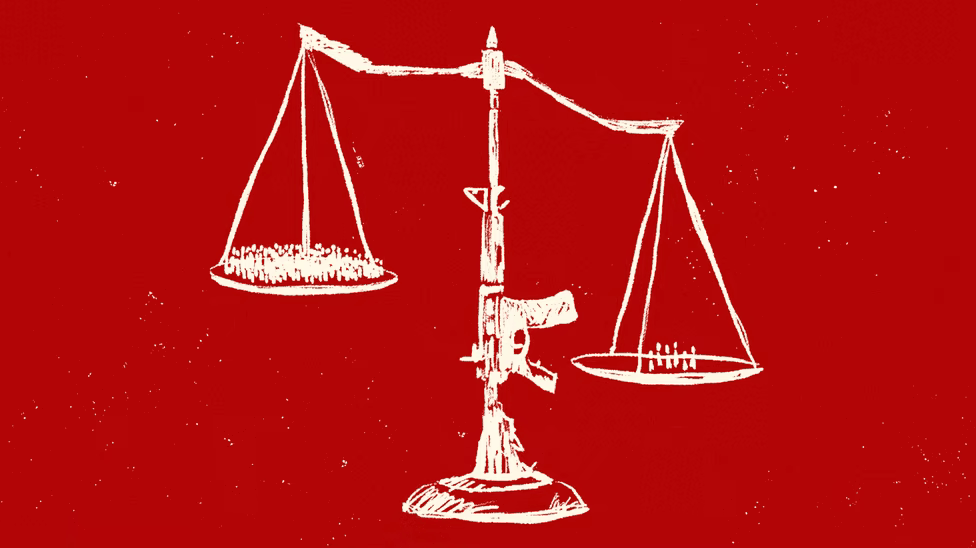
I chatted with an associate this evening about the gun debate in America. For some reason, gun control is again a hot topic. He believes that guns, like drugs, should be treated as mental health issues.
Click an image to read the referenced article.
The Atlantic: An ER Doctor’s ‘Third Way’ Approach to the Gun CrisisThe Atlantic: The Real Reason America Doesn’t Have Gun Control
Full Disclosure: I do not believe that the Second Amendment of the United States confers unrestricted rights to own a gun. Full stop. I believe this is a perversion by activist Supreme Court justices of the original intent of the grammatically-challenged Forefathers of that cursed country.
The mental health topic brought my attention to the question of tolerance and normalisation. Mental health, an interest of psychology has a sordid past. At its very core is the idea that humans can be normalised, that they can be categorised into normal and abnormal behaviours, and what is deemed normal might have some room for variation, but this tolerance doesn’t really allow for much discrepancy.
Normalisation expects to bring people into some basic conformity—give or take. The problem is that this is contextual and the acceptable range changes over time and place. Many behaviours previously considered abnormal are now acceptable, and some acceptable behaviours are no longer tolerated. Some of these changes have flip-flopped legal status as well. It’s just a game to some people.
Tolerance takes a position that there is no normal, per se. Some people just have different ideas.
Here is a clip of an interview with Dr Oz ( né Mehmet Cengiz Öz) where he illustrates my position. I’ll disintegrate it next.
Dr Oz explains why he does not support legalisation of marijuana
Transcript
Reporter: What is your stance on [the legalisation of] marijuana?
Dr Oz: … There are not enough Pennsylvanians to work in Pennsylvania, so giving them pot so they stay home… I don’t think [is] an ideal move. I also don’t want to breed addiction to marijuana. It’s not physical addiction; it’s emotional addiction, but I don’t want young people to think they have to smoke a joint to get out of their house in the morning. We need to get Pennsylvanians back at work you got to give them their mojo, and I don’t want marijuana to be a hindrance to that. I also don’t want people operating heavy machinery and driving by me when they’ve been taking their fourth joint of the day. But there are other issues that are plaguing Pennsylvanians. We’re a border state, practically, … because they’re flying illegal immigrants up here from the border in the middle of the night … but they’re also getting their narcotics up here really easily.
So, let’s break down this word salad. This will reveal some of Dr Oz’ and my worldview biases.
Neither Oz nor I advocate the use of marijuana or other recreational drugs. However, Oz wants to make or keep it illegal and criminalised. I do not agree. I feel they should regulate it and tax it. Although I neither advocate nor endorse the use of any of these herbs and chemicals, I feel they should do this for all drugs. [And if we are going to make these chemicals illegal, let’s not be hypocrites and make nicotine, alcohol, and caffeine illegal.] I’m not advocating this. I’m just saying adopt a position and maintain it with integrity.
There are not enough Pennsylvanians to work in Pennsylvania.
First, Oz is a wage slaver. Next, the unemployment rate for PA was 4.9% in March, so this does not appear to be a problem.
so giving them pot so they stay home… I don’t think [is] an ideal move.
Oz makes an unsubstantiated connection between the legalisation of marijuana and staying home—being lazy or unmotivated.
I also don’t want to breed addiction to marijuana.
Marijuana is not known to be addictive. As a doctor, Oz knows this.
It’s not physical addiction; it’s emotional addiction
Here, Oz backtracks, but he also introduces an unsubstantiated claim. If you are interested in why I consider psychology pseudoscience, follow this link to explain DSM changes in this area.
but I don’t want young people to think they have to smoke a joint to get out of their house in the morning
Oz makes a total non-sequitur here. Nothing he has mentioned this far would lead to this conclusion. If someone already feels this way, its legal status is irrelevant. Enough said.
We need to get Pennsylvanians back at work you got to give them their mojo, and I don’t want marijuana to be a hindrance to that.
This is more Calvinistic wage slavery advocacy. Again, he is equating the consumption of marijuana with being unmotivated. Perhaps he should challenge Micheal Phelps to a swimming race. If motivation is the issue, perhaps he rather favours legalising amphetamines—but I supposed he’d have a preconceived rationale for that, too.
I also don’t want people operating heavy machinery and driving by me when they’ve been taking their fourth joint of the day.
Where does the number four come from? Is four different to one or two? Has this been studied? Is he saying this doesn’t already happen? Does he believe that current intoxication laws and incapacitation regulations aren’t in place?
We’re a border state, practically…
Where to start… Pennsylvania is a border state. It borders New York, New Jersey, Ohio, Delaware, Maryland, and West Virginia. If one counts for the water border of Lake Erie, one might be able to argue that it shares an international border with Canada—although, I feel that’s a stretch. At that point, one wouldn’t be far from considering Hawaii to border California. It’s only water. He does say practically, so perhaps that’s his out.
because they’re flying illegal immigrants up here from the border in the middle of the night
Wait a minute… Geezer’s talking about the southern border between the United States and Mexico. (That’s where brown people live.) The fewest number of states between Mexico and Pennsylvania is four, but that’s stretching it. Something tells me that Oz is at least an elitist and at worst a racist. I’m a sad panda.
Another non-sequitur. Somehow, Oz is trying to create a link between marijuana and narcotics whilst also contending that legalising marijuana would somehow affect these illegal flights. Wait, are the flights illegal or just the passengers? How does he know that either is illegal? And does it have to be at night? I get the feeling that Oz watches too much television. Perhaps that’s what we should criminalise. So many questions.
but they’re also getting their narcotics up here really easily
OK? Perhaps we should contract with them to transport the marijuana up here if they are so efficient. Or would it be better to grow it locally? Racists tend to be nationalists and would likely favour a Made In America policy—unless they can exploit brown people. Or Oz can employ otherwise unemployed Pennsylvanians on his pot plantations. Where does it end?
What does this have to do with normalisation and toleration?
People like Dr Oz want to mainstream people, a concept some familiar with special education might remember—get the people in line with the herd. Proper people—normal people—are supposed X and Y and Z. Toleration allows that there may be people with descriptively ‘normal’ traits and behaviours, but there should not necessarily be a penalty for noncompliance.
When I was an undergrad student, I had a side job as a shift supervisor at an Au Bon Pain in Boston. On an occasion, one worker, let’s call her Mary, was arguing with another worker that we’ll call Marie. Mary said she was not going to make any more sandwiches because she had already made twice as much as Marie. Although I understand the notion of fairness she was invoking, I reminded her that she was being paid by the hour, not the piece. As long as she was still on the proverbial clock, she would continue to make sandwiches. Although I didn’t press this point, I could have hired Marie to watch Mary make sandwiches. In fact, I suppose I was hired to watch them both make sandwiches.
The point is—Mary’s perception aside—that there was no reason to presume these two should produce an equal number of sandwiches in an hour, a day, or a month.
I mention this because—getting back to Oz’ drugs scenario—if people are happy getting high on heroin and nodding out on Kensington Ave, that’s their issue, not Oz’ and not mine. If Pennsylvania needs workers and can’t get them, figure out how to attract workers. Don’t create a situation so bad that the alternate to work is just the lesser of two evils. This reminds me of a story from my consulting days.
Without dropping any names, I was hired by a company to ‘deflect’ some costs. The high-level concept was to redirect people from a relatively expensive call centre to cheaper self-service. I reminded them of the Principle of least effort.
Essentially, I conveyed that people are inherently lazy—echoing Carl Jung. People will take the path of least resistance. If it’s easier for them to call, they’ll call; if it’s easier to self-serve, they’ll do that.
“So we should make it more difficult for customers to call?” was how this was interpreted.
“You should make it easier to self-serve.”
I’m still shaking my head to this day. What humans will do to other humans in the name of commerce.
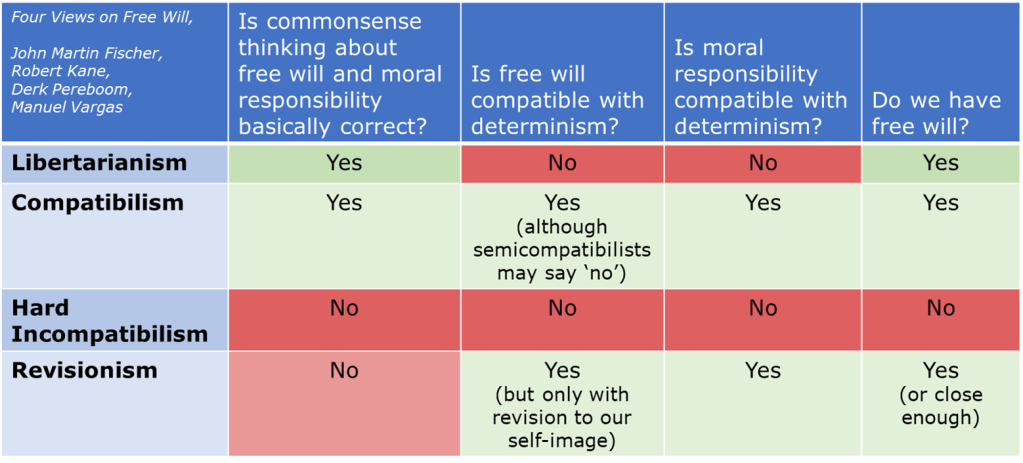
Reading Four Views on Free Will. In the introduction are some guiding definitions as well as this chart to help one to understand various views (row-wise) based on some questions (column-wise).
According to this chart, I’m a hard incompatibilist, As it reads,
I don’t subscribe to notions of free will or moral responsibility.
Free will and determinism cannot coexist in the same domain. (And the domain is the universe.)
Moral responsibility cannot be assigned in a deterministic environment.
Humans have no free will. (And neither can anything else.)
I’ve only read Robert Kane’s chapter so far. He’s a defender of Libertarianism.
John Martin Fischer is next. He’s known as a semi-compatibilist. We’ll find out what that means.
This is the end of a very short post, but I felt that the chart would be helpful for some.
Self and identity are cognitive heuristic constructions that allow us to make sense of the world and provide continuity in the same way we create constellations from the situation of stars, imagining Ursa Major, the little dipper, or something else. The self and identity are essentially expressions of apophenia.
Consider this thought experiment about responsibility. Rob decides to rob a bank. He spends weeks casing the target location. He makes elaborate plans, drawing maps. and noting routines and schedules. He gets a gun, and one day he follows through on his plans, and he successfully robs the bank, escaping with a large sum of money in a box with the name of the bank printed on it. Rob is not a seasoned criminal, and so he leaves much incriminating evidence at the scene. To make it even more obvious, he drops his wallet at the scene of the crime containing his driver’s licence with fingerprints and DNA on the licence and other contents of his wallet. He leaves prints and DNA on the counter where he waited for the money. This wallet even contains a handwritten checklist of steps to take to rob this bank—the address of the bank, the time and date. All of this left no doubt about who robbed the bank.
The self and identity are essentially expressions of apophenia.
Using this evidence, the police show up at Rob’s apartment to arrest him. They knock on the door and identify themselves as law enforcement officers. Rob opens the door and invites them in. All of the purloined money is still in the box with the name of the bank printed on it. It’s on a table in plain sight next to the gun he used. All of his maps, plans and, surveillance notes are in the room, too. They read him his rights and arrest him. Things aren’t looking good for Rob.
Before I continue this narrative, ask yourself is Rob responsible for robbing the bank? Let’s ignore the question of whether Rob has agency. For this example, I am willing to ignore my contention that no one has or can have agency. Besides, the court will continue to presume agency long after it’s been determined that it is impossible because agency is a necessary ingredient to law and jurisprudence.
Is Rob responsible? Should he be convicted of armed robbery and sentenced to incarceration? Let’s make it even easier. This isn’t Rob’s first offence. In fact, he’s been in prison before for some other crimes he committed. He’s no first-time offender. Why do you think that he’s responsible? More importantly, why should he be convicted and sentenced? What should his sentence be?
Consider that the money has been recovered, no one was injured, and Rob didn’t resist arrest. At first glance, we might consider both restorative and retributive justice. I’ve purposely made it easy to ignore restorative justice as all the money was recovered. This leaves us with retributive justice. What should happen to Rob? What would you do if you were the judge? Why? Hold that thought.
Let’s continue the narrative. All of the above happened, but I left out some details. Because of course I did. After the heist, Rob returned home and he lost his balance and hit his head rendering him an amnesiac—diagnosed with permanent retrograde and dissociative amnesia. Because of the retrograde amnesia, Rob can’t remember anything prior to hitting his head. Because of the dissociation, Rob has no recollection of anything about himself, not even his name. In fact, he now only responds to the name Ash. (This is where I debate whether to have Rob experience a gender-identity swap, but I convince myself to slow my roll and focus on one thought experiment at a time.)
Because of the retrograde amnesia, Rob can’t remember anything prior to hitting his head. Because of the dissociation, Rob has no recollection of anything about himself
To make this as obvious as I can consider, Ash has no recollection of Rob, robbing the bank, or anything about Rob. Ash doesn’t know Rob’s friends or family. Ostensibly Ash is a different person inhabiting former-Rob’s body. To make it even easier, Ash is not feigning this condition. So, let’s not try to use that as an out when I ask you to reconsider responsibility.
If my experience serves as a guide, if I asked you about your response to whether Rob was responsible and what his sentence should be, you would be committed to your same response and for the same reasons, so I won’t ask again.
What I ask now is if Ash is responsible and what his sentence should be. Keep in mind that we should be able to ignore the restorative element and focus on the retributive aspect. What should happen to Ash? What would you do if you were the judge? Whether your response has changed or remained the same, why would you judge Ash this way?
Here are some considerations:
Retributive justice might serve as a lesson to other would-be offenders.
The public may not believe the amnesia excuse—even though you, as judge, are convinced thoroughly.
Ash does not believe he committed the crime and does not comprehend the charges.
Ash was surprised to discover the money and gun and was pondering how it got there and what to do with it when the police arrived at his apartment.
If released, Ash would not commit a crime in the future. (My thought experiment, my rules; the point being that Ash was no threat to society.)
From my perspective, Ash is a different person. Sentencing Ash is ostensibly the same as sentencing any person arbitrarily.
The purpose of this experiment is to exaggerate the concept of multiple selves. Some have argued that there is no self; there is just a constructed narrative stitching discrete selves together to create a continuous flow of self-ness.
Is Ash responsible for Rob’s action?
I’m interested in hearing what you think. Is Ash responsible for Rob’s action, and why or why not? Let me know.
Love and hate are almost archetypal. In some ways, they are opposite ends of a spectrum, if not for the challenge of love having several other contexts that don’t serve to anchor the other end.
Hate and the love that opposes it are trebled versions of dislike or disdain and like or affinity. Both of these terms are hyperbole meant to elicit an emotional response. As such, they are abused to this end.
As Cristhian notes, hate is used as a qualifier—hate speech, hate crime, and other things people want to punctuate. It’s exclamatory. We might have rather presented it as !speech or crime! or perhaps borrow from Spanish, ¡speech! perhaps stylise it in all caps to double down on the effect ¡CRIME!
In any case, the intent is to manipulate emotions. Perhaps the intent is similar to the Spinal Tap parody of turning the volume to 11 — on a scale or 0 to 10. Hate is off-the-charts loathing. Perhaps it denotes a pathological response almost paralleling evil, another nonsense word.
Synonyms are detest, abhor, loathe, and so on. Hate seems to be just a smidge harsher.
I’d say that English has more than its fair share of nonsensical terms, but other languages have words to serve the same archetypal role. In French, there is a similar superlative— je le hais.
I don’t really have much more to add. I was just triggered by this piece, and I felt compelled to comment. Much language usage seems to be phatic, but in this case, I suppose emphatic is the word for the day.
* Thin Line Between Love and Hate is a song I first heard as a cover by Chrissy Hynde on the first Pretenders album, but it was first performed (perhaps even written by) The Persuaders, a fact I discovered searching for the video to insert here. The original sounds good, too. I just wanted to find the one who introduced me to it.
I just published a video on YouTube—just over 7 minutes long. I’ll be publishing the audio as a podcast and will share the script here as well.
Human Agency is an illusion. This is the end of the story. If you listen for a while, you’ll hear as I rewind and pull back the curtains.
[Redacted]
Let’s get started.
Human Agency is an illusion.
Think of life as a motion picture that’s already been filmed. The ending is already known. The script has been written and performed by actors already chosen and hired.
I like this visual, but it’s not quite right. The end is not known in the same sense as that of the movie. It’s just as inevitable, just unknown.
Some might prefer to use the metaphor of cascading dominos. And this might even play better into the illusion. Some unforeseen force might intervene and stop the otherwise inevitable. But even this is beyond our control. Like an action-adventure story, we’re strapped into a runaway train and just along for the ride. This train might someday stop, but we’ll have had nothing to do with it. Enough of metaphors. What am I saying? Why am I saying it? And what does it mean?
Allow me to set up the scene. From there, I’ll elaborate.
For millennia, there’s been a debate over free will and determinism. These terms have been defined in different ways in an attempt to sway the argument for or against, one way or another. It turns out that for the human agency illusion, it doesn’t much matter, but it might still help to set the stage, so let’s establish some foundation. I like to consider free will and determinism as bookends.
free will is the ability to make a choice and have had the ability to have chosen otherwise
Commonly, free will is the ability to make a choice and have had the ability to have chosen otherwise. That one can make this choice of their own accord or volition, is typically added for good measure. On the other hand, determinism says that everything that happens is determined by everything that has happened prior in a chain of cause and effect. Like dominoes falling one after another, so some event has caused another event since the dawn of time. Perhaps before time.
Some have argued that random events occur in our universe. Quantum theory suggests this. But that these events happen, doesn’t mean that we as humans have any say in the matter. This is what is known as indeterminism. Causes and effects are not so cut and dry. Some stochastic event serving as an exogenous factor manifesting as a pigeon, can swoop down and break the causal domino chain, but that doesn’t afford us human agency. A little more background. Some hold that free will and these alternatives are either mutually exclusive, or they’re compatible with each other. Not surprisingly, those who believe that these can coexist are called compatibilists, whilst the others are incompatibilists.
What I am saying is that if we allow that this wide shot might have validity, we can zoom in for a tight shot on the agent and notice that it doesn’t really matter. Some have said that the freewill versus alternatives challenge is a pseudo-problem. I am going to agree for the time being, if only for expedience. Before getting to the illusion of agency, let’s see why this situation creates problems.
Without getting too deep, humans seem to be wired to view their reality in a manner of cause and effect. Moreover, they seem wired to attribute blame based on this presumed causal relationship. Oksana hit a homerun. We should praise her. Raj robbed a store. We should blame him. Western society is constructed with this worldview, so we create rules and laws. We may even choose to codify how to rehabilitate or punish him. Or to reward her.
Without agency, there is no cause to praise or blame
Without agency, there is no cause to praise or blame. Whilst I consider it a pathology, for better or for worse, given the human propensity to blame concomitant with the agency illusion, I don’t see this changing any time soon.
There are arguments around quarantining bad actors independent of their agency or lack thereof on the grounds of public safety. Even this logic has serious holes, but we’ll save that for another time. And now the big reveal. With a reminder that my intent is to not go deep, how can I say that human agency is an illusion? Let’s start with the science.
As a lifeform, humans are a product of heredity, genetics, and epigenetics. Essentially, DNA passes information from generation to generation. Besides determining our physical attributes—head, shoulders, knees, and toes, potential height and weight, pigmentation, sex, and so on, it also establishes our temperament—our base attitude and way we perceive and interpret the world. This doesn’t make us clones or robots or automatons, but it does comprise some percentage of what we are. Identity politics aside, we don’t have much control of our sex, finger count, or eye colour. Clearly, we aren’t talking about trans-humans and cyborgs here.
Genetics and so on aren’t the only factor. Behaviourists will remind us that the environment and circumstances mould us, too. Each of us is taught mores and moral codes; how to behave and act. We are raised in a structure comprised of family, school, church, peers, larger society, authority figures, and whatever else—ostensibly like a sausage being stuffed into a skin.
Beyond the genetics that we have no control over, we are products of our environment
Beyond the genetics that we have no control over, we are products of our environment. These things interact, but there is nothing of us that we are responsible for creating. Despite the motivational tripe, we cannot create ourselves. This, too, is an illusion—delusion if I am being less charitable.
I’ll reserve elaboration for future content. In a nutshell, you’ve got no agency. Every choice you make is based on prior events. Even something as simple as choosing to order a chocolate or vanilla ice cream in a cup or a cone, sugar cone or waffle cone is predicated on some prior events, and you had nothing to do with them. You were a passive vessel.
I’ll leave with two relevant quotes.
A man can do what he wants, but not want what he wants.
Arthur Schopenhauer
And as Galen Strawson puts it,
You do what you do, in any given situation, because of the way you are.
So in order to be ultimately responsible for what you do, you have to be ultimately responsible for the way you are—at least in certain crucial mental respects.
But you cannot be ultimately responsible for the way you are in any respect at all.
So you cannot be ultimately responsible for what you do.
So there you have it. I hope you found this cursory treatment interesting and informative if not provocative.
[Redacted]
I’m interested in hearing what you think. Do you think you have agency? Do we have free will, or is everything determined at the start? I didn’t even mention religion. Does that throw a spanner in the works? Let me know.
My love affair with Foucault goes way back. Joseph Campbell is said to have spent five years (1929–1934) living in a shack, engaged in intensive and rigorous independent study. In my dreams, I’d spend five years with Foucault, Galen Strawson, and David Guignion.
Michel Foucault is likely the most well-known of these three, and I’ve written a few Galen Strawson-related posts lately, but who the hell is David Guignion? I’ll tell you. David is a PhD philosophy student studying conspiracy theories if his bio is up to date and otherwise relevant. I’ve shared some of his content and insights over the years.
The reason I love David is that he introduces me to contemporary philosophers I had not been aware of as well as material or perspectives on classical philosophers to broaden my horizons. I think it’s safe to say that David and I are both Foucault fanboys. Hell, I don’t even have a tee shirt with Foucault’s likeness, so he’s even ahead of me in that game.
So, where’s this all leading, you ask. And I’m glad you did. A couple of days ago David posted a clip on YouTube called Michel Foucault’s “The Subject and Power”. I was drawn to the mention of Foucault, but I decided not to visit. I get so many distractions on my anti-agency endeavour—and that’s not even accounting for the sheer quantity of research—, and I didn’t need yet another. But the synchronicity was determined.
Last night, as I was getting ready for bed, I decided that I’d just let the video play as I fell into slumber. Spoiler Alert: That never happened. Topic after topic caught my ear, and it took all of my will to not get out of bed and start reading and writing. But it was almost 4 am, so that worked in favour of remaining supine—though alternately prostrate.
Kumi Yamashita, Building Blocks (2014)
My thesis is that the free will versus determinism or indeterminism debate is not inherently critical to the agency versus structure debate. My position is that agency has little breathing room and no material degrees of freedom to matter. Foucault’s subjectification or subjectivation makes the same argument. In effect, this is an argument about structure over agency. It’s about conscious and unconscious forces to conform. Full disclosure, I identify most as an indeterminist, but in the end, I don’t think it much matters. I disclose this being it may provide a clue as to how I ended up here—of my own free will, it goes without saying.
I’m not going to summarise David’s summary because you can just watch his clip for yourself. But the gist of it is that we are all subjectivised or moulded. Foucault tries to convince us that this is the crux of his decades of teaching, but to me, it still comes down to power—to the pressure that creates these diamonds. Diamonds have no free will; they just become diamonds. And so it goes for humans cum subjects.
Not to come across like Rousseau, but I am still interested in understanding what happens to those outside of this sphere of influence.
Cover Image Credit
Kumi Yamashita
BUILDING BLOCKS 2014 H200, W300, D10 cm Carved wood, single light source, shadow Permanent Collection Otsuma Women’s University, Tokyo, Japan
















 Philosophics