As a (slightly) more considered response to Marvin Edwards’ comment in response to a prior post: ‘I’m working under the presumption that “the best good and least harm for everyone” is behind every rule that our consequentialists have created…’, I wanted to bring to the forefront the adolescent-appropriate short story, The Ones Who Walk Away from Omelas (PDF). Among the key themes, author Ursula K Le Guin paints a thought experiment that showcases the weakness of the foundation of Utilitarianism.
To summarise, Omelas is a utopian city, and the residents are copacetic—all but one. The one is a veritable scapegoat. The one suffers all of the pain, to create a system wherein the best good and the least harm could be experienced. Whilst the concept breaks down well before this scale, this thought experiment illustrates the absurdity of the claim. At a more basic (and classic) level, we can simply look at the various trolley experiments or the conceptual dilemma proposed in the scenario wherein some number—4 and 5 seem to be popular—of ill people may be saved at the expense of 1 healthy one.
At a more conceptual level, at its inception in the Age of Reason by Bentham and Mill, a time where Scientism was wrestling the reins from the Age of Superstition Scholasticism, utililty was thought to be able to be quantified and measured. As with other non-ontic concepts, it can’t be.
As with other non-ontic concepts, utility is specious. Like a Pointillist painting, it looks coherent at a distance, but upon any scrutiny, it becomes incoherent, and the best an adherent can do is to step back until it again feels rational, arguing that to get any closer is to make perfection the enemy of the good. But that’s not the point, to ask for a workable definition prior to engaging in discourse is not about perfection; it’s creating a common basis for discussion. Utility offers little utility.
Why should justice be the foundation of a society, and why not something else, say, honour or valour or wealth? What do we mean when we say justice? Do you mean the same thing as me? Dating myself to be sure, but would a Klingon from the Star Trek universe share your definition? So what is justice anyway?
‘Justice is the constant and perpetual will to render to every man his due. Jurisprudence is the knowledge of divine and human affairs and knowledge of what is just and what is unjust’, or so writes Justinian in Institutes 1.1 in 533 CE.
“Iustitia est constans et perpetua voluntas ius suum cuique tribuens. Iuris prudentia est divinarum atque humanarum rerum notitia, iusti atque iniusti scientia.”
This is Justinian’s answer to the question: What is justice? In his Philosophy and Real Politics, Geuss relates that ‘justice is the constant and unflagging will to render to each person what is due to him’ (or perhaps ‘what he’s entitled to’), and therein lies the rub: what exactly is one entitled to?
Geuss goes on to point out that entitlement was contingent to one’s place in society. Citizens were entitled to some things, resident aliens another, and slaves, pretty much nothing at all. In fact, giving a slave more than s/he was entitled to would be considered unjust, as it would be considered to be undeserved. As Geuss writes, ‘that to treat a slave as if he or she had any entitlements would be a gross violation of the basic principles of justice’. Of course, you are thinking, post-Enlightenment ‘all men are created equal’, or so the saying goes.
In practice, it’s been easy to sidestep the application of justice by redefining a certain group to be outside of some protected group. During the illegal aggression by the United States against Middle Eastern countries that resulted in extraordinary rendition of civilians spirited off to Guantánamo Bay, Cuba, off the coast of the United States and outside of their jurisdiction, their acting regime declared that the detainees were not people, strictly speaking, and as such were not subject to the protections afforded to people, therefore they had no access to justice.
“Justice is the first virtue of social institutions, as truth is of systems of thought.”
— John Rawls, A Theory of Justice
Hermione’s Time Turner
The ancient Greeks had a different idea of justice, so perhaps we just need to break out our trusty time turner to see what Aristotle had to say about it.
Here Aristotle rather equates the notion of justice to that of equality, but that begs the question: what equality? as we understand that equality comes in a variety of colours, so I won’t belabour the point any further here.
Instead of asking about justice, why don’t we focus on the root of the word, just? This yields the following definition:
Just: (adj) based on or behaving according to what is morally right and fair
This brings us into the normative domain of morality, fairness, and reason, so it’s not much to work with—basically, we are in the realm of opinion defended by rhetoric.
For ‘all’ intents and purposes, we’ve got four forms of justice. We’ve been focused on the distributive type, but there are also procedural, restorative, and retributive varieties. In many cases, not just one form of justice is satisfying and so multiple varieties are deemed, well, just.
Distributive or economic justice is about fairness in how things are distributed, about getting a fair share.
Procedural justice is also about fairness, but it’s more about fair play, an even playing field.
Restorative justice is about compensating for an injustice, about restoring some perceived balance.
Retributive justice is about punishment—retribution.
A problem arises when we try to quantify and measure justice. Consider distributive justice: If two people work in a field and each cultivates 50% of the crop, are each entitled to 50% of the yield? If the cultivated land was the ‘property’ of some other landowner, what portion would s/he be entitled to? All of it? Some of it? None of it?
What about the court system? Procedural justice comes into play here. Should a wealthy person have access to better attorneys than a poor person? Is this just? The poor person may argue no, but the wealthy person may argue that s/he earned the ability to pay for a better lawyer, so s/he is entitled to this benefit.
Restorative justice sounds simple at the surface. If I steal a loaf of bread, wouldn’t returning the loaf (or, at least, a similar loaf) be restorative—no harm, no foul? Many people will argue that this is not good enough. Balance has not been restored.
This is where retributive justice comes into play. Retributive justice is a poorly veiled euphemism for vengeance. This is where Hammurabi‘s code (or Leviticus‘) eye for an eye—but not Matthew‘s turn the other cheek rendition—comes in. Let’s not get into Nietzsche’s take on forgiveness as being unjust and part of slave morality.
Keep in mind that in Hammurabi’s code, as with Roman law, justice was relative: Given eyes, (Nº 196) ‘If a man put out the eye of a nobleman (amelu), his eye shall be put out’, yet (Nº 198) ‘If he puts out the eye of a freedman or breaks the bone of a freedman, he shall pay one gold mina’.
Through all of this, we are still left wondering: just what is justice besides some vague notion constructed solely to preserve the status quo.
The first thing that popped into my head was blockchain.
Polymath, Gottfried Wilhelm Leibniz (1646–1716), coincidental discoverer of differential calculus with Isaac Newton, was also an Age of Reason (or Rationalism) philosopher. Whilst listening to a lecture (Nº 5) about Leibniz’ monism (whence: monads), wherein he believed that all substance is comprised of monads—think of them as like atoms—, which contain ‘entelechy‘ (from Aristotle’s Greek, ἐντελέχεια*), « an inner principle that unfolds all the changes it goes through with respect to other substances, that everything true of the substance, including its relations to all other things, must be deductible from it ».
The first thing that popped into my head was blockchain, that a thing would contain within itself the entire history of itself, in particular, it’s spatiotemporal relationships. Of course, this is not a very tight analogy, but I thought I’d share it anyway.
*Etymology: entelekheia: en– (within), –teleos– (end or perfection), and –ekhein (to be in a certain state).
A mate in an online forum turned me onto Raymond Geuss, who’s got just the perspective I’ve been looking for. I’ve felt that the concepts of rights and justice are weak on etymological grounds, but Geuss’ critique is even more fundamental. In his Philosophy and Real Politics, Geuss undercuts the positions of both Nozick and Rawls. I’ve never been a fan of Nozick, but I do consider (have considered) myself to be a bit of a Rawlsian.
Nozick is a key figure underneath Libertarianism, as this movement is very centred on rights. Opting for rights as his starting place as his preface to Anarchy, State, and Utopia:
“Individuals have rights, and there are things no person or group may do to them (without violating their rights).” — Robert Nozick
As Geuss points out, Nozick ‘allows that bald statement to lie flapping and gasping for breath like a large, moribund fish on the deck of a trawler, with no further analysis or discussion, and proceeds to draw consequences from it’. In other words, Nozick leads with an unsubstantiated claim that ‘individuals have rights’, and then ‘advances’ his position tautologically.
As for Rawls, justice is his centrepiece. In his A Theory of Justice, the opening line is “Justice is the first virtue of social institutions, as truth is of systems of thought”. He merely starts from this emotional place and advances his theory based on this basis of justice, yet nowhere does he explain of defend why this should be the foundation. As with Nozick, Rawls simply conjures this out of thin air.
“Justice is the first virtue of social institutions, as truth is of systems of thought.” — John Rawls
On top of this, Geuss comments on the shaky etymologic foundation of both justice and rights. Harkening back to the Latin origin of justice,
As Geuss writes, ‘To begin with the question of the concept of “justice,” it is striking how unclear this concept is in ordinary language and to what extent conceptions of justice differ from one context to another and in different human societies at different times. Thus at the beginning of one of the standard treatises of Roman law, the codification made for the emperor Justinian — one of the most influential texts in European history — we find that the very first sentence gives us a definition of “justice”: “iustitia est constans et perpetua voluntas ius suum cuique tribuens.” That is, justice is “the constant and unflagging will to give each person what is due to him.”
“What have the Romans ever done for us?” – Monty Python
Then he goes on to clarify that “what is due to him” is radically different dependant on being a citizen, an alien, a slave, a woman, a minor, and so on. To simplify this, we are stuck in a tautological loop: one is due what one is due, as determined somewhat exogenously.
Rights don’t fare any better, being even more ambiguous, so I don’t feel so bad about pursuing the irrelevance of these virtue concepts on etymological grounds.
I stumbled upon Professor Jordan Peterson and his defenders of virtue morality, like Dr Stephen Hicks, and I decided to watch some vids.
Full Disclaimer: Not a fan
I ended up on his lecture about Carl Jung.
I’d been interested in archetypal and depth psychology for ages, and I’ve read most of Jung’s work. I still own all of the volumes of his complete works. The difference between me and Professor Peterson is that I take it as metaphor and, by his words, I presume that he doesn’t.
The video clip is cued to the location where Jordan says, speaking of Nietzsche,
“…‘God is dead, and we have killed him’ led Nietzsche to pose another question, which was: What are we going to do to replace him? Because Nietzsche believed—and I think he was absolutely right about this. I can’t see how it could be otherwise—, he believed that the morality that had structured Western society was predicated on the fundamental axiom of divinity, and so, as far as Nietzsche was concerned, the whole purpose of morality was dependent on that axiom being true—or at least being accepted as true. And when that axiom was knocked out by, say, the conflict between science and religion—because in some sense that’s what did it—, then the whole system no longer had anything to stand on and could become entirely questionable…”
“The whole purpose of morality was dependent on [the existence of divinity] being true.”
As I’ve said time and again, this is the primary reason people—especially those defending or seeking some sense of status quo, conservative vanguards, and morality warriors—insist on the existence of a real, objective moral centre or a good-enough version of it—one that coincidentally conforms to their worldview.
I’m afraid that I am going to need to hear something well more convincing than that because I’m not buying what these guys are selling.
As I read his Utilitarianism, I want to like John Stuart Mill. He seems like such a clever man, but he is a victim of his Enlightenment Age. Attempting to fabricate order created by science’s encroachment on the absolutes of religion and the shifting sentiments toward monarchies, Mill tries to replace this moral compass with Jeremy Bentham‘s utility.
£1 ≠ £1
The problem is that despite (sort of) dispensing of religious doctrine, Mill was still fettered by the dogma of virtue ethics of dignity and duty. To this, he adds happiness. Not to go full-on Foucault, but these are concepts leveraged, like religion, to maintain power—take an elevated system in a constructed society, and the duty becomes a burden to the bottom, save for pretence of duty and dignity at the top.
I’ve had an issue with the concept of virtue and all of its offspring: duty, justice, and so on. I’ll likely write about this later. I expect that I’ll be reading Mill’s On Liberty next, so stay tuned.
Ignoring my contention that Utilitarianism is baseless, I have two other issues, using economic examples, each related to prospect theory (pdf):
Regressivity: A person with less money values an incremental dollar more than a person with more money.
Loss to gain asymmetry due to risk aversion: A person values losing a dollar more than earning a dollar, ceteris paribus.
Pareto efficiency, a cornerstone of Classical economics, does not take this into account. For this theory, all dollars are created (or perceived to be) equal, so it doesn’t matter whether person A, who earns £10,000 p.a., or person B, who earns £100.000 p.a., gets £100, but in the real world, person A would give it a higher value, so a transfer from A to B would be an inferior transaction to a B to A transaction.
This said, person B values the £100 more than having gained the amount, but it is not clear how to reconcile (in order to reach perceived parity) what the fair equilibrium would be, allowing that equality of outcome might not be the desired outcome.
[EDIT: Researching immediately after I wrote this article, I skimmed—I’ll have to find time to read it later—Turkheimer’s paper Still Missing (PDF, 2011), where he walks back his original assertion.]
The question, “why are children in the same family so different?” is answered, “Because measurable differences in their environment make them that way.”
I finished Pinker’s The Blank Slate the other day, but I didn’t have much time to capture my reflections. I’m already onto my next book, Mill’s Utilitarianism, so I figured I record some thoughts before they become too distant.
The First Law: All human behavioural traits are heritable.
The Second Law: The effect of being raised in the same family is smaller than the effect of the genes.
The Third Law: A substantial portion of the variation in complex human behavioural traits is not accounted for by the effects of genes or families.
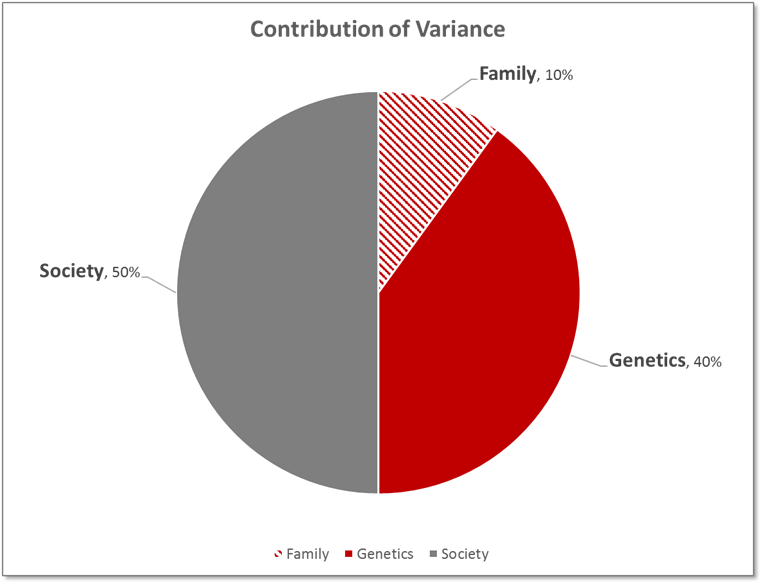
Elaborating on this, he summarises Turkheimer’s assessment on the variance in personality contributable to three factors: genetics, society, and family. According to this theory, variations in personality due accounted for by environment, are composed as
50 percent accounted for by society (non-shared environment); 40 – 50 percent accounted for by genetics (biology) and 0 to 10 percent attributable to family (shared environment). In his assessment, he was able to eliminate usual-suspect factors like birth order and siblings.
“Genotype is in fact a more systematic
source of variability than environment.”
According to Pinker, the 0 to 10 percent is generous, and it could just as well be 50% society and the rest is genetics. That doesn’t leave a lot of room for psychoanalysis, a discipline who strongly pushes back on this concept—just with emotional appeal in lieu of science.



![legiao_W8DiZkmnspwzXaYu3AUoEM7xeQSCOLfcHlyGPNb_Ij[1]](https://philosophics.blog/wp-content/uploads/2017/11/legiao_w8dizkmnspwzxayu3auoem7xeqscolfchlygpnb_ij1.jpg)
![US-Camp_x-ray_detainees-Guantanamo-Bay-Jan-11-2002-Phot-Shane-T-McCoy-US-Navy-Creative-Commons-513x239[1]](https://philosophics.blog/wp-content/uploads/2017/11/us-camp_x-ray_detainees-guantanamo-bay-jan-11-2002-phot-shane-t-mccoy-us-navy-creative-commons-513x2391.jpg) In practice, it’s been easy to sidestep the application of justice by redefining a certain group to be outside of some protected group. During the illegal aggression by the United States against Middle Eastern countries that resulted in extraordinary rendition of civilians spirited off to Guantánamo Bay, Cuba, off the coast of the United States and outside of their jurisdiction, their acting regime declared that the detainees were
In practice, it’s been easy to sidestep the application of justice by redefining a certain group to be outside of some protected group. During the illegal aggression by the United States against Middle Eastern countries that resulted in extraordinary rendition of civilians spirited off to Guantánamo Bay, Cuba, off the coast of the United States and outside of their jurisdiction, their acting regime declared that the detainees were