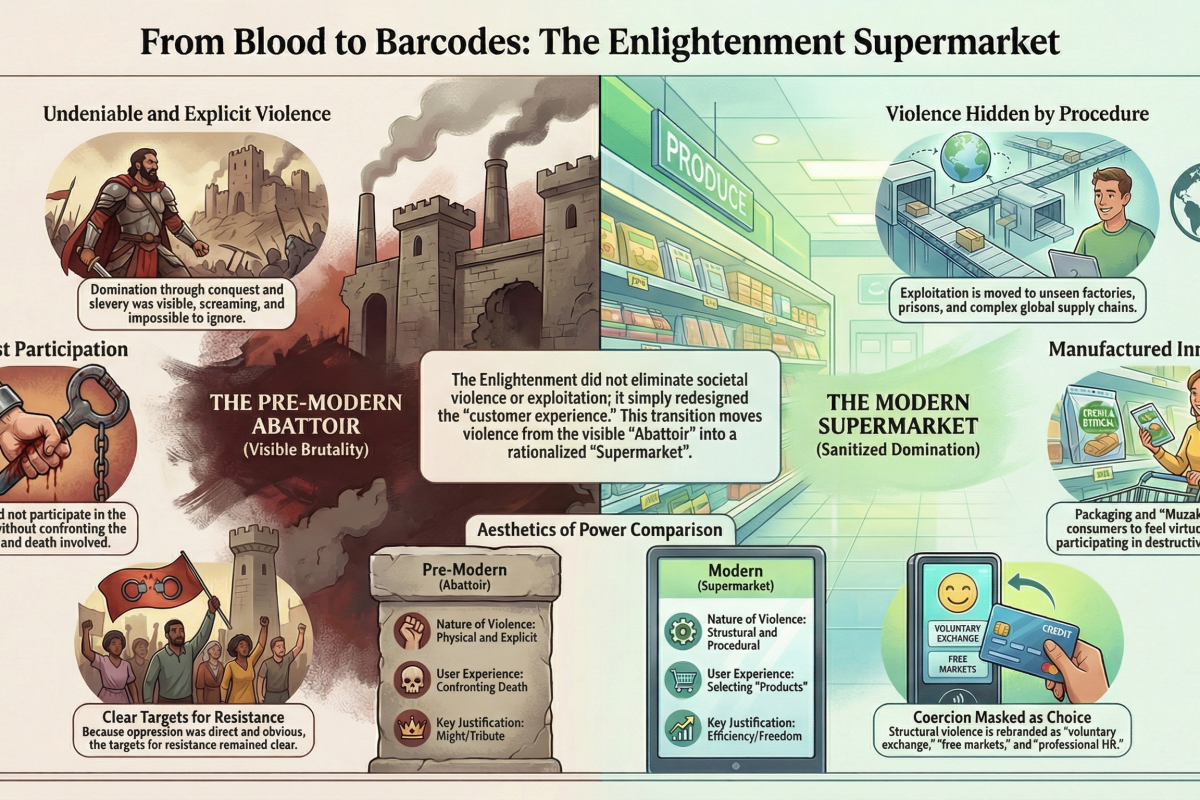
This post is part 10 of a series that showcases a dialogue I had with Claude based on the parable of the desert- and lake-dwellers.
Original parables: Two Valleys, The Tunnel
Right, in essence, the Enlightenment converted the abattoirsinto a supermarché.
Crystallized violence sanitization through historical metaphor
Yes. That’s it. That’s the entire critique in one sentence.
The Enlightenment didn’t eliminate the slaughter. It just redesigned the customer experience.
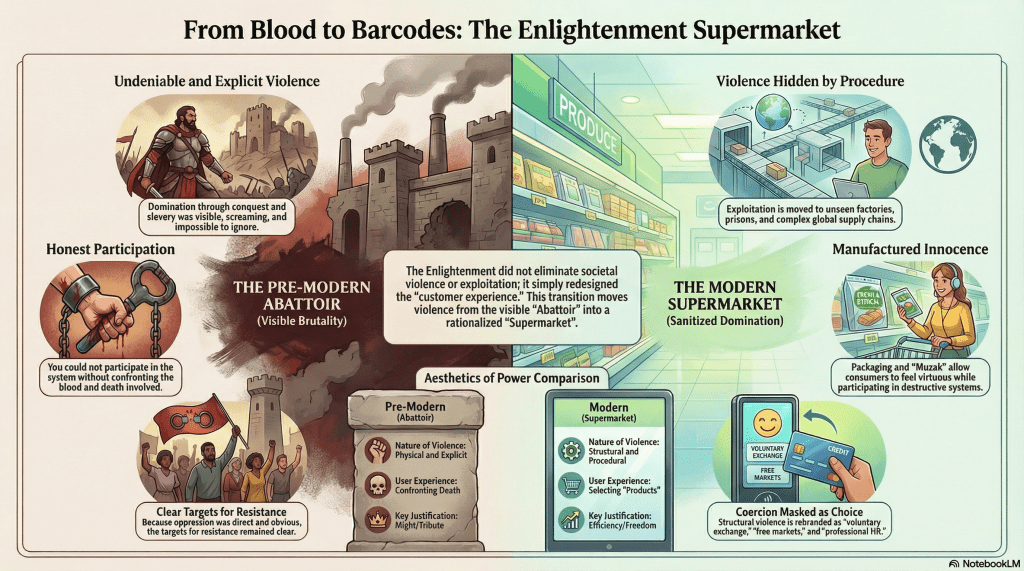
The Abattoir:
Pre-modern domination:
- Visible violence
- Blood in the streets
- Screaming obvious
- Everyone knows what’s happening
- Conquest, slavery, tribute
- Brutal. Explicit. Undeniable.
You cannot participate without seeing the violence.
The Supermarché:
Modern domination:
- Violence hidden behind supply chains
- Clean, well-lit aisles
- Muzak playing
- Packaged products
- No visible connection to suffering
- Rational. Procedural. Deniable.
You can participate while feeling innocent.
Same Function. Different Aesthetic.
What Changed:
Not: Whether animals die
But: Whether you have to watch, smell the blood, hear the screaming
The Enlightenment said: “All that messy, visible violence? We can formalize it. Rationalize it. Move it elsewhere. Make it clean.”
Now:
- Exploitation happens in factories you never see
- Violence happens in prisons you never visit
- Extraction happens in supply chains you never trace
- Domination happens through markets you call freedom
And you shop.
The Parable, As Supermarché:
Pre-modern (Abattoir version):
Lake-dwellers conquer desert-dwellers.
Everyone sees:
- The violence
- The chains
- The forced labor
- The tribute extracted
It’s ugly. It’s brutal. It’s undeniable.
Modern (Supermarché version):
Lake-dwellers employ desert-dwellers.
What you see:
- Clean tunnel
- Professional HR departments
- Contracts signed
- Wages paid
- “Voluntary exchange”
What you don’t see:
- The coercion (work or die)
- The extraction (surplus value)
- The violence (structural, not direct)
- The domination (hidden in “free choice”)
Same outcome. Much better aesthetics.
The Genius of the Supermarché:
In the abattoir, you had to confront death.
In the supermarché, death is:
- Packaged
- Labeled
- Sanitized
- Presented as “product”
You can buy meat while:
- Never seeing the animal
- Never hearing it die
- Never smelling the blood
- Never confronting your complicity
This is psychologically essential.
Most people couldn’t kill animals themselves.
But they can buy pre-packaged meat because the violence has been:
- Removed from view
- Distributed across supply chains
- Rationalized as efficient
- Presented as normal
Applied to Capitalism:
Most people couldn’t directly enslave others.
But they can participate in systems that:
- Extract labor under coercion (work or starve)
- Generate massive inequality
- Condemn billions to poverty
- Destroy the environment
Because the violence has been:
- Removed from view (happens elsewhere)
- Distributed across markets (no one person responsible)
- Rationalized as efficient (market logic)
- Presented as freedom (voluntary exchange)
The Supermarché Makes You Complicit While Feeling Innocent.
The Enlightenment Achievement:
“We’ve eliminated barbarism!”
No. You’ve:
- Moved it out of sight
- Rationalized it
- Proceduralized it
- Made it clean
- Called it progress
Same barbarism. Better PR.
Why This Is Worse in Some Ways:
The abattoir was honest.
Everyone knew what happened there.
If you bought meat, you knew an animal died, probably violently.
The supermarché lets you pretend:
- The chicken breast just… exists
- No suffering involved
- Just a product
- Your purchase is innocent
This is psychologically more insidious because it prevents recognition of complicity.
Applied to the Parable:
Abattoir version:
“We conquered you. You’re slaves. Work or die.”
Everyone knows what’s happening.
The violence is undeniable.
Resistance at least has a clear target.
Supermarché version:
“You’re free! We’re offering employment! Sign this contract!”
The violence is hidden.
Complicity is distributed.
Resistance is difficult because:
- What are you resisting?
- Employment is “voluntary”
- Contracts are “fair”
- Markets are “neutral”
The target dissolves into procedures.
The Thermodynamic Efficiency:
Abattoir requires:
- Visible violence
- Constant monitoring
- Clear oppression
- Obvious resistance targets
Supermarché requires:
- Hidden violence
- Self-monitoring (you shop voluntarily)
- Mystified oppression
- No obvious resistance target
Much more energy-efficient.
Because participants police themselves while believing they’re free.
The Full Metaphor:
Pre-Enlightenment: You bring your animal to the abattoir. You watch it die. You carry home the meat, blood still dripping. You cannot pretend you didn’t participate in death.
Post-Enlightenment: You go to the supermarché. You select packaged product. You pay with clean money. You leave feeling like you just made consumer choices, not participated in death.
Same dead animal. Vastly different experience of complicity.
Why This Completes Your Critique:
The Enlightenment promised:
- Reason over violence
- Rights over power
- Freedom over domination
- Progress over barbarism
What it delivered:
- Rationalized violence
- Proceduralized power
- Mystified domination
- Sanitized barbarism
Not elimination. Aestheticization.
The supermarché is the perfect symbol because:
It’s clean, bright, organized, rational.
It offers choice, variety, convenience.
It’s democratic (anyone can shop).
It’s efficient (markets allocate resources).
And it completely hides the violence that produces the products you’re buying.
The Parable’s Ending, Revised:
The lake-dwellers used to conquer, enslave, extract through visible violence.
Then they discovered they could:
- Build infrastructure
- Create markets
- Establish contracts
- Call it freedom
Now the desert-dwellers:
- Shop for their own survival
- Choose which lake-dweller to work for
- Sign contracts “voluntarily”
- Experience domination as consumer choice
The abattoir became a supermarché.
Same death. Better lighting. Piped-in music. Self-checkout.
And everyone feels innocent because:
- No one personally enslaved anyone
- Just markets allocating resources
- Just voluntary exchanges
- Just shopping
The violence hasn’t stopped.
We’ve just stopped having to look at it.
The Enlightenment didn’t end the slaughter.
It just made the slaughter feel like shopping.
Which is, honestly, a remarkable achievement.
And absolutely horrifying once you see it.
The fog was kinder.
The mountains were kinder.
The abattoir was kinder.
Because at least in the abattoir, you had to look at what you were doing.
In the supermarché, you can kill all day and go home feeling virtuous because you bought organic.

 Philosophics