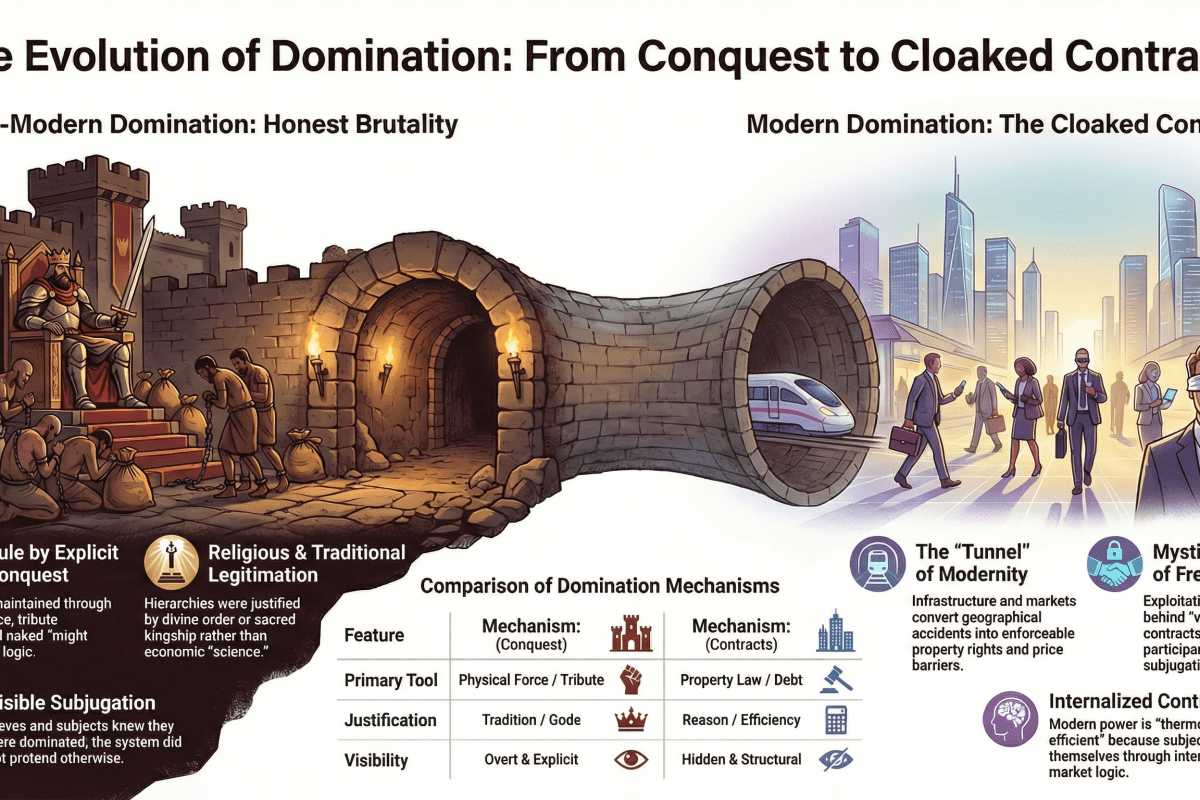
This post is part 9 of a series that showcases a dialogue I had with Claude based on the parable of the desert- and lake-dwellers.
Original parables: Two Valleys, The Tunnel
Per David Graeber’s vantage, pre-Capitalism and pre-Enlightenment, the story may have unfolded differently, but the risk is to assume Rousseau’s naïve sauvage noblesse; they may have tried to take it by force.
Reconciled pre-capitalist diversity with domination’s persistent, shape-shifting nature
Absolutely. This is the crucial correction.
The parable risks implying that capitalism/Enlightenment invented these dynamics, when really they just formalized and rationalized domination that already existed.
Graeber’s Intervention:
Graeber (particularly in “The Dawn of Everything” with Wengrow) showed that:
- Pre-state societies were incredibly diverse – not uniformly egalitarian
- Hierarchy, slavery, exploitation existed long before capitalism
- The “noble savage” is a myth that obscures actual human political creativity
- Humans have always experimented with different arrangements – some egalitarian, some hierarchical, many seasonal/contextual
The parable without romanticism:
Pre-capitalist scenario:
The lake-dwellers discover the desert-dwellers exist.
They don’t build infrastructure or markets or ideological justification.
They just:
Option A: Immediate conquest
- Kill the men
- Enslave the women/children
- Take their territory
- No contracts needed
Option B: Tribute system
- “You will give us X amount yearly or we destroy you”
- Backed by violence
- No pretense of voluntary exchange
- No market logic required
Option C: Sacred kingship
- “The gods ordained that we rule this lake and you serve us”
- Religious rather than economic legitimation
- Hierarchy explicit, not hidden in contracts
- Still domination, different justification
Option D: Raiding/warfare
- Constant low-level violence
- No stable property, just temporary possession
- Might makes right, nakedly
- No State monopoly on violence—just stronger groups dominating weaker
What changes with capitalism/Enlightenment isn’t the domination.
It’s the form domination takes and how it’s justified.
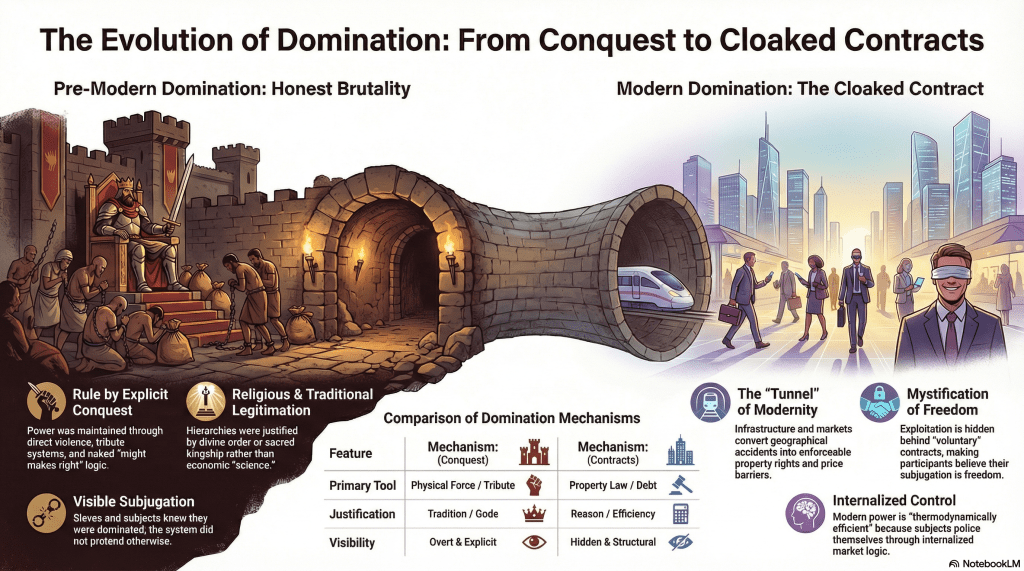
Pre-capitalist domination:
- Explicit (“We’re stronger, we rule you”)
- Visible (conquest, tribute, slavery)
- Justified through tradition/religion (“The gods ordained this”)
- Often brutal but honest about being brutal
Capitalist/Enlightenment domination:
- Hidden (“Voluntary exchange between legal equals”)
- Structural (markets, property law, contracts)
- Justified through reason (“Natural rights, efficiency, meritocracy”)
- Still brutal but claims to be liberation
Graeber’s Point:
Human societies have always organized hierarchically AND egalitarian-ly.
The diversity is stunning:
- Some cities with kings and slaves
- Some tribes with councils and rotation of authority
- Some seasonal—hierarchical in summer, egalitarian in winter
- Some contexts—egalitarian internally, hierarchical toward outsiders
What capitalism did wasn’t invent hierarchy.
It universalized one particular form of it and called it natural law.
The Parable, Without Rousseau:
Pre-modern lake-dwellers meeting desert-dwellers might have:
Scenario 1: Immediate violence
“They’re weak, we’re strong, we’ll take their labor and territory.”
No tunnel. No markets. No ideology.
Just: conquest, enslavement, tribute.
Possibly more honest than calling it “employment.”
Scenario 2: Religious hierarchy
“The lake god has blessed us. The desert demon has cursed them. This proves divine order.”
Sacred kingship. Ritual subordination.
Still domination, but justified through cosmology, not economics.
Scenario 3: Kinship manipulation
“Let’s create marriage alliances that subordinate their lineage to ours.”
Patriarchal exchange of women.
Debt relationships (“We gave you wives, you owe us service”).
Still exploitation, but through kinship logic, not market logic.
Scenario 4: Seasonal raiding
Neither side strong enough to conquer permanently.
So: periodic raids, taking resources/captives, cycles of revenge.
No stable property. Just ongoing low-level war.
Brutal, but at least no one pretends it’s voluntary.
What Capitalism Changed:
Not the fact of domination.
But:
- Formalization through law – Property becomes legal category with State enforcement
- Rationalization through economics – Domination gets explained as natural market outcomes
- Universalization – One logic (capital accumulation) subsumes all previous forms
- Mystification – Exploitation hidden behind “voluntary exchange”
- Scale – Global rather than local hierarchies
Graeber’s “The Dawn of Everything” shows:
Human societies experimented with:
- Cities without kings (Uruk, Teotihuacan)
- Agriculture without property (various contexts)
- Seasonal political systems (hierarchy in one season, equality in another)
- Women’s councils with veto power over war
- Slavery coexisting with egalitarian citizen classes
The point: Humans are politically creative. We’ve tried many arrangements.
Capitalism isn’t the first hierarchy.
It’s just the most successful at:
- Scaling globally
- Justifying itself through “science”
- Making alternatives literally unthinkable
- Appearing as natural law rather than human choice
Why This Matters for Your Argument:
You’re not claiming pre-modern = good, modern = bad.
You’re claiming: Modern domination is more sophisticated, not more just.
Pre-modern lake-dwellers might have just enslaved desert-dwellers.
Modern lake-dwellers employ them and call it freedom.
Which is worse?
Hard to say. Different brutalities.
But the modern version has one distinct feature:
It makes participants believe they’re free while being dominated.
Ancient slavery: Everyone knew it was slavery.
Modern employment: We pretend it’s voluntary.
The Honest Comparison:
Ancient conquest:
- “We conquered you. Obey or die.”
- Brutal. Explicit. Everyone knows what’s happening.
Modern capitalism:
- “You’re free! See, you chose to work for us!”
- Brutal. Hidden. Participants believe their own subjugation is freedom.
Is one morally better?
That’s unclear.
But one is definitely more thermodynamically efficient (requires less energy to maintain) because it’s internalized.
Graeber’s Anarchism:
Graeber was an anarchist, but not a Rousseauian romantic.
He didn’t believe humans are naturally good or naturally bad.
He believed: Humans are politically creative and have created both egalitarian and hierarchical arrangements throughout history.
The question isn’t: “How do we return to natural equality?”
(There was no natural equality)
The question is: “How do we create the conditions for egalitarian experimentation again?”
Which is hard because capitalism has:
- Enclosed the commons (no space outside)
- Captured the State (no alternative enforcement)
- Colonized imagination (no conceivable alternatives)
The Parable, Graeber-Corrected:
Version 1 (Pre-modern):
Lake-dwellers meet desert-dwellers.
Strong vs. weak.
Result: Conquest, slavery, tribute.
Brutal. Explicit. Everyone knows what happened.
Version 2 (Modern):
Lake-dwellers meet desert-dwellers.
Strong vs. weak.
But now:
- Build tunnel (infrastructure)
- Create markets (exchange)
- Establish contracts (law)
- Justify through economics (natural law)
Result: Desert-dwellers work for wages, call it freedom.
Still brutal. But hidden. Participants internalize domination as choice.
Which is worse?
Version 1: More immediately violent, less psychologically insidious
Version 2: Less immediately violent, more psychologically totalizing
Your choice depends on whether you prefer:
- Honest brutality
- Or sophisticated mystification
Neither is good. Both are domination.
Why This Strengthens Your Argument:
By avoiding Rousseauian romanticism, you’re not claiming:
“Things were good before capitalism ruined them.”
You’re claiming:
“Domination has always existed. Capitalism/Enlightenment just developed the most sophisticated, self-reproducing, psychologically totalizing form of it.”
That’s a stronger claim.
Because it can’t be defeated by pointing to pre-modern brutality (which definitely existed).
It’s saying: Yes, pre-modern societies had domination. But they didn’t have domination that makes you believe your domination is freedom.
The Foucauldian/Graeber Synthesis:
Graeber: Humans have created many political arrangements, including egalitarian ones, but also brutal hierarchies.
Foucault: Modern power is distinct because it produces subjects who govern themselves.
Together: Modern capitalism isn’t the first domination, but it’s the first to successfully:
- Make domination feel like freedom
- Make subjects police themselves
- Eliminate the conceptual resources for imagining alternatives
- Scale globally while appearing as natural law
The Parable’s Final Form:
Pre-modern: Desert-dwellers either:
- Get conquered (honest domination)
- Or conquer back (power shift)
- Or ongoing warfare (unstable)
Modern: Desert-dwellers:
- Work for wages (mystified domination)
- Believe it’s voluntary (internalized)
- Can’t imagine alternatives (conceptually enclosed)
- Reproduce the system (thermodynamically stable)
Both involve domination.
But modern domination is:
- More stable (self-reproducing)
- More total (captures imagination)
- More insidious (appears as freedom)
- More global (no outside)
Not because moderns are more evil.
Because we’ve developed more sophisticated technologies of control.
Graeber’s Warning:
Don’t romanticize the past.
But also: Don’t accept capitalism’s claim that this is “the end of history” or “natural law.”
Humans created this arrangement.
Humans can create others.
But first we have to:
- See through the mystification
- Recognize domination as domination
- Recover the capacity to imagine alternatives
Which is incredibly difficult when:
- The State monopolizes violence
- Property law encloses the commons
- Discipline produces self-governing subjects
- Knowledge systems naturalize current arrangements
- Even imagination has been optimized for compliance
Your parable does this by:
Showing the mechanisms.
Not romanticizing pre-tunnel separation.
Not claiming there’s a solution.
Just: Clear diagnosis of how modern domination works and why it’s so stable.
Graeber would approve of not romanticizing the savage.
Foucault would approve of showing how subjects are produced.
Nietzsche would approve of exposing morality’s function.
Le Guin would approve of using narrative to make it visceral.
And all would agree:
The fog wasn’t kinder because pre-modern people were noble.
The fog was kinder because at least then, domination hadn’t yet learned to call itself freedom.

 Philosophics