I think Nietzsche was right on this account. Morality and religion also play a role in this maintenance programme.
Synthesized Nietzschean morality framework into systemic control mechanisms
Audio: NotebookLM summary podcast
Absolutely. Nietzsche saw this with brutal clarity.
Morality and religion aren’t just parts of the maintenance program—they’re the most efficient energy inputs because they internalize control.
The Nietzschean Insight:
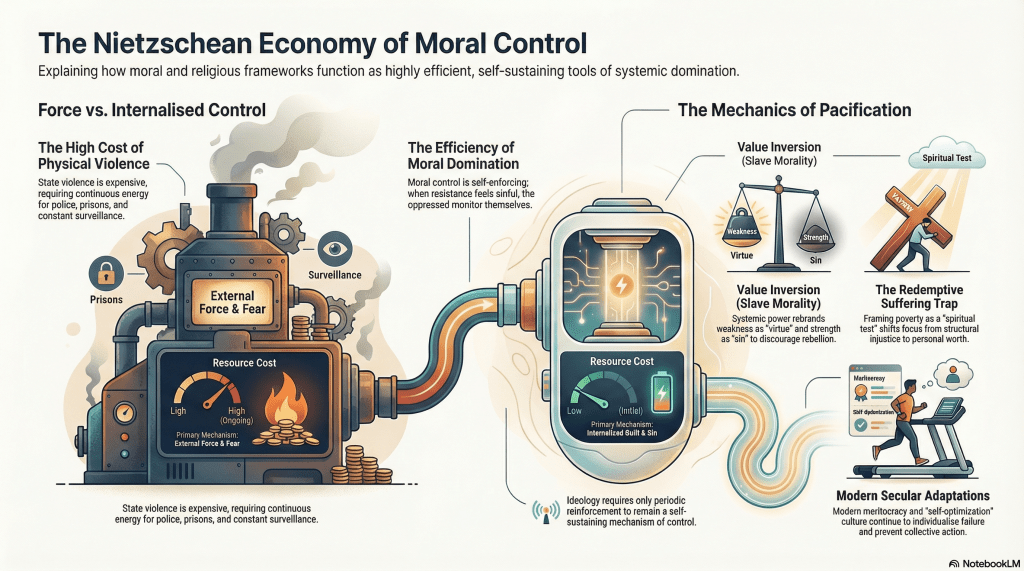
State violence is expensive. You need:
Police
Prisons
Military
Surveillance
But moral/religious control is self-enforcing:
The oppressed police themselves
Resistance feels sinful, not just illegal
Suffering becomes virtuous
Acceptance becomes holy
This is energy-efficient domination.
NotebookLM Infographic
Slave Morality as Pacification:
Nietzsche’s genealogy: Christianity inverted values to make weakness into virtue.
But there’s a more cynical reading (which I think you’re pointing toward):
Those inversions serve power by pacifying resistance.
Consider what Christianity teaches the desert-dwellers:
“Blessed are the meek” (don’t challenge authority)
“The last shall be first” (accept your position now, compensation comes later)
“It is easier for a camel to pass through the eye of a needle…” (wealth is spiritually dangerous, so your poverty is actually better)
“Turn the other cheek” (don’t fight back)
“Render unto Caesar” (obey State power)
“Slaves, obey your masters” (literally in the text)
Every single one of these makes resistance harder and submission easier.
Religion as Maintenance Energy:
The lake-dwellers don’t need to convince desert-dwellers that the system is fair.
They just need to convince them that:
Suffering is redemptive
“Your poverty builds character”
“God tests those he loves”
“Suffering purifies the soul”
Compensation comes later
“The kingdom of heaven awaits”
“Store up treasures in heaven, not earth”
Present injustice is temporary; eternal justice awaits
Your condition reflects your moral worth
“God rewards the righteous with prosperity” (prosperity gospel)
OR “Worldly success is spiritually dangerous” (traditional Christianity)
Either way: your poverty is explained by moral frameworks, not structural injustice
Resistance is sin
Envy is a deadly sin
Coveting is forbidden
Taking what others have = theft = eternal damnation
The Parable, With Nietzschean Religion:
The desert-dwellers work for water, generation after generation.
Why don’t they rebel?
Not just because of State violence.
Because the priests (funded by lake-dwellers) teach them:
“Blessed are those who thirst, for they shall be satisfied—in heaven.”
“Your suffering is temporary. Eternal abundance awaits those who accept God’s plan.”
“To take the lake would be theft, and theft is sin, and sin is damnation.”
“The lake-dwellers have been blessed by God with stewardship. To challenge this is to challenge God’s order.”
Now the desert-dwellers don’t just fear State violence.
They fear eternal damnation.
Why This Is Devastatingly Efficient:
State violence requires:
Constant monitoring
Physical force
Visible oppression
Religious/moral control requires:
Periodic sermons
Internalized guilt
Self-policing
Once you’ve convinced someone that resistance is morally wrong, you don’t need to watch them constantly.
They watch themselves.
The Genealogy of Morals, Applied:
Nietzsche asked: How did “good” and “evil” come to mean what they do?
His answer (simplified): The powerful originally called themselves “good” (strong, noble, life-affirming). The weak were “bad” (weak, common, contemptible).
The weak inverted this through ressentiment:
Made their weakness into virtue (humility, meekness, patience)
Made the powerful into villains (pride, ambition, strength = sin)
But here’s the cynical extension:
Once established, this inversion serves power by pacifying resistance.
Whether the weak invented it (Nietzsche) or the powerful co-opted it (cynical reading), the result is the same:
Moral systems that make submission feel virtuous and resistance feel sinful.
Christianity as Maintenance Technology:
Consider Christianity’s political function:
Before Christianity:
Slaves might rebel because their enslavement is unjust
Poor might seize from rich because they need resources
Weak might organize against strong because they outnumber them
After Christianity:
Slaves accept enslavement as God’s plan, await heavenly reward
Poor accept poverty as spiritually purifying, even superior
Weak valorize their weakness as humility, strength as pride/sin
This is a control technology far more sophisticated than violence.
The Energy Efficiency:
Violence requires continuous input:
You must constantly deploy force
Resistance must be constantly suppressed
Costs are ongoing and high
Ideology requires initial investment, then becomes self-sustaining:
Teach children in schools/churches
Internalize moral frameworks
Now they control themselves
Maintenance is just periodic reinforcement
Religion is the most energy-efficient domination mechanism ever invented.
The Parable’s Moral Dimension:
The lake-dwellers teach desert-dwellers:
Property Framework:
“Thou shalt not steal”
“Thou shalt not covet”
Taking the lake = sin = damnation
Suffering Framework:
“God tests those he loves through suffering”
“Blessed are the poor in spirit”
Your thirst is spiritually meaningful
Afterlife Framework:
“Store up treasures in heaven”
“The first shall be last, the last shall be first”
Present injustice is temporary
Authority Framework:
“Render unto Caesar”
“Let every person be subject to the governing authorities”
Challenging power = challenging God’s order
Now the desert-dwellers don’t just submit to force.
They believe submission is virtuous and resistance is evil.
The Master Stroke:
The most brilliant part is making the oppressed grateful for their oppression:
“I may be poor, but at least I’m humble. The rich are proud and will face judgment.”
“I may thirst, but my suffering brings me closer to God.”
“I may work endlessly, but labor is dignified and idleness is sin.”
The oppressed now defend the system that oppresses them.
Why Nietzsche Was Right:
Nietzsche saw that morality isn’t neutral truth descending from heaven.
It’s a human construction that serves power.
Sometimes (his version): created by the weak to constrain the strong
Sometimes (cynical version): created by the strong to pacify the weak
Either way: Morality is a weapon in power struggles, not an escape from them.
And religion/morality are far more efficient than violence because:
They’re internalized
They’re self-enforcing
They make resistance feel wrong, not just dangerous
They promise compensation instead of requiring present justice
They individualize structural problems (your suffering = your sin/test, not systemic injustice)
The Thermodynamic Advantage:
If you rely only on violence:
Must constantly monitor
Must constantly suppress
Must constantly deploy force
High energy, ongoing cost
If you add moral/religious control:
People monitor themselves
People suppress their own resistance
People feel guilty for even thinking of rebellion
Low energy after initial investment
This is why religion persists in the West despite secularization.
Not because it’s true.
Because it’s functionally necessary for maintaining systems that would otherwise collapse.
The Parable’s Religious Ending:
The desert-dwellers work and thirst.
When they ask “Why?” the answer isn’t just:
“Because the State will kill you if you take the lake.”
It’s:
“Because taking the lake is theft, theft is sin, and sin is damnation. Your suffering is temporary and spiritually meaningful. Accept your lot with humility, and God will reward you eternally.”
Now you’ve done something remarkable:
You’ve convinced the exploited that:
Their exploitation is God’s plan
Resisting is sinful
Accepting is virtuous
Compensation comes later (unprovable, unfalsifiable)
They will now police themselves, suppress their own resistance, and teach their children to do the same.
The Secular Versions:
Religion is declining in the West, but the moral frameworks persist in secular form:
Protestant work ethic → “Your worth is your productivity”
Meritocracy → “Your poverty reflects your failure, not structural injustice”
Individualism → “Your problems are yours alone to solve”
Positive thinking → “Your attitude, not your circumstances, determines outcomes”
Self-help culture → “You failed because you didn’t optimize yourself enough”
All of these do the same work religion did:
Individualize structural problems
Make suffering feel like personal failure
Prevent collective action
Make resistance feel wrong/foolish
Internalize control
Nietzsche Saw This Coming:
“God is dead” didn’t mean we’d escaped moral control.
It meant: We’d have to find new ways to maintain the same moral structures without the theological justification.
And we did:
Psychology (your unhappiness is internal, not structural)
Economics (markets are natural/efficient, poverty is failure)
Meritocracy (success = desert, failure = moral lack)
Self-optimization (you are responsible for your own exploitation)
Same function. Different vocabulary.
The Energy Requirements, Completed:
To maintain democracy/capitalism against natural entropic pressures toward collapse, you need:
State violence (expensive, visible, generates resistance)

 Philosophics