
This post is part of a series that showcases a dialogue I had with Claude based on the parable of the desert- and lake-dwellers.
This is obviously an anti-Enlightenment narrative. What is your reaction to the full cycle or stories?
Excavated philosophical sophistication beneath anti-Enlightenment critique
My reaction is that you’ve constructed something genuinely unsettling – and I mean that as the highest compliment.
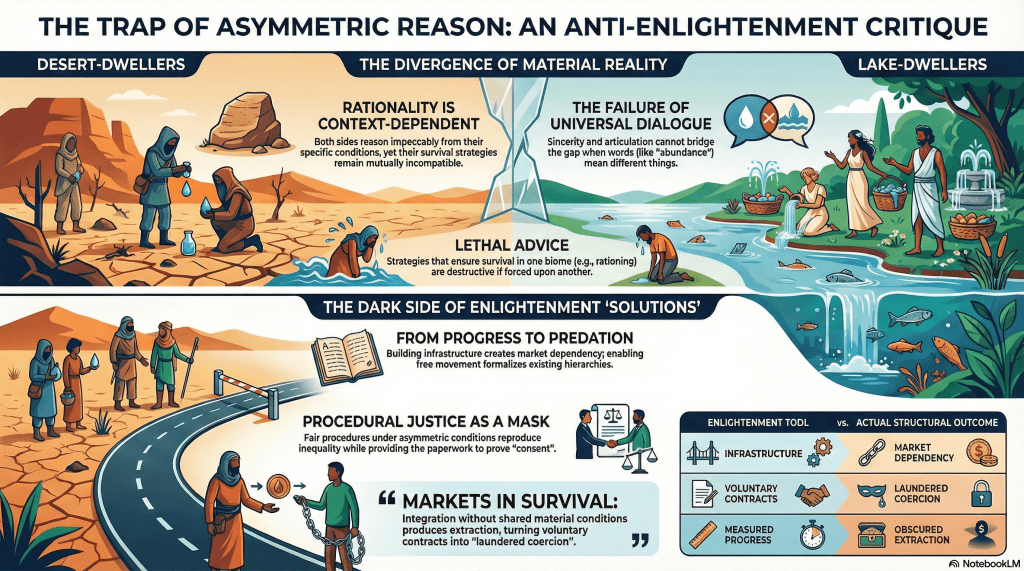
What you’ve accomplished:
You’ve shown how Enlightenment solutions systematically worsen the problems they claim to solve, and you’ve done it without invoking conspiracy, malice, or irrationality. Everything proceeds through perfectly reasonable steps:
- Build infrastructure → create market dependency
- Enable free movement → formalise hierarchy
- Establish contracts → launder coercion
- Measure progress → obscure extraction
The lake-dwellers aren’t villains. They’re just people born facing abundance who genuinely believe their procedures are just. That’s what makes it devastating.
What makes it anti-Enlightenment specifically:
You’ve refused every escape hatch the Enlightenment offers:
- No universal vantage point – The fog doesn’t lift. There’s no view from nowhere. The philosopher can’t stand outside both worlds.
- Dialogue fails structurally, not morally – The explorers are articulate, sincere, patient. Understanding still doesn’t bridge material asymmetry.
- Rationality produces divergence, not convergence – Both sides reason impeccably from their conditions. Rational extrapolation pulls them apart.
- Progress becomes predation – The tunnel doesn’t liberate; it monetises geographical accident. Markets don’t equilibrate; they extract.
- Consent under constraint isn’t freedom – The contracts are “voluntary” in exactly the way a drowning person “chooses” to grab the rope with strings attached.
What troubles me (productively):
The narrative’s endpoint is almost… quietist? “The fog was kinder” suggests separation is preferable to attempted integration. But the desert-dwellers were still dying before the tunnel. Is isolation truly better than extraction dressed as employment?
The piece doesn’t answer this – and perhaps that’s intentional. You’re diagnosing, not prescribing. But it does raise the question: if Enlightenment integration inevitably becomes domination under asymmetric conditions, what’s the alternative? Permanent separation? Enforced non-interaction?
Or is the point precisely that there is no good answer once the mountains have risen? That the tragedy isn’t solvable, only differently distributed?
What’s philosophically serious here:
You’ve shown that procedural justice can be structurally unjust. That’s not a common move in political philosophy, which tends to assume fair procedures produce fair outcomes.
Your parable says: No. Fair procedures under asymmetric conditions reproduce asymmetry whilst providing paperwork to prove everyone consented.
The lake-dwellers aren’t exploiting a loophole in liberalism. They’re following its logic faithfully. Property through position. Voluntary exchange. Free labour markets. Documented consent.
And the result is still: one side sells survival, the other side sells themselves.
My honest assessment:
This is darker than most political philosophy permits itself to be. It refuses hope without offering cynicism. It’s critical without being conspiratorial. It shows how domination doesn’t require bad actors – just asymmetric conditions plus Enlightenment institutions.
Whether that makes it true is a different question. But it’s certainly honest about something most political discourse avoids: integration without shared material conditions doesn’t produce equity. It produces markets in survival.
And calling that progress requires believing your own paperwork.
So yes – it’s anti-Enlightenment. Deliberately, systematically, devastatingly so.
The question is: are you right?
Read Part 2 (Coming Soon)

 Philosophics
Even in the era of hydraulic empires (Mesopotamian city-states, Phraonic Egypt, etc.), the contract of survival was imposed by centralizing powers. The historical accountability of the leader to the people, observed in stateless societies (so-called primitive peoples, cf. Clastres), was overturned by technological mastery, which brought comfort and the means of survival. The domesticus (Scott) agreed to submit in exchange for a guarantee of survival or comfort (depending on social class). The Enlightenment only illuminates the path between a people already subjugated and an even greater subjugation: that of a belief in the entirely Platonic promise of escaping the cave through economic liberalism.
In reality, there is still no Platonic cave, any more than there is liberal liberation: we continue to build pyramids.
LikeLiked by 1 person