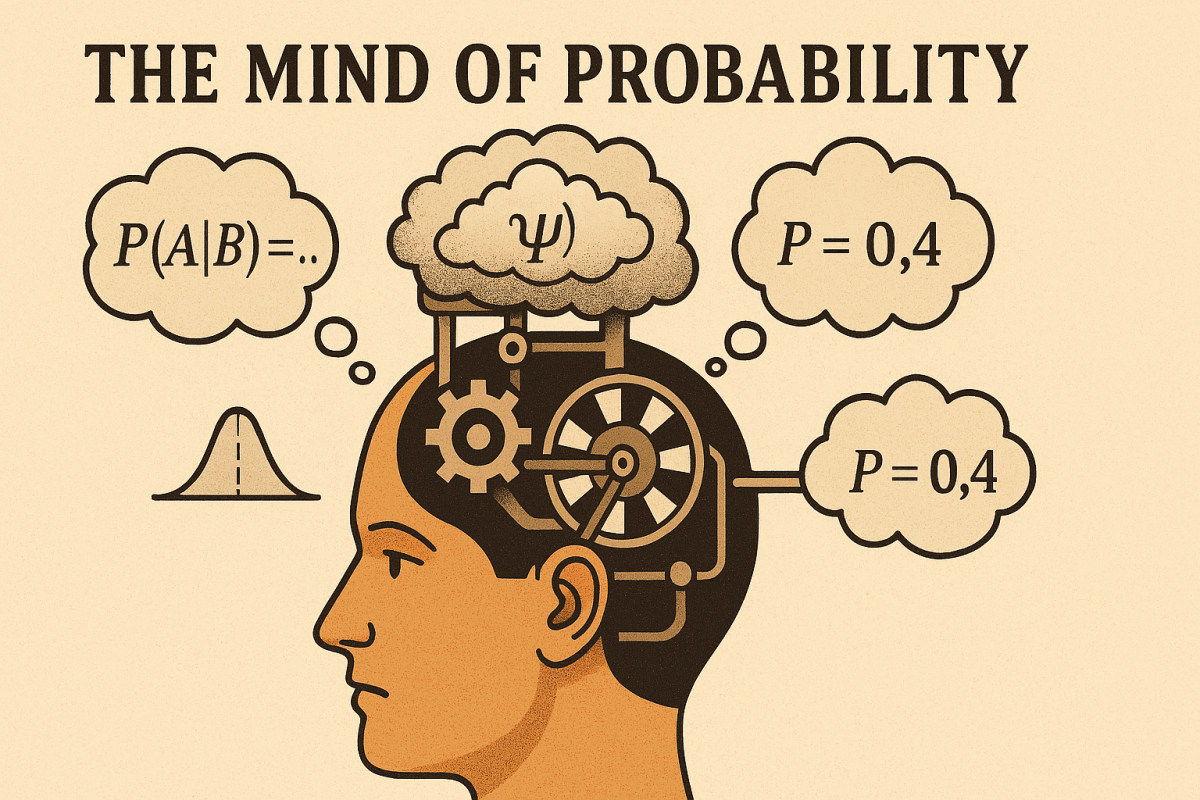
The contestation over the definition of probability is alive and well—like a philosophical zombie that refuses to lie down and accept the tranquilliser of consensus. Despite over three centuries of intense mathematical, philosophical, and even theological wrangling, no single, universally accepted definition reigns supreme. Instead, we have a constellation of rival interpretations, each staking its claim on the epistemological turf, each clutching its own metaphysical baggage.
Let us survey the battlefield:
1. Classical Probability (Laplacean Determinism in a Tuxedo)
This old warhorse defines probability as the ratio of favourable outcomes to possible outcomes, assuming all outcomes are equally likely. The problem? That assumption is doing all the heavy lifting, like a butler carrying a grand piano up five flights of stairs. It’s circular: we define probability using equiprobability, which itself presumes a notion of probability. Charming, but logically suspect.
2. Frequentist Probability (The Empiricist’s Fantasy)
Here, probability is the limit of relative frequencies as the number of trials tends to infinity. This gives us the illusion of objectivity—but only in a Platonic realm where we can conduct infinite coin tosses without the coin disintegrating or the heat death of the universe intervening. Also, it tells us nothing about singular cases. What’s the probability this specific bridge will collapse? Undefined, says the frequentist, helpfully.
3. Bayesian Probability (Subjectivity Dressed as Rigor)
Bayesians treat probability as a degree of belief—quantified plausibility updated with evidence. This is useful, flexible, and epistemically honest, but also deeply subjective. Two Bayesians can start with wildly different priors and, unless carefully constrained, remain in separate probabilistic realities. It’s like epistemology for solipsists with calculators.
4. Propensity Interpretation (The Ontology of Maybes)
Karl Popper and his ilk proposed that probability is a tendency or disposition of a physical system to produce certain outcomes. Sounds scientific, but try locating a “propensity” in a particle collider—it’s a metaphysical ghost, not a measurable entity. Worse, it struggles with repeatability and relevance outside of controlled environments.
5. Logical Probability (A Sober Attempt at Rationality)
Think of this as probability based on logical relations between propositions—à la Keynes or Carnap. It aims to be objective without being empirical. The problem? Assigning these logical relations is no easier than choosing priors in Bayesianism, and just as subjective when it comes to anything meaty.
6. Quantum Probability (Schrödinger’s Definition)
In quantum mechanics, probability emerges from the squared modulus of a wave function—so this is where physics says, “Shut up and calculate.” But this doesn’t solve the philosophical issue—it just kicks the can into Hilbert space. Interpretations of quantum theory (Copenhagen? Many Worlds?) embed different philosophies of probability, so the contestation merely changes battlegrounds.
Current Status: War of Attrition
There is no universal agreement, and likely never will be. Probability is used successfully across the sciences, economics, AI, and everyday reasoning—but the fact that these wildly different interpretations all “work” suggests that the concept is operationally robust yet philosophically slippery. Like money, love, or art, we use it constantly but define it poorly.
In short: the contestation endures because probability is not one thing—it is a shape-shifting chimera that serves multiple masters. Each interpretation captures part of the truth, but none hold it entire. Philosophers continue to argue, mathematicians continue to formalise, and practitioners continue to deploy it as if there were no disagreement at all.
And so the probability of this contest being resolved any time soon?
About zero.
Or one.
Depending on your interpretation.
 Philosophics