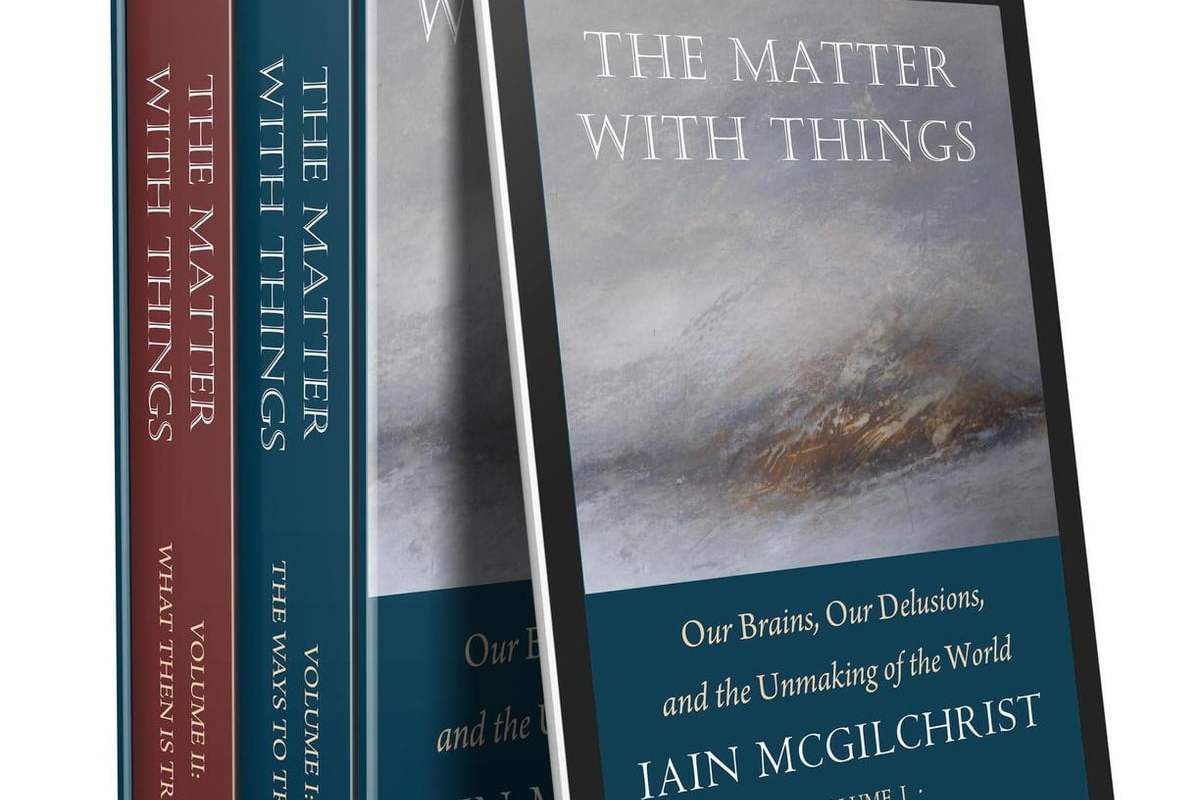
I can’t recommend Iain McGilchrist’s book, The Matter with Things, highly enough. I recommend reading The Master and His Emissary first. I didn’t figure this out until I started reading The Matter with Things, so I am reading them in parallel.
The book arrives as two volumes split into three sections. Part one is the foundation the rest of the book builds on. I’ve recently finished it and summarised each chapter, but I feel a high-level chapter orientation would be in order. Part one contains nine chapters:
- Some preliminaries: how we got here
- Attention
- Perception
- Judgment
- Apprehension
- Emotional and social intelligence
- Cognitive intelligence
- Creativity
- What schizophrenia and autism can tell us
Here’s the breakdown:
Some preliminaries: How we got here
As this book is a follow-up to The Master and His Emissary, published in 2008, Iain has already laid much of the foundation for it. Moreover, he doesn’t assume that you’ve already read The Master and His Emissary, and the work leading up to it, so this is what he outlines here as he drops hints of what’s to come in the chapters ahead.
Attention
This chapter reminds us that we cannot perceive what we don’t attend to, to pay attention to. The world outside just is, and we can attend to this or to that. From there, our perception will develop, perhaps, in turn, drawing out attention elsewhere.
As is a thread throughout, Iain uses various mental illnesses and split cerebral hemispheres to make his points. In this case, he tells us how neuro-atypical people have attention challenges, whether attending to the ‘wrong’ or otherwise inappropriate things or attending to too many things at once, flittering from this to that to the next thing without pause or resolution.
Perception
This chapter articulates how we perceive after attention has been focused. Perception is based on prior experience and knowledge combines with new sensory inputs.
Following the trend of people with hemisphere disturbances, Iain reminds us that people coming from different experiential places will perceive the same scenario differently. And if they are attending to the ‘wrong’ stimulus, their perception may be limited to that context, even if that micro-focused scope is otherwise correct.
Judgment
For some reason, Iain uses the American English spelling of Judgment, which in this case happens to be my preferred rendition, though my spell-checker disagrees.
In this chapter, we move from attention and perception to now being able to make judgements in this space. Of course, if we’ve attended to the ‘wrong’ thing leading to a variant perception, our judgment may be similarly out of order. Following the American trend, let’s say I am watching a baseball match, and the umpire calls a ball thrown out of the strike zone as a strike. If instead, my attention was distracted to another person in the stands picking his nose, my perception of the strike situation would be peripheral at best, and I would be in no place to make a judgment—about the pitch in any case. I may likely have plenty of judgment about the nose-picker.
In a nutshell, judgment is a left hemisphere function. The right hemisphere simply doesn’t care to judge. It’s a dispassionate observer taking in all without even categorising, let alone judging.
Apprehension
In this chapter, Iain explains that he is employing the term apprehension classically to mean to grasp or hold onto. This is a left hemisphere function as well. The right hemisphere is not grasping. Deficits in the right hemisphere don’t allow one to view the world in context as a whole. The left hemisphere will just see things are disconnected parts, so whilst we might grasp and apprehend, our comprehension is deficient. Without a robust big picture, we may just grasp at things indiscriminately.
Emotional and social intelligence
This chapter and the next are about intelligences. As the name suggests, this chapter is concerned with emotional and social intelligence. For me, I think of the Raymond character in Rain Man, itself the result of a misperception of the name Raymond for the phrase ‘Rain Man”. Raymond is devoid of emotional and social intelligence. He is limited to mechanistic cognitive intelligence and is a fine example of what one looks like without the other.
This chapter reminds us that the right hemisphere not only constructs our sense of self, but it also facilitates the construction of other selves, which allows us to empathise with others. It also allows us to assess intent. It allows us to see the value of the whole of society. Of which we are parts rather than thinking that we are simply parts that make up the whole. This is an important distinction. This is what happens with the ego of the left hemisphere denies the Gestalt of the right.
Cognitive intelligence
This second chapter on intelligence focuses on the cognitive variety. It’s what we think of when we consider IQ scores and such. It’s the reasoning part of the brain. It’s about rote learning and reciting trivia and perceived facts as re-presented by the left hemisphere.
Creativity
In this chapter on creativity, we are told that this is a right hemisphere function. To be creative, the best advice to keep the left hemisphere from engaging and interrupting. Creativity comes to us holistically. It is not the result of a process. It is an absence of process. Thinking and analysis are the antitheses of creativity. This is a case where less definitely is more.
What schizophrenia and autism can tell us
Each of the chapters touches on aspects of schizophrenia and other mental illnesses and situations where the hemispheres get disconnected or out of whack. In this chapter, Iain drives the point home with a focus on these cases and what it can tell us about these neuro-atypical conditions.
People assume that schizophrenics and autism spectrum people are irrational, but this is precisely incorrect. In fact, it’s the opposite. These people are hyper-rational at the expense of empathy and social intelligence. It’s not a surprise that we are seeing more schizophrenics these days. Neither is it a surprise that we see a modern society that more and more resembles schizophrenia. But I digress.
Summary
This was only meant to give a high-level vantage to connect the chapters of part one of The Matter with Things. I give more comprehensive summaries on my blog. This will give you more of an idea, but my recommendation is to read the book itself as well as The Master and His Emissary which I recommend reading first. Don’t be like me.
 Philosophics