
Hear me out. The Age of Enlightenment and after is based on the notion that ordinary people are rational, capable of reason, and critical thinking. I may not get out much, but I don’t notice a lot of evidence of this. In fact, I feel that the original proponents of this didn’t get out much either. And when they did, they congregated together.
I’m not talking about rote learning and being functionally literate. I’m talking about being able to suss out solutions to novel challenges. Call me an elitist, but I noticed this in my classmates at both university and grad school. I could count on one hand the number of people I would consider to be more than rote learners. I can report similar results when I taught undergrad economics. And to be honest, even rote learning seemed to be a challenge beyond reach for many.
Some may accuse me of being an elitist or a misanthrope, and I understand the motivation, but I could also be critiqued for claiming elephants to be large land mammals or ice to be cold. To be fair, notions of intelligence are sketchy enough without trying to measure reason and rationality, so I am speaking generically and metaphorically as I have no good measure either. I’m operating on intuitions.
The right hemisphere is about creative problem-solving.
In reading Iain McGilchrist’s books, he might argue that these people are just left-hemisphere dominant. That’s all rote activity. The right hemisphere is about creative problem-solving. I may be wrong, but I think it’s more than that.
As a metaphor, pick your favourite high-performing athlete. I’m not into sports, so I’ll toss out some names. Perhaps you’ve heard of some: Cristiano Ronaldo, Kylian Mbappé, Leo Messi, Virat Kohli, Micheal Jordan, LeBron James, or whomever. Who’s your favourite athlete? Leave a comment.
I might have practised some 10,000* hours a year for decades and I wouldn’t have been able to elevate my skills to the level of any of these. Moreover, even if I were to target someone in the lowest centile of all professional athletes in any given sport, I wouldn’t likely reach that level. I was holding out for curling, but alas, I still don’t think so. If you happen to be a professional athlete, then switch metaphors to music or art and ask if you could then reach the pinnacles of these disciplines.
The point I am trying to make is that when it comes to reason, most people aren’t even rank amateurs. They are more like pigeons playing chess. And let’s be serious, whether these pigeons are playing chess, checkers, go, or croquet, they aren’t going to fare any better.
Phenotypes such as brown eyes or red hair are determined. Aspects such as height and intelligence have propensities.
When a person is born into this world, some aspects are determined outright, whilst others have propensities. Phenotypes such as brown eyes or red hair are determined. Aspects such as height and intelligence have propensities.
At birth, a person’s height is limited by some upper limit under optimal conditions. If I encounter nutritional deficits or some other stressors, this theoretic height may never be reached. I feel the same is true for intelligence and how well we can reason. I don’t particularly agree that IQ scores are a great measure, but I’ll use the notion conceptually since most people likely know of them and generally how they work. In a nutshell, a score of 100 is considered average, give or take a standard deviation in either direction, so roughly speaking about 68.26 per cent of people in a population fall between 85 and 115. This leaves about 16 per cent above and below average. By extension, about 85 per cent of people are average and below.
I’d like to assert is that the majority if not the entirety of this cohort cannot reliably reason or think rationally or critically.
What I’d like to assert is that the majority if not the entirety of this cohort cannot reliably reason or think rationally or critically. They can memorise that 1 + 1 = 2 and Paris is the capital of France, but novelty and synthesis are pretty much out of scope. And they can reason about small things in small doses.
Practically, this means a couple of things. Firstly, on the positive side, they can be trained to be drones. Wage slaves. Most jobs in the world are rote. Insert tab A into slot B. Follow an algorithm or procedure. This is not limited to so-called unskilled labour. This goes all the way up the food chain to doctors and lawyers, two rote professions if there are any.
Secondly, on the negative side, they cannot be trained to participate in democratic processes. This is a failure of insight of the Fathers of the Enlightenment. Is that a thing? Moving on. To be fair, they did notice. Plato noticed, too. This is why, among other reasons, they sought a republic over a pure democracy. The problem, besides bad incentives and ulterior motives, is that many of these people aren’t any, or materially better, thinkers. Recall my previous reference to lawyers. How many politicians are lawyers? Q.E.D. OK, so I’m being irascible, but still.
The problem is that the masses have been taught that participative democracy is both good and a right to be cherished. And it would be if the population were up to par. In the United States, they’ve had challenges in the past with literacy tests to limit access to the polls, but one, this wasn’t testing the right thing, and two, as I said at the start there isn’t really a test for this particular capacity.
Let’s imagine that there was a test. And let’s further imagine that it was somewhat aligned to IQ score. Let’s say that the threshold kicks in just over 115. This would mean that only 15.9 per cent of the adult population would be able to vote. Even if the threshold was met at 100, that would still eliminate 50 per cent of eligible voters. That would not go over very well. Remember these people are rote learners, and they learned that (1) rights are inalienable and sacred and (2) voting is a right. Justified or otherwise, you could expect a revolt, even in America where people are afraid of their own shadows. They aren’t the French showing their numbers in yellow vests. They are much more docile when it comes to things like this. Gun-related violence is another story, but unless they are shooting each other this is where fending for their rights end.
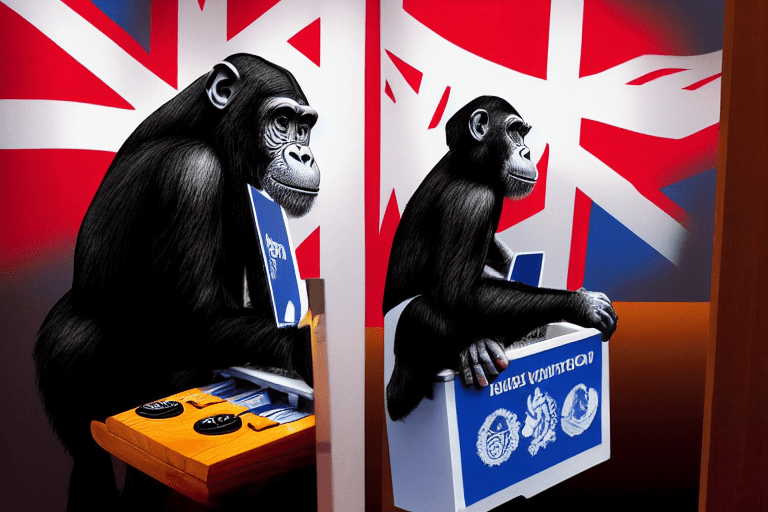
perhaps we could start allowing chimps to participate in the process
And maybe I am wrong, perhaps we could start allowing chimps to participate in the process. I’ve heard a lot of good things about dolphins and octopuses. I look around me, and I see a lot of nice people. People who enjoy life and are nice to talk with, maybe even about the weather. But being affable doesn’t make one a critical thinker. It doesn’t make a great foundation for government or even the selection of government.
The 64,000 question is what to do. The problem, as with any challenge involving people, is that it involves people. We could construct a test, and the affluent would find a way to bribe to get a favourable result or pay for the rote information and strategy to pass the test. They already use both of these approaches for college admissions, so I wouldn’t expect anything different here.
On a final note, some including Kant and Chomsky have argued that there are limits to human reason on a global level. I am just applying this to the local level, and there are many more local limits that never come close to encountering this higher global limit. That’s a challenge in and of itself.
In the end, you can rest assured. No one is going to voluntarily give up their voting rights any time soon. No meaningful test is on the horizon. The system will likely implode on itself first. In some places sooner than others.
* Yes, I know there are only 8,760 hours in an earth year. I was hoping you didn’t notice.
 Philosophics
It does seem like thinking and reason are elite sports. I can read my favorite philosopher and think wow, I get that! That makes so much sense, but being able to carry a thought process rationally to its conclusion on my own is a different story. That takes discipline and imagination. Discipline, you can force, but that automatically deflates imagination, which can’t be forced very well. I think part of the problem is there is no natural quiet anymore and our brains can’t keep up with the volumes of information and artificial, social saturation levels. We have no immunity to social media and the devices—even someone like Max Tegmark or Sean Carrol, as brilliant as they are in their field can’t rationally process what’s going on outside their ideology.
LikeLiked by 1 person
I feel the same, at least in some cases. For me, there seem to be two main cases. Firstly, there’s as you describe. This is where I am with McGilchrist. I’m like, “wait, what?” and it really makes me consider my worldview. Kastrup is another example, though these are different subcases.
For Kastrup, he filled in some holes I had already acknowledged (specifically relative to reality correspondence issues). McGilchrist—and I am not entirely bought into his whole argument— has converted me from the mass notion that brain hemisphere differences were a myth. Now I understand that our prior notion was pseudoscience, and he is replacing it with neuroscience, so this really satisfies the left brain, giving something new to map and hopefully supplant some of the stale info.
Secondly, there are cases where I have thoughts and ideas tumbling around my noggin, and then I come across someone like Foucault or Strawson. Not only have these people crystalised my thoughts, but they have broadened them, deepened them, and given them vocabulary.
In fact, in April I set out to publish something about my thoughts about humans having no agency. Once I dove in headlong, I notice that were dozens of people ahead of me, and by about a decade. I was late for the party. I ended up at a position less travelled, which is the area of blame and retributive justice. Others have been there, but they are using different lenses, so I might have room to roam.
One last note. When I read the available publications on neuroscience, the focus is almost exclusively on anomalies—so schizophrenics, bipolars, BPD, OCD, strokes, tumours, and injuries—, but as this post shows, I think that even ‘normal’ people don’t really pass muster. Of course, that leads people to be some eugenicist or holocaust denier. But I’m just an observer and the messenger. I call it as I see it. Might I be wrong? Sure. Does it matter on a higher level? Am I going to alter the way society operates? Unlikely. But I can still observe and write.
LikeLiked by 1 person