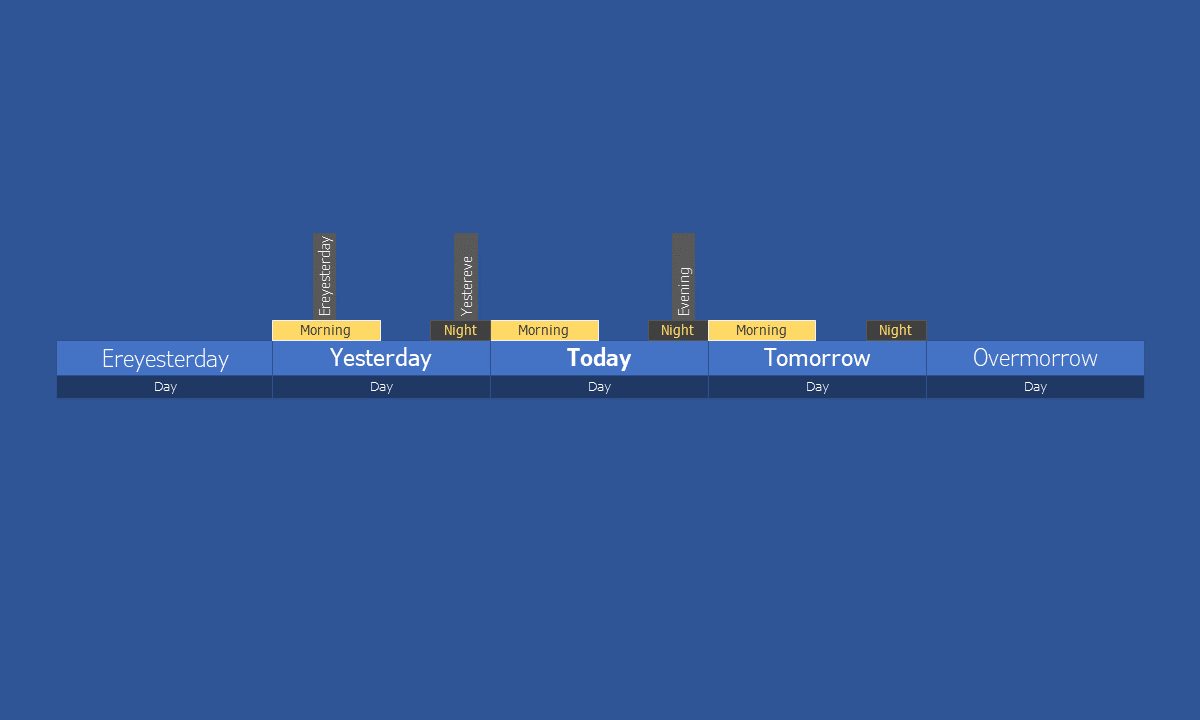
Rather it’s about days.
Have you even just let your mind and fingers wander?
The English language morphs, and sometimes some useful notions are lost to the dustbin of history. I take it especially hard when other languages retain these aspects.
I tend to evaluate much in terms of time. In practice, this is why I dispute notions of self and identity—Plank-sliced frames stitched in time.
Although ‘today’ is the central reference and I could start with ‘today’, I’m going to unfold this chronologically, instead. First some background.
Getting Down to Basics
Day
In its original incarnation, day meant the ‘period during which the sun is above the horizon’ and was expanded to comprise the entirety of a cycle.
Fun Fact: Days used to be measured starting at sunset rather than midnight as is the current custom. So time was relative in a different sense to today.
Evening
Originally referring to the time just before sunset—parallel to the morning having meant the time just before sunrise—, it’s been expanded to mean the time from sunset (post the original intent) and bedtime.
Morning
Although morning had originally been limited to the time just before sunrise, its domain has been expanded to encompass the part of the day between midnight and noon, exclusively.
Morrow
Morrow simply means morning. Good morrow would have been taken as ‘good morning‘.
Night
Night is ostensibly the dark part of a day.
Yester
I don’t want to be the one to break it to you, but yester (from gester) means yesterday. More on this later.
Putting It All Together
Ereyesterday
Ereyesterday can be disintegrated into three components. Ere means before or previous, so reintegrating, we get something like the day before yesterday or the day prior to yesterday.
Yestermorrow
Yestermorrow is a rendition of yesterday with a focus on the morrow—the morning.
Yesterday
If you’ve been following the breadcrumbs, there is no big reveal here. Given that yester already means ‘the day before today‘, yesterday disintegrates into yesterday day—’the day before today day‘. That’s the English language for you. It could be worse.
Yesternight
Yesternight is the flip side of yestermorrow, but it should be more recognisable as the night of the prior day—yesterday.
Yestreen
I debated whether to include this yestreen the mix. Yestreen is more of a Scottish word that is a synonym for yesternight. And we don’t use either of them anymore. Such a shame.
Today
As with tomorrow, today was generally written as a hyphenated word—to-day—until about 100 years ago. It had been two words until the 1500s. Essentially, today refers to this day—the current day.
Tomorrow
As with today, tomorrow was generally written as a hyphenated word—to-morrow—until about 100 years ago. It had been two words until the 1500s. Effectively, tomorrow refers to the next morning, though we have extended the meaning to account for the entirety of the next day.
Overmorrow
If you’ve been paying attention and following the progression, you’ll have guessed that overmorrow is the day over tomorrow—after tomorrow.
And so it goes…
I understand that many (at least some) languages retain some of these time markers—German and Dutch come to mind. There are other markers such as the English fortnight—meaning fourteen days or two weeks, but I wanted to limit my focus around today.
 Philosophics