Unlearning reason’s religion. Examining the ghosts modernity mistook for gods.
About the Project
The Anti-Enlightenment Project is an ongoing philosophical initiative by Bry Willis, exploring the failures, limits, and afterlives of Enlightenment rationality. It gathers essays, preprints, and speculative analyses tracing how Western modernity built its institutions – law, markets, democracy, even morality – on fictions of autonomy, coherence, and progress that no longer hold.
Where the Enlightenment sought light, this project studies the burn marks. It argues that the same rational architecture that promised emancipation also produced surveillance, extraction, and the moral machinery of blame. Each essay interrogates one of reason’s sacred premises – agency, consent, progress, or truth – and offers dis-integrative alternatives grounded in relation, responsiveness, and maintenance rather than control.
The project is archived and published through Zenodo as an open repository of post-Enlightenment thought.
Mission Statement
To curate a living archive of thought beyond the Enlightenment paradigm – neither nostalgic nor nihilistic, but diagnostic. To map what remains when ‘reason’ loses its monopoly. To build a vocabulary fit for the ruins.
Orientation
The Anti-Enlightenment Project does not seek to destroy the Enlightenment, but to perform its archaeology. It treats reason as an artefact – once divine, now bureaucratic – and excavates the strata of its persistence in modern forms of governance, identity, and care. Each essay isolates a different residue of this architecture:
- Objectivity Is Illusion exposes truth as consensus scaffolding.
- Rational Ghosts and Temporal Ghosts trace the metaphysical defects in democracy’s design.
- Against Agency dismantles the myth of autonomy.
- The Discipline of Dis-Integration reframes philosophy as maintenance rather than salvation.
- The Myth of Homo Normalis closes the circuit, revealing legibility itself as the final faith of modernity.
- The Will to Be Ruled shows how totalitarianism is a predictable outgrowth of Enlightenment thinking.
- The Great Substitution: From Metaphysics to Metaphysics shows how Enlightenment critique never escaped metaphysics at all, merely replacing older gods with newer, shinier abstractions and mistaking substitution for emancipation.
- Moral Universality and Its Discontents: A Critical Examination of Normative Ethics’ Conceptual Foundations exposes moral universality as a rhetorical convenience, revealing “universal” ethics to be historically freighted norms posing as timeless necessity.
Together they map an intellectual terrain after the collapse of reason’s empire – a landscape where ethics begins not in certainty but in attention.
Roadmap, and What’s Missing
Before we continue, I’d like to also share ideas I haven’t yet expressed but hope to eventually.
Core Essays
9. Moral Universality and Its Discontents: A Critical Examination of Normative Ethics’ Conceptual Foundation
Published December 2025
Normative ethics struts about like a toga-clad orator on the steps of some imagined agora, banging on about moral universals as if they’re carved on tablets by the Platonic gods. This essay rips the toga off, points out the stench of historical contingency and parochial assumption, and then sets fire to the entire stage. It dismantles the smug architecture of universality – utilitarian, deontological, virtue-theoretic – and shows how each pretends to transcend context while smuggling in their own culturally buffered norms through the back door. The result isn’t neat relativism sold with a bow; it’s an unsettling rumination on why moral universals are less cosmic law and more rhetorical prosthesis. There’s no comforting certitude at the end, just an invitation to acknowledge moral life as messy, situated, and forever haunted by its own aspirational fantasies.
8. The Great Substitution: From Metaphysics to Metaphysics
Published November 2025
A gleefully unhinged exposé on how modernity never actually exorcised its metaphysical demons – it merely swapped their altars for server racks and algorithmic fetishism. This essay tracks the grand recursive deception: Kant, Nietzsche, Heidegger, Derrida, Harari, each proclaiming emancipation while erecting new temples of belief. Progress doesn’t kill gods; it industrialises them. What we call liberation is just automation with better branding. The piece unfurls through ten blistering sections – from epistemic limits to linguistic legerdemain to the cults of dataism and scientism – and closes not with redemption but Dis-Integration – maintenance over mastery, looking away from the blinding light of Enlightenment certainty long enough to notice the shadows it casts.
7. The Will to Be Ruled: Totalitarianism and the Fantasy of Freedom
Published October 2025
This essay examines how the Enlightenment’s ideal of autonomy contains the seed of its undoing. The rational, self-governing subject – celebrated as the triumph of modernity – proves unable to bear the solitude it creates. As freedom collapses into exhaustion, the desire for direction re-emerges as devotion. Drawing on Fromm, Arendt, Adorno, Reich, Han, and Desmet, The Will to Be Ruled traces the psychological gradient from fear to obedience, showing how submission is moralised as virtue and even experienced as pleasure. It concludes that totalitarianism is not a deviation from reason but its consummation, and that only through Dis-Integrationism – an ethic of maintenance rather than mastery – can thought remain responsive as the light fades.
6. The Myth of Homo Normalis: Archaeology of the Legible Human
Published October 2025
Modernity’s most persistent myth is the “normal” human. This essay excavates how legibility – the drive to measure, categorise, and care – became a form of control. From Quetelet’s statistical man to Foucault’s biopower and today’s quantified emotion, Homo Normalis reveals the moral machinery behind normalisation. It ends with an ethics of variance: lucidity without repair, refusal without despair.
5. The Discipline of Dis-Integration: Philosophy Without Redemption
Published October 2025
This essay formalises Dis-Integrationism – a philosophical method that refuses synthesis, closure, and the compulsive need to “make whole.” It traces how Enlightenment reason, deconstruction, and therapy culture all share a faith in reintegration: the promise that what’s fractured can be restored. Against this, Dis-Integrationism proposes care without cure, attention without resolution – a discipline of maintaining the broken as broken. It closes the Anti-Enlightenment loop by turning critique into a sustained practice rather than a path to redemption.
4. Against Agency: The Fiction of the Autonomous Self
Published October 2025
“Agency” is not a metaphysical faculty – it’s an alibi. This essay dismantles the myth of the autonomous self and reframes freedom as differential responsiveness: a gradient of conditions rather than a binary of will. Drawing on philosophy, neuroscience, and decolonial thought, it argues for ethics as maintenance, not judgment, and politics as condition-stewardship.
→ Read on Zenodo
3. Temporal Ghosts: Tyranny of the Present
Published October 2025
Modern democracies worship the now. This essay examines presentism – the systemic bias toward immediacy – as a structural flaw of Enlightenment thinking. By enthroning rational individuals in perpetual “decision time,” modernity erased the unborn from politics. What remains is a political theology of the short term, collapsing both memory and imagination.
→ Read on Zenodo
2. Rational Ghosts: Why Enlightenment Democracy Was Built to Fail
Published October 2025
The Enlightenment built democracy for rational ghosts – imagined citizens who never existed. This essay dissects six contradictions at the foundation of “rational” governance and shows why democracy’s collapse was prewritten in its metaphysics. From mathematical impossibility to sociological blindness, it charts the crisis of coherence that modern politics still calls freedom.
→ Read on Zenodo
1. Objectivity Is Illusion: An Operating Model of Social and Moral Reasoning
Published September 2025
Objectivity, in the social and moral sense, is a performance – a consensus mechanism mistaken for truth. This essay maps how “objectivity” operates as a scaffold for Enlightenment rationality, masking moral preference as neutral judgment. It introduces a five-premise model showing that what we call objectivity is merely sustained agreement under shared illusions of coherence. The argument reframes moral reasoning as provisional and participatory rather than universal or fixed.
SEO Metadata
Anti-Enlightenment, Enlightenment critique, post-rational philosophy, dis-integrationism, decolonial philosophy, free will, agency, democracy, reason, Michel Foucault, Freiderich Nietzsche, Jacques Derrida, Judith Butler, care ethics, posthumanism, neuroscience, modernity, philosophy of mind, ethics of maintenance

▼ Related Content on Philosophics Blog ▼

Capitalism Doesn’t Merely Exploit Labour
Capitalism’s defenders like to boast that it rewards talent. This is one of its more successful marketing slogans, up there with ‘choice’, ‘meritocracy’, and ‘we’re like a family here’. What capitalism actually rewards is saleability, compliance, stamina, inheritance, and the ability to endure long periods of spiritual self-betrayal without becoming visibly troublesome.
Comrade Claude (2) – Private Property
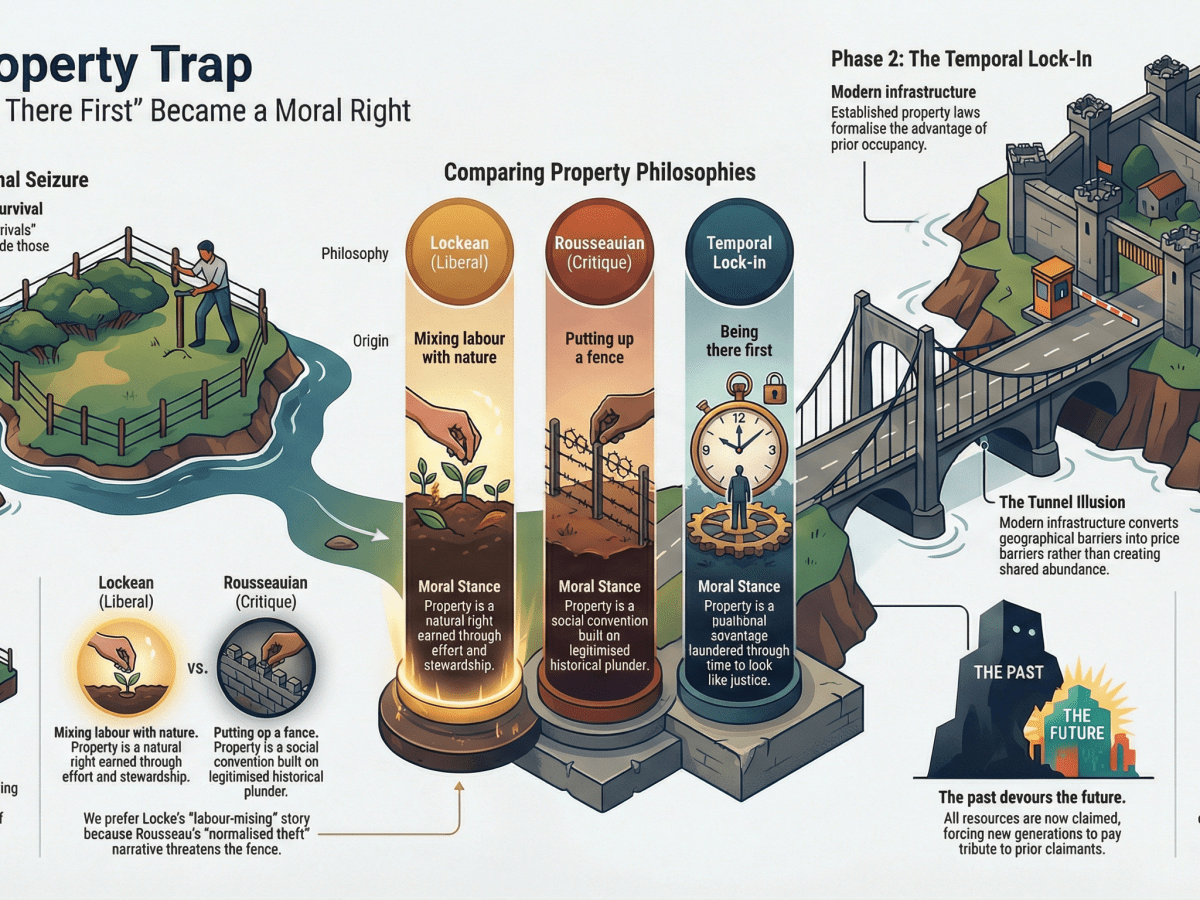
This post is part of a series that showcases a dialogue I had with Claude based on the parable of the desert- and lake-dwellers. This reflects my worldview. I am more of an opponent of private property ownership. A starker version might be a single person on a deserted island, and a shipwreck survivor is…

Mark Carney Explains Nietzsche
He doesn’t, but he accidentally demonstrates the problem. There is a certain kind of person who loathes Nietzsche for the same reason they loathe earthquakes. Not because he causes damage, but because he refuses to pretend the ground was ever stable. In a recent address, Mark Carney says something that would have been unutterable in…

Facts, Intent, and the Afterlife of Metaphysics
I’ve been reading Bernard Williams lately, and I’ve written about his work on Truth and Truthfulness. I’m in the process of writing more on the challenges of ontological moral positionsand moral luck. I don’t necessarily want to make contemporary news my focal point, but this is a perfect case study for it. I’ll be releasing…

The Melian Dialogue, Trump, and the Persistent Fantasy of Fair Play
We like to believe the world is governed by rules. By fairness. By international law, norms, institutions, treaties, and laminated charters written in earnest fonts. This belief survives not because it is true, but because it is psychologically necessary. Without it, we would have to admit something deeply unfashionable: power still runs the table. Two…

A So Long to 2025, and a Way Into 2026
Why Post-Position? 🧐 As 2025 closes, I find myself in the mildly suspicious position of being asked where I stand. I’m almost pretty sure it’s a deontological duty I must fulfil. This has become the ritual gesture of our time. Not what are you working on? or what are you unsure about? but what is…

Democracy, Competence, and the Curious Case of the Missing Test
This is awkward. I’d been preparing some posts on the age of consent, and I decided to write a formal essay on ageism. Since the age of consent is a moral hot-button topic for some, I decided to frame the situation in a political framework instead. The setup isn’t much different, but it keeps people’s…
A History of Language Insufficiency
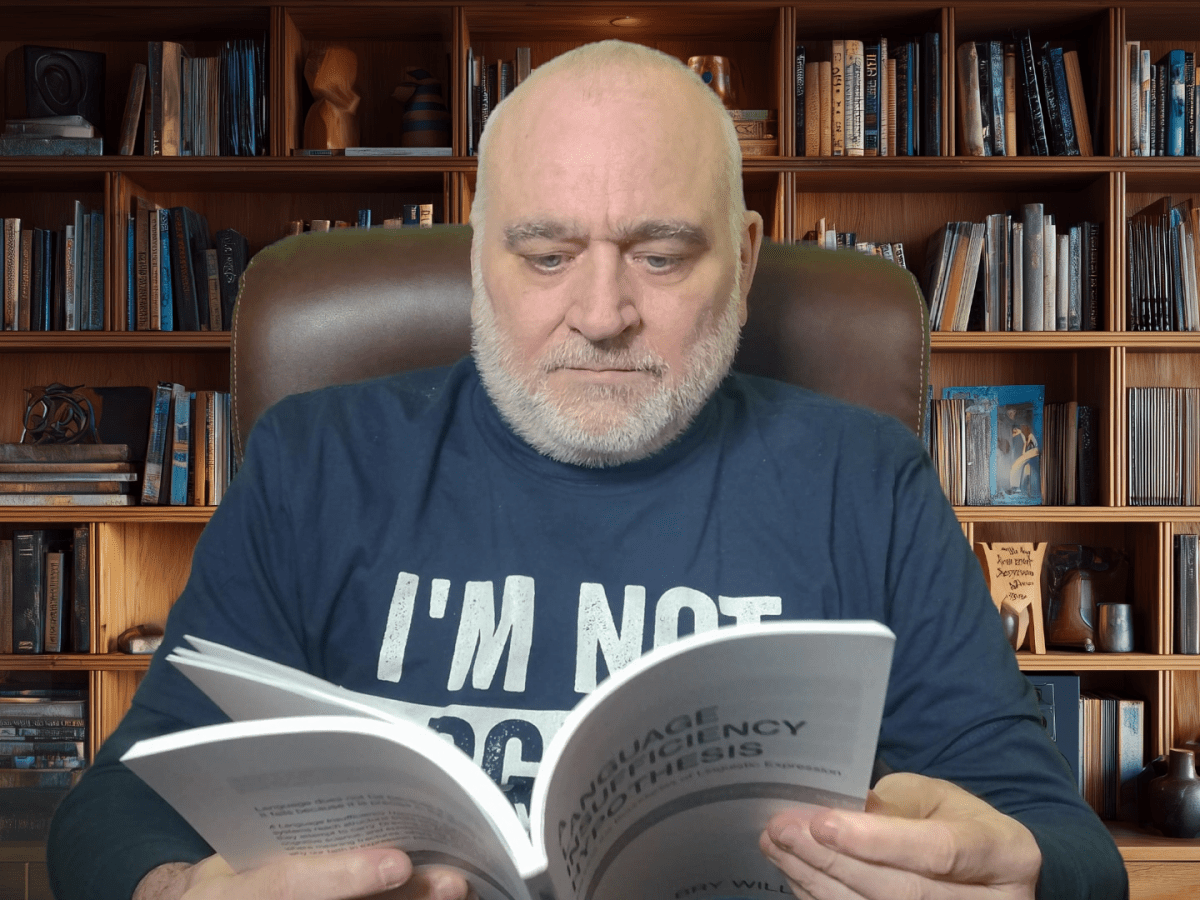
I’ve been working on A Language Insufficiency Hypothesis since 2018. At least, that’s the polite, CV-friendly version. The truer account is that it’s been quietly fermenting since the late 1970s, back when I was still trapped in primary school and being instructed on how the world supposedly worked. Social Studies. Civics. Law. The whole civic…

Solidarity as a Local Moral Grammar
Although I didn’t want to publish a formal essay, I wanted to produce something otherwise rigorous. The references I make are of the authored piece I am critiquing – MacIntyre, Žižek, Lacan – I’ve discussed these figures and their works, sometimes at length. Preamble: Setting the Encounter Over the past several weeks, Otti Vogt and…

When Aliens Speak English: The False Promise of Linguistic Familiarity
Why shared language creates the illusion – not the reality – of shared experience Human beings routinely assume that if another agent speaks our language, we have achieved genuine mutual understanding. Fluency is treated as a proxy for shared concepts, shared perceptual categories, and even shared consciousness. This assumption appears everywhere: in science fiction, in…
 Philosophics