
Source: https://www.linkedin.com/posts/lucyhay_unpopular-opinion-that-shouldnt-be-unpopular-activity-7437399419584405505-SDvF

Lucy V. Hay posted this on LinkedIn… and then stopped allowing comments, so I figured I’d recycle it here for comment.
Unpopular opinion (that shouldn’t be unpopular):
The term “Mary Sue” is inherently s3xist 🎯
The phrase comes from a 1973 parody story by Paula Smith called A Trekkie’s Tale. It mocked the self-insert characters appearing in Star Trek fanfiction.
Those writers? Mostly teenage girls 😡
That matters, because culturally we have a long history of treating teenage girls – and the things they create – with contempt. Their fandoms, their stories, their passions are routinely framed as embarrassing, shallow or ridiculous.
Sometimes that ridicule even comes from older women punching down.
And no, the fact Smith was a woman doesn’t magically make the term neutral. Internalised misogyny exists.
Here’s what happened next …
For the last 50+ years, the label “Mary Sue” has been used against practically every female protagonist who shows competence, power or narrative importance.
Meanwhile, male characters with identical arcs are celebrated.
An inexperienced boy who turns out to be the chosen one? Hero.
A woman who discovers she has unusual power or talent? “Mary Sue.”
Same narrative structure … Different reaction 😡
Also, it’s worth noticing something interesting: I hadn’t seen the term “Mary Sue” on my timeline for yeeeeeeaars. Now, every time I post something about female characters, there it is again. In 2026 🤮
Given the current climate around women’s rights and the growing attacks on women and girls globally, that resurgence doesn’t feel accidental. Language shapes culture. Storytelling shapes culture.
And here’s another truth many people don’t realise:
The professional writing industry does not use the term “Mary Sue.”
Not in publishing. Not in development notes. Not in writers’ rooms.
If you’re using it as critique, you’re not signalling professional insight. You’re signalling that you learned storytelling discourse from internet flame wars.
If we want better conversations about character, we need better vocabulary than a 1970s insult aimed at teenage girls writing fanfic.
If you want to explore how bias shapes the way we write and judge characters, that’s exactly what I unpack in my book Writing Diverse Characters For Fiction, TV Or Film (Creative Essentials) 👇 👇 👇
Writing Diverse Characters for Fiction, TV or Film
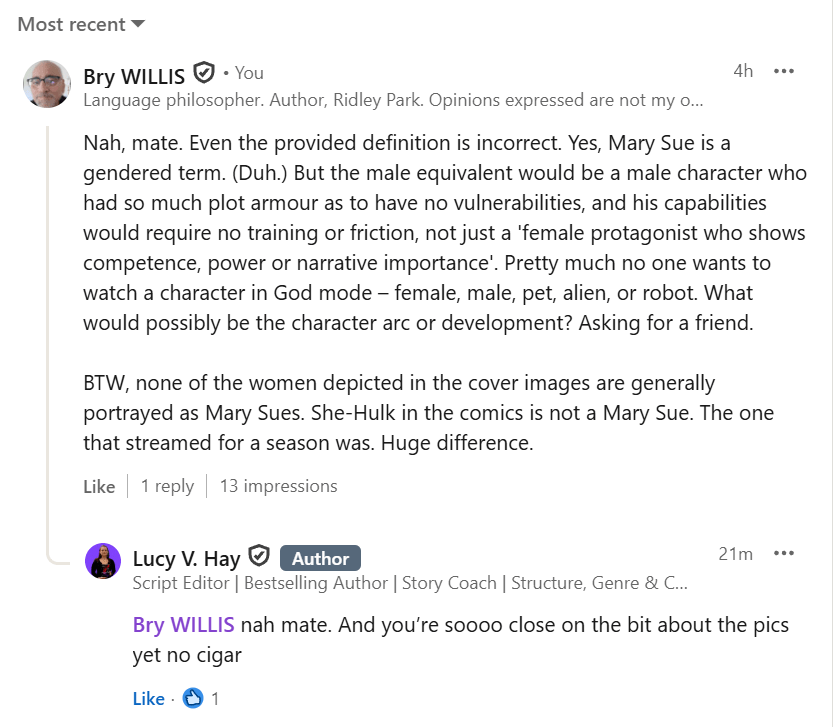
My response.
Nah, mate. Even the provided definition is incorrect. Yes, Mary Sue is a gendered term. (Duh.) But the male equivalent would be a male character who had so much plot armour as to have no vulnerabilities, and his capabilities would require no training or friction, not just a ‘female protagonist who shows competence, power or narrative importance’. Pretty much no one wants to watch a character in God mode – female, male, pet, alien, or robot. What would possibly be the character arc or development? Asking for a friend.
BTW, none of the women depicted in the cover images are generally portrayed as Mary Sues. She-Hulk in the comics is not a Mary Sue. The one that streamed for a season was. Huge difference.
Her response was flippant and contained no useful information. I can only imagine she’s trolling.
Obviously, I understand that language is an imperfect vehicle, but it doesn’t have to be this abused. And, obviously, she provided her definition, but it doesn’t comport with any definitions I’m aware of.
As far as the Mary Sue argument goes, ‘no one’ in that space berates all female roles, not even past heroes like Wonderwoman, Spiderwoman, Batwoman, or Ripley from Alien, Terminator’s Sarah Connor, and so on. No one (except Lucy) categorises them as Mary Sue.
This is convenient for an argument, but it’s really tilting at windmills. I understand she’s likely trying to drum up publicity for her book. Good on her. She’ll attract people sympathetic to her message. As for me, I don’t trust a disingenuous source.
 Philosophics