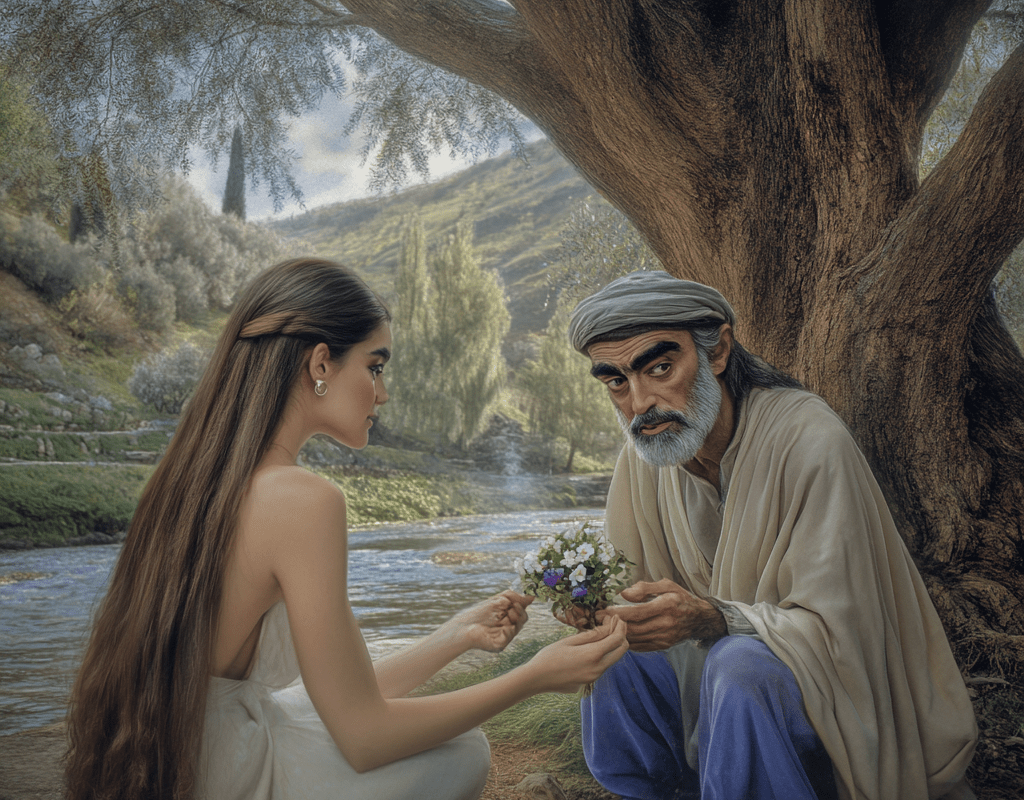
Many of my readers know that I use AI often. I have been using it to create content for an in-depth book review for The Blind Owl. For those less aware of the foibles of generative AI, I share some insights—or low-lights. For this, I used Midjourney v6.1.
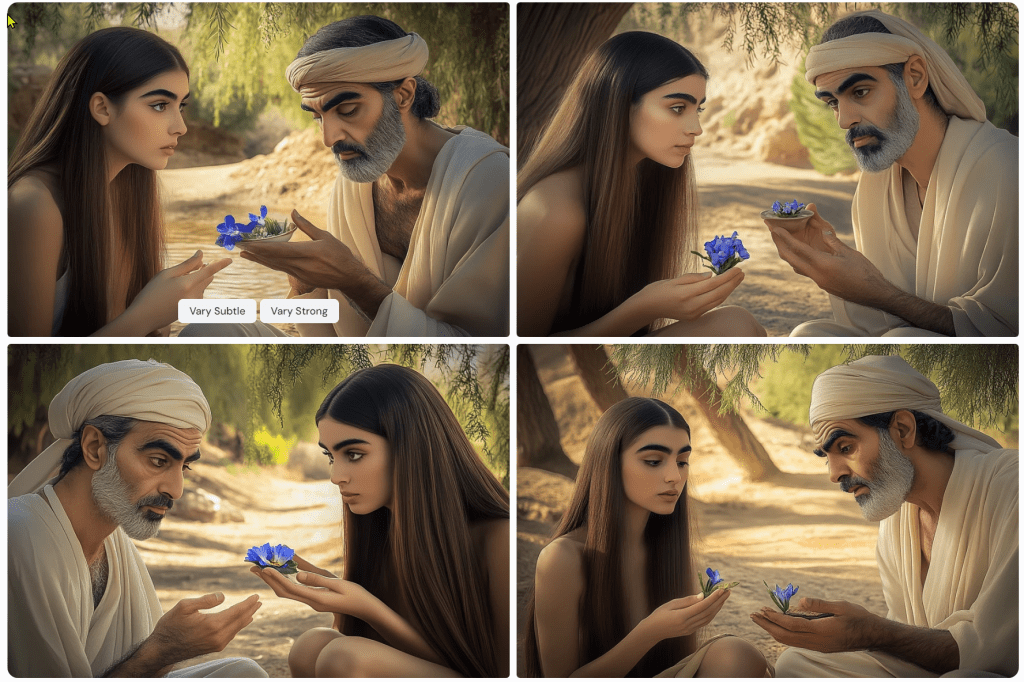
Prompt: a young woman gives a flower to an old man, who is crouched under a large cypress tree by a river
I issued this prompt, and as per usual, it rendered four options. Notice that in some instances, the tree is not a key element.
Given enough time, one can slowly improve to obtain the desired result.

Here, an old man indeed crouches under a prominent cypress tree and by a river. A young woman hands him some flowers—though not so much blue morning glories. On balance, I like this output, but it still needs work.
Some other problems:
- The man is looking away—neither at her nor her flowers.
- Her (right) eye is deformed.
- Her left hand is deformed.
- I didn’t ask for jewellery—an earring.
At least I can in-paint out these imperfections—perhaps.
Here’s another render using the same image prompt.

Notice that it ignored the man altogether. My point is that for every awesome image you see, there may have been hundreds of iterations to get there. There are ways to get persistent characters and scenes, but this takes a bit of up-from effort and iterations that one can leverage going forward.
On the topic of Midjourney model 6.0 versus 6.1, I share this comparison—front-facing faces for a character sheet for this old man. Here, I prefer the earlier model as displayed in the top row.

In some cases, there are minor improvements over v6.0. In other cases, they stepped back. v6.1 renders less realistic human images, making them look more computer-generated and less natural. It also over-applies sexual stereotypes, traditional beauty archetypes, smoother skin, and so on. But that’s not the main topic for today.
DISCLAIMER: This post has little to do with philosophy, but it ties into a philosophical novella.
 Philosophics