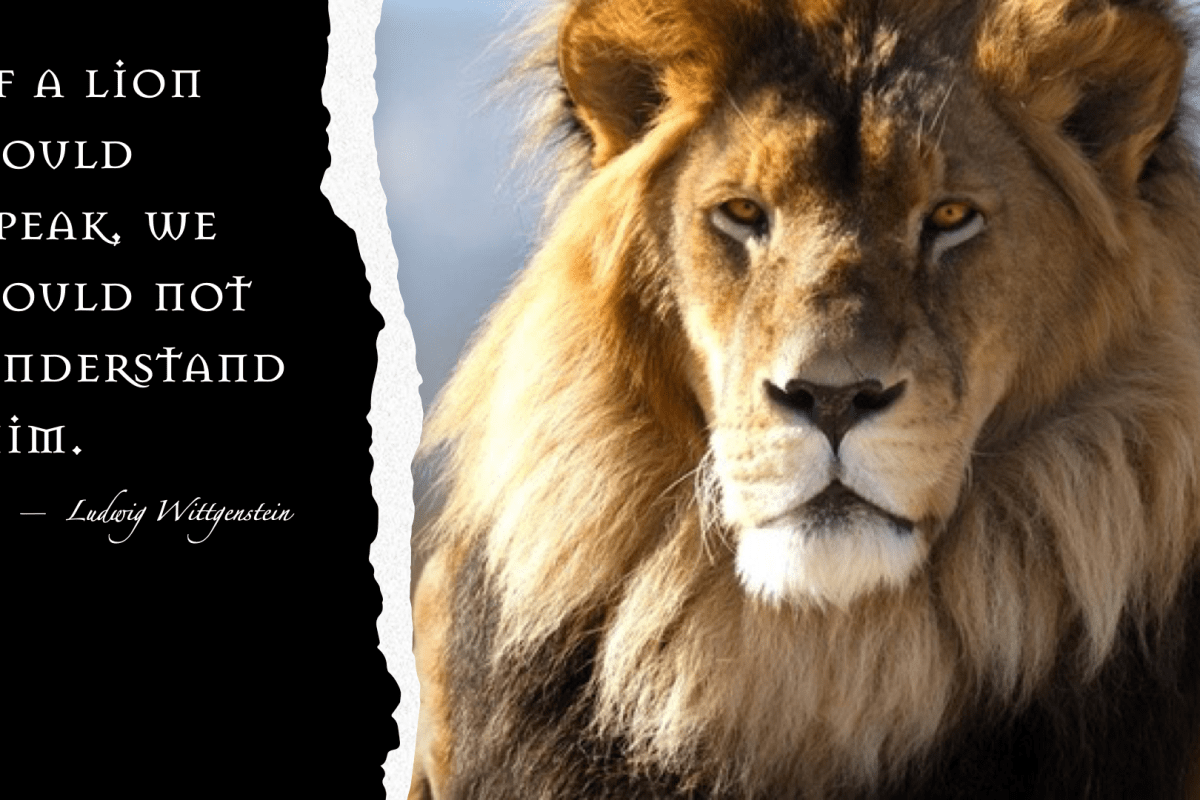
If a lion could speak, we could not understand him.
— Ludwig Wittgenstein
As much as I love Wittgenstein’s quote on language, I find it vastly more amusing aside the lion of Gripsholm Castle in Sweden. Because as talking lions come, this one is certainly more unintelligible than most.
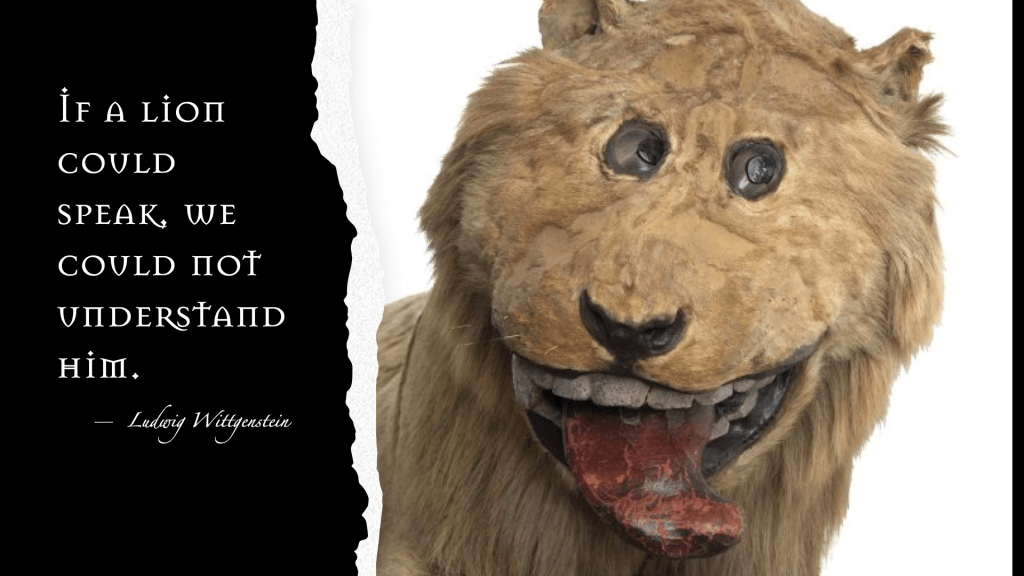
I also appreciate Daniel Dennett’s retort that if we could manage to communicate with this one talking lion—not, of course, this lion in particular—that it could not speak for the rest of lionity. (Just what is the equivalent of humanity for lions?)

Ludwig Wittgenstein famously said, “If a lion could talk, we could not understand him.” ( [Philosophical Investigations] 1958, p. 223) That’s one possibility, no doubt, but it diverts our attention from another possibility: if a lion could talk, we could understand him just fine—with the usual sorts of effort required for translation between different languages—but our conversations with him would tell us next to nothing about the minds of ordinary lions, since his language-equipped mind would be so different. It might be that adding language to a lion’s “mind” would be giving him a mind for the first time! Or it might not. In either case, we should investigate the prospect and not just assume, with tradition, that the minds of nonspeaking animals are really rather like ours.
Daniel Dennet — Kinds of Minds: Toward an Understanding of Consciousness (p.18)
 Philosophics