America’s Team: A Losing Franchise with No Prospects

Let’s face it – the United States™ are the sporting world’s equivalent of an also-ran team. For decades now, they’ve been united in name only – USINO, if you will. No cohesion, no teamwork, and definitely no vision. Imagine the country as a sort of Premier League relegation-battler or a bottom-tier NFL team, clinging to nostalgia and the fumes of past glory. The problem? They’ve got no talent to speak of, no bench depth, and if they’ve got feeder prospects anywhere, they’re keeping it under wraps.

Let’s start with the fanbase. Every country has one, and every sporting team has its die-hards – the blind loyalists who defend their team no matter how appalling the statistics look. Take Sheffield United fans in the UK, or the eternally hopeful New England Patriots followers post-Brady. There’s always this romantic, ridiculous belief that “next year will be our year,” but let’s be honest: it never is. That’s precisely where we find the United States™ right now – stuck in a loop of misplaced optimism and declining influence, running out a roster that’s more washed up than a Boxing Day sale.

The Ageing Star

Then there’s Donaldo Trump, our once-all-star quarterback, whose glory days, such as they were, are long behind him. It’s like watching a faded reality TV star trying to make a comeback on the pitch. He’s not just past his prime; he’s sitting in the dugout, signing autographs and giving interviews about the good old days when he had the crowd eating out of his hand. But instead of giving him the gold watch and a retirement party, they’ve signed him on for another four-year contract with a no-trade clause.

If America were a halfway self-aware team, this is where they’d start thinking about rebuilding – shipping off the old guard, drafting fresh faces, and looking to the future. But instead, they’re clinging to this over-the-hill has-been with all the fervour of a fourth-division club hoping their star from 1987 will somehow lead them to the title in 2024. It’s not just embarrassing; it’s delusional.

No Depth, No Prospects

Let’s be clear: America doesn’t have any rising stars waiting in the wings, either. There’s no next generation being groomed for greatness, no wunderkind on the bench. This is a franchise that’s either too proud or too stubborn to think about succession. Look at other national squads – they’ve all got their academies, their training camps, their eye on the future. Meanwhile, the United States™ is playing with the same ragged roster, wheeling out worn-down veterans while the rest of the world shakes its head in bemusement.

And it’s not as if they’re out there scouting for talent, either. No, this team is closed to outside recruitment. No trades, no international transfers. The rules of the game are rigged to keep foreign talent out of the league entirely. It’s like they’re terrified that if they bring in anyone from abroad, the whole enterprise will collapse under the weight of actual competition. Meanwhile, the USINO brass keep shouting from the box seats, claiming they’re on the verge of a new era of dominance. They’re not. They’re on the verge of irrelevance, and everyone but their own die-hard fanbase knows it.

It’s not that America is wholly devoid of talent. Anyone with any integrity knows better than to be sullied by this broken system and wouldn’t want to be dragged into the dramatic clown show.

Lovable Losers?

Most people can find a soft spot for the underdogs – the Chicago White Sox, the Detroit Pistons, the San Jose Sharks – they’re lovable losers who at least seem to be trying. But America? Not even close. There’s no underdog charm here, no scrappy team spirit, just an unearned arrogance paired with the performance record of a pub team. They’re failing spectacularly, yet somehow, they seem entirely unaware of it. It’s like watching a player trip over their own shoelaces and then yell at the referee. Endearing, if only they weren’t so cluelessly convinced of their own superiority.

Where Does This Go Next?

So, where does this leave us? America’s in the league, but at this rate, they’re in a relegation battle. The question is, do they even know it? Are they ready to shake things up, bring in some new talent, maybe look beyond their own borders for a change? Or will they keep throwing their weight around, pretending they’re top-tier while everyone else just sighs and rolls their eyes?

Is there a chance for a real rebuild, or are we just waiting for them to pull their hamstring one last time before the inevitable? Because as it stands, the next seasons don’t look any better than the last ones.
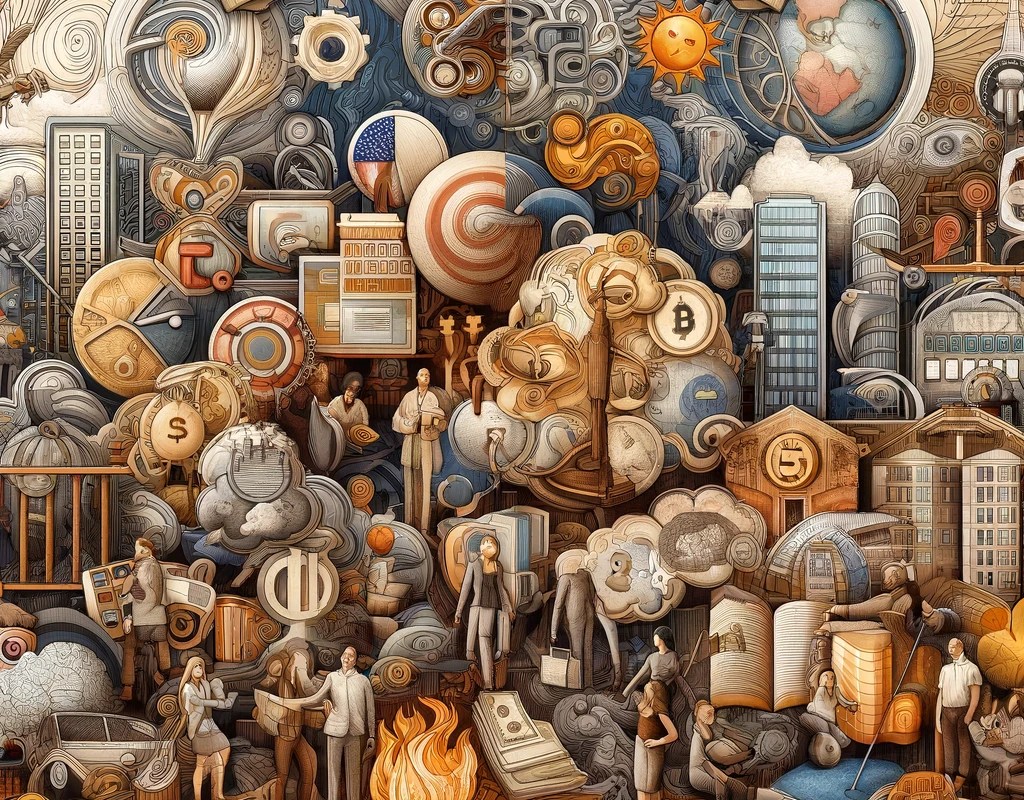
Fiction Nation: Living in a World of Fictions


Section 5: Living in a World of Fictions

The Ubiquity of Fictions

In examining nations, economies, money, and legal systems, it becomes evident that much of what structures our daily lives is founded on fictions—collective agreements and constructs that shape our reality. Recognizing this opens a new perspective on how we understand and interact with the world. These fictions, while not inherently negative, demonstrate the power of human imagination and the social nature of our existence.

From the moment we wake up, we engage with these fictions. The money we use, the laws we abide by, and the national identities we hold are all part of a complex web of social constructs that provide order and meaning to our lives. These fictions create a shared reality that allows for coordination, cooperation, and coexistence on a large scale.

The Power and Potential of Fictions

Fictions are powerful because they shape our perceptions and behaviors. They provide frameworks for understanding our place in the world and guide our interactions with others. For instance, the belief in the value of money enables complex economic transactions, while national identities foster a sense of belonging and community.

However, the power of these fictions also means they can be manipulated. Political narratives, economic policies, and legal decisions can be crafted to serve particular interests, often at the expense of others. This underscores the importance of critically examining the fictions we live by and questioning whose interests they serve.

The potential of fictions lies in their flexibility. Because they are constructed, they can be deconstructed and reconstructed. This offers opportunities for innovation and change. By reimagining our social constructs, we can address contemporary challenges such as inequality, climate change, and global conflicts. For example, the emergence of new economic models, such as the sharing economy or digital currencies, illustrates how rethinking foundational fictions can lead to transformative change.

Sports as Fiction

Sports provide a compelling example of another pervasive fiction in human society. Like money and legal systems, sports are constructed through a set of agreed-upon rules, rituals, and narratives. The games we play, the leagues we follow, and the teams we support are all part of a shared fiction that brings people together, creates communities, and evokes strong emotions.

The rules of sports are arbitrary yet accepted by all participants and fans, creating a framework within which competition and achievement are celebrated. These rules can be changed, and often are, to adapt to new circumstances or to improve the game. This flexibility highlights the constructed nature of sports, similar to other social systems.

Moreover, sports narratives—stories of underdogs triumphing, legendary performances, and historic rivalries—are powerful fictions that shape our collective memory and identity. They provide a sense of continuity and shared experience, connecting individuals across different backgrounds and generations.

Challenges of Living with Fictions

Living in a world of fictions comes with challenges. One significant challenge is the tension between reality and fiction. When the fictions we live by are mistaken for immutable truths, it can lead to rigidity and resistance to change. This can be seen in the reluctance to reform outdated legal systems, economic models, or national identities that no longer serve the common good.

Another challenge is the potential for disillusionment. Recognizing that much of what we consider to be real is, in fact, a construct can lead to a sense of instability and uncertainty. This awareness requires a balance between skepticism and pragmatism—understanding that while fictions are not inherently true, they are necessary for social cohesion and functioning.

The Role of Critical Awareness

Critical awareness is crucial in navigating a world of fictions. This involves questioning the assumptions and narratives that underpin our social constructs and being open to alternative perspectives. Education, media literacy, and public discourse play vital roles in fostering this critical awareness.

By understanding the constructed nature of our realities, we can become more active participants in shaping them. This empowers individuals and communities to advocate for changes that reflect their values and address their needs. It also encourages a more inclusive and equitable approach to social organization, recognizing the diverse ways in which people experience and contribute to society.

Imagining New Fictions

The future will undoubtedly bring new fictions that will shape our lives in unforeseen ways. As technology advances, new forms of social organization, identity, and interaction will emerge. For example, the rise of virtual reality and artificial intelligence will create new spaces and entities that challenge our current understanding of reality.

Imagining new fictions involves creativity and collaboration. It requires us to envision possibilities beyond our current constructs and to work together to bring those visions to life. This imaginative process is fundamental to human progress and the continual evolution of our societies.

Conclusion

Living in a world of fictions is both a profound and practical reality. By recognizing and understanding the fictions that structure our lives, we gain the power to question, reform, and innovate. This critical awareness allows us to navigate the complexities of our social world with greater insight and intentionality, fostering a more just and dynamic society.

⬅ Fiction Nation: Legal and Jurisprudence Sytems (section 4)

➡ Fiction Nation: Can This Be True (section 6)

References

  1. Graeber, David. Debt: The First 5,000 Years (2011).
  2. Anderson, Benedict. Imagined Communities: Reflections on the Origin and Spread of Nationalism (1983).
  3. Giddens, Anthony. The Consequences of Modernity (1990).
  4. Beck, Ulrich. Cosmopolitan Vision (2006).
  5. Cover, Robert. “Nomos and Narrative” (1983).

Metanarrative Problem

Audio: Philosopher Bry Willis discusses this topic.

Postmodernism was summarised by Lyotard as having an incredulity toward metanarratives.

What does this mean? What are metanarratives, and why harbour incredulity toward them?

Audio: NotebookLM podcast on this topic.

Metanarratives are narratives. Stories presented through a lens with a certain perspective. These stories provide a historical account of how a culture arrived to where it has. They can be viewed as origin stories. Metanarratives are also teleological, as they provide the foundation to progress, to advance the culture to a better future. Embedded in these metanarratives are the rules and conditions necessary to navigate, both from the past and into the future.

We’ve got stories. In his book Sapiens: A Brief History of Humankind, historian, Yuval Noah Harari tells us how important stories are for having made human progress. Hooray for us!

This sounds good so far. Right? We’ve got Caesar, Cornwall, and Kahn. We’ve got triumph of us over others. Good prevailing over evil. Right over wrong. So why the incredulity?

Let’s keep in mind that Lyotard is suggesting incredulity and not rejection. The narrative could be fine and accurate enough. One might argue that the benefit of the narrative for the purpose of cohesion outweighs the detriments posed.

There are several notable problems with metanarratives.

Firstly, the past suffers from a cherry-picked survivorship bias. The story threads that don’t support the narrative are abandoned, and some threads are marginalised. So, there’s a dimensional problem. As with any historical account, one needs to adopt a perspective and create a story. Let’s not forget that the word history comes from the word story. In fact, French only has one term: l’histoire. History is story.

Secondly—and this is somewhat related to the survivorship bias problem—, is that we privilege the perspective we take to view this history. In his book, We Have Never Been Modern, Latour uses this line of argumentation to arrive at the conclusion that we have never been modern. It is only because we are here now and surveying history through a rearview mirror that we can even look into the past. And we feel that we have somehow overcome this past. The past was primitive, but we are modern. Some time in the future we’ll deservedly be viewed in the same light because that’s how progress works. But there is no reason to accept this privileged assignment. It’s a function of ego—and to be even more direct: hubris.

Lastly, there’s the issue of teleology. Through this privileged vantage, we orient toward some alleged destination. Like fate, it’s just there for the taking. The only barriers are time, not keeping your eyes on the prize, and not following the rules to get there. There’s an embedded deontology. Those other societies don’t understand what it takes. You need to follow this path, this religion, this sports team. Because this is the best there is.

But there are no crystal balls. We cannot divinate the future. There is no particular reason to believe that our imagined path is the best path. If you don’t believe this, just ask the culture next door.

I’d like to think that somehow Progressives would be more aware of this tendency—and perhaps in some sense they are, but it’s not very apparent pragmatically. I don’t want to get distracted by the notion of institutionalism, but that is evidence of taking a privileged position regarding the status quo—even if your vision of the future would take a different path than your more conservative brethren and sistren.

In closing, this has been a summary of the problem postmoderns have with metanarratives. It could be that the metanarrative you believe to be valid is valid. It could be that your religion is the true religion. It could be that your sports team is the best sports team. That your system of government is the best of all other alternatives. It’s more likely that you’ve convinced yourself that these things are true than them being true.

We can either adopt the perspective of Voltaire’s Dr Pangloss and consider our world to be the best of all possible worlds, or we can step back and consider that we haven’t exhausted all of the possibilities.