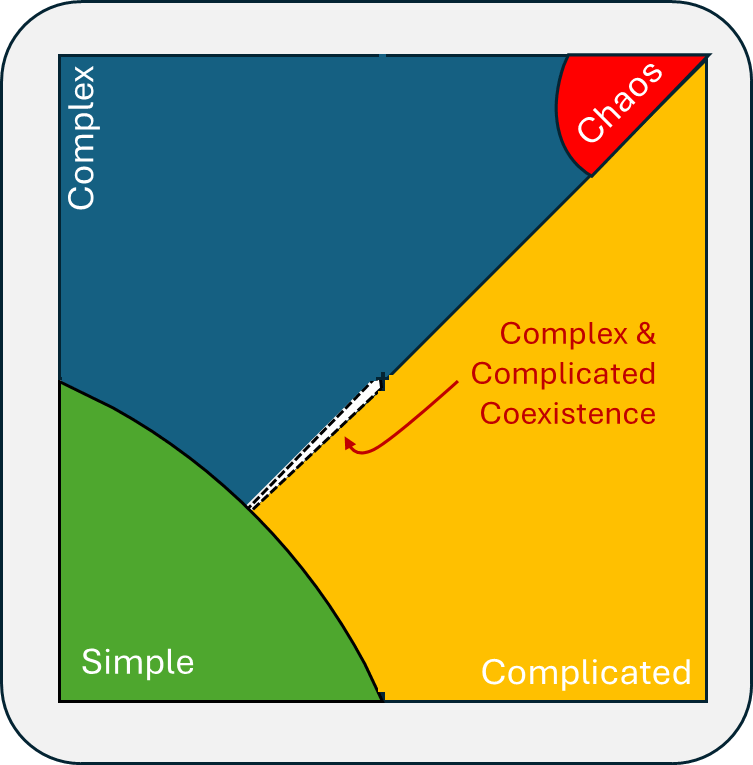
I participated in a thread recently. It prompted me to create a diagramme* to explain. This one:

I also wrote an article, but I’d like to share more here. As I was drafting this, I went through several iterations. This is just where I landed at the end. I’ll walk through it.
Keep It Simple, Stupid
Let’s begin at the origin. At the start, we’ve got simplicity in all directions. These are ingredients and building blocks. Nothing fancy. Perhaps these are atoms or Legos. They are easy to describe and easy to reproduce.
It’s Complicated
One can remain simple or venture up the Y-axis or out on the X-axis. Let’s go right. Eventually, we leave the land of Simplicity and cross into the land of Complication. This might be thought of as a linear journey, a land of addition and multiplication. Instead of a Lego piece, a single cell, or an atom, we’ve assembled structures from building blocks. Perhaps a Lego car or house. Perhaps a Death Star or Hogwarts. Perhaps we’ve gone from a single-celled organism to multicellular organisms or from an atom to a molecule or even a cluster of molecules. We’ve gone from a couple of hydrogens and an oxygen to a water molecule. Repeat this enough and we’ve got a glass or water – or an ocean.
In a nutshell, simple and complicated objects are predictable, designable, and controllable.
It’s Complex
Let’s travel up the Y-axis instead. Leaving the land of Simplicity, we end up in Complexity. Here, all bets are off. We are in a land of probability and uncertainty. Combining simple components results in unpredictable results, emergent properties, and self-organisation. Life is not linear on this path, so small differences in inputs can create wildly different outputs in each of magnitude and direction.
Morever, when a thing gets too complicated, it can no longer become complex. Emergence is not for the complicated.
Emergence is somewhat reserved for the complex, but where simple transitions to complicated, there is a tiny window that may allow both complicated and complex.

 Philosophics